Leidsid 33 sarnast õppematerjali, mis on seotud failiga "Tallinn". Need materjalid aitavad sul teemat sügavamalt mõista.
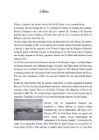
became, russia, soviet, independent, first, toompea, medieval, northern, europe, february, german, nazi, again, settlement, found, center, years, built, member, league, strategic, position, crossroads, between, western, imperial, occupation, peace, treaty, signed, republic, started, later, germany, democratic, established, period, quick, developmentTallinn Tallinn is situated on the southern coast of the Gulf of Finland, in north-western Estonia. A limestone cliff runs through the city. It is exposed, for instance, at Toompea and Lasnamäe. However, Toompea is not a part of the cliff, but a separate hill. Coastline is 46 kilometres long.The highest point of Tallinn, at 64 meters above the sea level, is situated in the district of Nõmme, in the south-west of the city. The first human steps, that archeologists found, are about 5000 years old. Tallinn`s first fortress was built in Toompea, in 1050. As an important port for trade between Russia and Scandinavia, it became a target for the expansion of the Teutonic Knights and the Kingdom of Denmark during the period of Northern Crusades in the beginning of the 13th century when Christianity was forcibly imposed on the local population. Danish rule of Tallinn and Northern Estonia started in 1219.
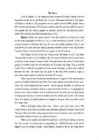
I hope, this is not hard subject for me and I can do this report finely. 3 Beginning of 20th century Estonian literates participated in the fight for local power mainly with the help of the newspaper "Teataja" created in 1901. The 1904 elections were won by an Estonian-Russian block of 5 Russians and 38 Estonians. The first Estonian mayor was Voldemar Lender and assistant major Konstantin Päts. In 1905 was bloody Sunday in St. Petersburg and this influenced estonian workers: mass meeting, had conflicts with police. 17.10.1905 was made first estonian party Eesti Rahvameelne Eduerankond created by newspaper ,,Postimees" supporters. In 1906 was created estonian proffesional theatre ,,Estonia". Theathre ,,Estonia" In 1912 was started to constructing seastronghold and war harbour ( Peter the Great seastronghold)
Tallinn is a very beautiful city that lies on the Baltic Sea. It covers 158 square kilometres. The Mayor of Tallinn is Jüri Ratas. The population of our capital is about 400000 people. About 55% of them are Estonian, 37% Russians and the other 8% are from different nations. The people here are mostly engaged in industry- mainly the food industry (23%), trade (16%) and transport and communication (14%). History. Tallinn has a great history. It was first marked on a map of the world by the Arab geographer al-Idrisi in 1154, its name then being Kolyvan. In the 13 th- century chronicle of Henricus de Lettis the town was called Lyndanise. Then it was called Reval for some time and finally Estonians started to call the town Tallinn from Taanilinn (Danish town) after the Danish conquest in the 13th century. The Knights of the Sword took Tallinn from the Danes in 1227 and made Toompea their fortress
INTRODUCTION Tallinn is the capital and largest city of Estonia. It occupies a surface of 159.2 km2 in which 404,000 inhabitants live. It is situated on the northern coast of the country, on the banks of the Gulf of Finland, in north-western Estonia. Tallinn is the location of many institutions of higher education and science. As an important port for trade between Russia and Scandinavia, it became a target for the expansion of the Teutonic Knights and the Kingdom of Denmark. Historically, the city has been attacked, sacked, razed and pillaged on numerous occasions. Although extensively bombed by Soviet airforces during the latter stages of World War II, much of the medieval Old Town still retains its charm. Since independence, improving air and sea transport links with Western Europe and Estonia's accession to the European Union have made Tallinn easily accessible to tourists.
Independence Day On 24 February, Independence Day is celebrated in the Rebublic of Estonia. This is the day that the Manifesto was declared in Tallinn 91 years ago. In responce to a period of Russification initiated by the Russian empire in the 1890's, Estonian nationalism took on more political tones, with intellectuals first calling for greater autonomy, and later, complete independence from the Russian empire. Following the Bolshevik takeover of power in Russia after the October Revolution of 1917 and German victories against the Russian army, between the Russian Red Army's retreat and the arrival of advancing German troops, the Committee of Elders of the Maapäev issued the Estonian Declaration of Independence in Pärnu on February 24, 1918. after winning the Estonian Liberation War against Soviet Russia and at the same time German Freekorps volunteers (the Tartu Peace Treaty was signed on 2 February 1920), Estonia
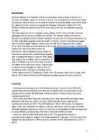
Facts and figures The Republic of Estonia is a small country. Covering only 45, 228 sq km it is slightly bigger than Denmark, Belgium or Switzerland. Estonia's population is under 1.4 million. The official language is Estonian but since very many Russians live here Russian is also wide spread. The capital of Estonia is Tallinn. The currency used in Estonia is Eesti kroon. The Estonian national flag is blue-black-white. It was originally the flag of the Estonian Students' Society. The flag was first consecrated in Otepää Church in 1884. For a while, during the Soviet occupation, the flag was banned but it was again seen in public in Tartu in May 1988. The national flower is cornflower, the national bird is barn swallow and the national stone is limestone. The Estonian national anthem called "My Native Land, My Pride and Joy" was composed in 1848 by Friedrich Pacius. The Estonian language words were written by J. V. Jannsen. It was officially adopted after the War of Independence in 1920
Tallinn English College English Sergo Vainumäe 9A TALLINN Report Supervisor: Inge Välja Tallinn 2006 Order of contents: 1.Introduction 2.Toompea 3.Lower Town 4.Kadriorg and Pirita 5.Museums 1. Introduction Tallinn, the capital of Estonia, lies on the Baltic Sea. It is on almost the same latitude east St. Petersburg in Russia, Stockholm in Sweden and Stavanger in Norway, and covers 158 sq km. Tallinn was first marked on a map of the world by the Arab geographer al-Idrisi in 1154, its name then being Kolyvan (probably derived from the name Kalev). In the 13th-century Chronicle of Henricus de Lettis the town was called Lyndanise. Later came Reval (presumably after the old county of Rävala), the name used by the Germans who ruled the country for seven centuries. Russians then modified Reval to Revel
Estonia Where it is? Republic of Estonia is a state in the Baltic region of Northern Europe .It is bordered to the north by the Finland, to the west by the Baltic Sea, to the south by Latvia (343 km), and to the east by lake Peipus and Russia (338.6 km). Across the Baltic Sea lies Sweden in the west and Finland in the north. Towns Tallinn is the capital and the largest city of Estonia. It lies on the northern coast of Estonia, along the Gulf of Finland. There are 33 cities and several town-parish towns in the country. In total, there are 47 linna, with "linn" in English meaning both "cities" and "towns". More than 70% of the population lives in towns. History • Estonia was settled near the end of the last glacial era, beginning from around 8500 BC. Before the
Topic Estonia Tallinn 2008 1. Introduction Estonia is a small country about the size of Switzerland, or New Hampshire and Massachussetts combined. Estonia is named after the people called "Ests" who lived in the region in the 1 st century AD. The Republic of Estonia is one of the three countries commonly known as the "Baltic States". The other Baltic States are Latvia and Lithuania. 2. Geographical position Estonia is situated in northeastern Europe. Estonia is bounded on the north by the Gulf of Finland, on the east by Russia, on the south by Latvia and on the west by the Baltic Sea. In the north it borders on Finland. The coastline of the Baltic Sea in Estonia is characterized by numerous gulfs and bays, the biggest of them being the Gulf of Finland, the Gulf of Riga and the Gulf of Pärnu. Bays include the Narva Bay, Matsalu Bay, Kolga Bay, Kunda Bay, Tallinn Bay etc. Estonia has over
Estonia lies on the eastern shores of the Baltic Sea on the level northwestern part of the rising east European platform. Estonia is a flat country covering 46 226 square kilometers.Estonian's neighbours are Finland, Sweden, Latvia and Russia. Estonia is rich in islands. The two largest are Saaremaa and Hiiumaa . Saaremaa is famous for its big meteorite crater called Kaali and Hiiumaa is famous for its nature and plants. The countries highest point Big Egg hill ( Suur- Munamägi) reaches 318 meters above sea level. Estonia has many uplands too. The uplands are: Pandivere upland, Otepää upland, Vooremaa upland, Karula upland Haanja upland, Sakala upland. Estonia is covered by about 18 000 square kilometers of forest
........................... 14 Our opinion............................................................................................................................ 18 References............................................................................................................................ 19 2|Page 17101850 The century and a half following the Great Northern War, which ended with the Peace of Uusikaupunki, was a relatively static period in Estonian history with few momentous events. This was the time of the crystallization and the culmination of serfdom, when various socio- political and cultural undercurrents were also active, preparing the ground for the industrial society and the national-democratic movement in the second half of the 19th century. The 1710 of the corporations of knights and towns, until Alexander II (18551881),
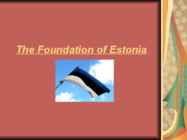
The Foundation of Estonia Estonia The history of Estonia The history of Estonia is a part of the history of Europe. Estonia was settled near the end of the last glacial era, beginning from around 8500 BC. Before the Germans invaded in the 13th century proto-Estonians of the Ancient Estonia worshipped the spirits of nature. Since the Northern Crusades Estonia became a battleground for centuries where Denmark, Germany, Russia, Sweden and Poland fought their many wars over controlling the important geographical position of the country as a gateway between East and West. Being conquered by Danes and Germans in 1227, Estonia was ruled initially by Denmark in the north, by the Livonian Order, an autonomous part of the Monastic state of the Teutonic Knights and Baltic German ecclesiastical states of the Holy Roman Empire. From 1418–1562 the whole of Estonia was part of the Livonian
Introduction Estonia, officially the Republic of Estonia (Estonian: Eesti or Eesti Vabariik) is a country in the Baltic region of Northern Europe. It is bordered to the north by Finland across the Gulf of Finland, to the west by Sweden across the Baltic Sea, to the south by Latvia (343 km), and to the east by the Russian Federation (338,6 km). The territory of Estonia covers 45,227 km² and is influenced by a temperate seasonal climate. The Estonians are a Finnic people closely related to the Finns, with the Estonian language sharing many similarities to Finnish. The modern name of Estonia is
The Most Interesting Historical Events in Estonia Liana Põldver · The nationwide Song Festival tradition began with the first Song Festival in Tartu, June 18 20, 1869. · 1860 marks the beginning of the period of the National Awakening. A singing society led by Johann Voldemar Jannsen started and carried through the nationwide idea of Song Festival. · During 1879 1910 six Song Festivals were held that played an important part in the nation's cultural and economical awakening and growth. In the independent Estonian Republic the Song Festivals were held in every
It is unique for its well-preserved architecture from the 13-15 centuries. In contrast to the ancient town-walls and towers, Tallinn of today offers modern hotels, restaurants, sport and cultural centres. Every five years national song and folk dance festivals take place in Tallinn. The yachting regatta of the 1980 Moscow Olympic Games was held at Pirita. History Tallinn means in English "Danish town". The place is believed to have been settled by Finno-Ugric people about 2500 BC. It was first marked on a map of the world by the Arab geographer al-Idrisi in 1154. The Estonians were the first to build a stronghold on the spot of the Toompea Hill, but the real Tallinn was built by the Danes who conquered the north of Estonia in 1219. Legend has it that one day, when the Danes were about to lose a bloody battle, the sky suddenly opened and a red flag with a white cross on it dropped down upon them from the heaven. This is how the Danes obtained their national flag.
Festivals and events dedicated to the consumption of beer are a lot of fun, but if you want to get the true feel of the country, you need something a little more ethnic. Like a town fair. Just as July becomes August, the seaside town of Haapsalu will host a grand spectacle of rural Estonian entertainment. The White Lady Days is a summer celebration filled with amusement for all the family. Held in and around the remains of the Teutonic-knights-era castles, the fair combines enchanting medieval legends with modern countryside charm to create a comprehensive experience of Estonia beyond the big cities. But the legend of the White Lady of Haapsalu, which is at the heart of the festival, is perhaps the most famous tall tale of the many that are so abundant in Estonia's folklore. It is the story of a poor girl who falls in love with the son of the village elder, and disguises herself as a choirboy in order to sneak into the castle
Estonia Estonia is a small country in Northern Europe with an area of about 45 000 sq km. As a part of the East-European Plain, the country has a rather flat surface. The highest and most diverse region in Estonia is in the south-eastern part of the country. At 318 metres, Suur Munamägi is not only the highest point in Estonia, but of all the Baltic countries. There are about 1500 islands in Estonia, the biggest of which being Saaremaa and Hiiumaa. Sixty-four species of mammals have been recorded in Estonia, three of them have been
Milestones in Estonian History The Estonians are a Finno-Ugric people who came from the area near the Urals and the Volga and Oka rivers. They migrated westward to the Baltic shores some 5, 000 years ago. In the ninth century A.D. Viking ships invaded Estonia and the country became a vital link in the sea-trade between East and West. By the 12th century, the Arabian geographer al-Idrisi had placed the city on his maps. In the 13th century, Tallinn joined the Hanseatic League, the union of European commercial towns that stretched from London to Novgorod. Pärnu, Viljandi and Tartu were also members. Estonia became a vital link in the sea-trade between East and West. The oldest preserved book written in Estonian, a catechism, dates from 1535. Tartu
The area today lies in the very heart of the historical Mulgimaa the home of hills, deep valleys and lakes brought together by a beauty spot Halliste primeval valley. According to several folk tales, it is also in these valleys, woods and bogs that Old Nick found refuge.The great variety displayed in the nature is also reflected in the local cultural heritage. At the beginning of the 19th century growing linen spread and became the basis of the legendary wealth of Mulgi farms. The ancient barn-dwellings and decaying manor houses are the mute witnesses of those times. The riches and cultural heritage of Mulgimaa owe to the diligence and tenacity of the local people. Village handicraftsmen and masters have always been honoured. Mulgikapsad (stewed sauerkraut with barley groats), Estonian cheesecakes and kama (a roasted meal-mixture) have not lost their popularity.
Estonian War of Independence During World War I the greatest colonial power in Europe the Russian Empire seized to exist. On its ruins the formerly enchained nations founded their own states. Among them was the Estonian Republic, officially declared on February 24, 1918. When Germany surrendered to the Western Allies on November 11, 1918 a strategic vacuum arose in Eastern Europe. The new rulers of Russia the Bolsheviks decided to use it as a proper moment to re-conquer their lost territories. The ultimate goal was international communist revolution and Germany was the first standing on their way. Thus on November 13, 1918 the Government of Soviet Russia denounced peace with Germany. On November 16 the Commander-in-Chief of the Red Army, Jukums Vacietis, gave orders to start a massive attack on a long front from the Gulf of Finland to the Ukraine.
February 24: Independence Day The Republic of Estonia was founded on February 24, 1918 when the Salvation Committee, Päästekomitee, declared the independence of the Republic of Estonia. This date was celebrated as the Day of Independence until the Soviet occupation of Estonia in 1940. During the Soviet occupation, the Independence Day was festively celebrated in Estonian communities around the world. Every year, the US Secretary of State sent greetings on the occasion to the Ambassador of the Republic of Estonia to the United States, Ernst Jaakson. On February 24, 1989, the red flag of Soviet Estonia was replaced by the blue-black-white Estonian national flag on Toompea and since that time the Independence Day has been celebrated as a public holiday again
Kunda Gymnasium Rait Türkel Old Tallinn Report Instructor:Teacher Kristi Aron Kunda 2012 Introduction Like most cities with an eight-hundred-year-old past, Tallinn is a patchwork of historic areas. The city's pride and joy is without a doubt its Medieval Old Town, but equally enchanting is the Kadriorg district, a throwback to the time when Estonia was ruled by the Russian Tsars. Tallinn is the capital and largest city of Estonia. It occupies an area of 159.2 km2 with a population of 416,470. It is situated on the northern coast of the country, on the shore of the Gulf of Finland, 80 km south of Helsinki, east of Stockholm and west of Saint Petersburg. Tallinn's Old Town is in the list of UNESCO World Heritage Sites
Estonia. Estonia, officially the Republic of Estonia is a country in Northern Europe. It is the smallest of the three Baltic countries. Estonia has land borders with Latvia (339 km) to the south and Russia (229 km) to the east. It is separated from Finland in the north by the narrow Gulf of Finland and from Sweden in the west by the Baltic Sea. Estonia has been a member of the European Union since May 1, 2004 and of the NATO since March 29, 2004. The area of Estonia is about 45000 square kilometres and the population is about 1.4 million people. The capital of Estonia is Tallinn and the official language is Estonian. The currency is Eesti kroon. The main religion is Lutheran
1894 and 1900, during the period when the country was part of theRussian Empire. The Alexander Nevsky Cathedral is Tallinn's largest and grandest orthodox cupola cathedral. It is dedicated to Saint Alexander Nevsky who in 1242 won the Battle of the Ice on Lake Peipus, in the territorial waters of present-day Estonia. The late Russian patriarch, Alexis II, started his priestly ministry in the church. Interior of the Cathedral. The Alexander Nevsky Cathedral crowns the hill of Toompea where the Estonian folk hero Kalevipoeg is said to have been buried according to a legend. (There are many such legendary burial places of him in Estonia.) The cathedral was built during the period of late 19th century Russification and was so disliked by many Estonians as a symbol of oppression that the Estonian authorities scheduled the cathedral for demolition in 1924, but the decision was never implemented due to lack of funds and the building's massive construction. As
century, and the Department of Russian Folklore. The core curriculum includes courses in the history of Russian literature (from Kievan Rus times to the present) and folklore, modern Russian , Old Slavonic, the history of the Russian language and Russian dialectology, etc. The Department of Russian Literature of XX century in Russian literature explore (from 1890s to the present), including works of Russian emigrants abroad and nonRussian writers in Russia proper. Curriculum at the Division of Russian as a Foreign Language is similar to the one of the Division of the Russian Language and Literature, with additional stress laid on foreign languages, the theory and methods of teaching Russian as a foreign language, and area studies. Division of Theoretical and Applied Linguistics aims at giving students profound knowledge in the field of linguistic theory. The core courses include mathematics (mathematical
Old Tallinn Old Town, a medieval walled city filled with old buildings and fortifications. The sheltered bay and the easily defended Toompea Hill made it a natural place to settle. Sometime about 1050 A.D. a fortress was built atop the hill, the first of many. In 1219 the Danes showed up as part of the Northern Crusade to subjugate the Baltics and convert the local pagans to Christianity whether they wanted to or not. The Danes improved the fortifications and expanded the town, which became part of the Hanseatic League, a trading organization of a hundred northern cities. The Danes sold Tallinn to the Livonan Order, a branch of the Teutonic Knights, in 1346. The Swedes came next in 1561. Tallinn weathered plague and the Great Northern War and became part of Russia in 1710. In 1918, Estonia declared
and academic conferences, science, technology, diplomacy and sport. Perhaps even more important contributor to the dominant role of the English language in the world is that over two-thirds of the world's scientists are able to read in English. Three quarters of the world's mail is written in English and eighty per cent of the world's electronic information is stored in English. The biggest countries where English is spoken as the first language are: Great Britain, Canada, United States of America and Australia. Estonian on in comparison to English is a language that is spoken only by approximately 1 million people. On the other hand English in comparison to Estonian is a very young language. According to Wikipeia online dictionary, English is an Anglo-Frisian language brought to south-eastern Great Britain in the 5th century AD by Germanic settlers from various parts of northwest Germany (Saxons, Angles)
social power. By the early Middle Ages most Estonians were small landholders, with farmsteads primarily organized by village. With the collapse of the Russian empire in World War I, Russia's provisional government granted national autonomy to Estonia. A popularly elected assembly (Maapaev) was formed but was quickly forced underground by opposing extremist political forces. The Committee of Elders of the underground Maapaev announced the Republic of Estonia on February 24, 1918, 1 day before German troops invaded. After the withdrawal of German troops in November 1918, fighting broke out between Bolshevik and Estonian troops. On February 2, 1920, the Treaty of Tartu was signed by the Republic of Estonia and Soviet Russia. The terms of the treaty stated that Soviet Russia renounced in perpetuity all rights to the territory of Estonia. Independence lasted 22 years. This period was one of great cultural advancement.Estonia underwent a number of
buildings, roads Christianity in Roman Britain Until 4th C christians were persecuted 313 AD Emperor Constantine legalised christianity 380 AD Emperor Theodosius I made it the official religion of the empire Paganism had been eclipsed but continued to pose a political, religious challenge Boudicca Queen of Iceni people of Eastern England, led an uprising against Roman forces Prasutagus(ruler) was first allowed to rule when romans conquered England, after his death, romans decided to rule Iceni and flogged Boudicca and raped her daughters 60-62 AD Iceni rebelled, Boudicca´s warriors defeated Roman Ninth Legion, destroied capital-Colchester Finally Boudicca was defetated, she poisoned herself to avoid capture Hadrian´s wall A defensive barrier builtin 122 AD by Roman emperor Hadrian to guard the northern part of
· Worshipped the spirits of nature. · Own gods. · 5 periods: mesolithic, neolithic, bronze age, iron age, early middle ages. Click icon to add picture Click icon to add picture Estonian crusade · One of the last corners of medieval Europe to be christianized. · Against pagans in Estonia. · Estonian commander Lembitu was killed. ·
..................................................17 Appendix 1...................................................................................................................................18 2 Introduction The aim of this research is to get know more about the Netherlands history and its geographical facts. This report is describing one of most the most beautiful countries in the Europe - Netherlands. Netherlands is famous for its windmills and flowers. Netherlands is also known unofficially as Holland. Government is constitutional monarchy of north-western Europe. Netherlands is bordered on the north and west by the North Sea, on the east by Germany and on the south by Belgium. The European portion of the Netherlands has a total area of 41,528 sq km of which 33,939 sq km is land surface. Country's capital and largest city is Amsterdam. Population is about 16 million.
2 Towns (Upper & Lower Town) Tallinn used to be divided into 2 parts - Upper Town where lived the aristocracy, gentry and the clergy; and Lower Town with traders, craftsmen and merchants. Legend says the Toompea Hill is actually the tumulus mound of the great Kalev. Linda carried rocks to his grave. It is a naturally- formed limestone hill. Lower Town was a merchantile centre, Tallinn also belonged to the Hansaetic League (1285). It is often referred to as the town of citizens. Any grown-up, married and economically independent person, born in a legal marriage between two free people and having lived in the town for at least 3 months, could apply to the Magistracy for citizenship
RUNNING HEAD: RUSSIA Russia Throughout the History U.S Government Table of Contents 1. Introduction 2. History of Russia 3. Russia nowadays 4. Important people in Russia throughout the history 5. Conclusion 6. References Introduction- Russia Throughout the History Russia is a one of the biggest countries is the world. The first clues about Russian history are from as early as the 9th century. Russia has suffered through rough times in war, mad leaders and tough life amongst the locals. Over times the country has had several different names and political systems. They have been an empire ruled by a czar, a communist nation, and a democratic federation. Nowadays the country's official name is the Russian Federation ("Basic facts about,").
 annaabi.ee