Leidsid 33 sarnast õppematerjali, mis on seotud failiga "Taj Mahal". Need materjalid aitavad sul teemat sügavamalt mõista.
mahal, garden, tomb, build, arch, building, stone, elements, complex, wall, year, finial, wife, years, construction, interior, chamber, wallser, built, architecture, around, during, dome, structure, sides, traditional, shape, materials, complete, than, these, located, agra, emperor, favorite, considered, finest, heritage, seen, square, plinth, baseOr the Statue of Christ Redeemer (Portuguese: Cristo Redentor) is a statue of Jesus Christ with the largest Art Deco architectural style and located in Rio de Janeiro, Brazil. The statue has a height 38 meters and is located at the top of Corcovado Mountain is 710 m high in the Tijuca Forest National Park, overlooking the city. Chichen Itza It is a Mayan archaeological heritage in Mexico is the most complete and still well maintained. According to the Mayan culture of Chilam Balam, the temple complex was built between the years 502-522 AD. Mayans occupy just over 200 years, then they migrate to coastal areas in Campeche. Itza is the central point of the complex and other buildings such as the Pyramids of Kukulcan, Temple of Chac Mool, and building the Thousand Pillars. Colosseum Is a large theater / Amphitheater, located at the State Capital of Italy, Rome, called the original "Flavian Amphitheatre", founded by King Vespasian and completed by his son Titus. Some argue
jpg Kailasa Temple Represents Mt. Kailasa, home of god Shiva; Largest monolithic structure in the world; 200 000 tons of removed rocks; 2x the area of Parthenon and 1,5 times higher; 7000 labourers; 150 years. Kailasa Temple Indo-Islamic Architecture Muslims in medieval time Imperial style under patronage of the Sultans of Delhi Mughal architecture round domes, high minarets, pillars, open courtyards Indo-Islamic style most important symbol is tomb provided spaciosness, massiveness and breadth Examples : Qutub Minar, Alai Darwaza, Tughlaqabad Fort, Fatehpur Sikri, Agra Fort, Taj Mahal, Red Fort Delhi Fahpur Sikri Palace Qutub Minar and Alai Darwaza Tughlaqabad Fort Agra Fort Red Fort Delhi Taj Mahal (built 1631 A.D -1654 A.D) More than 22, 000 workers Height of Dome 35 m Height of Minarets 40m
INDIA Sten Form 9 *Taj Mahal Taj Mahal is a white marble mausoleum located in Agra, Uttar Pradesh, India It was built by Mughal emperor Shah Jahan in memory of his third wife, Mumtaz Mahal The Taj Mahal is widely recognized as the jewel of Muslim art in India and one of the universally admired masterpieces of the world's heritage Taj Mahal is regarded by many as the finest example of Mughal architecture, a style that combines elements from Persian, Ottoman Turkish and Indian architectural styles *Taj Mahal *Lotus Temple The Bahá'í House of Worship in New Delhi, India, popularly known as the Lotus Temple because of its flowerlike shape, is a Bahá'í House of Worship, and also a prominent attraction in Delhi It was completed in 1986 and serves as the Mother Temple of the India It has won numerous architectural awards and been featured
BOLLYWOOD Bollywood - Commonly used for "Hindi Cinema" as well as Bombay (Mumbai) Film Industry, has taken name from the combination of Bombay + Hollywood. Indians are in love with long movies with item songs, even though most films follow a similar format called masala, almost all of them have happy ending. NATURE IN INDIA Images of India are exotic and magical. In India is have beauty landscape and nature. In India is have excotic plants and animals. TAJ MAHAL The Taj Mahal is one of the most beautiful masterpieces of architecture in the world. It is an extravagant marble monument of love, built by Shahjahan in 1653 as a memorial to his queen Mumtaz Mahal who died giving birth to their 14th child. Taj Mahal stands on the bank of River Yamuna, which otherwise serves as a wide moat defending the Great Red Fort of Agra, the center of the Mughal emperors until they moved their capital to Delhi in 1637.tourist like that building.
Legend has it that one day, when the Danes were about to lose a bloody battle, the sky suddenly opened and a red flag with a white cross on it dropped down upon them from the heavens. This is allegedly how the Danes obtained their national flag, the Dannebrog in a battle against the Estonians. In the middle of the 14th century Denmark sold its possessions in Estonia to the German Teutonic Order. Toompea became the seat of the German-born gentry. A wall was built to separate the Upper Town and the Lower Town. In 1285 Tallinn joined the Hanseatic league and became a junction of trade between East and West. Tallinn is said to be built on salt, as it was an important trading commodity. In the 16th century Tallinn had a population of about 7,000 8,000 making it one of the biggest cities in northern Europe. In 1629 Sweden took control of the whole of Estonia. Though hard times
Most accepted construction theories are based on the idea that it was built by moving huge stones from a quarry and dragging and lifting them into place. There are three known chambers inside the Great Pyramid. The lowest chamber is cut into the bedrock upon which the pyramid was built and was unfinished. The so-called Queen's Chamber and King's Chamber are higher up within the pyramid structure. Building of the Great pyramid of Giza It is believed the pyramid was built as a tomb for Fourth dynasty Egyptian pharaoh Khufu around 2540 BC. It is thought that, at construction, the Great Pyramid was originally 146.59 metres tall but with erosion, its current height is 138.74 metres. The total mass of the pyramid is about 5.9 million tonnes. Based on these estimates, building this in 20 years would involve installing about 800 tonnes of stone every day. The pyramid remained the tallest man-made structure in the world for over 3,800 years Pyramid complex
1660 to ca. 1725. Many examples of Baroque architecture and town planning are found in other European towns, and in Latin America. Town planning of this period featured radiating avenues intersecting in squares, which took cues from Baroque garden plans.In Sicily, Baroque developed new shapes and themes as in Noto, Ragusa and Acireale "Basilica di San Sebastiano". Another example of Baroque architecture is the Cathedral of Morelia Michoacan in Mexico. Built in the 17th century by Vincenzo Barrochio, it is one of the many Baroque
Foreword Bridging rivers, gorges, narrows, straits, and valleys always has played an important role in the history of human settlement. Since ancient times, bridges have been the most visible testimony of the noble craft of engineers. A bridge can be defined in many ways, but Andrea Palladio, the great 16th century Italian architect and engineer, hit on the essence of bridge building when he said "...bridges should befit the spirit of the community by exhibiting commodiousness, firmness, and delight." In more practical terms, he went on to explain that the way to avoid having the bridge carried away by the violence of water was to make the bridge without fixing any posts in the water. Since the beginning of time, the goal of bridge builders has been to create as wide a span as possible which is commodious, firm, and occasionally delightful
· The Hajj, which is the pilgrimage during the Islamic month of Dhu alHijjah in the city of Mecca. Every ablebodied Muslim who can afford it must make the pilgrimage to Mecca at least once in his or her lifetime. When the pilgrim is about ten kilometers from Mecca, he must dress in Ihram clothing, which consists of two white seamless sheets. Rituals of the Hajj include walking seven times around the Kaaba, touching the Black Stone, running seven times between Mount Safa and Mount Marwah, and symbolically stoning the Devil in Mina. The pilgrim, or the hajji, is honored in his or her community, although Islamic teachers say that the Hajj should be an expression of devotion to God instead of a means to gain social standing. In addition to the khums tax, Shi'a Muslims consider three additional practices essential to the religion of Islam
London History The Romans AD 43- AD 410 The Romans finally invaded Britain in AD 43 from Kent. The Romans lead by Julius Caesar attempted to invade Britain twice before that in 55 and 54 BC but the invasions were unsuccessful. They made their way to the river Thames and sailed up it. The Romans knew it was important to control a crossing point at the river Thames, so they decided to build a settlement on the north bank. Although small settlements had been built on the banks of the Thames, the Romans were the ones who built the first city. They called their city Londinium. The Roman engineers noticed that the point where the swampy river narrowed would make an ideal crossing point, they built London Bridge. Less than 20 years later the native Iceni tribe, led by Queen Boudicca, rose up against the Romans in revenge for mistreatment and burnt Londinium to the ground
THE CITY OF LONDON History The City of London occupies one square mile in the middle of the capital. It once made up entire town of London, surrounded by the wall first built by Romans. The Romans also built a bridge over the Thames and there has been one in the same area ever since. The Roman Londinium grew up on the northern side of the bridge. In AD 61 the native Celtic tribe, led by Queen Boudicca, rose up against the Romans. They burnt down Londinium to the ground and killed most of its inhabitants. Roman armies eventually defeated Boudicca and Londinium was rebuilt.
graceful bronze statue of a Roe Deer by Jaan Koort (1883-1935), one of the best-known Estonian sculptors, has been standing for several decades. Lai Street stretches from Nunne Street to Pikk Street. Parallel with Pikk Street, Lai Street, too, ends at the Great Coast Gate (first mentioned 1359). Lai Street is very wide considering that it was laid out in the Middle Ages. This is because it sprang up on both sides of former city wall. Lai is quite a peaceful street with few shops. However, it has three museums and two theatres. The main entrance into St Olaf´s Church also faces the street. Several Lai Street houses have kept their Gothic appearance and even interiors, although we can also notice moderate Nordic Baroque, Neoclassicicm, Historicism and even Art Nouveau. The origin of the name "Lai" Lai Street belongs among the oldest streets of Tallinn. Despite its length and width its share in
EHITUSTEADUSKOND Ehitustootluse instituut KUIDAS MUUDAB MUDELPROJEKTEERIMINE TERASKONSTRUKTSIOONIDE PROJEKTEERIMIST, VALMISTAMIST JA EHITAMIST? HOW ARE 3D AND BIM CHANGING THE DESIGN, FABRICATION AND CONSTRUCTION OF COMPLEX STEEL STRUCTURES? EPJ 60 LT Üliõpilane: Tanel Friedenthal Juhendaja: Prof. Roode Liias Kaasjuhendaja: Prof. Carrie S. Dossick Tallinn, 2010.a. Olen koostanud lõputöö iseseisvalt. Kõik töö koostamisel kasutatud teiste autorite tööd, olulised seisukohad, kirjandusallikatest ja mujalt pärinevad andmed on viidatud.
The City of London History The City of London occupies one square mile in the middle of the capital. It once made up the entire town of London, surrounded by the wall first built by the Romans. The Roman Londinium grew up on the northern side of the "London Bridge" in the past. Products such as olive oil, wines and fruit were brought by ships from different parts of the Roman Empire and unloaded onto wooden quays along the river. In AD 61 the native Celtic Iceni tribe, led by Queen Boudicca, rose up against The Romans. They burnt Londinium to the ground but Roman armies eventually defeated Boudicca
His intellectual stature is indicative of the quality of the monastery's leadership. The offerings made on the occasion of such family festivals made a significant contribution to the monastery's finances. The various guilds gave gifts when their feast days were celebrated. The Merchant Guild, for example, each year in December gave the friars a tun of meat, a tun of codfish, and a tun of peas. Rich burgers left legacies to the monastery for the privilege of having a family tomb in the church, But these did not suffice to sustain all those whom the monastery housed. The friars, in consequence, becaipe farmers and fish-mongers. In addition they ran a brewery, which produced four different kinds of beer. In northern Europe beer occupied the place enjoyed by wine in the south, and was a staple element of both the monastic and secular diet. The monastery also drew profit from the veneration of relics
Edinburgh Castle is an ancient stronghold which dominates the sky-line of the city of Edinburgh from its position atop Castle Rock. It is Scotland's second most visited tourist attraction. Human habitation of the site is dated back as far as the 9th century BC. As it stands today though, few of the castle's structures pre-date the Lang Siege of the 16th century, with the notable exception of St Margaret's Chapel, the oldest surviving building in Edinburgh, which dates from the early 12th century.As with all castles, Edinburgh's fortress has been a centre of military activity. As an ancient fortress Edinburgh Castle is one of the few that still has a military garrison, albeit for largely ceremonial and administrative purposes. The New Barrack Block is now home to the official headquarters of the Royal Regiment of Scotland and 52 Infantry Brigade, as well as home to the regimental museum of the Royal
TOOMPEA Toompea (from German Domberg – Cathedral Hill ) is a limestone hill with an area of about 7 hectares in the central part of Tallinn. It towers about 30-40 m above the surrounding areas. According to the legend it´s the tumulus mound over the grave of the national hero Kalev, erected stone by stone in his memory by his grieving wife Linda. It is the birthplace of Tallinn - a place where in 1229 the Knights of the Sword built a fortress instead of the wooden Estonian stronghold. Toompea Castle is also one of the most potent symbols of the reigning power. Today Toompea is the seat of the Government of Estonia as well as the Riigikogu, both of which are often simply colloquially referred to as Toompea. For centuries there was only one access to Toompea - Pikk Jalg - but there is also
restaurants, sport and cultural centres. Every five years national song and folk dance festivals take place in Tallinn. The yachting regatta of the 1980 Moscow Olympic Games was held at Pirita. History Tallinn means in English "Danish town". The place is believed to have been settled by Finno-Ugric people about 2500 BC. It was first marked on a map of the world by the Arab geographer al-Idrisi in 1154. The Estonians were the first to build a stronghold on the spot of the Toompea Hill, but the real Tallinn was built by the Danes who conquered the north of Estonia in 1219. Legend has it that one day, when the Danes were about to lose a bloody battle, the sky suddenly opened and a red flag with a white cross on it dropped down upon them from the heaven. This is how the Danes obtained their national flag. In 1346 the Danish king sold his Estonian lands to the Teutonic Order, who a year later resold them to the Livonian Order
•I haven't got many pens. definite article The definite article the is the most frequent word in English. We use the definite article in front of a noun when we believe the hearer/reader knows exactly what we are referring to. • because there is only one: The Pope is visiting Russia. The moon is very bright tonight. The Shah of Iran was deposed in 1979. This is why we use the definite article with a superlative adjective: He is the tallest boy in the class. It is the oldest building in the town. • because there is only one in that place or in those surroundings: We live in a small village next to the church. (the church in our village) = Dad, can I borrow the car? = (the car that belongs to our family) When we stayed at my grandmother’s house we went to the (the beach near my grandmother’s beach every day. = house)
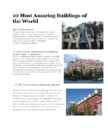
10 Most Amazing Buildings of the World The Crooked House Though it looks like some sort of painting by a drunk painter. But this is a real house located in Rezydent Shopping Center in Sopot, Poland. It is claimed to be the most photographed building in Poland. It is spread to an area of 4,000 square meters. Designed by Architect: Szotynscy Zaleski 2. Forest Spiral - Hundertwasser Building Architect: Heinz M. Springmann This is a residential building complex located in Darmstadt, Germany. The building has a unique façade which doesn’t follow a regular grid pattern and the windows appear as if they are dancing out of line and appear out of order. It was designed by Viennese artist Friedensreich Hundertwasser and finally planned and implemented by architect Heinz M. Springmann. It contains 105 apartments, an inner courtyard, a small artificial lake and also a playground for children. The building has 12 floors. 3. The Torre Galatea Figueras (Spain)
Art Museum of Estonia Art Museum of Estonia was founded on November 17th, 1919, but it was not until 1921 that it got its first permanent building the Kadriorg Palace, built in the 18th century. In 1929 the palace was expropriated from the Art Museum in order to rebuild it as the residence of the President of Estonia. The Art Museum of Estonia was housed in several different temporary spaces, until it moved back to the palace in 1946. In September, 1991 the Kadriorg Palace was closed, because it had totally deteriorated by then. At the end of the year the Supreme Council
Sydney Opera House Introduction The Sydney Opera House is a multi-venue performing arts centre in Sydney. It was conceived and largely built by Danish architect Jorn Utzon, opening in 1973. The Sydney Opera House was made a UNESCO World Heritage Site on 28 June 2007. It is one of the 20th century's most distinctive buildings and one of the most famous performing arts centres in the world. Contrary to its name, the building houses multiple performance venues. The Sydney Opera House is among the busiest performing arts centres in the world, hosting over 1,500 performances each year attended by some 1.2 million people. It provides a venue for many performing-arts companies. It is also one of the most popular visitor attractions in Australia, with more than seven million people visiting the site each year, 300,000 of whom take a guided tour. Desing Design and construction were closely intertwined
large lakes and marine basins. (slide 5) Clays exhibit plasticity when mixed with water in certain proportions. When dry, clay becomes firm and when fired in a kiln, permanent physical and chemical changes occur. These reactions, among other changes, cause the clay to be converted into a ceramic material. Because of these properties, clay is used for making pottery items, both practical and decorative, and construction products such as bricks, wall and floor tiles. Depending on the content of the soil, clay can appear in various colors, from a dull gray to a deep orange-red. Clay in Estonia (slide 6) There are 3 basic types of clay in Estonia. Firstly from Cambrian era the blue clay, which has blue-greenish color and deposit fields round 100m thick found in North-Estonia. Secondly from Devon era the Red-Brown colored clay mostly find in South-Estonia and finally the layered clay found on islands mainly
TALLINN TOWN HALL Tallinn Town Hall is the only surviving Gothic town hall in Northern Europe. Built in the heart of Tallinn, next to a marketplace, the Town Hall has witnessed trade and social activities for over 700 years. It has still remained the most important representational building in town. The building history of the Town Hall goes back to the 13th century, but it acquired its medieval appearance in 140204. It was as early as 1248 when King Eric IV Ploughpenny of Denmark granted the Lübeck Charter to Tallinn. Relying on that document a town council was elected from amongst merchants of the Hanse and started convening in the Town Hall. It is possible to state on the basis of research findings that a meeting place of the magistracy and a goods depot in the form of a small, fortified
Isle of Man, Isle of Wight, Isle of Lewis, Island of Mull, Island of Arran, Anglesey Island Severn, Thames, Tweed, Avon, Trent, Dove Ben Nevis, Snowdon, Ben Macdui 7. Stonehenge. Stonehenge was produced by a culture that left no written records. Built on Salisbury Plain, in Wiltshire, England some time between 5,000-4,300 years ago. One of the most famous megaliths in the world, dating from prehistoric times. Stonehenge consists of circles of stone arranged in complex patterns, and their origin is still being explored. Some of the stones come from over 200 miles away in Wales. There is little or no direct evidence revealing the construction techniques used by the Stonehenge builders. It was probably associated with sun-worship and other rites of prehistoric people. It appears to function as a kind of astronomical clock. Conceivable reports and implications about a secret government conspiracy, which
But, under the control of various English kings, London once again prospered as an international trading centre. However, Viking raids began in the late 10 th century and reached a head when they took the city under Danish king Canute and forced the then-English king to flee. Years later, following a victory at the Battle of Hastings, William the Conqueror was crowned King of England in the newly-finished Westminster Abbey in 1066. William granted the citizens of London special privileges while building a castle in the corner of the city to keep them under control. This castle was expanded by later kings and is now known as the Tower of London. The city grew in wealth and population during the Middle Ages. In 1100 its population was around 18,000 but after 200 years it had grown to nearly 100,000. However disaster struck during the Black Death, when London lost nearly a third of its population. After the defeat of the Spanish Armada, stability in politics allowed the city to grow even more
Prior to these, the local kami may be ritually installed in mikoshi and paraded through the streets. One can always find in the vicinity of a matsuri booths selling souvenirs and food such as takoyaki, and games, such as Goldfish scooping. Karaoke contests, sumo matches, and other forms of entertainment are often organized in conjunction with matsuri. If the festival is next to a lake, renting a boat is also an attraction. Favorite elements of the most popular matsuri, such as the Nada Kenka Matsuri of Himeji or the Neputa Matsuri of Hirosaki, are often broadcast on television for the entire nation to enjoy. Some examples of famous matsuri are the Jidai, Hadaka Matsuri, Aoi and Gion Matsuri held in Kyoto; Tenjin Matsuri in Osaka; and the Kanda Matsuri, Sann and Sanja Matsuri of Tokyo. Especially, Gion Matsuri, Tenjin Matsuri, and Kanda Matsuri are the three most famous matsuri in Japan. Sapporo Snow Festival (Hokkaido)
It can cause brain damage, kidney problems and even Alzheimer's disease. The countries that are producing the majority of the pollutions that causes acid rain are not that badly affected (Germany, Britain, USA). Instead the wind direction means the acid rain falls in the other places (in Europe : Scandinavia, USA; Canada) Cultural effects Acid rain and the dry deposition of acidic particles contribute to the corrosion of metals (such as bronze) and the deterioration of paint and stone (such as marble and limestone). These effects significantly reduce the societal value of buildings, bridges, cultural objects (such as statues, monuments, and tombstones), and cars. Famous buildings like the Statue of Liberty in New York, the Taj Mahal in India and St. Paul's Cathedral in London have all been damaged by this sort of air pollution. Acid rain can also damage stained glass windows in churches, railway lines and steel bridges. The acid rain slowly eats away them all. Building
seasons. It appears in number of novels. These days it is not only the interest of tourists but is also a gathering point of certain minority groups. It is now fenced off to protect it from damage. 3. The Roman conquest Julius Caesar's first raid was in 55 BC but the romans left. Ad 43- the Romans came to stay. The army established Roman rule in the south and SW of the country. The Romans started to introduce their laws to a new province of the Roman Empire and started to build good roads. Officials were appointed (governors, procurators to collect taxes, look after the estates and mines and se that the gold, silver, iron and lead were exported back to Rome). Introduced schools,a new language Latin, large farms (villas), baths. In AD 410 they had to leave . roman occupation lasted nearly 400 years. They left behind very little. Roman province of Britannia covered most of present-day England and Wales. 4. Latin influence on English
Geography Inuit communities are found in the Arctic, in the Northwest Territories, Labrador and Quebec in Canada, above tree line in Alaska (where people are called the Inupiat and Yupik), and in Russia (where people are called the Yupik people). In some areas, Inuit people are called "Eskimos" however many Inuit find this term offensive. The word "Inuit" means "the people" in the Inuktitut language. Inuit Homes In the tundra, where Inuit communities are found, there are not many building materials. No trees grow in the tundra so houses can not be made from wood unless it is transported from elsewhere. However, during a large part of the year, the cold part, there is a lot of snow in the tundra. And it turns out that snow can be a very good construction material. In the winter, Inuit lived in round houses made from blocks of snow called "igloos". In the summer, when the snow melted, Inuit lived in tent-like huts made of animal skins stretched over a frame
Landseer; the metal used is said to have been recycled from the cannon of the French fleet. The column is topped by a statue of Horatio Nelson, the admiral who commanded the British Fleet at Trafalgar. The fountains are memorials to Lord Jellicoe (western side) and Lord Beatty (eastern side), Jellicoe being the Senior Officer.[2] On the north side of the square is the National Gallery and to its east St Martin-in-the-Fields church. The square adjoins The Mall via Admiralty Arch to the southwest. To the south is Whitehall, to the east Strand and South Africa House, to the north Charing Cross Road and on the west side Canada House. At the corners of the square are four plinths; the two northern ones were intended for equestrian statues, and thus are wider than the two southern. Three of them hold statues: George IV (northeast, 1840s), Henry Havelock (southeast, 1861, by William Behnes), and Sir Charles James Napier (southwest, 1855)
At 12 he became almost homeless and had to work at a shoe-‐blackening factory after his father was arrested for debt. This helped form his personality and also gave material for his writings. His novels are a mixture of romantic and realist elements. His writing is satirical (form of humorous criticism), ironic (inconsistencies btwn what is said and what is meant) and funny and criticizes some social evil. Oliver Twist opposes workhouses; Nicholas Nickleby concentrates on children’s education in boarding schools
Tallinn Mustamäe College G2K Jaana-Kristiina Jõgevest The Four oldest churches of Tallinn Report Supervisor: Ingrid Teigar Tallinn 2009 The Dome Church The Danes began fortification of Toompea after the conquest of Tallinn in 1219 and probably also built the first church there. It was presumably a wooden building located at the site of the present cathedral. However, a serious conflict with the Order of the Brothers of the Sword broke out soon as the latter wanted to gain control of the entire Estonia. The order succeeded in subordinating Tallinn and the whole of North Estonia to its rule in 1227. The monks of the Dominican Order began the construction of a stone church in Toompea in 1229. The first written data on the cathedral date back to 1233, the date of a
 annaabi.ee