 50 punkti
Autor soovib selle materjali allalaadimise eest saada 50 punkti.
50 punkti
Autor soovib selle materjali allalaadimise eest saada 50 punkti.
 ~ 13 lehte
Lehekülgede arv dokumendis
~ 13 lehte
Lehekülgede arv dokumendis
 2012-11-15
Kuupäev, millal dokument üles laeti
2012-11-15
Kuupäev, millal dokument üles laeti
 5 laadimist
Kokku alla laetud
5 laadimist
Kokku alla laetud
 0 arvamust
Teiste kasutajate poolt lisatud kommentaarid
0 arvamust
Teiste kasutajate poolt lisatud kommentaarid
 stenpeterson
Õppematerjali autor
stenpeterson
Õppematerjali autor
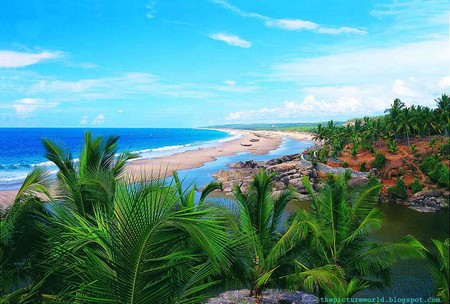
INDIA COUNTRY · India is a country in South Asia. · It is the seventh-largest country by geographical area. · The most populous democracy in the world. · Country with over 1.18 billion people. · The capital of India is New Delhi. · India has a coastline of 7,517 kilometres. Mainland India is bounded by the Indian Ocean on the south, the Arabian Sea on the west, and the Bay of Bengal on the east; and it is bordered by Pakistan to the west Bhutan, the People's Republic of China and Nepal to the north; and Bangladesh and Burma to the east. In the Indian Ocean, mainland India and the Lakshadweep Islands are in the vicinity of Sri Lanka and the Maldives. India has a coastline of 7,517 kilometres. THE SYMBOLS OF INDIA The National Flag is orange withe and green.
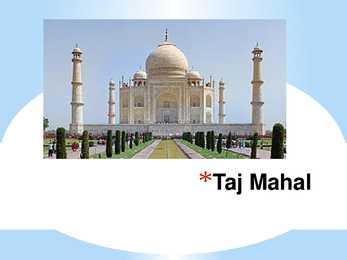
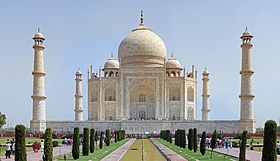
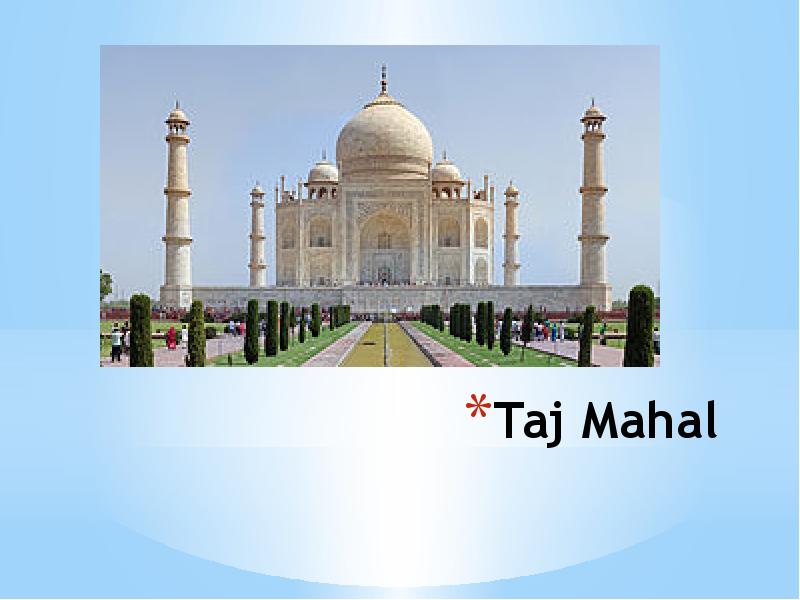
TAJ MAHAL The Taj Mahal is a mausoleum located in Agra, India, built by Mughal Emperor Shah Jahan in memory of his favorite wife, Mumtaz Mahal. The Taj Mahal (also "the Taj") is considered the finest example of Mughal architecture, a style that combines elements from Persian, Ottoman, Indian, and Islamic architectural styles. In 1983, the Taj Mahal became a UNESCO World Heritage Site and was cited as "the jewel of Muslim art in India and one of the universally admired masterpieces of the world's heritage." Building began around 1632 and was completed around 1653, and employed thousands of artisans and craftsmen. The Persian architect, Ustad Ahmad Lahauri is generally considered to be the principal designer of the Taj Mahal. Origin and inspiration In 1631 the emperor during the Mughal empire's period of greatest prosperity, was griefstricken when his third wife died during the birth of their fourteenth child. In her dying
Petra was the capital of Nabatean kingdom. Founded in 9SM-40M by King Aretas IV as we that are difficult to penetrate the enemy and secure from natural disasters such as sandstorms. Petra Nabatean building with irrigation sisitem extremely complex. There is a tunnel of water and water chambers that deliver clean water to the city, thus preventing banjirmedadak. They also have hydraulic technology to lift water. Taj Mahal It is a monument located in Agra, India. Built on the desire of Mughal Emperor Shah Jahan, the son of Jahangir, as a mausoleum for the wife of Persian, Arjumand Banu Begum, also known as Mumtaz-ul-Zamani or Mumtaz Mahal. Development spent the next 23 years (1630-1653) and is a masterpiece of Mughal architecture. Ustad Ahmad Shah Jahan ordered the making of this building. Ustaz Ahmad workers gather 20,000 people consisting of a mason, goldsmith and engraver who famous from around the world. With the roof, dome and minarets are made of
such is suspended since Muhammad alMahdi's occultation in 868 AD. Community Demographics Commonly cited estimates of the Muslim population in 2007 range from 1.1 billion to 1.8 billion. Approximately 85% are Sunni and 15% are Shi'a, with a small minority belonging to other sects. Some 3040 countries are Muslimmajority, and Arabs account for around 20% of all Muslims worldwide. South Asia and Southeast Asia contain the most populous Muslim countries, with Indonesia, India, Pakistan, and Bangladesh having more than 100 million adherents each. According to U.S. government figures, in 2006 there were 20 million Muslims in China. In the Middle East, the nonArab countries of Turkey and Iran are the largest Muslimmajority countries; in Africa, Egypt and Nigeria have the most populous Muslim communities. Islam is the second largest religion after Christianity in many European countries. Mosques
following the Umayyad Caliphate conquest of the Iberian Peninsula in 711 until 1249 with the taking of the Algarve by King Afonso III of Portugal during the Reconquista. After beating the Visigoths in only a few months, the Umayyad Caliphate started expanding rapidly in the peninsula. Beginning in 711, the land that is now Portugal became part of the vast Umayyad Caliphate's empire of Damascus that stretched from the Indus river in India up to the South of France until its collapse in 750, a year in which the west of the empire gained its independence under Abd-ar-Rahman I with the creation of the Emirate of Córdoba. After almost two centuries, the Emirate turned into the Caliphate of Córdoba in 929 until its dissolution a century later in 1031 to no less than 23 small kingdoms, called Taifa kingdoms. The governors of the taifas proclaimed themselves each Emir of his province and established
History exam *Stonehenge - is a monument located in England. It is one of the most famous prehistoric sites in the world and is composed of earthworks surrounding a circular setting of large standing stones. The surrounding circular, earth bank and ditch, have been dated to about 3100 BC. Stonehenge was produced by a culture with no written language. Many aspects of Stonehenge remain subject to debate. There is little or no direct evidence for the construction techniques used by the Stonehenge builders. *The Celts in Britain and their legacy The Cets lived in Britain in The Iron Age. They were warring tribes who were battleful amongst themselves as well as inter-tribal war. They were not centrally governed. The Celts brought iron working, iron ploughs and metal swords, horses, wheels and chariots - all these things gave them an instant superiority over the native tribes. The Celts built a number of hill forts throughout the region. The society
the rest of her life. Her subsequent withdrawal from public life made her unpopular, but during the late 1870s and 1880s she gradually returned to public view and, with increasingly 6 pro-imperial sentiment, she was restored to favour with the British public. After the Indian Mutiny in 1857, the government of India was transferred from the East India Company to the Crown. In 1877, Victoria became empress of India. Her empire also included Canada, Australia, New Zealand, and large parts of Africa. During this period, Britain was largely uninvolved in European affairs, apart from the Crimean War from 1853 - 1856. Victoria's Golden Jubilee in 1887 and her Diamond Jubilee in 1897 were celebrated with great enthusiasm. Having witnessed a revolution in British government, huge industrial expansion
ways to form composite structures, the type selected depending on the nature of the crossing, the span required, the materials at hand, and the type of load anticipated - pedestrian, vehicular, railroad, or a channel of water as in aqueducts. Primitive bridges Other than the clapper bridges of England and similar spans surviving in other countries, bridges dating from prehistoric periods are rare. Bridges of twisted vines and creepers found in India, Africa, and South America, the ancient cantilevers of China, Kashmir, and Japan, if any survive, or the wooden arches of Japan may be candidates for World Heritage listing because they perpetuate primitive ingenuity and craft technology that is important to recognize. Since some of their materials cannot be original, these structures will have to pass the test of authenticity. In 51 BC, during the Gallic War, Caesar attested to the construction of narrow wooden bridges by
 annaabi.ee













Kõik kommentaarid