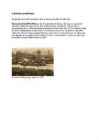
Singing Revolution To the end of 80s, the Soviet Union folks didn't want to live under socialistic- communistic order anymore. The Soviet Union was protected with the Iron Curtain, which symbol was the Berlin wall. At the same time, not only Estonia, but also other countries that were under the authority of the Soviet Union, increased the independence efforts. People didn't want to live like this anymore, it was based on fear and commands. The start of the Estonian public announcement of the reindependence is probably the Singing Revolution. To begin with, the Singing Revolution was a non-violent wish expressing and embarked on the Soviet Union to fall apart. The Singing Revolution is a commonly used name for events between 1987 and 1990 that led to the restoration of the independence of Estonia and also Latvia and Lithuania. Afterwards, there was a spontaneous mass night-...
Independence Day On 24 February, Independence Day is celebrated in the Rebublic of Estonia. This is the day that the Manifesto was declared in Tallinn 91 years ago. In responce to a period of Russification initiated by the Russian empire in the 1890's, Estonian nationalism took on more political tones, with intellectuals first calling for greater autonomy, and later, complete independence from the Russian empire. Following the Bolshevik takeover of power in Russia after the October Revolution of 1917 and German victories against the Russian army, between the Russian Red Army's retreat and the arrival of advancing German troops, the Committee of Elders of the Maapäev issued the Estonian Declaration of Independence in Pärnu on February 24, 1918. after winning the Estonian Liberation War against Soviet Russia and at the same time German Freekorps volunteers (the Tartu Peace Treaty was signed on 2 February 1920), Estonia maintai...
The Membership of World Organisations Merilin Tamme Xa Tallinna Järveotsa Gymnasium 2008 The schedule · 04.04.1949 establishment of NATO. · 1951 Supreme Headquarters Allied Power Europe (SHAPE) was created near Paris in France. Later, SHAPE was relocated to Mons in Belgium. · 1952 Greece and Turkey join NATO. · 1955 Western Germany joins NATO. · 1982 Spain joins NATO. · 1991 Rome summit. Estonia is one of the founding members of the NACC. · January 1994 Brussels summit. Estonia joins PFP on 3 February. · March 1995 Estonia submits the first Individual Partnership for Peace (IPP) to NATO. It contains priority areas of cooperation with NATO and future cooperation events, altogether in 23 subject fields. · March 1997 beginning of involvement of Estonia in peacekeeping mission in SFOR (Stabilisation Force) in Bosnia Herz...
Latvia Capital city: Riga Total area: 65 000 km² Population: 2.3 million Language: Latvian Latvia, officially The Republic of Latvia, is a country in the Baltic region of the Nothen Europe. The country has a temperate seasonal climate. Latvia and Estonia share a long common history. As a consequence of the Soviet occupation both countries are home to a large number of ethnic Russians (26.9% in Latvia and 25.5% in Estonia). Latvia was found on 18th November 1918. However, its independence was interrupted at the outset of World War II. In 1940, the country was forcibly incorporated into the Soviet Union, invaded and occupied by Nazi Germany in 1941, and re-occupied by the Soviets in 1944 to form the Latvian for the next fifty years. The peaceful Singing Revolution, started in 1987. Lithuania Capital city: Vilnius Total area: 65 200 km² Population: 3.5 milion Language: Lithuanian Lithuania, officially The Republic of Lithuania, ...
Nõukogude Liit Brežnevi ajal – impeeriumi kokkuvarisemise edasilükkamine Kaisa Kamenik A83347 Nõukogude Liit eksisteeris suurem osa 20-ndast sajandist ning selle aja jooksul jõudis sotsialistliku suurriigi juhtideks olla mitmed omapärased isikud – alustades Leninist ja lõpetades Gorbatšoviga. Ajalugu on meile õpetanud, et enamjaolt sellised diktaatorlikud režiimid pole jätkusuutlikud ning tahes tahtmata varisevad nad mingil hetkel kokku – kas siis sisemiste vastuolude tõttu või välise surve tõttu. Ka Nõukogude Liit polnud selles suhtes erand – rohkem huvi pakub aga küsimus, kuivõrd on kokkuvarisemises süüdi ajastu ja riigijuhi roll. Üldlevinud on arvamus, et Nõukogude Liidule said saatuslikuks Gorbatšov ja tema reformid. Millisesse rolli aga Nõukogude Liidu ajaloos panna temale eelnenud Leonid Brežnev ja tema 18-aasta pikkune valitsemisae...
Tallinn The first traces of human settlement found in Tallinn's city center by archeologists are about 5000 years old. In 1050 the first fortress was built on Tallinn Toompea.[3] In 1285 the city became the northernmost member of the Hanseatic League. Medieval Tallinn enjoyed a strategic position at the crossroads of trade between Western and Northern Europe and Russia. On 24 February 1918, the Independence Manifesto was proclaimed in Tallinn, followed by Imperial German occupation and a war of independence with Russia. On 2 February 1920, the Tartu Peace Treaty was signed with Soviet Russia, wherein Russia acknowledged the independence of the Estonian Republic. Tallinn became the capital of an independent Estonia. After World War II started, Estonia was occupied by the Soviet Union (USSR) in 1940, and later occupied by Nazi Germany from 1941–44. After Nazi retreat in 1944, it was occupie...
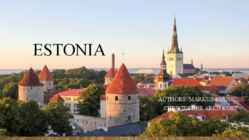
ESTONIA AUTHORS: MARKUS KUUSE, CHRISTOFHER ARKO KÖST FACTS ABOUT ESTONIA • Estonia is about 50% forest • Estonia has over 2000 islands • Estonia was the first country in the world to use online political voting. HISTORY • Humans settled in the region of Estonia near the end of the last glacial era • In the Middle Ages, Estonia became a battleground for centuries where Denmark, Germany, Russia, Sweden and Poland fought their many wars • Estonians declared their independence in February 1918 RECENT HISTORY • In 1940, the Soviet Union occupied Estonia • Nazi Germany occupied Estonia in 1941; later in World War II the Soviet Union reoccupied it (1944). GEOGRAPHY • The two largest islands are Saaremaa and Hiiumaa • The highest point in Estonia is Suur Munamägi ESTONIA CITIES • Capital: Tallinn • Tartu • Pärnu TALLINN • The capital of Estonia • Reval, Lindanise • Old town TARTU • Second larg...
The most important key dates in Estonian history Every country has its history and some moments are more important than the others. Here are some of the most notable dates from Estonian history. 3rd millennium BC the Finno-Ugric tribes arrive in Estonia 1154 First written mention of Tallinn (by al-Idrisi) 13th century German and Danish invade Estonia. Estonians' numerous attempts to restore independence fail 1343 St. George's Night uprising 1558-1583 the Livonian War after which Northern Estonia is occupied by Sweden and Southern Estonia occupied by Poland 1632 Tartu University was founded 1860-1885 the era of national awakening, the foundation for Estonian journalism was laid, collection of folklore 1869 First all-Estonian Song Festival in Tartu 1884 The blue-black-and-white flag of Estonian Students' Society was consecrated ...
The Most Interesting Historical Events in Estonia Liana Põldver · The nationwide Song Festival tradition began with the first Song Festival in Tartu, June 18 20, 1869. · 1860 marks the beginning of the period of the National Awakening. A singing society led by Johann Voldemar Jannsen started and carried through the nationwide idea of Song Festival. · During 1879 1910 six Song Festivals were held that played an important part in the nation's cultural and economical awakening and growth. In the independent Estonian Republic the Song Festivals were held in every five years (1923 1938). After World War II, the Song Festival tradition began again in 1947. Since 1950 General Song Festivals were held in every five years again. 1969 was an exception though when 100th anniversary of the Song Festival was celebrated. · The foreign authorities have tried to use the ...
HISTORY OF ESTONIA Estonians are one of the longest-settled European peoples, whose forebears, known as the "comb pottery" people, lived on the southeastern shores of the Baltic Sea over 5,000 years ago. Like other early agricultural societies, Estonians were organized into economically self-sufficient, male-dominated clans with few differences in wealth or social power. By the early Middle Ages most Estonians were small landholders, with farmsteads primarily organized by village. With the collapse of the Russian empire in World War I, Russia's provisional government granted national autonomy to Estonia. A popularly elected assembly (Maapaev) was formed but was quickly forced underground by opposing extremist political forces. The Committee of Elders of the underground Maapaev announced the Republic of Estonia on February 24, 1918, 1 day before German troops invaded. After the withdrawal of Ger...
Milestones in Estonian History The Estonians are a Finno-Ugric people who came from the area near the Urals and the Volga and Oka rivers. They migrated westward to the Baltic shores some 5, 000 years ago. In the ninth century A.D. Viking ships invaded Estonia and the country became a vital link in the sea-trade between East and West. By the 12th century, the Arabian geographer al-Idrisi had placed the city on his maps. In the 13th century, Tallinn joined the Hanseatic League, the union of European commercial towns that stretched from London to Novgorod. Pärnu, Viljandi and Tartu were also members. Estonia became a vital link in the sea-trade between East and West. The oldest preserved book written in Estonian, a catechism, dates from 1535. Tartu University was established in 1632, on orders from Sweden's King Gustav II Adolf. Literacy spread. The Bible was translated into Estonian in 1739(pole vaja teada). A period of wars began in...
Lennart Meri Lennart Meri was a writer, film director and statesman who served as the second President of Estonia. Meri was a leader of the Estonian independence movement. His lifestory: Lennart Georg Meri was born in Tallinn, 29 March 1929, a son of the Estonian diplomat and later translator Georg Meri, and Estonian Swedish Alice-Brigitta Engmann. Because his father was a diplomat, Lennart left Estonia at an early age and studied abroad, in nine different schools and in four different languages. In addition to his native Estonian, Lennart Meri fluently spoke five other languages: Finnish, French, German, English and Russian. The family was in Tallinn when Estonia was occupied by the armed forces of the Soviet Union in June 1940 and in 1941, the Meri family was deported to Siberia. They came back to Estonia 1945. In 1953, Lennart Meri graduated cum laude from t...
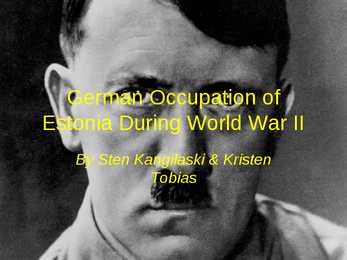
German Occupation of Estonia During World War II By Sten Kangilaski & Kristen Tobias The Beginning · WWII began with the invasion of Poland · Poland was an important regional ally to Estonia · On september 24th, 1939, the Moscow press and radio started attacking Estonia as "hostile" to the Soviet Union. Summer War · After Germany invaded the Soviet Union on June 22, 1941, Finland sided with Germany in the Continuation War. · Thousands of people including a large portion of women and children were killed. · Dozens of villages, schools and public buildings were burned to the ground. German Occupation · Most Estonians greeted the Germans with relatively open arms. · In April 1941, Alfred Rosenberg laid out his plans for the East. · Rosenberg felt that Estonians were the most Germanic out of the people living by the Baltic Sea. The Holocaust · The first...
Competitive rhythmic gymnastics began in the 1940s in the Soviet Union. The FIG formally recognized this discipline in 1961, first as modern gymnastics, then as rhythmic sportive gymnastics, and finally as rhythmic gymnastics. The first World Championships for individual rhythmic gymnasts was held in 1963 in Budapest. Rhythmic gymnastics was added to the 1984 Summer Olympics in Los Angeles, with an individual all-around competition. However, many federations from the Eastern European countries were forced to boycott by the Soviet Union. Canadian Lori Fung was the first rhythmic gymnast to earn an Olympic gold medal. The group competition was added to the 1996 Summer Olympics in Atlanta. Olympic rhythmic gymnastics is typically restricted to female participants, although Japan has begun developing programs in which men can compete and in Spain, men are allowed to participate in women's competitions. The men's program has yet to be forma...
RUNNING HEAD: RUSSIA Russia Throughout the History U.S Government Table of Contents 1. Introduction 2. History of Russia 3. Russia nowadays 4. Important people in Russia throughout the history 5. Conclusion 6. References Introduction- Russia Throughout the History Russia is a one of the biggest countries is the world. The first clues about Russian history are from as early as the 9th century. Russia has suffered through rough times in war, mad leaders and tough life amongst the locals. Over times the country has had several different names and political systems. They have been an empire ruled by a czar, a communist nation, and a democratic federation. Nowadays the country's official name is the Russian Federation ("Basic facts about,"). The head of the executive branch i...
The History of Estonia 8000 BC traces of first settlement at Pulli 3000 BC Finno-Ugric tribes arrive 1st cent AD Estonians mentioned in written records by Tacitus 1030 first written mention of Tartu 1154 first written mention of Tallinn, map of Estonia 1219 Danish invasion by the Teutonic Order 13th century German invasion by the Livonian Order 1343 St George's Night uprising 15th century serfdom begins to develop 16th century Reformation 1558.1583 The Livonian War between Sweden, Poland, Denmark, Russia 1629.1710 Swedish era 1700.1721 The Northern War, Russian invasion 1860.1885 era of national awakening 1918.1920 the War of Independence 1918.1940 the Republic of Estonia 1940.1941 first Soviet occupation 1941.1944 German occupation, World War II 1945.1991 second Soviet occupation 1991 the Decla...
I Native Americans · Origin of Native Americans Origin is debatable Siberia->Alaska Crossed the land bridge around 14,000 years ago "ice-free corridor" Hunters, searching for fresh grounds · Different tribes and their way of life In tents, dark skin, hair is long, black and straight, women-agriculture, men- hunting. bands(chief. Travelled together) and tribes land was owned by the tribe that occupied it. 200 different tribes Apache- "enemy"- hunted buffalos, oil and natural gas from their land Cherokee- largest tribe Cheyenne- from Minnesota and S & N Dakota. High system of laws Northwest Ordinance of 1787 Signed in 1787 by Thomas Jefferson. The creation of the Northwest Territory as the first organized territory Ohio River was settled, 5 new states Advancement of education, maintenance of civil liberties, exclusion of slavery Promised not to invade or disturb Indians Northwest Indian War-> to stop white expropriation (sun...
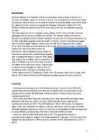
Estonia Topic Tallinn 2007 2 List of Contents page Facts and figures 3 Geography 3 Climate 3 Nature 4 History 5 Economy 6 Culture 6 Biggest towns 7 Language 8 3 Facts and figures The Republic of Estonia is a small country. Covering only 45, 228 sq km it is slightly bigger than Denmark, Belgium or Switzerland. Estonia's population is under 1.4 million. The official language is Estonian but since very many Russians live here Russian is also wide spread. The capital of Estonia is Tallinn. The currency used in Estonia is Eesti kroon. The Estonian national flag is blue-black-white. It was originally the flag of the Estonian Students' Society. The flag was first consecrated in Otepää Church in 1884. For a while, during the Soviet occupation, the flag was banned but it was again seen in p...
Valentina Tereskova Valentina Vladimirovna Tereshkova · Born: 6 March 1937 (age 81) · The first woman to go into space · Retired Russian cosmonaut, engineer, and politician · The only woman ever to have been on a solo space mission Valentina Tereshkova · June 16, 1963 · Vostok 6 · Time in space: 2 days, 23 hrs, and 12 mins · Orbited Earth 48 times in her space capsule · Only trip into space Before · Inspired by Gagarin · Volunteered for the Soviet space program · No experience as a pilot, but was accepted into the program because of her 126 parachute jumps. · 18 months of training · Of the five women, only Tereshkova went into space. After · Never flew in space again. · Later became a test pilot and instructor · Politician · Earned a doctorate in technical sciences. Honours and awards · Was honored with the title Hero of the Soviet Union. · She received the Order of Lenin · The Gol...
The United States of America (The U.S.A) Geography The main part of the United states extends from the Atlantic Ocean in the east to the Pacific Ocean in the west. It covers the middle of the North American continent. This area is called ,,the continental United states". The continental United States is bounded to the North by Canada and to the South by Mexico. The border with Canada is often called ,,the longest unguarded border in the world". The United States and Canada are good friends and they have very few problems in managing the border. The borded with Mexico is different. Immigrants are constantly crossing the border illegally. Every day about 2,000 of them are captured and sent back, but may others get through. There are also two states that are not connected to the continental United States. They are Alaska and Hawaii. There are two mountain ranges in ...
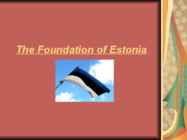
The Foundation of Estonia Estonia The history of Estonia The history of Estonia is a part of the history of Europe. Estonia was settled near the end of the last glacial era, beginning from around 8500 BC. Before the Germans invaded in the 13th century proto-Estonians of the Ancient Estonia worshipped the spirits of nature. Since the Northern Crusades Estonia became a battleground for centuries where Denmark, Germany, Russia, Sweden and Poland fought their many wars over controlling the important geographical position of the country as a gateway between East and West. Being conquered by Danes and Germans in 1227, Estonia was ruled initially by Denmark in the north, by the Livonian Order, an autonomous part of the Monastic state of the Teutonic Knights and Baltic German ecclesiastical states of the Holy Roman Empire. From 1418–1562 the whole of Estonia was part of the Livonian Confederation. A...
Lennart Meri Lennart Meri was a writer, a film director and a statesman who served as the second President of Estonia. Meri was a leader of the Estonian independence movement. His lifestory: Lennart Georg Meri was born in Tallinn, 29 March 1929, a son of the Estonian diplomat and later translator Georg Meri, and Estonian Swedish Alice-Brigitta Engmann. Because his father was a diplomat, Lennart left Estonia at an early age and studied abroad, in nine different schools and in four different languages. In addition to his native Estonian, Lennart Meri fluently spoke five other languages: Finnish, French, German, English and Russian. The family was in Tallinn when Estonia was occupied by the armed forces of the Soviet Union in June 1940 and in 1941, the Meri family was deported to Siberia. They came back to Estonia 1945. In 1953, Lennart Meri graduated cum laude fr...
Introduction Estonia, officially the Republic of Estonia (Estonian: Eesti or Eesti Vabariik) is a country in the Baltic region of Northern Europe. It is bordered to the north by Finland across the Gulf of Finland, to the west by Sweden across the Baltic Sea, to the south by Latvia (343 km), and to the east by the Russian Federation (338,6 km). The territory of Estonia covers 45,227 km² and is influenced by a temperate seasonal climate. The Estonians are a Finnic people closely related to the Finns, with the Estonian language sharing many similarities to Finnish. The modern name of Estonia is thought to originate from the Roman historian Tacitus, who in his book Germania (ca. AD 98) described a people called the Aestii. Similarly, ancient Scandinavian sagas refer to a land called Eistland, close to the German term Estland for the country. Early Latin and other ancient versions of the name are Estia and Hestia. Until the late 1930s, the ...
A single nation. A million voices. The fall of and empire. Main events in Estonian history NIMI Ancient Estonia · Begins from around 8500 BC. · Worshipped the spirits of nature. · Own gods. · 5 periods: mesolithic, neolithic, bronze age, iron age, early middle ages. Click icon to add picture Click icon to add picture Estonian crusade · One of the last corners of medieval Europe to be christianized. · Against pagans in Estonia. ...
Estonia Estonia is a small country in Northern Europe with an area of about 45 000 sq km. As a part of the East-European Plain, the country has a rather flat surface. The highest and most diverse region in Estonia is in the south-eastern part of the country. At 318 metres, Suur Munamägi is not only the highest point in Estonia, but of all the Baltic countries. There are about 1500 islands in Estonia, the biggest of which being Saaremaa and Hiiumaa. Sixty-four species of mammals have been recorded in Estonia, three of them have been introduced: the racoon dog, the American mink and the muskrat. A couple of species have been re-introduced The European beaver, who was hunted to extinction by the end of the 19th century. A vital population of them now exists in Estonia once again. Another re- introduced species is the red deer. An attempt has been made in Estonia in recent years to disperse the p...
Tallinna Lillekyla Gymnasium Report Tallinn in the 20th century Student: ------------ Supervisor: --------------- Tallinn 2008 Table of Content Table of Content..........................................................................................................................2 Introduction .....................................................................................................................................................3 Beginning of 20th century...........................................................................................................4 Independent Estonia (1918-1940) ...............................................................................................................................................
Report on Estonia Estonia is a country in northern Europe. Estonia has land borders in the south with Latvia and in the east with Russia, it's oversea neighbours are Finland and Sweden. Estonia has got 15 counties. Estonia has been an independent country since 1991. Tallinn is the capital city of Estonia. Estonia is a member of European Union nad NATO. Estonia is a democratic republic and it's president is Toomas Hendrik Ilves. The official language of Estonia is Estonian, which is Finno-Ugric language and has many similarities with Finnish. The population of Estonia contains mainly Estonians but some Russians and other ethnicities too. Many foreign people think of Estonia as an old-timed soviet union country, but in my opinion Estonia is quite far-advanced country. Estonian national symbols are cornflower, slate, swallow and it's blue-black-white flag. There is very high level of education in Estonia, m...
Estonia Where it is? Republic of Estonia is a state in the Baltic region of Northern Europe .It is bordered to the north by the Finland, to the west by the Baltic Sea, to the south by Latvia (343 km), and to the east by lake Peipus and Russia (338.6 km). Across the Baltic Sea lies Sweden in the west and Finland in the north. Towns Tallinn is the capital and the largest city of Estonia. It lies on the northern coast of Estonia, along the Gulf of Finland. There are 33 cities and several town-parish towns in the country. In total, there are 47 linna, with "linn" in English meaning both "cities" and "towns". More than 70% of the population lives in towns. History • Estonia was settled near the end of the last glacial era, beginning from around 8500 BC. Before the German invasions in the 13th century proto-Estonians of the Ancient Estonia worshipped the spirits of n...
The Troubled Peace 1 a) The Nazis didn't care for any other nationalities, they used people who weren't German only for ''slave work'' . Germanys only concern was to keep themselves happy and powerful. They wanted to make themselves the superior race. Hitlers idea of the perfect race, the Aryan race also didn't help, because the Aryan race should have people with light eyes,hair and skin, they should be tall and powerful. He didn't care for people who didn't meet his expectations of the perfect race. In his eyes all other groups of people like the Russians, Jews and just crazy, crippled or diseased people were worthless and didn't have any other use than for slave work or just killing. b) After the war twenty-four major political and military leaders of Nazi Germany, indicted for aggressive war, war crimes, and crimes against humanity, were brought to trial before the British, French, Russian...
Estonia is a pretty small country in northern Europe. Estonia has land borders in the south with Latvia and in the east with Russia, it's oversea neighbours are Finland and Sweden. Estonia divided into fifteen counties. Estonia has been an independent country since 1991. Tallinn is the capital city of Estonia. It's not very large, there lives about 400 000 pedestrians. Estonia is a member of European Union and NATO. Estonia is a democratic republic and it's president is Toomas Hendrik Ilves. The territory of Estonia covers 45,227 km² and is influenced by a temperate seasonal climate. The surface there is mainly flat, but in the southern parts of Estonia it gets little bumpy. The official language of Estonia is Estonian, which is Finno-Ugric language and has many similarities with Finnish. The population of Estonia contains mainly Estonians but some Russians and other ethnicities too. Many foreign people think of Estonia as an old-timed...
Tallinn English College Topic Estonia Tallinn 2008 1. Introduction Estonia is a small country about the size of Switzerland, or New Hampshire and Massachussetts combined. Estonia is named after the people called "Ests" who lived in the region in the 1 st century AD. The Republic of Estonia is one of the three countries commonly known as the "Baltic States". The other Baltic States are Latvia and Lithuania. 2. Geographical position Estonia is situated in northeastern Europe. Estonia is bounded on the north by the Gulf of Finland, on the east by Russia, on the south by Latvia and on the west by the Baltic Sea. In the north it borders on Finland. The coastline of the Baltic Sea in Estonia is characterized by numerous gulfs and bays, the biggest of them being the Gulf of Finland, the Gulf of Riga and the Gulf of Pärnu. Bays include the Narva Bay, Matsalu Bay, Kolga Bay, Kunda Bay, Tallinn Bay etc....
1. USA’s type of the country is constitutinal republic. Their type of government is parliamentary democracy 2. The flag has 13 red and white stipes which stand for the first states. The flag also has 50 stars on it which represent the states now and the last star is for Hawaii. 3. Their motto is In God We Trust. The national bird is the bald eagle. Symbols : The Lincoln Memorial, The White House, the Statue of Liberty (a gift from France 1886), Uncle Sam, the Jefferson Memorial, the Washington Monument. 4. America was discovered by Christopher Columbus in 1492. Christopher Columbus arrived in the „New World“ in 1492 and thought it was India and called the people Indians. 5. Thomas Jefferson, author of the Declaration of Independence and the third U.S. president, was a leading figure in America’s early development. During the American Revolutionary War (1775-83), Jefferson served in the Virgini...
Tallinn Tallinn is situated on the southern coast of the Gulf of Finland, in north-western Estonia. A limestone cliff runs through the city. It is exposed, for instance, at Toompea and Lasnamäe. However, Toompea is not a part of the cliff, but a separate hill. Coastline is 46 kilometres long.The highest point of Tallinn, at 64 meters above the sea level, is situated in the district of Nõmme, in the south-west of the city. The first human steps, that archeologists found, are about 5000 years old. Tallinn`s first fortress was built in Toompea, in 1050. As an important port for trade between Russia and Scandinavia, it became a target for the expansion of the Teutonic Knights and the Kingdom of Denmark during the period of Northern Crusades in the beginning of the 13th century when Christianity was forcibly imposed on the local population. Danish rule of Tallinn and Northern Estonia started in 1219. In 1285...
Estonia Estonia is a little country in Northen Europe. Estonia is borderd by the Baltic Sea and Gulf of Finland, it's between Latvia and Russia. Its geographic coordinates are 59 North 26 Eeast. Estonias capital is Tallin, it is situated in the North of Estonia. Estonias mainland terrain is flat, boggy, and partly wooded, offshore lie more than 1,500 islands. From the north flat and from the east is Estonia hilly. It's highest peak is Suur Munamägi(318 m). Sometimes flooding occurs in the spring in Estonia. It's biggest lakes are Lake Peipsi and Lake Võrtsjärv. It's biggest islands are Saaremaa and Hiiumaa. In Estonia there is 26.5% arable land, 0.35% permanent crops and 73.15% other land. Natural resources in Estonai are oil shale, peat, phosphorite, clay, limestone, sand, dolomite, arable land, sea mud. The population of Estonia is about 1,341,000 people. Estonia, as a new member of the Wor...
Estonia is a state in the Baltic region of Northern Europe. It is bordered to the north by the Gulf of Finland, to the west by the Baltic Sea, to the south by Latvia (343 km), and to the east by Lake Peipus and Russia (338.6 km). Across the Baltic Sea lies Sweden in the west and Finland in the north. The territory of Estonia covers 45,227 km2 (17,462 sq mi), and is influenced by a humid continental climate. The Estonians are a Finnic people, and the official language, Estonian, is a Finno-Ugric language closely related to Finnish, and distantly to Hungarian and to the Sami languages. Estonia is a democratic parliamentary republic divided into fifteen counties, with its capital and largest city being Tallinn. Estonia's population of 1.3 million makes it one of the least-populous member states of the European Union, Eurozone and the North Atlantic Treaty Organization. A developed country with an advanced, high-income economy, Estonia has ...
Estonian presidents Estonia has only had 4 presidents, since it's been a republic for little time. Konstantin Päts (1874-1956) was the first president of Estonia. His reign as a president started in 1938 and ended in 1940. Päts' political career started early. He served as a municipal advisor in 1904 and had many political positions after that. With his speech during the War of Independence he put a basis to Estonian economy. Päts' position as a president ended when Soviet Union occupied Estonia in 1940. Päts was forced to leave his office and was deported to Leningrad with his family. In 1941, he was arrested. In time he ended up in psychiatric hospital, where he died in 1956. Konstantin Päts giving a speech in 1919. Lennart Meri (1929-2006). His reign as the second president of Estonia started in 1992 and ended in 2001. He started out as a writer and filmmaker. Through his political activeness he got the position of Foreign mi...
Economy of Estonia The economic growth during the recent years has been very fast. The Estonian economy is diverse industry and transport, as well as commerce and different branches of services are all equally important. Due to the available natural resources Estonian economy largely relies on the branches related to the forest; Estonian energy sector is based on oil shale. Finland and Sweden are the most important trade partners. The Estonian economy profits significantly from the business generated by more than 2 million tourists a year. The important sectors of the Estonian economy are the processing, transport, warehousing and communications, commerce and estate, rental and letting, as well as business services, agriculture, construction and government, education and health care. In order to be able to import all the products and services, something must be exported, that's why export holds such a prominent posit...
Russian philology The meaning of the word "philology" is "love for word". This is love that unites teachers and researchers of modern and Classical languages and literature, interpreters and diplomats, journalists and publishers, writers and poets. Russian philologis are highly demanded in various spheres of scholarly research and education, in the mass media, in civil service at the Ministry of Foreign Affairs, in archives, libraries, museums, in travel agencies, as well as Russian and international companies. Curriculum within in philological faculty includes courses of Russian and European languages and literature, courses of Linguistics and Theory of Literature for students to familiarize themselves with various schools and trends of Russian and foreign philology. The core curriculum also includes a number of Liberal Arts courses (Philosophy, History, Psychology, Pedagogy), as well as courses of basic mathematics and compute...
The Estonian Green Party Green Party History The Estonian Green Party is a political party and follower of the political activity of Estonian Green Movement (EGM), which was formed in 1988 during a massive movement against the Soviet Union's plans to start exploitation of huge phosphorite deposits on NorthEastern part of Estonia EGM was one of the first independent political popular movement in Estonia under Soviet rule. The party Estonian Greens (EG) was formally registered in March 1992 (precessor EGM was registered as party on 20.09.1989) after merger of EGM political wing and EGP. It had approximately 250 members and 3 regional branches. In the 1992 general elections, the Greens were only able to scrape 2.6% of the vote and one deputy to the 101strong Riigikogu (Parliament). Estonian Greens Today After joining the EU (European Union) on May 2004 along the election...
Marit Moorits 12b Kristjan Raud Kristjan Raud (18651943) belongs to the older generation of Estonian artistic pathfinders. Together with his twin brother Paul Raud and his contemporary artist, Ants Laikmaa, he managed to break through the obstacles set before the Estonians by the prevailing peasant mentality and the extremely classconscious society of the time. Kristjan Raud was one of the first Estonian artists who is brave enough to try and make his career in his homeland, although his talent and connections in the art world, established already during his studies in Germany and St.Petersburg would have enabled him to easily merge in either place. The long years of study in St.Petersburg, Dusseldorf and Munich ended in 1903 when Kristjan Raud settled at home. A great ...
PENTAGON The Pentagon is the headquarters of the United States Department of Defense, located in Arlington County, Virginia. As a symbol of the U.S. military, "the Pentagon" is often used metonymically to refer to the Department of Defense rather than the building itself. Designed by the American architect George Bergstrom (1876 1955), and built by Philadelphia, Pennsylvania, general contractor John McShain, the building was dedicated on January 15, 1943, after ground was broken for construction on September 11, 1941. General Brehon Somervell provided the major motive power behind the project;[1] Colonel Leslie Groves (whose administrative ability, drive, and forcefulness led to his nomination to head the Manhattan Project in 1942) and Major Clarence Renshaw were responsible for overseeing the project for the Army. The Pentagon is the world's largest office building. It houses approxim...
History of Estonia Elina, Rasmus, Joosep Pre-history The Mesolithic Period The Neolithic Period The Bronze Age The Iron Age Early Middle Ages Click to edit Master text styles Second level Third level Fourth level Fifth level Counties of Ancient Estonia The Middle Ages Danish Estonia Swedish Coastal Settlements Terra Mariana The Reformation Period Division of Estonia in the Livonian War PolishLithuanian Commonwealth Estonia in the Swedish Empire Estonia in the Russian Empire Age of Enlightenment National Awakening Road to Republic Occupation of Estonia by German Empire. United Baltic Duchy Declaration of Independance As a result of the availability of education Age of awakening Red Army's retreat and arrival of German troops in Pärnu on 23 February in Tallinn on 24 February 1918 Independence (1918-1939) Tartu peace treaty in 1920 First recognized by Finl...
ENVIRONMENTAL PROBLEM The term acid rain refers to what scientists call acid deposition. It is caused by airborne acidic pollutants and has highly destructive results. Scientists first discovered acid rain in 1852, when the English chemist Robert Agnus invented the term. From then until now, acid rain has been an issue of intense debate among scientists and policy makers. Acid rain, one of the most important environmental problems of all, cannot be seen. The invisible gases that cause acid rain usually come from automobiles or coal-burning power plants. Acid rain moves easily, affecting locations far beyond those that let out the pollution. As a result, this global pollution issue causes great debates between countries that fight over polluting each other's environments. For years, science studied the true causes of acid rain. Some scientists concluded that human production was primarily responsible, while others cited natu...
President of Estonia Kadi Hõim Form 10 The President of the Republic (in Estonian: Eesti Vabariigi President) is the head of state of the Republic of Estonia. Estonia is a parliamentary republic, therefore President is mainly a symbolic figure and holds no executive power. Presidential Flag of Estonia The President is elected by the Parliament or a special electoral body for a five-year term. The electoral body is convened in case no candidate secures a two-third-majority in Parliament after three rounds of balloting. The President can not be elected for more than two consecutive terms. History Estonia didn't have a president from 1918 to 1938. This institution was intentionally left out of the first Estonian constitution, for its authors tried to avoid the concentration of power in one person's hands by all means possible. Esto...
Olympic Sport Fact Sheet Name of sport-- Cross-country skiing Country of origin-- Norway Rules of the sport-- Racers use two basic techniques in cross-country skiing: classic technique, where the skis move parallel to each other through machine-groomed tracks in the snow, and free technique, where skiers propel themselves in a manner similar to speed skating, pushing off with the edge of their skis. Free technique uses shorter skis and is slightly faster than classic -- on average about eight per cent faster over an entire race distance. When did your sport enter the Olympics?-- In 1924 How do people participate in this sport at the Olympics (is it an individual, or a team sport)?-- It's an individual sport. What equipment is needed to participate in this sport?-- You need to have a pair of skates and ski poles. What is the competition format of your sport (tick the ...
INTRODUCTION Tallinn is the capital and largest city of Estonia. It occupies a surface of 159.2 km2 in which 404,000 inhabitants live. It is situated on the northern coast of the country, on the banks of the Gulf of Finland, in north-western Estonia. Tallinn is the location of many institutions of higher education and science. As an important port for trade between Russia and Scandinavia, it became a target for the expansion of the Teutonic Knights and the Kingdom of Denmark. Historically, the city has been attacked, sacked, razed and pillaged on numerous occasions. Although extensively bombed by Soviet airforces during the latter stages of World War II, much of the medieval Old Town still retains its charm. Since independence, improving air and sea transport links with Western Europe and Estonia's accession to the European Union have made Tallinn easily accessible to tourists. SIGHTSEEING The main attractions are in the two old towns, ...
My Town I live in Tallinn. It's the capital and main seaport of Estonia. Tallinn is a very beautiful city that lies on the Baltic Sea. It covers 158 square kilometres. The Mayor of Tallinn is Jüri Ratas. The population of our capital is about 400000 people. About 55% of them are Estonian, 37% Russians and the other 8% are from different nations. The people here are mostly engaged in industry- mainly the food industry (23%), trade (16%) and transport and communication (14%). History. Tallinn has a great history. It was first marked on a map of the world by the Arab geographer al-Idrisi in 1154, its name then being Kolyvan. In the 13 th- century chronicle of Henricus de Lettis the town was called Lyndanise. Then it was called Reval for some time and finally Estonians started to call the town Tallinn from Taanilinn (Danish town) after the Danish conquest in the 13th century. Th...
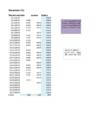
Tööajatabel [1] Tööpäevad Jaak Joosep Kokku 10/1/2005 ### 10/2/2005 ### ### 1. Leia iga päeva kohta töötatud tundide 10/3/2005 ### ### ### Kasuta sobivat andmevormingut. 10/4/2005 ### ### ### 2. Leia iga töötaja kohta töötatud tundid 10/5/2005 ### ### ### Kasuta sobivat andmevormingut (näidata 10/6/2005 ### ### 10/7/2005 ### ### 10/8/2005 ### ### ### 10/9/2005 ### ### ### 10/10/2005 ### ### 10/11/2005 ### ### ### 10/12/2005 ### ### ### 10/13/2005 ### ### 10/14/2005 ### ### Viidatud allikad 10/15/2005 ### ### ### [1] H. Sarv, „Ajatabel palkadega,“ 200 10/16/2005 ### ### ### 18...
Space exploration should be a priority Since the beginning of time people have wondered about what's really hidden behind the clouds and what goes on there. Before people had the technology to study space, they tried to make sense of the universe with the help of religion. Luckily thanks to the great interest in the subject, the first manned spaceflight happened on April 12, 1961 by the Soviet Union, with cosmonaut Yuri Gagarin aboard. Travelling in space could become very important and useful for people on earth in case something happens to our planet. Many things could happen since humans are taking advantage of earth's natural resources like oil and building dangerous factories that produce toxic waste. With space travel we could find planets that have the material to replace our resources and maybe get rid of the toxic waste we no longer have room here. Besides that, a war could break out involving ...
Education in Estonia { The beginning The history of formal education dates back to 1314th century crusades The first schools were built near churches The first primer was published in 1575 It was possible to learn reading & writing in various guilds during the 16th century 1617th century Education in the Estonian language started after the reformation by Martin Luther During Swedish era, on Gustav Adolf II's orders, the first school and university were built in 1631 GAG in Tallinn and in 1632 the University of Tartu After The Great Northern War, as Estonia was occupied by Russia, many admiralty schools were built 18th century During the reign of Russian empress Katarina II, many great improvements were made in peasant school system and girls started going to school Estonians were quite highly educated for that time, since at least half of the folk in a parish could read and a third write In 1739, the first bible w...
 annaabi.ee