Leidsid 33 sarnast õppematerjali, mis on seotud failiga "Partners schools in Comenius project". Need materjalid aitavad sul teemat sügavamalt mõista.
students, primary, part, project, there, secondary, tradition, sport, children, look, come, partner, aged, even, around, attend, rest, berlin, back, year, little, poland, cultural, staff, teachers, other, england, historic, english, forward, schools, comenius, targo, though, takes, place, urban, families, still, traditional, ways, belong, rural, areasTALLINN COLLEGE OF ENGINEERING INGLISE KEEL Essee Differences between Estonian and USA school and education systems. Juhendaja: Koostanud: 2009 Differences between Estonian and USA school and education systems. Question is, how different are our own and this big country they call United States of America's education. Or maybe there is no difference at all, and our systems about school and education are more similar than they appear at first sight. After reading all the materials and all sorts of notes about USA's education systems and their school household. All at once I realized, that they are not so different at all. Like for example USA's kids have to go to school exactly the same amount of time as our Estonian children. And basically learn same amount of same things. Like everywhere there are always differences
The basic ingredients, when fresh, are so full of flavour that British haven't had to invent sauces to disguise their natural taste. What can compare with fresh pees or new potatoes just boiled and served with butter? Why drown spring lamb in wine or cream and spices, when with just one or two herbs it is absolutely delicious? If you ask foreigners to name some typically English dishes, they will probably say "Fish and chips" then stop. It is disappointing, but true that, there is no tradition in England of eating in restaurants, because the food doesn't lend itself to such preparation. English cooking is found at home. So it is difficult to a good English restaurant with a reasonable prices. In most cities in Britain you'll find Indian, Chinese, French and Italian restaurants. In London you'll also find Indonesian, Mexican, Greek... Cynics will say that this is because English have no "cuisine" themselves, but this is not quite the true. Vocabulary: to criticize - tasteless
Comparison of Education in Britain and Estonia When looking into the educational systems of Britain and Estonia, several differences appear. In this essay I am going to point out some of the most distinguish features in the education of both countries. Firstly, there are dissimilarities in the age at which children go to school. In Estonia the age is 7 whereas in Britain children start their educational journey already as young as 5 years old. Primary school lasts 6 years just like in Estonia but the pupils in Britain are 2 years younger when they finish primary school than the pupils in Estonia. However, students in Britain and Estonia finish secondary school at the same age because secondary school lasts 5 years in Britain instead of 3 like it is in Estonia. Altogether, compulsory school in Britain lasts 11 years which is 2 years more than in Estonia.
School system in the USA Education in the United States is provided by government. Each of the 50 states has its own laws regulating education. Children start school at the age of 5 or 6 and continue until the age of 18. Primary or grade school starts from the first grade up to the sixth grade. Then students attend middle school also called junior high school for three years. After middle school, students attend secondary schools, which are called "high schools" from ninth to twelfth grades. The idea of secondary school is to get a high school diploma. Students should take on average 17 or over 20 units during their studies. Public schools are free of charge and available for everybody. To which school a child attends is determined by where they live. Primary school American children start school at the age of five. The first year at school is called kindergarten
The castle has been garrison fortress, home, official palace and sometimes prison for most of the Kings and Queens of England/Great Britain. During the war, the castle has been heavily fortified but when country has been in peace, it has been expanded with large and grand apartments and this pattern has continued nowadays. The White Cliffs of Dover is one of England’s most famous natural landmarks. The cliffs were formed over 80 million years ago. They are a part of British coastline facing France and the Strait of Dover. The cliffs owe its impressive façade to its composition of chalk accentuated by streaks of black flint and they spread east and west from the town of Dover in the county of Kent. There are miles of hidden tunnels behind the cliff face which were created during the Middle Ages and had an important role in the defence of Britain during the Napoleonic wars. London, the capital of England, has a lot of famous sightseeings itself
Education The education system is a little bit different in the UK than ours. For example they have go to school 2 years earlier than us. Primary school is for pupils aged 5-11. Though schooling is only compulsory from age 5 in the UK, children most commonly enter Reception Class aged 4 in the academic year in which they will reach their 5th birthday. When pupils are aged 7 they sit Key Stage 1 [SATs]. Key Stage 2 SATs are taken when pupils are aged 11. Secondary school is for pupils aged 11-16. 11-13 years old pupils study a broad range of 10–15 subjects. No public examinations are taken during this time. Traditionally, at the age of 14 students
Between 1956 and 1992, the number of her realms varied as territories gained independence and some realms became republics. Today, in addition to the first four aforementioned countries, Elizabeth is Queen of Jamaica, Barbados, the Bahamas, Grenada, Papua New Guinea, the Solomon Islands, Tuvalu, Saint Lucia, Saint Vincent and the Grenadines, Belize, Antigua and Barbuda, and Saint Kitts and Nevis. In 1947 she married Prince Philip, Duke of Edinburgh, with whom she has four children: Charles, Anne, Andrew, and Edward. In 1992, which Elizabeth termed her annus horribilis ("horrible year"), Charles and Andrew separated from their wives, Anne divorced, and a severe fire damaged part of Windsor Castle. Revelations continued on the state of Charles's marriage to Diana, Princess of Wales, and they divorced in 1996. The following year, Diana died in a Paris car crash, and the media criticised the royal family for remaining in seclusion
2 Educational system in Croatia divided into: 1. Early childhood education 2. Primary education 3. Secondary education 4. Higher education 3 Early childhood education There are three stages of early childhood education: • from when the child is 6 months old to when they're one • from the ages of one to three • from the age of three until the child stars attending primary school
Challenges of children`s “participation”: A Case Study of active citizenship in Cadle Primary School Gerli Orumaa – 662974 9th of May 2014 Word Count: 8,800 `Submitted in partial fulfilment of the requirements for the degree of B.A. International Relations` Table of Contents Abstract 3 Introduction 4 Chapter 1: Citizenship, Children`s Rights and Participation: from the UN to the UK 6
Education Education is so multifaceted that it is difficult for me to know where to begin discussing it, or how to prioritize the many factors. Relaying my own experience is easy: I had a standard classroom approach, supplemented by inordinate reading. In only the briefest and least memorable instances did I receive any individual tutoring. Education is commonly thought of as the job of schools. Adults cry "educate our children!" Everyone has opinions about the best way to do the job. It is of urgent importance, and all the numerous factors are much studied, debated, and new (or old) ideas continually tested or retested. Some people say "it's as simple as . . . " and then name their pet peeve or passion. My view is not of an education specialist, but of one who loves sharing what I learn, and owes much to educators. Since I don't have an educational theory neatly worked-out, nor an outline
Personal statement ,,Whatever course you decide upon, there is always someone to tell you that you are wrong. There are always difficulties arising which tempt you to believe that your critics are right. To map out a course of action and follow it to an end requires courage." - Ralph Waldo Emerson This quato, mentioned before, gives me confidence to do great things myself in life and pursue them into bigger ones one day ahead. In these moments i like to remember what Napoleon Hill once said: ,,If you can´t do great things, do small things in a great way
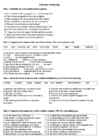
Use each word once only. classmate examiner learner principal pupil coach graduate lecturer professor tutor a) Someone who teaches at a university lecture f) Someone who teaches one student or a very small class b) Someone who has a college degree g) Someone in the same class as yourself c) The head of a school h) Someone who trains a sports team d) Someone who studies at primary or secondary i) Someone who writes the question papers of an school examination e) The most important teacher in a university j) Someone who drives but has not yet passed a driving department test Task 4. Complete each sentence (a-j) with a suitable ending (1-10). Use each ending once. a) Joe was absent most of the time .4 1
Truancy in school individual responsibility Hello ladies and gentlemen, today I am here to talk to you about truancy in school and why is it an individual responsibility. Truancy in school is a very serious problem nowadays. Unfortunately many students have lost their motivation to study. According to the BBC 400,000 children were persistently absent from England's schools in the past year and missed about one month of school each. The effect that poor attendance at school can have on a child's education can be permanent and damaging but skipping should be child's own responsibility and it is not right to punish the parents for it. Students have many reasons why they are skipping school, mostly they do not like the teachers or the subjects that they are taught. They tend think that they won't need
Estonian and British Education System Estonian and British education system is not quite different. In Estonia, the education system is based on six levels which include the: kindergarten, primary school, basic school, secondary school and university or vocational school. In Britain, the education system is also based on six levels which include the: nursery school, infant school, junior school, secondary school, 6th form and university or college. What is similar for both systems is that the first level of education starts at age of three. While in Estonia this level is called Kindergarten, then in Britain it is called Nursery school. Kindergarten is for children´s from age three to six, but Nursery school is for children´s three to four. Differently from Estonian system, at age of five to seven, British children ´s go to Infant school
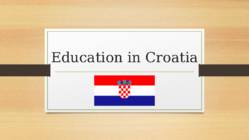
Education in Croatia Educational system in Croatia divided into: 1.Early childhood education 2.Primary education 3.Secondary education 4.Higher education Early childhood education There are three stages of early childhood education: · from when the child is 6 months old to when they're one · from the ages of one to three · from the age of three until the child stars attending primary school Even though these three stages are not compulsory, every child must attend kindergarten for a year prior to primary school. Primary education (Children begin school at the age of 6 or 7.) There are two stages: · 1st through 4th grade, being taught by one teacher per class that teaches every subject with the exception of foreign languages and Religion. The students stay in one classroom for the 4 years.
There is still a place, where I can not do this. That place is unfortunately my home, what does not makes the homely feeling in me. When I was just a little girl, my mother died and everything in my life changed. My father separated me from my sister and brother. I had to go to live in his family and accept with a stepmother and their kids. To me was verboten to say my opinion about something. I knew only that, everyday there was a paper on my desk and there were jobs, what I had to do along this day. Sometimes they were too hard to me and I had to study late at night. In my opinion every person should feel them well and free at home. But with me it did not happened. What I am trying to say with that long story is, that if there is a freedom of speech, it is still limited with laws or from other humans. Limited freedom is understandable in state bust at home it still should be aloud. Talkeing about the school
USA school system Most children enter the public education system around ages five or six. They may begin in preschoolpreschool, kindergartenkindergarten or first gradefirst grade. They normally attend 12 grades of study over 12 calendar years of primary and secondary education before graduating, earning a diploma that makes them eligible for admission to higher educationhigher education. Education is only mandatory until age 16, however. There are generally five years of primary (elementary) school, during which students customarily advance together from one grade to the next as a single cohort or "class", three years of middle school, which may have cohorts, and four years of high school. There is some variability in the arrangement of grades. In the U.S., ordinal numbersordinal numbers (e.g., first gradefirst grade) are used for identifying grades. Typical ages and grade groupings in contemporary, public and private schools may be found through the U.S
The camera cost $599, and I paid for it by credit card. When I arrived at my hotel in Wondercity almost 24 hours later, I discovered that the box which contained the camera did not include the battery, and the space in the box for the charger was empty. I am now in Wondercity, and I am not returning to Freetown, so I need to get the missing parts here. I would be grateful if you could arrange for the parts to be sent to me. I attach a copy of the receipt for your information. I look forward to hearing from you. Yours faithfully, Introduction This report looks at the dietary habits of twenty students in their final year at Freedonian Secondary School. The report is based on the students' responses to the questionnaire administered by the school's doctor. Meals The survey have revealed that the students do not have enough meals. Only eight of those questioned eat before school, and half of them have their midday meal at school
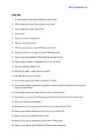
Why? 17. How old were you when you first went to see a puppet show? Do you remember what it was? 18. Who is your favourite actor/actress? 19. What performance or concert would you like to see if it were possible? Why? 20. Have you got a drama club at your school? Are you a member of it? 21. Have you ever worn a costume? When? Why? 22. Have you ever seen a rehearsal of a show? When? Which show? 23. Have you ever been to a zoo? Which zoo? What animals were there? http://www.abiks.pri.ee 24. Have you ever been to a funfair? Where? 25. Have you ever been to a circus? When? Where? 26. Have you ever seen a circus show on TV? 27. What did you see in the show? (an animal act? clowns? acrobats? jugglers?) 28. Are you good at juggling? What makes you think so? 29. Do you like aerobics? Are you good at it? Do you know anybody who is? 30. Would you like to perform in a circus?
The Estonian War of Independence began with the attack of the Red Army of the Soviet Russia on Narva on the 28 November 1918 and lasted until a ceasefire on the 3 January 1920 (juridically until the 2 February 1920). In the War of Independence, Estonia received support from the UK, Finland, Latvia and the White Russian Northwestern Army. In the defence of the independent statehood of Estonia in the battlefield participated at least 130 students and 11 teachers of the Gymnasium for Boys, which was the name for Gustav Adolf Grammar School at that time. Johan Laidoner has said that it was the schoolboys who brought "the belief, that we would win and that is the greatest gift they have given to the Republic during its birth." (point to the list of students on the slide.) The youngest students of our school in the War of Independence were 15 and the oldest, Martin Hendrikson, celebrated
Sociological factors: Religions: Main religion is Roman Catholic 41,8%, then comes Protestants with 35,3% and on the third place are so called non-believers (people with no religion) 11,1%. (Other: muslin, orthodox, other Christian and so on). Birth rates: Switzerland has a birthrate of 9, 51 births to 1000 people, it's in the 199 place in the world's birth rate comparison. Leisure activities: Leisure activities range from taking part in grueling sports to relaxing with family and friends. Many people also devote part of their leisure time to the public service. Life expectancy at birth: total average is 81 years but if you look at genders separately it's: male 78 years and female 84 years. Environmental problems: air pollution from vehicle emissions and open-air burning; acid rain; water pollution from increased use of agricultural fertilizers.
The main question is what makes a human being happy? In my opinion, as a person claims that he is happy, then we can firmly say that this person is successful in life because he feels content with his life. Contentedness and happiness are the key factors in determing how succesful someone is. It is often said that for a small town inhabitant, it is a lot harder to achieve something in life. I totally disagree with this statement. There are just other values in a town with a small population density. Values concerning family life are coming more forth, career and such kind of personal ambitions are kept in the backround. Also it is often mentioned that making a successful career in a small town is largely impossible, because of the lack of different resources and opportunities. By these it is commonly ment a uncompetitive education and few opportunities to develop extracurricular activities
endorsements or funding to carry out its work. Maintained schools funded by the state. Schools maintained by the local education authority (LEA, or, in Northern Ireland, by Education Authority). Some of those schools are voluntary schools (also known as religious schools or faith schools) where the land and buildings are owned by a charity, often a religious organisation such as a church, but the school is at least partly funded by the local education authority. In all state schools, students must follow the National Curriculum. Independent schools independent fee-charging schools. Schools that are independent of local or central government control; private schools • financed by fees and endowments financially independent Public schools = now a somewhat archaic term for the oldest, most exclusive and expensive of the boys' independent secondary boarding schools (some are now at least partly co- educational).
MY SCHOOL & SPECIALITY Kuressaare Regional Training Centre is an educational institute that provides initial vocational training and in wide area of specialties. The school was established on the 6th of november 1922, named the Kuressaare Ehitusinstruktorite school. First accepted 19 students to the new school. This marks the beginning of the continuous training on Saaremaa. Nowdays, over 1000 of students enrolled in school. As tourism is an important industry in our region, training specialists in catering, cooking, tourism management and hotel service has a very important role. Construction and related fields like carpentry have also quite a number of students. My school is located on an island which has a strong seamanship traditions and small vessel building companies, Kuressaare Reginal Traingin Centre is the only vocational school in Estonia training boat builders.
[3][4] Rosewarne (1984) states that "the heartland of this variety lies by the banks of the Thames and its estuary". However, in the name itself the Thames is not mentioned. This seems to have irritated some of the academics, who willingly displayed their reluctance to the term. In his posting to the Linguist List, for instance, Battarbee (1996) talks of "... regional arrogance of the SouthEast within the UK: it takes for granted that 'Estuary' means the Thames Estuary. There are many estuaries in Great Britain, and several of the emerging regional mega-accents are estuarially based". Other linguists have criticised the term because it suggests that the variety is restricted to the area of the Thames estuary. Trudgill (2001) severely criticises both the concept of EE and its name, among others because "it suggests that it is a variety of English confined to the banks of the Thames Estuary, which it is not". Also Maidment (1994)
Art week Art week is a big event for students and teachers of Tallinn 21. School. It is a tradition that has been held for the last 30 years. Art Week is always organized by 11c class students who study Humanities and Social Sciences. Organizing class has to introduce the culture of the country they have picked to other students in school. The Art Week was originally initiated by Tiina Meeri, who is still working in our school and still organizes the week. At the beginning there were no countries, just certain time periods of history. The Art Week has some traditional events, such as the play "Moving Pictures" which tells the story of the theme country. At the opening ceremony, people from embassy come to congratulate and thank the students for their efforts of making such a big event happen. There´s also Art Week´s café where traditional food is served. Traditionally Art Week ends with costume party where organizing class performs with their own play.
1. John wondered what the doctor would charge him for the operation. 2. I received a fine for illegal parking yesterday. 3. As soon as the school as sufficient funds, they will build a new gym. 4. This jumper cost me a lot of money. 5. Embarrassingly, we nearly left the restaurant without paying the bill. 6. The instructor's fee for driving lessons is £10,00 per hour. 7. He wouldn't accept a cheque as payment. 8. I have had an account at that bank for years. IV Exercise In Britain, some children start their education by going to a kindergarten or nursery school when they are 2 or 3 years old. They must go to school from the age of 5, when they usually enter the state school system by attending primary school until they are 11 years old. Then they go on to a secondary school, which they can leave when they reach 16. Before leaving, students sit their GCSE examinations in 8 or 9 subjects. If they want to go on to study at
as books the way we understand the word today. Centuries went before paper replaced parchment and papyri. In the 15 th century Johann Gutenberg invented a mechanical process of duplicating texts, which we today call book printing. The first book was printed between 1444 and 1446, so these years can be considered as the beginning years of book printing. His most important preserved printings are the 40 copies of the Bible. By the end of the 15 th century there were about 1000 print-shops in Europe already. The oldest Estonian book dates back to 1535. Libraries form a vital part of education. They make available-through books, films, recordings and other media- knowledge that has been accumulated through the ages. People in all walks of life use libraries to get information for their work. Libraries also play an important role in preserving people's cultural heritage.
SCIENCE AND TECHNOLOGY A century ago communication across any distance was dependent upon the telegraph or letters. No jets crossed the ocean, no television pictures enabled us instantly to see events in any part of the world, there were no worldwide telephone networks and no computers. It is just a short lifetime since humanity first travelled into space and discovered how fragile our planet looks. FROM FIREWORKS TO THE MOON At first glance you might think that there couldn't possibly be anything common between a 13 th century festival in China and the Apollo 11 moon landing in 1969. However, there is a link and that is that they both relied on the use of rockets.
DEPARTMENT OF ENGLISH Using Blogs as a Platform in the Teaching of English as a Foreign Language Research paper Tartu 2010 ABSTRACT This work analyses the usefulness of blogging in teaching English as a foreign language. The definition of the term `blog' is provided along with the advantages and disadvantages of blogs' usage in practice. The analysis of language skills developed by students throughout the use of blogs for learning purposes is given in the paper with possible limitations that blogs have. Author of this paper also shares personal comments about the experience in the field. In this paper it is also described which research methods are planned to be employed for the conduction of research project. 2 ABSTRACT...........................................................
Positive sides of outdoor learning Essay "Tell me and I forget. Teach me and I remember. Involve me and I learn." Benjamin Franklin In the last few years outdoor education has become more and more popular worldwide and in Estonia too. While there are many definitions for outdoor education, I think the best way to describe it would be outdoor education is a form of education, when learning takes place somewhere else than a classroom and the subjects are not only about the environment and nature but also linked to the national curriculum. Outdoor education often takes place on a walk around the block, a visit to the cemetery or a local post office. It can happen at a city zoo, on a forest trail, or in a national park
very uncomfortable aswering them and at that point he doesn’t care as well. Being a third year history student in University of Tartu, I am wondering over the same questions and find myself often thinking what is expected of me after graduating and how has university played a role in my development for almost three years now. When asked what is the main purpose of university, most people would say that it is preparing students for different proffessions, which would later be the driving force of the country. But I think it is more complicated than that. Going to university is a logical step to a ambitious young high school graduate and some even don’t consider other possibilities. On the other hand, universities are getting a lot of critic because some say that the goal of universities are to produce as many diploma graduates as possible. I think that universities are
2 Kas see on teie kooli direktor? Is that the head teacher of your school? 3 Peaaegu igaüks räägib võõrkeelt aktsendiga. Almost everyone speaks a foreign language with an accent. 4 Ära muretse, sinu inglise keel on suurepärane. Don´t worry, your English is excellent. 5 Ma ei suuda taluda valju muusikat. I can´t stand loud music. 6 Kas sa tahaksid töötada ruumis või väljas? Would you like to work indoors or outdoors? 2 Complete the sentences with a job. 1 Vets look after sick animals. 2 Lifeguards work on the beach and help swimmers in danger. 3 Childminders look after small children when their parents are at work. 4 Teachers work at school. 5 Plumbers mend baths, sinks, and leaks. 6 Cooks prepare food. 7 Nurses help doctors and look after people who are ill. 8 Farmers work in the fields. 3 Write the opposites. 1 lazy hardworking 5 possible impossible
 annaabi.ee