Leidsid 33 sarnast õppematerjali, mis on seotud failiga "History of Estonia". Need materjalid aitavad sul teemat sügavamalt mõista.
period, empire, first, middle, ages, swedish, russian, awakening, german, february, economy, elina, joosep, bronze, iron, early, fourth, ancient, coastal, terra, reformation, division, commonwealth, road, republic, occupation, baltic, result, army, peace, treaty, finland, july, member, league, parlament, established, konstantin, soviet, stalin, livingA single nation. A million voices. The fall of and empire. Main events in Estonian history NIMI Ancient Estonia · Begins from around 8500 BC. · Worshipped the spirits of nature. · Own gods. · 5 periods: mesolithic, neolithic, bronze age, iron age, early middle ages. Click icon to add picture Click icon to add picture Estonian crusade · One of the last corners of medieval Europe to be christianized.
Independence Day On 24 February, Independence Day is celebrated in the Rebublic of Estonia. This is the day that the Manifesto was declared in Tallinn 91 years ago. In responce to a period of Russification initiated by the Russian empire in the 1890's, Estonian nationalism took on more political tones, with intellectuals first calling for greater autonomy, and later, complete independence from the Russian empire. Following the Bolshevik takeover of power in Russia after the October Revolution of 1917 and German victories against the Russian army, between the Russian Red Army's retreat and the arrival of advancing German troops, the Committee of Elders of the Maapäev issued the Estonian Declaration of Independence in Pärnu on February 24, 1918. after winning the Estonian Liberation War against Soviet Russia and at the same time German Freekorps
1710-1850 and 1850-1918 Contents Contents.................................................................................................................................. 2 17101850.............................................................................................................................. 3 Population and social structure........................................................................................ 4 Serfdom and the intensifying manorial economy ............................................................. 4 Influences of Pietism and the Moravian Brethren............................................................. 5 Enlightenment and enlightened absolutism...................................................................... 6 18501918.............................................................................................................................. 8 The national awakening.............................
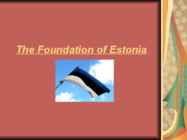
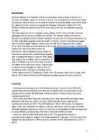
5. Symbols The flag The Estonian blue-black and white national flag was originally the flag of the Estonian Students' Society and was consecrated in Otepää Church in 1884. Today there is a memorial plaque on the church wall commemorating the event. The Flag Museum, opened in an annex in 1996, attracts tourists who take an interest in the history of the flag. After about half a century, during which it was prohibited by the Soviet authorities, the flag was seen again in public for the first time in Tartu in May 1988. 24 February 1989, Estonia, still part of the Soviet Union, hoisted its tricolor on the tower of Pikk Hermann in Tallinn. Since then the flag has always been hoisted with ceremony on that day, which is the national holiday the anniversary of the republic. According to the Estonian tradition, the national flag is hoisted at sunrise and lowered at sunset except on June 23, Victory Day, when it is left out for the shortest night of the year, followed by
The local cultural heritage offers as much variety as the nature. Many rare work and mythological motives are retained in folk songs. The flax-growing that spread rapidly in the beginning of the 19th century was the basis of the prosperous Mulgi family farms in Southern Viljandimaa. 19. The second half of the 19th century and the beginning of the 20th century constituted the golden age for many local families. The mulgi inhabitants were actually the first farmers in Estonia who bought the farms for their families after being released from the servitude. The farming was developed rapidly thanks to flax-growing. The wealthiest farmers gained even so much money that for the first time in history Estonian farmers became owners of mansions. The wealthy mulk were the first of Estonian farmers to build manses, until then the farmers all over Estonia lived in farmhouses that included a barn so that people and animals lived under one roof
became a battleground for centuries where Denmark, Germany, Russia, Sweden and Poland fought their many wars over controlling the important geographical position of the country as a gateway between East and West. Being conquered by Danes and Germans in 1227, Estonia was ruled initially by Denmark in the north, by the Livonian Order, an autonomous part of the Monastic state of the Teutonic Knights and Baltic German ecclesiastical states of the Holy Roman Empire. From 1418–1562 the whole of Estonia was part of the Livonian Confederation. After the Livonian War, Estonia became part of the Sweden from the 16th century to 1710/1721, when it was ceded to the Russian Empire as the result of the Great Northern War. Throughout this period the Baltic German nobility enjoyed autonomy, where the language of administration and education was German. The Estophile Enlightenment Period 1750–1840 led to the Estonian
Germany, Russia, Sweden and Poland fought their many wars over controlling the important geographical position of the country as a gateway between East and West. Being conquered by Danes and Germans in 1227, Estonia was ruled initially by Denmark in the north, by the Livonian Order, an autonomous part of the Monastic state of the Teutonic Knights and Baltic German ecclesiastical states of the Holy Roman Empire. From 1418–1562 the whole of Estonia was part of the Livonian Confederation. After the Livonian War, Estonia became part of the Swedish Empire from the 16th century to 1710/1721, when it was ceded to the Russian Empire as the result of the Great Northern War. Throughout this period the Baltic German nobility enjoyed autonomy, where the language of administration and education was German.
The Most Interesting Historical Events in Estonia Liana Põldver · The nationwide Song Festival tradition began with the first Song Festival in Tartu, June 18 20, 1869. · 1860 marks the beginning of the period of the National Awakening. A singing society led by Johann Voldemar Jannsen started and carried through the nationwide idea of Song Festival. · During 1879 1910 six Song Festivals were held that played an important part in the nation's cultural and economical awakening and growth. In the independent Estonian Republic the Song Festivals were held in every five years (1923 1938). After World War II, the Song Festival tradition began again in 1947. Since 1950
Facts and figures 3 Geography 3 Climate 3 Nature 4 History 5 Economy 6 Culture 6 Biggest towns 7 Language 8 3 Facts and figures The Republic of Estonia is a small country. Covering only 45, 228 sq km it is slightly bigger than Denmark, Belgium or Switzerland. Estonia's population is under 1.4 million. The official language is Estonian but since very many Russians live here Russian is also wide spread. The capital of Estonia is Tallinn. The currency used in Estonia is Eesti kroon. The Estonian national flag is blue-black-white. It was originally the flag of the Estonian Students' Society. The flag was first consecrated in Otepää Church in 1884. For a while, during the Soviet occupation, the flag was banned but it was again seen in public in Tartu in May 1988. The national flower is cornflower, the national bird is barn swallow and the national stone is limestone.
Tallinn Tallinn is situated on the southern coast of the Gulf of Finland, in north-western Estonia. A limestone cliff runs through the city. It is exposed, for instance, at Toompea and Lasnamäe. However, Toompea is not a part of the cliff, but a separate hill. Coastline is 46 kilometres long.The highest point of Tallinn, at 64 meters above the sea level, is situated in the district of Nõmme, in the south-west of the city. The first human steps, that archeologists found, are about 5000 years old. Tallinn`s first fortress was built in Toompea, in 1050. As an important port for trade between Russia and Scandinavia, it became a target for the expansion of the Teutonic Knights and the Kingdom of Denmark during the period of Northern Crusades in the beginning of the 13th century when Christianity was forcibly imposed on the local population. Danish rule of Tallinn and Northern Estonia started in 1219.
Introduction Estonia, officially the Republic of Estonia (Estonian: Eesti or Eesti Vabariik) is a country in the Baltic region of Northern Europe. It is bordered to the north by Finland across the Gulf of Finland, to the west by Sweden across the Baltic Sea, to the south by Latvia (343 km), and to the east by the Russian Federation (338,6 km). The territory of Estonia covers 45,227 km² and is influenced by a temperate seasonal climate. The Estonians are a Finnic people closely related to the Finns, with the Estonian language sharing many similarities to Finnish. The modern name of Estonia is thought to originate from the Roman historian Tacitus, who in his book Germania (ca. AD 98) described a people called the Aestii. Similarly, ancient Scandinavian sagas
Milestones in Estonian History The Estonians are a Finno-Ugric people who came from the area near the Urals and the Volga and Oka rivers. They migrated westward to the Baltic shores some 5, 000 years ago. In the ninth century A.D. Viking ships invaded Estonia and the country became a vital link in the sea-trade between East and West. By the 12th century, the Arabian geographer al-Idrisi had placed the city on his maps. In the 13th century, Tallinn joined the Hanseatic League, the union of European commercial towns that stretched from London to Novgorod. Pärnu, Viljandi and Tartu were also members. Estonia became a vital link in the sea-trade between East and West. The oldest preserved book written in Estonian, a catechism, dates from 1535. Tartu University was established in 1632, on orders from Sweden's King Gustav II Adolf. Literacy spread. The Bible was translated into Estonian in 1739(pole vaja teada).
the north by the narrow Gulf of Finland and from Sweden in the west by the Baltic Sea. Estonia has been a member of the European Union since May 1, 2004 and of the NATO since March 29, 2004. The area of Estonia is about 45000 square kilometres and the population is about 1.4 million people. The capital of Estonia is Tallinn and the official language is Estonian. The currency is Eesti kroon. The main religion is Lutheran. Anniversary of the republic is celebrated on February 20. The national flower is cornflower, national bird is barn swallow and national stone is limestone. It is a land of great natural beauty with a long and varied history and rich culture. It has served as a junction of international trade routes for centuries. History. The oldest marks of habitation on the territory of Estonia date from the 8th millennium BC. Fortified settlements were established in the 1 st century BC.
Tallinn is a very beautiful city that lies on the Baltic Sea. It covers 158 square kilometres. The Mayor of Tallinn is Jüri Ratas. The population of our capital is about 400000 people. About 55% of them are Estonian, 37% Russians and the other 8% are from different nations. The people here are mostly engaged in industry- mainly the food industry (23%), trade (16%) and transport and communication (14%). History. Tallinn has a great history. It was first marked on a map of the world by the Arab geographer al-Idrisi in 1154, its name then being Kolyvan. In the 13 th- century chronicle of Henricus de Lettis the town was called Lyndanise. Then it was called Reval for some time and finally Estonians started to call the town Tallinn from Taanilinn (Danish town) after the Danish conquest in the 13th century. The Knights of the Sword took Tallinn from the Danes in 1227 and made Toompea their fortress
HISTORY OF ESTONIA Estonians are one of the longest-settled European peoples, whose forebears, known as the "comb pottery" people, lived on the southeastern shores of the Baltic Sea over 5,000 years ago. Like other early agricultural societies, Estonians were organized into economically self-sufficient, male-dominated clans with few differences in wealth or social power. By the early Middle Ages most Estonians were small landholders, with farmsteads primarily organized by village. With the collapse of the Russian empire in World War I, Russia's provisional government granted national autonomy to Estonia. A popularly elected assembly (Maapaev) was formed but was quickly forced underground by opposing extremist political forces. The Committee of Elders of the underground Maapaev announced the Republic of Estonia on February 24, 1918, 1 day before German troops invaded
Estonian War of Independence During World War I the greatest colonial power in Europe the Russian Empire seized to exist. On its ruins the formerly enchained nations founded their own states. Among them was the Estonian Republic, officially declared on February 24, 1918. When Germany surrendered to the Western Allies on November 11, 1918 a strategic vacuum arose in Eastern Europe. The new rulers of Russia the Bolsheviks decided to use it as a proper moment to re-conquer their lost territories. The ultimate goal was international communist revolution and Germany was the first standing on their way. Thus on November 13, 1918 the Government of Soviet Russia denounced peace with Germany
The selection of music varies from jazz to rock and disco. It is a great Estonian party which cannot be found anywhere else in the world. Estonian Song Festival (Laulupidu) The AllEstonian Song Festival (Laulupidu) happens in Tallinn every five years, and gives a privileged insight into Estonian music and culture. Its aim is to bring together all the traditional songs and singers from across the country, as well as guest singers from other countries. The first AllEstonian Song Festival was held in 1869 in the town of Tartu , near the centre of Estonia. Around 870 singers took part, along with 76 musicians. Things have changed a lot, and today, the average festival gathering involves 25,000 participants, including large, joint choirs from all over Estonia
February 24: Independence Day The Republic of Estonia was founded on February 24, 1918 when the Salvation Committee, Päästekomitee, declared the independence of the Republic of Estonia. This date was celebrated as the Day of Independence until the Soviet occupation of Estonia in 1940. During the Soviet occupation, the Independence Day was festively celebrated in Estonian communities around the world. Every year, the US Secretary of State sent greetings on the occasion to the Ambassador of the Republic of Estonia to the United States, Ernst Jaakson.
The most important key dates in Estonian history Every country has its history and some moments are more important than the others. Here are some of the most notable dates from Estonian history. 3rd millennium BC the Finno-Ugric tribes arrive in Estonia 1154 First written mention of Tallinn (by al-Idrisi) 13th century German and Danish invade Estonia. Estonians' numerous attempts to restore independence fail 1343 St. George's Night uprising 1558-1583 the Livonian War after which Northern Estonia is occupied by Sweden and Southern Estonia occupied by Poland 1632 Tartu University was founded 1860-1885 the era of national awakening, the foundation for Estonian journalism was laid, collection of folklore
numbers in other places where it is too high. About 350 bird species have been recorded in Estonia. More than 200 of them breed in Estonia. Due to the vast preserved natural landscapes, large raptorial birds, such as the golden eagle and eagle owl have made Estonia their home. It is the small islets, however, that can really be called bird paradise. Undisturbed by man and protected from most smaller predators by the sea, they are real nesting sanctuaries for a diversity of birds. The first inhabitants came to the area that now forms present-day Estonia some 11 000 years ago. Estonians were one of the last pagan people in Europe. Estonia was incorporated into Christendom at the beginning of the 13th century, under the pressure of crusaders from Denmark and Northern Germany. Estonians were reduced to the status of peasantry until the 19th century. From 1558 onwards, Estonia became the battleground for the Livonian War involving Denmark, Sweden, Russia and Poland
9A TALLINN Report Supervisor: Inge Välja Tallinn 2006 Order of contents: 1.Introduction 2.Toompea 3.Lower Town 4.Kadriorg and Pirita 5.Museums 1. Introduction Tallinn, the capital of Estonia, lies on the Baltic Sea. It is on almost the same latitude east St. Petersburg in Russia, Stockholm in Sweden and Stavanger in Norway, and covers 158 sq km. Tallinn was first marked on a map of the world by the Arab geographer al-Idrisi in 1154, its name then being Kolyvan (probably derived from the name Kalev). In the 13th-century Chronicle of Henricus de Lettis the town was called Lyndanise. Later came Reval (presumably after the old county of Rävala), the name used by the Germans who ruled the country for seven centuries. Russians then modified Reval to Revel. For Estonians, the town came to be called Tallinn from Taanilinn (Danish
Russian philology The meaning of the word "philology" is "love for word". This is love that unites teachers and researchers of modern and Classical languages and literature, interpreters and diplomats, journalists and publishers, writers and poets. Russian philologis are highly demanded in various spheres of scholarly research and education, in the mass media, in civil service at the Ministry of Foreign Affairs, in archives, libraries, museums, in travel agencies, as well as Russian and international companies. Curriculum within in philological faculty includes courses of Russian and European languages and literature, courses of Linguistics and Theory of Literature for students to familiarize themselves with various schools and trends of Russian and foreign philology. The core curriculum also includes a number of Liberal Arts courses (Philosophy, History, Psychology, Pedagogy), as well as courses of basic mathematics and computer studies, and
Estonia is covered by about 18 000 square kilometers of forest. Estonia is also rich in lakes and rivers The largest lake is Peipsi and the second-largest lake is Võrtsjärv. The largest river is Võhandu whinch is 162 meters long. Estonia has many national parks. A national park is a protected area. They are good to protect animals, birds, insects and other natural resources. The most famous national parks are: Lahemaa, Karula, Soomaa, Vilsandi, Matsalu. On the 8th millenium BC first people began to settle here in Estonia. On the 13th century Germans and Danish tried to conquer our country. On the 16th century the first book in Estonian language was publicated. Then the Livonian War began. Northern part of Estonia was occupied by Sweden and the southern part of Estonia was occupied by Poland. On the 17th century Estonia was under Sweden occupation. In 1632 Tartu University was founded. On the 18th century there was a Norhern War and Estonia was occupied by Russia
In tents, dark skin, hair is long, black and straight, women-agriculture, men- hunting. bands(chief. Travelled together) and tribes land was owned by the tribe that occupied it. 200 different tribes Apache- "enemy"- hunted buffalos, oil and natural gas from their land Cherokee- largest tribe Cheyenne- from Minnesota and S & N Dakota. High system of laws Northwest Ordinance of 1787 Signed in 1787 by Thomas Jefferson. The creation of the Northwest Territory as the first organized territory Ohio River was settled, 5 new states Advancement of education, maintenance of civil liberties, exclusion of slavery Promised not to invade or disturb Indians Northwest Indian War-> to stop white expropriation (sundkoormis) · Indian Removal Act of 1830 Destructive to tribes. Many died when travelled to the other side of Missisippi. Signed on May 28 by Andrew Jackson "Trade" land with the tribes Resolve the Georgia crisis (dispute with Cherokee)
Kunda Ühisgümnaasium Tallin Old Town Report Student: Kristin Karu Teacher: Kristi Aron Kunda 2012 The Alexander Nevsky Cathedral The Alexander Nevsky Cathedral is an orthodox cathedral in the Tallinn Old Town,Estonia. It was built to a design by Mikhail Preobrazhensky in a typical Russian Revivalstyle between 1894 and 1900, during the period when the country was part of theRussian Empire. The Alexander Nevsky Cathedral is Tallinn's largest and grandest orthodox cupola cathedral. It is dedicated to Saint Alexander Nevsky who in 1242 won the Battle of the Ice on Lake Peipus, in the territorial waters of present-day Estonia. The late Russian patriarch, Alexis II, started his priestly ministry in the church. Interior of the Cathedral. The Alexander Nevsky Cathedral crowns the hill of Toompea where the Estonian folk hero
It is unique for its well-preserved architecture from the 13-15 centuries. In contrast to the ancient town-walls and towers, Tallinn of today offers modern hotels, restaurants, sport and cultural centres. Every five years national song and folk dance festivals take place in Tallinn. The yachting regatta of the 1980 Moscow Olympic Games was held at Pirita. History Tallinn means in English "Danish town". The place is believed to have been settled by Finno-Ugric people about 2500 BC. It was first marked on a map of the world by the Arab geographer al-Idrisi in 1154. The Estonians were the first to build a stronghold on the spot of the Toompea Hill, but the real Tallinn was built by the Danes who conquered the north of Estonia in 1219. Legend has it that one day, when the Danes were about to lose a bloody battle, the sky suddenly opened and a red flag with a white cross on it dropped down upon them from the heaven. This is how the Danes obtained their national flag.
Tallinna Inglise Kolledz Estonia Topic Alice Tärk, 9b Tallinn 2007 FACTFILE Area: 45 228 sq km Poplulation: under 1.4 million Capital: Tallinn Language: Estonian Currency: Eesti kroon (EEK) Main religion: Lutheran National holiday: 24 February (anniversary of the republic) National flower: Cornflower National bird: Barn Swallow National stone: Limestone LOCATION The Republic of Estonia is the northernmost and smallest of the three Baltic States. It is located on the eastern shores of the Baltic Sea in the north east of Europe. To the east the country borders Russia. Latvia is the countries neighbour to the south. From the west the coast of Estonia is washed by the Baltic Sea and from the north by the Gulf of Finland
7 metres below sea level. Its highest point, the Vaalserberg, is 312 meters above sea level. The Vaalserberg is in the southeast of the country, where the borders of the Netherlands, Belgium and Germany meet. The Netherlands has a temperature climate, thanks to its long coastline. The average temperatures are 18 degrees Celsius in summer and three degrees Celsius in winter. Average annual rainfall is 800 millimetres. (6) 4 1.3 Economy The Netherlands is a prosperous and open economy depending heavily on foreign trade. The economy is noted for stable industrial relations, moderate inflation, a sizable current account surplus, and an important role as a European transportation hub. Industrial activity is predominantly in food processing, chemicals, petroleum refining, and electrical machinery. A highly mechanized agricultural sector employs no more than 4% of the labor force but provides
since prehistoric times. In the 8th century most of the Iberian Peninsula was conquered by Moorish invaders professing Islam, who were later expelled by the Knights Templar. During the Christian Reconquista, Portugal established itself as an independent kingdom from León in 1139, claiming to be the oldest European nation-state. In the 15th and 16th centuries, as the result of pioneering the Age of Discovery, Portugal expanded western influence and established the first global empire, becoming one of the world's major economic, political and military powers. In addition, the Portuguese Empire was the longest-lived of the modern European colonial empires, spanning almost 600 years, from the capture of Ceuta in 1415 to the handover of Macau in 1999 and grant of sovereignty to East Timor in 2002. The empire spread throughout a vast number of territories that are now part of 53 different sovereign states
.....................1 2. Nature and geography.....................................................................................2 3. Position and size.............................................................................................2 4. Climate............................................................................................................3 5. Flora and fauna...............................................................................................4 6. Main fields of economy and industry..............................................................5 7. The people......................................................................................................6 8. Population......................................................................................................6 9. Traditions and culture.....................................................................................7 10. History...................................................................
*Estonians conquered by the crusaders 1208 *Reformation 16th century establishments of new school, Estonians first book appeared in 1525 *Tartu University 1632 founded by King Gustavus II Adolphus, classical university, member of the Coimbra group *Abolition of serfdom 1816 *Song festival 1869 in Tartu, an organiser was J.V.Jannsen, 822 singers, men only *Declaration of independence 24th February 1918 *War of independence 1918-1920 during the Russian Civil War, resulted in a victory for Estonia *Deportation 1949 *Estonia becomes independent 20th August 1991 *Joining EU 1st May 2004 Language: Estonian language, belongs to the Balti-Finnic group of the Finno-Ugric languages, closely realted to Finnish and rather remotely to Hungarian; Latin alphabet with 32 letters , 5 of which occur only in foreign words, the phenomes include 9 vowels and 18 consonants; words are borrowed from Latin, Greek, English etc
tribes. The Celts built a number of hill forts throughout the region. The society was divided into warrior aristocracy, agricultural commons and the priests, the druids. *Caesar in Britain - Britain was very rich in minerals but that wasn't the main reason Caesar wanted to defeat it. He could clearly see that Britain was a threat to his latest and greatest conquest - France. He invaded Britain twice, in 55 and 54 BC. The first invasion was unsuccessful - it gained a beachhead on the coast of Kent but achieved little else. The second was more successful, the Celts asked for truce. However it wasn't a victory he had imagined and Julius Caesar never returned to Britain after that. The island was left undisturbed for nearly a century. *The Roman occupation of Britain 43-410 and its legacy Britain was conquered by Emperor Claudius, the Roman rule in England lasted up to 410. The Romans left behind a
I hope, this is not hard subject for me and I can do this report finely. 3 Beginning of 20th century Estonian literates participated in the fight for local power mainly with the help of the newspaper "Teataja" created in 1901. The 1904 elections were won by an Estonian-Russian block of 5 Russians and 38 Estonians. The first Estonian mayor was Voldemar Lender and assistant major Konstantin Päts. In 1905 was bloody Sunday in St. Petersburg and this influenced estonian workers: mass meeting, had conflicts with police. 17.10.1905 was made first estonian party Eesti Rahvameelne Eduerankond created by newspaper ,,Postimees" supporters. In 1906 was created estonian proffesional theatre ,,Estonia". Theathre ,,Estonia" In 1912 was started to constructing seastronghold and war harbour ( Peter the Great seastronghold)
 annaabi.ee