Leidsid 33 sarnast õppematerjali, mis on seotud failiga "Giza Pyramid ". Need materjalid aitavad sul teemat sügavamalt mõista.
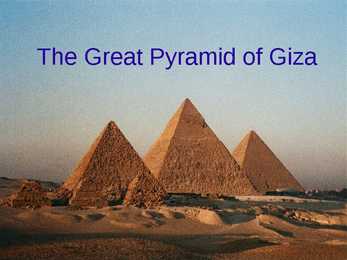
chamber, pyramid, king, stone, giza, khufu, structure, built, queen, granite, stones, chambers, tonnes, limestone, pyramids, around, base, there, construction, building, tall, complex, blocks, found, rough, original, year, originally, seen, based, them, known, higher, tomb, thought, metres, years, included, even, than, river, weigh, leading, lined, roofThe Great Pyramid of Giza · Oldest and largest · Survives mostly intact · Covered by casing stones Building · Fourth dynasty Egyptian pharaoh Khufu around 2540 BC · Originally 146.6 m tall · Currently 138.7 m tall · Mass is about 6 mln tons · Tallest man-made structure for 3800 years Pyramid Complex Materials · More than 2.3 mln limestone blocks · Granite stones King's Chamber · Red granite Sarcophagus · Room is lined with red granite · Roof includes 8-9 granite slabs Other Chambers · Queen's Chamber · Unfinished Chamber Thank You For Listening !
Giza Pyramid The Pyramids of Egypt are the largest constructions ever built and they are one of the most potent and enduring symbols of Ancient Egyptian civilization. They were buildings, where the dead kings and queens were placed. The pyramids were built between 2575-2465 BC. There were used 2, 3 million blocks of stone to build the Great Pyramid. Each block of stone weighed 2.5 tons and about 20 men transported it. There was about 100,000 men working there and it took about 20 years to build the Giza pyramid. This is the formula of setting the blocks to the Giza Pyramid : 2,400,000 stones used ÷ 20 years ÷ 365 days per year ÷ 10 work hours per day ÷ 60 minutes per hour = 0.55 stones laid per minute. Giza is the location of the Pyramid of Khufu also known as the "Great Pyramid" and the "Pyramid of Cheops"
the largest Art Deco architectural style and located in Rio de Janeiro, Brazil. The statue has a height 38 meters and is located at the top of Corcovado Mountain is 710 m high in the Tijuca Forest National Park, overlooking the city. Chichen Itza It is a Mayan archaeological heritage in Mexico is the most complete and still well maintained. According to the Mayan culture of Chilam Balam, the temple complex was built between the years 502-522 AD. Mayans occupy just over 200 years, then they migrate to coastal areas in Campeche. Itza is the central point of the complex and other buildings such as the Pyramids of Kukulcan, Temple of Chac Mool, and building the Thousand Pillars. Colosseum Is a large theater / Amphitheater, located at the State Capital of Italy, Rome, called the original "Flavian Amphitheatre", founded by King Vespasian and completed by his son Titus. Some argue
TAJ MAHAL The Taj Mahal is a mausoleum located in Agra, India, built by Mughal Emperor Shah Jahan in memory of his favorite wife, Mumtaz Mahal. The Taj Mahal (also "the Taj") is considered the finest example of Mughal architecture, a style that combines elements from Persian, Ottoman, Indian, and Islamic architectural styles. In 1983, the Taj Mahal became a UNESCO World Heritage Site and was cited as "the jewel of Muslim art in India and one of the universally admired masterpieces of the world's heritage."
Thanks to the rain Britain has a richly fertile countryside which is famous for its deep green colour. History The first inhabitants were Iberians and Celts who settled on the land and were often at war with eaeh other. In AD 43 the Roman Emperor Claudius invaded, and made Britain a Roman province. Julius Caesar had previously visited Britain to have a look around. The Romans stayed for three hundred years, and built villas, roads and towns. Many Roman remains can be visited in Britain today. Later, Christian missionaries ca me from other parts of the Roman Empire to bring Christianity to the people. The Romans finally abandoned Britain in AD 410 and a long period of invasions by Nordic peoples started. The Angles, Saxons and Jutes began to settle from the sixth to the eighth centuries, and the Angles gave England its name. These invaders introduced a new
Sydney Opera House Introduction The Sydney Opera House is a multi-venue performing arts centre in Sydney. It was conceived and largely built by Danish architect Jorn Utzon, opening in 1973. The Sydney Opera House was made a UNESCO World Heritage Site on 28 June 2007. It is one of the 20th century's most distinctive buildings and one of the most famous performing arts centres in the world. Contrary to its name, the building houses multiple performance venues. The Sydney Opera House is among the busiest performing arts centres in the world, hosting over 1,500 performances each year attended by some 1.2 million people
attention of the London press. Then British Airways showed an interest and became a partner. 'As the project developed,' says David Marks, 'everyone was inspired with one objective - to create an exciting new way to see and understand one of the greatest cities on earth.' A design, construction and logistics challenge Soon, everyone realised the sheer scale of what they were attempting. It would be the largest observation wheel ever built and the only cantilevered structure of its kind in the world. It would also be the largest structure ever hoisted into a vertical position in one operation. Over 1,700 people in five countries would be involved in building it. The population of an entire alpine village would test the embarkation procedures. Almost every component and construction technique would have to be invented from scratch. Glass for the capsules would have to be double-curved and laminated. And transportation of the components would take on a scale
Roman province of Britannia. At its height in the 2nd century, Roman London had a population of about 60,000. However, by the 3 rd century, the city fell into a decline due to trouble in the Roman Empire and by the 5th century, it was largely abandoned. But, under the control of various English kings, London once again prospered as an international trading centre. However, Viking raids began in the late 10 th century and reached a head when they took the city under Danish king Canute and forced the then-English king to flee. Years later, following a victory at the Battle of Hastings, William the Conqueror was crowned King of England in the newly-finished Westminster Abbey in 1066. William granted the citizens of London special privileges while building a castle in the corner of the city to keep them under control. This castle was expanded by later kings and is now known as the Tower of London. The city grew in wealth and population during the Middle Ages
TOOMPEA Toompea (from German Domberg – Cathedral Hill ) is a limestone hill with an area of about 7 hectares in the central part of Tallinn. It towers about 30-40 m above the surrounding areas. According to the legend it´s the tumulus mound over the grave of the national hero Kalev, erected stone by stone in his memory by his grieving wife Linda. It is the birthplace of Tallinn - a place where in 1229 the Knights of the Sword built a fortress instead of the wooden Estonian stronghold. Toompea Castle is also one of the most potent symbols of the reigning power. Today Toompea is the seat of the Government of Estonia as well as the Riigikogu, both of which are often simply colloquially referred to as Toompea. For centuries there was only one access to Toompea - Pikk Jalg - but there is also another way leading up to Toompea - Lühike Jalg, which was made in the 14th century
In 1865 the South accepted the loss. Lincoln was shot in 1865 and the next president wasn't strong enough to unite the country, so problems weren't solved.During the 19th century many people went to live in the west. To people of today the West comes to us through fun cowboys who in reality were hard-working men. They disappeared when the government gave them land and from 1862 to 1900 they became farmers. The farms that in the beginning were lonely, were brought together by the railway built in 1869.In the 15th century there were about two million Indians in America but due to diseases brought by Europeans and wars fought between them, by 1900 there were only about 250,000 natives left. The Indian wars finally ended in 1890 with the Battle of Wounded Knee and after it the government gave the Indians reservations, pieces of land that belonged to them.At the beginning of the 19th century many settlers came to America, in search for a better life.
Old Thomas - quardian of Tallinn, put on top of the spire of Tallinn Town Hall in 1530; boy that excelled springtime contests thrown by Baltic German elite, because of his low-born status was unable to receive a prize, therefore was granted the position of town guard. Right now there’s third Old Thomas, first one can be seen at Tallinn City Museum. Toompea as a symbol of power Toompea palace - wooden fortification was originally built in the 9th century, Danes made the castle the centre of secular power; Toompea palace hosts the parliament of the Republic of Estonia, designed by Eugen Habermann and Herbert Johanson. The parliament has 101 members and is chosen for 4 years. Stenbock House - the official seat of the Estonian Government since 2000; the building started in 1787, originally meant to be a courthouse. After russians ran out of fund, house went into Jakob Pontus Stenbock’s possession
Later came Reval (presumably after the old county of Rävala), the name used by the Germans who ruled the country for seven centuries. Russians then modified Reval to Revel. For Estonians, the town came to be called Tallinn from Taanilinn (Danish town) after Danish conquest in the 13th century. Over the course of time, Taanilinn was shortened to Tallinn The place is believed to have been settled by Finno-Ugric peoples about 2500 BC. The Danes, led by King Valdemar II, conquered northern Estonia in 1219. Legend has it that one day, when the Danes were about to lose a bloody battle, the sky suddenly opened and a red flag with a white cross on it dropped down upon them from the heavens. This is allegedly how the Danes obtained their national flag, the Dannebrog in a battle against the Estonians. In the middle of the 14th century Denmark sold its possessions in Estonia to the German Teutonic Order
Every five years national song and folk dance festivals take place in Tallinn. The yachting regatta of the 1980 Moscow Olympic Games was held at Pirita. History Tallinn means in English "Danish town". The place is believed to have been settled by Finno-Ugric people about 2500 BC. It was first marked on a map of the world by the Arab geographer al-Idrisi in 1154. The Estonians were the first to build a stronghold on the spot of the Toompea Hill, but the real Tallinn was built by the Danes who conquered the north of Estonia in 1219. Legend has it that one day, when the Danes were about to lose a bloody battle, the sky suddenly opened and a red flag with a white cross on it dropped down upon them from the heaven. This is how the Danes obtained their national flag. In 1346 the Danish king sold his Estonian lands to the Teutonic Order, who a year later resold them to the Livonian Order. The Germans renamed Tallinn and called it Reval.
executive and the judiciary, commander-in-chief of all the armed forces, and temporal governor of the Church of England, nowadays monarchs reign but they do not rule. Parliament is the supreme legislative authority. There is usually a one-party government. It consists of three separate elements: the Sovereign, the House of Lords and the elected House of Commons. After passing through the House of Commons, all bills are debated in the House of Lords, and after that, signed by the Queen. As a result the bills then become laws. There are 650 Members of Parliament in the House of Commons. Leaders of the Government and the Opposition sit in the front row and their supporters sit behind them. The House is presided over by the Speaker. He/she is elected by the MPs. The members of the House of Lords are not elected. This chamber consists of the Lords Spiritual. The House of Lords is presided over by the Lord Chancellor. There are about 1200 members there.
TALLINN TOWN HALL Tallinn Town Hall is the only surviving Gothic town hall in Northern Europe. Built in the heart of Tallinn, next to a marketplace, the Town Hall has witnessed trade and social activities for over 700 years. It has still remained the most important representational building in town. The building history of the Town Hall goes back to the 13th century, but it acquired its medieval appearance in 140204. It was as early as 1248 when King Eric IV Ploughpenny of Denmark granted the Lübeck Charter to Tallinn. Relying on that document a town council was elected from amongst merchants of the Hanse and started convening in the Town Hall. It is possible to state on the basis of research findings that a meeting place of the magistracy and a goods depot in the form of a small, fortified town hall, constructed of local limestone, existed in its present location already in the mid-13th century.
prefect way in its singularity. Only an artist whose inner world is rich in thought and perception and who is endowed with a strong faculty of logical thinking and powerful fantasy, can develop into a symphonist. In symphonism both the dynamics of inner and outer world conflicts, collisions and dialectics springing from the synthesis of opposing forces are revealed. Due to these qualities symphonism becomes apparent in opera, oratorio, concerto and chamber music. However, the broadest opportunities for the method are pronounced in orchestral music. From a historical standpoint we can divide the evolution of Estonian symphonic music into four periods: Russian Empire 1896-1918; Republic of Estonia 1918-1940; Soviet occupation 1940-1991; and the re-established independent Republic of Estonia since 1991. The latter period, however, began with some difficulties and serious problems.
It seems that the Celts, who had been arriving from Europe from the 8th cent BC onward, intermingled with the peoples who were already there. The Celts were extremely talented people, creative and artistic. More than 1 Celtic tribe invaded Br. The descendants of ancient Celts live in Wales, Scotland, Cornwall and Ireland. They lived in primitive society. Druids priests, more powerful than chiefs. Acted like prophets. 2. Stonehenge From prehistoric period. Was built on Salisbury plain between 2500 and 1500 bc. One of the most famous and mysterious archaeological sites in the world. One of the mysteries is how it was built at all with the technology of the time. Another is its purpose. It appears to function as a kind on astronomical clock and we know it was used by the Druids for ceremonies marking the passing of the seasons. It appears in number of novels. These days it is not only the interest of tourists but is also a
identified. The former are also known as Anglo-Catholic and the latter as Evangelical theologies and practices. Anglican church(es) The Anglican Communion is an international association of independent churches consisting of the Church of England and national and regional Anglican churches in full communion with it. Full participation in the sacramental life of each church is available to all communicant Anglicans. The Kirk = the Church of Scotland is Presbyterian in its structure, governed by a system of local, regional and national 'courts' or councils. 'Presbyterian' government refers to the sharing of authority in the church by an equal number of 'elders' (elected from the membership of the church) and ministers. Evangelical = low church The Low Church movement can trace its roots back to the early 18th century but is primarily associated with the opposition to the Anglo-Catholic movement of the later 19th century
Large ships typically have three or more synchronized generators to ensure smooth operation. The combined output of a ship's generators is well above the actual power requirement to accommodate maintenance or the loss of one generator. 1.1.1)Diesel engine The diesel engine (also known as a compression-ignition engine) is an internal combustion engine that uses the heat of compression to initiate ignition and burn the fuel that has been injected into the combustion chamber. This contrasts with spark-ignition engines such as a petrol engine (gasoline engine) or gas engine (using a gaseous fuel as opposed to gasoline), which use a spark plug to ignite an air-fuel mixture. 1.1.1.1) A two-stroke, two-cycle, or two-cycle engine is a type of internal combustion engine which completes a power cycle in only one crankshaft revolution and with two strokes, or up and down movements, of the piston in comparison to a "four-stroke
Bassano a Grappa near Venice (Italy). In the same context, some bridges have been moved when unable to function at their original location. It is not unusual in the USA, for example, to relocate a metal truss bridge to a less travelled road when it can no longer handle the traffic; the same probably holds true for other countries. This is within the functional tradition of some bridge types and should not be viewed as a negative factor in determining the integrity of a relocated structure. The definition of authenticity is in the process of being expanded to include intangible values such as a bridge that embodies the spirit or character of a people or place, as New York City is embodied in the Brooklyn Bridge, San Francisco in the Golden Gate, London in Tower Bridge, Sydney (Australia) in the Harbour Bridge, or Bosnia-Herzegovina in the recently destroyed Stari Most in Mostar. Bridges nominated for World Heritage listing also must have legal protection and management
Art Museum of Estonia Art Museum of Estonia was founded on November 17th, 1919, but it was not until 1921 that it got its first permanent building the Kadriorg Palace, built in the 18th century. In 1929 the palace was expropriated from the Art Museum in order to rebuild it as the residence of the President of Estonia. The Art Museum of Estonia was housed in several different temporary spaces, until it moved back to the palace in 1946. In September, 1991 the Kadriorg Palace was closed, because it had totally deteriorated by then. At the end of the year the Supreme Council of the Republic of Estonia decided to guarantee the construction of a new building for the Art
The City of London History The City of London occupies one square mile in the middle of the capital. It once made up the entire town of London, surrounded by the wall first built by the Romans. The Roman Londinium grew up on the northern side of the "London Bridge" in the past. Products such as olive oil, wines and fruit were brought by ships from different parts of the Roman Empire and unloaded onto wooden quays along the river. In AD 61 the native Celtic Iceni tribe, led by Queen Boudicca, rose up against The Romans. They burnt Londinium to the ground but Roman armies eventually defeated Boudicca. The city was rebuilt and was gradually surrounded with a wall
Kunda Ühisgümnaasium Tallin Old Town Report Student: Kristin Karu Teacher: Kristi Aron Kunda 2012 The Alexander Nevsky Cathedral The Alexander Nevsky Cathedral is an orthodox cathedral in the Tallinn Old Town,Estonia. It was built to a design by Mikhail Preobrazhensky in a typical Russian Revivalstyle between 1894 and 1900, during the period when the country was part of theRussian Empire. The Alexander Nevsky Cathedral is Tallinn's largest and grandest orthodox cupola cathedral. It is dedicated to Saint Alexander Nevsky who in 1242 won the Battle of the Ice on Lake Peipus, in the territorial waters of present-day Estonia. The late Russian patriarch, Alexis II, started his priestly ministry in the church.
The Great Guild Hall The Great Guild Hall is one of the most outstanding buildings of medieval Tallinn. In 1406, it was purchased Burgomaster Gosschalk Schotelmund's house on Pikk street. In 1410, the construction was completed. Same year the Great Guild moved into the building. The facade was designed in a style characteristic of gothic Tallinn. The 16th century witnessed the addition of a gable tower with wind vane, as well as a light latern above the main portal. In 1551, the excise chamber was built at the end of Börsi passage facing Pikk street. The Great Guild Hall The wind vane and coat of arms In the 19th century, the Guild Hall's windows were remodelled in the neo-gothic style and the interior of the building was renovated. It was decorated with prominent neo-gothic doors. Originally the house consisted of two spacious halls. The grand hall was the largest hall in Tallinn used for secular purposes.
London History The Romans AD 43- AD 410 The Romans finally invaded Britain in AD 43 from Kent. The Romans lead by Julius Caesar attempted to invade Britain twice before that in 55 and 54 BC but the invasions were unsuccessful. They made their way to the river Thames and sailed up it. The Romans knew it was important to control a crossing point at the river Thames, so they decided to build a settlement on the north bank. Although small settlements had been built on the banks of the Thames, the Romans were the ones who built the first city. They called their city Londinium. The Roman engineers noticed that the point where the swampy river narrowed would make an ideal crossing point, they built London Bridge. Less than 20 years later the native Iceni tribe, led by Queen Boudicca, rose up against the Romans in revenge for mistreatment and burnt Londinium to the ground. The well disciplined Roman army defeated her forces and Londinium was rebuilt
HOUSES OF PARLIAMENT Houses of Parliament also known as the Palace of Westminster is one of the most attractive buildings in London. It stands on the site where Edward the Confessor had the original palace built in the first half of the eleventh century . In 1547 the royal residence was moved to Whitehall Palace, but the Lords continued to meet at Westminster, while the commons met in St. Stephen's Chapel. Ever since these early times, the Palace of Westminster has been home to the English Parliament. In 1834 there was a huge fire that destroyed much of the old palace. All that remained was the chapel crypt, The Jewel Tower and Westminster Hall. It was Lord
THE CITY OF LONDON History The City of London occupies one square mile in the middle of the capital. It once made up entire town of London, surrounded by the wall first built by Romans. The Romans also built a bridge over the Thames and there has been one in the same area ever since. The Roman Londinium grew up on the northern side of the bridge. In AD 61 the native Celtic tribe, led by Queen Boudicca, rose up against the Romans. They burnt down Londinium to the ground and killed most of its inhabitants. Roman armies eventually defeated Boudicca and Londinium was rebuilt. At the end of the fourth century AD the Roman Empire began to crumble and the Roman armies were recalled from Britain to defend Rome itself. Once they had left, tribes such as Angles, Saxons and Jutes invaded and settled in from Holland, Germany and Denmark. Together they are known as Anglo-Saxons
Forms of Celtic language are still spoken in Britain. Romans (with Julius Caesar in the head of them) first tried to occupy Britain in 55 B.C., but there was a rebellion in Gaul so they had to leave to fight against it. Next time they came in 43 A.D. and their leader was Emperor Claudius. Romans brought a lot with them. Their brought paved roads, the sites of important cities, the seeds of Christianity, the Roman law, Roman baths, language and advanced civilization. They also built Hadrian's Wall in 122 A.D. Romans occupied Britain for four centuries. The Roman way of life all vanished after the invasions from Northern Europe by the Angles, Saxons and Jutes from the 5th century onwards. They ruined Londinium, but they were easily turned into Christianity and religion became more and more important. The Vikings, who came in the 9th century, first raided England to plunder it, but then they decided to stay
immediately from indicators that the message bore for the guidance of Japanese code clerks that it was in the top Japanese cryptographic system. This was an extremely complicated machine cipher which American cryptanalysts called PURPLE. Led by William F. Friedman, Chief Cryptanalyst of the Army Signal Corps, a team of codebreakers had solved Japan's enciphered dispatches, deduced the nature of the mechanism that would effect those letter transformations, and painstakingly built up an apparatus that cryptographically duplicated the Japanese machine. The Signal Corps had then constructed several additional PURPLE machines, using a hodgepodge of manufactured parts, and had given one to the Navy. Its three components rested now on a table in Room 1649: an electric typewriter for input; the cryptographic assembly proper, consisting of a plugboard, four electric coding rings, and associated wires and switches, set on a wooden frame; and a printing unit for output
Peter Rice and features a “floating” short-stay car park, move through roof, supported by a space frame of the check-in hall, go through security invented-pyramid roof trusses, and on to the departure gates hall on creating the impression of a the same level. From 1997 to 2007 Stansted saw stylised swan in flight. The base of each truss structure is rapid expansion of passenger numbers on the back of the boom in a "utility pillar", which provides low cost air travel, peaking at indirect up lighting illumination 24 million passengers in the 12 and is the location for air- months to October 2007, but conditioning, water, passenger numbers declined for the
British Parliament Structure and Functioning of the British Parliament today Britain is a parliamentary monarchy . The British Parliament is a bicameral parliament , that is to say that it is made up of two chambers, or two "Houses"; above the two Houses, but in an essentially formal role , there is the Sovereign - king or queen - also known as "the crown." Role of the Sovereign The British monarch has all authority, but no power. The Sovereign appoints the Prime Minister, and every year opens the sessions of parliament, in a historical and ritual ceremony called the State Opening of Parliament . Historically, this ceremony used to take place in the Autumn; but since 2012, it has been brought forward to May. This is the only regular time when the members of both Houses come together
The biggest river is the Murray River. Approximately 3,370 km in length. It is fed by melting snows. Other rivers are seasonal. The coastline of Australia is generally regular – with few bays and capes. The largest inlets are the Gulf of Carpentaria and the Great Australian Bight. In the northeast of the country a few km off the coast there is the Great Barrier Reef. It extends about 2000 km along the coast of Queensland. Made of coral, it is the world’s largest structure created by living organism. . 4 Climate & Time Zones Australia is the driest continent in the world except Antarctica. It has low average rainfalls. About 70 per cent of the country is arid or semi arid and cannot support agriculture. The north part of the country gets about 300 mm of rain a year. Much of the rain soaks into the ground and does not form any rivers or lakes. Monsoon winds bring moist air during summer
In 1925 they were adopted officially. The present large coat of arms is a golden shield charged with three blue lions with a golden oak branch on each side. The small coat of arms is identical but without oak branches. Use of the historic coat of arms as the official insignia of the Republic of Estonia was readopted in August 1990. In addition to the three main state emblems, Estonia has its national flower (the cornflower), its national bird (the barn swallow) and its national stone (limestone). There are a number of other things in Estonia which have symbolic value without any official status: the oak tree, the weather-vane and the Tower of Pikk Hermann in Tallinn, Hermann Castle in Narva, Big Egg Hill in South Estonia, and others. 6. Climate The climate in Estonia is determined by the country's location. Climatic differences are due, above all, to the vicinity of the Baltic Sea and the North Atlantic
 annaabi.ee