 10 punkti
Autor soovib selle materjali allalaadimise eest saada 10 punkti.
10 punkti
Autor soovib selle materjali allalaadimise eest saada 10 punkti.
 ~ 1 leht
Lehekülgede arv dokumendis
~ 1 leht
Lehekülgede arv dokumendis
 2009-05-21
Kuupäev, millal dokument üles laeti
2009-05-21
Kuupäev, millal dokument üles laeti
 17 laadimist
Kokku alla laetud
17 laadimist
Kokku alla laetud
 1 arvamus
Teiste kasutajate poolt lisatud kommentaarid
1 arvamus
Teiste kasutajate poolt lisatud kommentaarid
 hassikas
Õppematerjali autor
hassikas
Õppematerjali autor
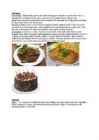
German Sauerbraten: Traditionally made with a beef roasting joint (topside or similar) the meat is marinated for 2-3 days in beer, spices such as cloves, juniper berries, allspice and peppercorns, bay leaves and onions and is braised in the marinade for a long period, resulting in very tender melt-in-the-mouth meat. The Black Forest: cake is one of the most popular German national foods. Cake consists of several layers of chocolate cake, with whipped cream and cherries between each layer. Then the cake is decorated with additional whipped cream and chocolate shavings. A Schnitzel in German is a slice of pork or veal haunch. Dish made with boneless meat thinned with a mallet (escalope-style preparation), coated in bread crumbs and fried. Only if it is made of veal and coated in bread crumbs is it called Wiener Schnitzel; a pork version is
Traditional Estonian food has its roots firmly in the countryside, relying heavily on pork, potatoes and garden variety vegetables. The main culinary influences were from Germans, who ruled over Estonia for so many centuries. The eating habits of the Estonian population are related to the season, which severely affect the availability of fresh food. The spring and summer are the seasons of fresh food, in this period are used vegetables, berries and herbs, with the warmer climate the Estonians also like to cook meat grilled outdoors. During the winter are used mushrooms, jams, and preserved foods. Among the typical Estonian dishes are: Baltic fish in acid sauce, pork with sauerkraut and boiled potatoes, blood sausage and
The traditional cuisine of Estonia has substantially been based on meat and potatoes, and on fish in coastal and lakeside areas, but is influenced by many other cuisines by now. In the present day it includes a variety of international foods and dishes, with a number of contributions from the traditions of nearby countries. German, Scandinavian, Russian and other influences have played their part. The most typical foods in Estonia have been rye bread, pork, potatoes and dairy products. Estonian eating habits have historically been closely linked to the seasons. In terms of staples, Estonia belongs firmly to the beer, vodka, rye bread and pork "belt" of Europe. The Cold Table Flounder The first course in traditional Estonian cuisine is based on cold dishes - a selection of meats and sausages served with potato salad or Rosolje, an Estonian signature dishes based on beetroot, meat and herring . Small pastries called pirukad ("pirukas" in the singular) - a
Handbook of Meat Processing Handbook of Meat Processing Fidel Toldrá EDITOR A John Wiley & Sons, Inc., Publication Edition first published 2010 © 2010 Blackwell Publishing Blackwell Publishing was acquired by John Wiley & Sons in February 2007. Blackwell’s publishing program has been merged with Wiley’s global Scientific, Technical, and Medical business to form Wiley-Blackwell. Editorial Office 2121 State Avenue, Ames, Iowa 50014-8300, USA For details of our global editorial offices, for customer services, and for information about how to apply for permission to reuse the copyright material in this book, please see our website at www.wiley.com/ wiley-blackwell. Authorization to photocopy items for internal or personal use, or the internal or personal use of specific clients, is granted by Blackwell Publishing, provided that the base fee is paid directly to the Copyright Clearance Center, 222 Rosewood Drive, Danvers, MA 01923. F
On a single street in a Johannesburg suburb, one finds Italian restaurants, two or three varieties of Chinese cookery, Japanese, Moroccan, French, Portuguese and Indian food, both Tandoor and Gujarati. Not far away are Congolese restaurants, Greek, even Brazilian and Korean establishments, and, everywhere, fusion, displaying the fantasies of creative chefs. It's not much different in the other major centres, such as Cape Town or Durban. Restaurant guides that categorise eateries by national style list close to two dozen, including Vietnamese and Swiss. Those in search of authentic South African cuisine have to look harder for those few establishments that specialise in it - like the justly famous Gramadoelas in central Johannesburg, Wandie's Place in Soweto, the Africa Café in central Cape Town or smaller restaurants in that city's Bo-Kaap, in Khayelitsha and Langa. Or one can watch for glimmers of the real thing. There are varieties of biltong in
heritage. At the beginning of the 19th century growing linen spread and became the basis of the legendary wealth of Mulgi farms. The ancient barn-dwellings and decaying manor houses are the mute witnesses of those times. The riches and cultural heritage of Mulgimaa owe to the diligence and tenacity of the local people. Village handicraftsmen and masters have always been honoured. Mulgikapsad (stewed sauerkraut with barley groats), Estonian cheesecakes and kama (a roasted meal-mixture) have not lost their popularity. However, linen growers have now been replaced by cereal grains growers and many farms have specialised on raising sheep or horses. And as the song goes: "Mulgimaa it's a place where life is good. It's a land of vast woods, fertile fields and nature's charms, the home of prosperous Estonian farms..." Tourism and handicraft in Lõuna-Viljandimaa
7) A soften B harden C widen D lengthen 8) A much B enough C mine D few 9) A Grate B Peel C Beat D Pour 10) A onion B up C one D water 11) A melted B beaten C poached D sliced 12) A One B Then C Add D Serve 13) A just B not C dish D mixer 14) A paper B puppy C pepper D poppy 15) A cookers B cooks C cookery D chiefs Task 5. Complete each sentence with one suitable word. a) I'm trying to cut down on fatty food. b) Don't worry! The smell of garlic wears …. after a while. c) Let's look …. the market before we buy any vegetables. d) I can't understand this recipe. Can you work …. what it means?
handfuls of mixed nuts, for a cumulative total of about 4,400 calories. It was my fourth meal of the day, breakfast having consisted of two glasses of grapefruit juice, a large cup of co ee with cinnamon, two chocolate croissants, and two bear claws. The more interesting portion of the story started well after Trent Reznor left the stage. Roughly 72 hours later, I tested my bodyfat percentage with an ultrasound analyzer designed by a physicist out of Lawrence Livermore National Laboratory. Charting the progress on my latest experiment, I'd dropped from 11.9% to 10.2% bodyfat, a 14% reduction of the total fat on my body, in 14 days. How? Timed doses of garlic, sugar cane, and tea extracts, among other things. The process wasn't punishing. It wasn't hard. Tiny changes were all it took. Tiny changes that, while small in isolation, produced enormous changes when used in combination. Want to extend the fat-burning half-life of ca eine
 annaabi.ee







Kõik kommentaarid