Leidsid 33 sarnast õppematerjali, mis on seotud failiga "Economy of Estonia.". Need materjalid aitavad sul teemat sügavamalt mõista.
import, products, year, able, tourist, economy, years, important, agriculture, export, europe, during, recent, equipment, other, part, ones, come, land, services, estonians, enterprises, branch, phones, growth, fast, different, forest, finland, sweden, than, processing, 1990s, cheap, became, although, production, considerable, among, wooden, germanyEstonian Economy Estonians earn about half of the average European income, despite the fact that the economic growth during the recent years has been very fast and the differences have been diminishing. Although the extremely vigorous period of economic reforms is now over, the changes that Estonia is presently going through are far more extensive than those in the developed countries. The Estonian economy is diverse industry and transport, as well as commerce and different branches of services are all equally important. Due to the available natural resources Estonian economy largely relies on the branches related to the forest; Estonian energy sector is based on oil shale, a resource quite rare elsewhere in the world. Finland and Sweden are the most important trade partners. The Estonian economy profits significantly from the business generated by more than 2 million tourists a year, most of
with an average elevation of about 50 metres above sea level. South-eastern and eastern parts of Estonia are higher than the western parts. The relief of the present-day landscape was shaped during the Ice Age. Ice sheet has carried large boulders and limestone blocks here, not to mention that the hilly terrain in Estonia was also shaped by the continental ice and the melting water. The land is rising 25 cm every one hundred years. In folklore, many features of the relief are explained by the activities of giants such as the legendary national hero Kalevipoeg. The Haanja and Otepää Uplands are particularly rich in Hills. It is here that You find Big Egg Hill, the highest point in the Baltic states with 318 metres above sea level. 4. Land regions The northern coast features a steep limestone bank, the Baltic glint, which is one of the world's most important denudations of Ordovician sedimentary rocks. The
The biggest ones are located to the west. The four biggest islands are Saaremaa, Hiiumaa, Vormsi and Muhu. The highest point in Estonia and also in the Baltic region is Suur Munamägi. It is 318. above sea level. Estonia is a country of a thousand lakes. The Largest one is Lake Peipsi which is also the fourth biggest freshwater lake in Europe. Lake Peipsi and Lake Võrtsjärv are rich in fish. Estonia has many rivers but only nine of them are longer than 100km. The most important ones are Pärnu River and Emajõgi River Climate Estonia lies in the northern part of the temperate climate zone and in the transition zone between maritime and continental climate. Because Estonia is continuously warmed by the Gulf Stream it has a milder climate despite its northern latitude. Northern latitude means long summer daylight hours (the longest summer day stretches to 19 hours), and dark winters when daylight lasts sometimes only six hours.
Life in Estonia through the eyes of an economics student With a population of 1 313 271 people, Estonia is one of the least populous member states of the European Union. However, according to the IMF, it is a developed country with an advanced and high-income economy. Estonia follows market economy system which ensures the little government intervention and the determination of prices of goods and services in a free price system. Therefore, economic decisions are guided solely by the aggregate interactions of a country's citizens and businesses. In addition to mentioned afore, Estonia tends to perform favourably in measurements of civil liberties, education, and press freedom. Living in Estonia has many of its good sides, for instance it is a secure place from nature
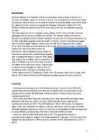
until 1919. Under Russian rule the Palace of Kadriorg was built and the park was laid out. The National Awakening in the middle of the 19th century brought rapid advances in the Estonian education system, general living conditions and culture. The national epic "Kalevipoeg" was published, theatre and music societies appeared and the 1st Song Festival was held in Tartu in 1869. Since then the Song Festivals have become a national tradition, being held every 4-5 years. This all lead to Estonia's independence on 24 February 1918. In June 1940 Estonia became a part of the Soviet Union. On 20 August 1991 the Republic of Estonia was restored without any bloodshed. CULTURE? National emblems. The Estonian blue-black-and-white national flag was originally the flag of the Estonian Students' Society, consecrated in Otepää Church in 1884. Today there is a memorial plaque on the church wall commemorating the event.
........................................................ 4 1. UKRAINE ...................................................................................................................... 5 1.1. General information ..................................................................................................... 5 1.1.1. Country Profile ..................................................................................................... 5 1.1.2. Post-Independent Ukraine. Economy and politics ............................................... 6 1.1.3. Key Macroeconomic indicators ......................................................................... 14 1.1.4. Foreign Direct Investments ................................................................................ 16 1.1.5. Demographics and labor force .......................................................................... 17 1.1.6. New emerging industry................................
.....................1 2. Nature and geography.....................................................................................2 3. Position and size.............................................................................................2 4. Climate............................................................................................................3 5. Flora and fauna...............................................................................................4 6. Main fields of economy and industry..............................................................5 7. The people......................................................................................................6 8. Population......................................................................................................6 9. Traditions and culture.....................................................................................7 10. History...................................................................
given. After, economic indicators (real GDP growth rate, inflation, unemployment, household consumption, investment, current account, government budget and deficit) of the three countries will be compared to draw a conclusion. 2 Country Specs 2.1 Finland 2.1.1 Background Finland was a province and then a grand duchy under Sweden from the 12th to the 19th centuries, and an autonomous grand duchy of Russia after 1809. It won its complete independence in 1917. During World War II, it was able to successfully defend its freedom and resist invasions by the Soviet Union albeit with some loss of territory. In the subsequent half century, the Finns made a remarkable transformation from a farm/forest economy to a diversified modern industrial economy; per capita income is now among the highest in Western Europe. A member of the European Union since 1995, Finland was the only Nordic state to join the euro system at its initiation in January 1999
sometimes aided by the maroons (slaves who had escaped to remote areas after Spain lost 3 control of Jamaica), succeeded in organizing frequent uprisings against the European landowners. The sugar industry declined in the 19th cent., partly because of the abolition of slavery in 1833 (effective 1838) and partly because of the elimination in 1846 of the imperial preference tariff for colonial products entering the British market. Economic hardship was the prime motive behind the Morant Bay rebellion by freedmen in 1865. The British ruthlessly quelled the uprising and also forced the frightened legislature to surrender its powers; Jamaica became a crown colony. Poverty and economic decline led many blacks to seek temporary work in neighboring Caribbean areas and in the United States; many left the island permanently, emigrating to England, Canada, and the United States
ERLE MAIDO TAAB11 Report Purpose The purpose of this report is to give an overview of Estonian population, political factors, technological factors, economic factors and the trends in Estonian economy compared to Germany and to briefly discuss Estonian business environment. Estonian population The total population of Estonia is 1 313 271 according to Statistics Estonia, of which 69.1% are Estonians, 25.1% Russians, 4.9% of which are of different nationalities for example Ukrainians, Belarusians and Finns. Rest are of unknown nationality. 68.5% of population speaks Estonian as a mother language, 29.6% speaks Russian as a mother language and 0.6% Ukrainian
Estonia is a democratic parliamentary republic and is divided into fifteen counties. The capital and largest city is Tallinn. With a population of only 1.4 million, it is one of the least-populous members of the European Union. Estonia was a member of the League of Nations from 22 September 1921, has been a member of the United Nations since 17 September 1991, of the European Union since 1 May 2004 and of NATO since 29 March 2004 Estonia has also signed the Kyoto protocol. Economy Estonian economy was one of the fastest growing in the world until 2006 with growth rates even exceeding 10% annually. Despite some concerns both in and outside of the country, the Estonian economy and its currency remained highly resilient and solvent. Until recent years the Estonian economy continued to grow with admirable rates. Estonian GDP grew by 6.4% in the year 2000 and with double speeds after accession to the EU in 2004. The GDP grew by 7.9% in 2007 alone. Increases in
the summer and descend to a chilly -25 degrees Celsius during winter. Canada's climate and environment are one of the main reasons that Canada is such a succesful country. The blend of natural resources and climate sustains us. The seasons dictate the look of the land: according to whether the natural environment is in a state of dormancy or growth. Canada's climate is characterized by its diversity, as temperature and precipitation differ depending on where you are and what time of year it is. Other than the North where it's above freezing for only a few months a year, most Canadian cities are within 300 km of the southern border, where mild springs, hot summers and pleasantly crisp autumns are common during the majority of the year. Climate sculpts the landscape through heat, cold, humidity, light and wind. In Canada, the variety of landscapes shows the diversity of our climate. In the north, low precipitation and cold
other eastern European countries, including Russia. Estonia has suffered from economic Chrisis as many ohter European countries and compared to ohter bigger countries like Spain and Greece, Estonia has managed to recover from the Chrisis quite well. The number of unemployed people has reduced, still many private companies have struggles due to the fact that the income of consumers has been low and the ability to consume products provided by the companies has suffered aswell. To develope business in Estonia, there is one option to set up here limited liability (piiratud) registered company. Business opportunities are: information technology, shared services, electronics, mechanical engineering, small craft building(väikelaevaehitus), logistics, wood, gaming industry etc. Estonia's main exports and imports are metals and chemical products, food products, textiles, wood and paper, machinery and equipment and furniture.
Tallinn grew into a major port and an industrial centre, with huge shipyards employing a large workforce. Interest in culture grew and Estonians became conscious of their national identity; dreams of independence gained ground. Tartu was the centre of the movement of national awakening. On 24 February 1918, Estonia was proclaimed an independent democratic republic. Tallinn developed into a modern European capital. A period of prosperity followed, but independence only lasted for 20 years. 1 During World War II Estonia was occupied by both German and Russian invaders, and Tallinn suffered heavily. The bombing of the city by the Soviet air force on 9 March 1944 left over 20,000 people homeless. During the Russian occupation which followed (and which lasted for five decades) attempts were made to Russify the local people. Large-scale industry was developed in Tallinn, workers were resettled
All about High Tech High tech is technology that is at the cutting edge--the most advanced technology currently available. There is no specific class of technology that is high tech--the definition shifts over time--so products hyped as high tech in the 1960s would now be considered, if not exactly low tech, then at least somewhat obsolete. This fuzzy definition has led to marketing departments describing nearly all new products as high tech. Economy Because the high-tech sector of the economy develops or uses the most advanced technology known, it is often seen as having the most potential for future growth. This perception has led to high investment in high-tech sectors of the economy. High-tech startup enterprises receive a large portion of venture capital. However, if, as has happened in the past, investment exceeds actual potential, then investors can lose all or most of their investment. High tech is often viewed as high risk, but offering the opportunity for high profits.
The parliament has 101 members, who are elected by the people. The prime minister is recommended by the president and he heads the operations of the government. Modern industrial development, which began in the second half of the 19 th century was oriented toward the Russian market. Large textile mills were set up in Narva and electric motor production plants and shipyard in Tallinn. Today Narva provides most of Estonian’s electricity. Developments in the Estonian agriculture have been influenced by the changes in the economical environment. Estonian agriculture must also find place in the European economy. The national conditions are best suited breeding daily cattle. At the moment the Estonian farmers predominantly export daily products and timber. Currently 8500 farms have been restored to their pre-war owners. Many of them would like to open their homes to bed and breakfast guests. Estonians have always had the greatest respect for education
Sixty-four species of mammals have been recorded in Estonia, three of them have been introduced: the racoon dog, the American mink and the muskrat. A couple of species have been re-introduced The European beaver, who was hunted to extinction by the end of the 19th century. A vital population of them now exists in Estonia once again. Another re- introduced species is the red deer. An attempt has been made in Estonia in recent years to disperse the population of wolves, encouraging their spread in areas where their colonies have disappeared, and restricting their numbers in other places where it is too high. About 350 bird species have been recorded in Estonia. More than 200 of them breed in Estonia. Due to the vast preserved natural landscapes, large raptorial birds, such as the golden eagle and eagle owl have made Estonia their home. It is the small islets, however, that can really be called bird paradise
The traditional cuisine of Estonia has substantially been based on meat and potatoes, and on fish in coastal and lakeside areas, but is influenced by many other cuisines by now. In the present day it includes a variety of international foods and dishes, with a number of contributions from the traditions of nearby countries. German, Scandinavian, Russian and other influences have played their part. The most typical foods in Estonia have been rye bread, pork, potatoes and dairy products. Estonian eating habits have historically been closely linked to the seasons. In terms of staples, Estonia belongs firmly to the beer, vodka, rye bread and pork "belt" of Europe. The Cold Table Flounder The first course in traditional Estonian cuisine is based on cold dishes - a selection of meats and sausages served with potato salad or Rosolje, an Estonian signature dishes based on beetroot, meat and herring . Small pastries called pirukad ("pirukas" in the singular) - a
order to sneak into the castle. But, alas, the lord of the manor's son discovers the deception. He is overcome by jealous rage and orders his men to seal the girl inside the thick stone walls while still alive. Turned into an incarnation of undying love, the White Lady now appears every August, on the night of the full moon, in the Dome Church chapel window. Haapsalu is seven-and-a- quarter centuries old this year, and the townsfolk intend to make it a celebration to remember. The annual dance and light show dedicated to the Lady alone involves over 100 performers - and you'll have several chances to catch it over the four days of the event. Musical shows, dances and contests of strength and skill will be held all over town. This festival is held in August and it is said that Haapsalu, Estonia's most famous ghost, appears during this festival Black nights film festival http://www.tourism.tallinn
The parliament has 101 members, who are elected by the people. The prime minister is recommended by the president and he heads the operations of the government. Modern industrial development, which began in the second half of the 19 th century was oriented toward the Russian market. Large textile mills were set up in Narva and electric motor production plants and shipyard in Tallinn. Today Narva provides most of Estonian's electricity. Developments in the Estonian agriculture have been influenced by the changes in the economical environment. Estonian agriculture must also find place in the European economy. The national conditions are best suited breeding daily cattle. At the moment the Estonian farmers predominantly export daily products and timber. Currently 8500 farms have been restored to their pre-war owners. Many of them would like to open their homes to bed and breakfast guests. Estonians have always had the greatest respect for education
Lõuna- Viljandimaa captivates senses with its beautiful landscapes. Lõuna- Viljandimaa as we know it today stays in the heart of the historic Mulgimaa. Mulgimaa is the home of mountains, deep valleys and lakes, its natural axis is the beautiful old valley of Halliste. Southern Viljandimaa has been the homeplace of mulgi inhabitants who spoke their own dialect called mulgi language. The speakers of mulgi language can still be found in Southern Viljandimaa and in the past years people have started to pay more attention to learning and developing the dialect. The mulgi inhabitants have always been characterised by strong connection to their old-established traditions and customs. At the same time, the way of life of the local people is characterised by strong families, marriage, children and respect and love for fellow men. The local cultural heritage offers as much variety as the nature. Many rare work and mythological motives are retained in folk songs
BOOK REVIEW ("Foreign direct investments in the Estonian economy", University of Tartu, Urmas Varblane) (Pages : 10 20) Prepared: Kadri Tamm, MF-I-5 Tartu 2007 I read book about direct investments in the Estonian economy. The book is issued by University of Tartu and the writers are also scientists from University of Tartu. "Foreign direct investments are relatively new phenomenon for Estonia because during the nearly five decades as part of the Soviet economic system, our economy received virtually none. Such economic isolation from the West lasted until the early 1990s. In consequence of the mid-1990s' radical macroeconomic reforms, foreign direct
United States of America Table of Contents 1. Facts 2. Geography 3. Nature 4. History 5. Population 6. Government 7. Industry, economy 8. America's pop culture Facts Official Name: United States of America Capital City: Washington, D.C. Largest city: New York City Official languages: None at federal level National language: English Government: Federal constitutional republic President: Barack Obama ( Barack Hussein Obama II) Vice President: Joe Biden (Joseph Robinette "Joe" Biden, Jr) Population: 2009 estimate 306,108,000 people
..................................................................................................... 9 Conclusions........................................................................................................................10 References..........................................................................................................................11 3 Introduction English is considered to be one of most important languages in the world. It is one of the official languages of the United Nations. According to research by the British Council, around 375 million people in the world speak English as their native language and English has official or special status in at least seventy-five countries. The British Council has also noted that English is the main language of newspapers, airports and air-traffic control, international business and academic conferences, science, technology, diplomacy and sport
1. UN as a world organization The United Nations officially came into existence on 24 October 1945, when the UN Charter had been ratified by a majority of the original 51 Member States. The day is now celebrated each year around the world as United Nations Day. The purpose of the United Nations is to bring all nations of the world together to work for peace and development, based on the principles of justice, human dignity and the well-being of all people. It affords the opportunity for countries to balance global interdependence and national interests when addressing international problems. There are currently 192 Members of the United Nations. The Aims of the United Nations:
This is allegedly how the Danes obtained their national flag, the Dannebrog in a battle against the Estonians. In the middle of the 14th century Denmark sold its possessions in Estonia to the German Teutonic Order. Toompea became the seat of the German-born gentry. A wall was built to separate the Upper Town and the Lower Town. In 1285 Tallinn joined the Hanseatic league and became a junction of trade between East and West. Tallinn is said to be built on salt, as it was an important trading commodity. In the 16th century Tallinn had a population of about 7,000 8,000 making it one of the biggest cities in northern Europe. In 1629 Sweden took control of the whole of Estonia. Though hard times continued, the period that followed is known as the "good old Swedish era": foundations were laid for the Estonian school system, the privileges of the nobility were curtailed, local peasants were granted the right to own property, and so on.
........................................................................................54 15.4.1 For electric power..............................................................................................54 15.4.2 For industry....................................................................................................... 54 15.4.3 For making steel................................................................................................ 54 15.4.4 For export.......................................................................................................... 55 15.5 Coal and the environment.........................................................................................55 NATURAL GAS.................................................................................................................55 ............................................................................................................................................
· Habitat of different species Measuring the amount of forest: · Fixing the area under the forests (ha/%) -> In Estonia 47.4%, 2.143 mil/ha It doesn't take into account the amount of timber · To measure the amount of timber (m3) -> 352.7 mil/m3 It doesn't take into account the annual increase · To fix different species of trees (%) -> Pine 40%, Birch 30%, Spruce 20% · To measure the annual increase of timber (m3, ha, year) -> 9 mil. m3/ha/year Main principle of the economy of forests: Annual cutting should be equal to annual increase. Trees are divided into: · Precious trees (ebony, mahagony, sandalwood) · Hard-broadleaf (decidious) trees (oak, beech pöök) · Coniferous trees -> consumption timber -> soft timber (spruce, pine, juniper) · Trees of little value (willow, bird-cherry toomingas) · Trees of special usage (fruits, cork) Forestry: · Planting, taking care of the trees · Protection of forests againts fire and pests
it got its first permanent building the Kadriorg Palace, built in the 18th century. In 1929 the palace was expropriated from the Art Museum in order to rebuild it as the residence of the President of Estonia. The Art Museum of Estonia was housed in several different temporary spaces, until it moved back to the palace in 1946. In September, 1991 the Kadriorg Palace was closed, because it had totally deteriorated by then. At the end of the year the Supreme Council of the Republic of Estonia decided to guarantee the construction of a new building for the Art Museum of Estonia in Kadriorg. Untill then the Knighthood House at Toompea Hill served as the temporary main building of the Art Museum of Estonia. The exhibition there was opened on April 1, 1993. Art Museum of Estonia premanently closed down the exhibitions in that building in October 2005.
durin the Soviet years; tears were rolling down their cheeks. On 24 February 1989, Estonia, still part of the Soviet Union, hoisted its tricolour on the tower of Pikk Hermann in Tallinn. Since then the flag has always been hoisted with ceremony on that day, which is the national holiday the anniversary of the Republic. According to Estonian tradition the national flag is hoisted at sunrise and lowered at sunset exept on June 23 when it is left out for the shortest night of the year. NATIONAL ANTHEM The Estonian national anthem, entitled "My Native Land, My Pride and Joy", was composed in 1848 by Friedrich Pacius, a Finn of German descent. The Estonianlanguage words were written by Johann Voldemar Jannsen. In 1869 it was performed at the first allEstonian Song Festival in Tartu and gained popularity during the period of the national movement. Estonians carried the melody in their hearts and souls during Soviet occupation, when it was banned
Australia is surrounded by the Indian and Pacific oceans, it is separated from Asia by the Arafura and Timor seas. Australia presents an enormous range of climatic conditions, since it covers thirty degrees of latitude. It is mostly temperate, but one third of the continent is tropical, and there are large desert areas. The two largest cities are Sydney and Melbourne. The capital of Australia is Canberra. It is a small city and was built in the early 1900s. History. Two hundred years ago there were no white people in Australia. The only inhabitants were dark-skinned people who were still living in a Stone Age. Their only weapons were stone knives and boomerangs. But their tribes had very well-worked- out customs. A few aborigines still live in the emptier part of the continent. In 1770, the British explorer Captain Cook raised the British flag. Cook found there a pleasant climate and beautiful forests. The British initially used Australia as a gigantic prison camp for
1710-1850 and 1850-1918 Contents Contents.................................................................................................................................. 2 17101850.............................................................................................................................. 3 Population and social structure........................................................................................ 4 Serfdom and the intensifying manorial economy ............................................................. 4 Influences of Pietism and the Moravian Brethren............................................................. 5 Enlightenment and enlightened absolutism...................................................................... 6 18501918.............................................................................................................................. 8 The national awakening.............................
........................................ 6 REFERENCES.................................................................. 7 3 INTRODUCTION The present report is going to give a compendious review of the most fascinating subjects concerning Nokia in my perspective. This report contains general but essential information about Nokia's history and its strategy, vision, products today and Nokia's quality of products. Firstly I will give brief information about the history of Nokia. The text will not be very detailed, but it will give a basic knowledge about Nokia's way of getting to what it is today. Secondly I will give an overview of Nokia's present-day state. I will talk about Nokia's location today and the range of its business and products. Thirdly I will talk about Nokia's basic business tactics. I will give a brief description of its
 annaabi.ee