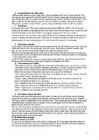
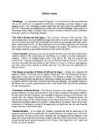
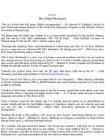
POLITICS Helen Laine 12 A POLITICAL SYSTEM Democracy Constitutional monarchy Head of the state – Elizabeth II Actual power – Prime Minister Executive power - Her Majesty’s Government Legislative power – Parliament House of Commons and House of Lords Multi-party system MAIN PARTIES Two largest - the Conservative Party and the Labour Party Before labourers - The Liberal party Third largest – the Liberal Democrats Current: Conservative, Liberal Democrats ... Some other parties in UK: Democratic Unionist Party Scottish National Party Palace of Westminster UK Independence Party Green Party of England and Wales Scottish Green Party Social Democratic and Labour Party Alliance Party of Northern Ireland MAIN POLITICIANS Prime Minister: David Cameron (Conservative)
Today, the United States has two major political parties. One is the Democratic party, which evolved out of Thomas Jefferson's party. The other is the Republican party, which was formed by people in the states of the North and West, such as Abraham Lincoln, who wanted the government to prevent the expansion of slavery into new states then being admitted to the union. Most Americans today consider the Democratic party the more liberal party. Democrats believe the federal government and the state governments should be active in providing social and economic programs for those who need them, such as the poor, the unemployed or students who need money to go to college. Republicans are not necessarily opposed to such programs. They believe, however, that many social programs are too costly to the taxpayers and that when taxes are raised to pay for such programs, everyone is hurt. They often accuse
German federal election, 2009 On the 27th of December, germans went to the polls in parliamentary elections. It was a vote that would decide the shape of the German parliament. The opinion polls before the elections suggested that Angelina Merkel would keep the top job and she did. The Christian Democrats won with 33% of the votes. The Christian Democratic Union, the Christian Social Union of Bavaria, and the Free Democratic Party have announced their intention to form a centre-right government with Angela Merkel continuing as the Chancellor. It is said that Angelina Merkel is the biggest poker face in German politics. In her four years as chancellor she has outmanouvered her opponents and become the country's most popular
- 1992 Maastrichti ja 1997 Amsterdami leping muutsid EP seadusandlikuks parlamendiks - Õigus anda seadusandlikke akte - Rahandusalased volitused - Järelvalve täidesaata võimu üle - On president, juhatus ja esimeeste konverents, komisjonid, fraktsioonid ja delegatsioonid - 751 liiget, 750 max + president Party groups - Group of the European People’s Party (Christian Democrats) - Group of the Progressive Alliance of Socialists and Democrats in the European Parliament - Group of the Alliance of Liberals and Democrats for Europe - Group of the greens/european free Alliance - European conservatives and reformists group - Confederal group of the european united left – nordic green left - Eruope of freedm and direct democracy group - Europe of nations and freedom European Comission - EL täitevorgan (rakendab seadusi ja viib ellu poliitikat), sai täidesaatva võimu
leadership but no over-concentration of power · Compare turbulence of German politics 1918-45, and stability since In part about design of constitution, in part about Germans becoming democrats Solutions Concept of the Rechtstaat, a state based on the rule of law supreme principle of Basic Law Catalogue of human rights (Articles 1-19) Basic rights (and some other provisions) protected by `eternity clause'
· omadussõna + nimisõna · mingi koha nime esimene sõna on muu nimi (Brown resturant) THE DEFINITE ARTICLE · eelnevalt mainitud asi · kui viidatakse kindlale esemele grupist · aastaajad (The summer is the best.) · kui on kindel, millest räägime (I prefer the red one.) · kui midagi on maailmas üks (The Sun, the Earth) · rahvuslikud grupid (The British like to drink tea.) · Kui inimesed on jaotatud klassidesse (the rich, the poor, the Social Democrats) · Kui kindel asi esindab kogu klassi (The fork is used for eating.) · Muusikainstrumendid, kui neid mängitakse (I can play the violin.) · Ühendatud riigid (The United States) · Jõed, kanalid, mered, ookeanid, regioonid · Lahed, väinad · Mäeahelikud, saarestikud, kõrbed · Ilmakaared · The president of the United States, the director of studies · Ajalehed · Filmide, raamatute pealkirjad · Kohanimed, kui on väljend of (the University of Leeds) · Ülivõrre
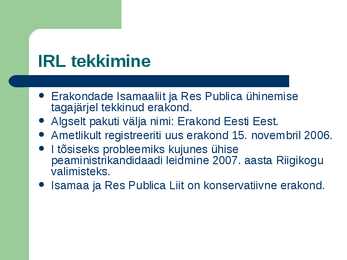
et vabadus tähendab enamat kui vabadust raha teenida. peetakse tähtsaks ühiskonna sidusust, kultuuri, traditsioone IRL kuulub Euroopa Rahvaparteisse (European People's Party, EPP) katusorganisatsiooniks on Rahvusvaheline Demokraatide Liit (International Democrat Union, IDU) Euroopa Parlamendis esindab IRLi Tunne Kelam, kes kuulub parlamendi suurimasse, 277 liikmega Euroopa Rahvapartei ning Euroopa Demokraatide fraktsiooni (The Group of the European Peoples Party and European Democrats, EPP-ED). Liikmed ja juhtkond Riigikogu esimees Ene Ergmaa Erakonna esimees Mart Laar Ministrid Haridus- ja teadusminister Tõnis Lukas Kaitseminister Jaak Aaviksoo Majandus- ja kommunikatsiooniminister Juhan Parts Põllumajandusminister Helir-Valdor Seeder Regionaalminister Siim Kiisler Siseminister Marko Pomerants
peetakse tähtsaks ühiskonna sidusust, kultuuri, traditsioone IRL kuulub Euroopa Rahvaparteisse (European People's Party, EPP) katusorganisatsiooniks on Rahvusvaheline Demokraatide Liit (International Democrat Union, IDU) Euroopa Parlamendis esindab IRLi Tunne Kelam, kes kuulub parlamendi suurimasse, 277 liikmega Euroopa Rahvapartei ning Euroopa Demokraatide fraktsiooni (The Group of the European Peoples Party and European Democrats, EPP-ED). IRL'I tööplaan Tugineb kuule sambale: 1.Tasakaalus eelarve 2. Tagada ettevõtlusele soodsad tingimused 3.Toetada eksporti 4. Täiend- ja ümberõpe asjakohaseks 5. Takus toob tõusu 6. Eelista Eestimaist IRL tegutseb selle nimel, et lastel läheks elus hästi soov näha Eestit maana, kus inimestel on tore elada: maana, kus meid ümbritsevad sõbralikud inimesed, kus kultuur õitseb ning kus keegi ei pea toimetuleku pärast muretsema
rate for the extra. The profit could be used to develop environmentally clean vehicles and fast efficient railway networks. Don't you think you're being unfair to the private motorist and what about the car industry? Clearly, a coeducational environment promotes understanding between boys and girls. It's far more natural. Don't you think they distract one another when they become teenagers? The Liberal Democrats want more or less the same as New Labour, though they are more eager to change the voting system. Don't you think the vision of the three major parties is more or less the same?
demokraatlike erakondadega kuulub IRL Euroopa Rahvaparteisse (European People's Party, EPP), mis on suurim üleeuroopaline erakond. Meie ülemaailmseks katusorganisatsiooniks on Rahvusvaheline Demokraatide Liit (International Democrat Union, IDU) Euroopa Parlamendis esindab IRLi Tunne Kelam, kes kuulub parlamendi suurimasse, 277 liikmega Euroopa Rahvapartei ning Euroopa Demokraatide fraktsiooni (The Group of the European Peoples Party and European Democrats, EPP- ED). Suhtumine kohalikku omavalitsusse ja haldusreformi · IRL-eesotsas regionaalminister Siim-Valmar Kiisleriga toetab haldusreformi ja selle läbiviimist võimalikult kiiresti. Vastupidiselt teistele erakondadele. · S-V.Kiisler esitas eelnõu, mis võimaldaks haldusreformi läbi viia 2009.aasta, kohalikel valimistel. · Eesmärk tagada KOV üksuste majanduslik toimetulek ja avalike teenuste ühtlane tase, kogu Eesti territooriumil läbi
initial role? 1979; Consultative 17. Which legislative procedure gives the European Parliament equal powers of co-legislator with the Council? Co-decision or Ordinary legislative procedure 18. What/who do the three main institutions of the EU represent? EP (the citizens of the EU) / Council (the member states of the EU) / Commission (the interests of the EU) 19. Mention the three largest/oldest party groups - European People’s Party (EPP) / Socialists & Democrats / Party of European Socialists (PES) / Liberal-democrats (ALDE) 20. Who are the current presidents of the European Parliament, European Commission, and European Council? Tajani (EP), Juncker (Commission), Tusk (Council) 21. What is the name of the Diplomatic Service of the EU and who chairs it? European External Action Service (EEAS), chaired by the EU High representative for Foreign Affairs and Security Policy 22
countries. The House of Representatives has a special power of its own - to invent a bill to raise money. The Senate is composed of 100 members - two from each of 50 states, who are elected for a term of years. Although congressional elections take place every two years, only 1/3 of the Senate is reelected. A Senator must be at least 30ty years old, a citizen of the USA for 9 years and a resident of the state from which he is elected. Democrats sit in the western part of the chamber - on Vice-president right. Republicans sit on his left. Vice-president presides over the Senate and conducts debates. The Senate is stable and more conservative than the House of Representatives and many Senators are more experienced politicians. The House of representatives has 450 members. The number of Representatives depends on the population of each state. A Representative
Netherlands Antilles and Aruba. With an area of 41,528 kilometers and a population of 16 million, The Netherlands (the European part of the Kingdom) is one of the world's smaller countries. (6) The Netherlands is a constitutional monarchy with a parliamentary system, in which the government consists of the queen and the ministers. For historical reasons, The Hague is the seat of government, but Amsterdam is the capital. The current government is a coalition between the Christian democrats (CDA), the liberal democrats (VVD) and the Pim Fortuyn List (LPF). Jan Peter Balkenende (CDA) is the Prime Minister. Queen Beatrix is the head of state. (6) 1.2 Land & Climate The Netherlands is very flat. Nearly a quarter of its surface area is below sea level. The lowest point in the Netherlands, near Rotterdam, is 6.7 metres below sea level. Its highest point, the Vaalserberg, is 312 meters above sea level. The Vaalserberg is in the southeast of the country,
Nende kahe ideoloogia esindajad on oma vaadetelt üsnagi erinevad ja nii tekibki küsimus, kuhu kuulub Demokraatlik partei. Nagu nähtub ka allpool olevalt jooniselt (vt joonis 3), siis on Demokraatlik partei oma olemuselt pigem liberaalne. (D. V. Edwards, 1998, p. 127) Tänapäeval on demokraadid mõnes mõttes ideoloogilises plaanis jaotunud kaheks: traditsioonilised liberaalid, kes toetavad tugevat riigi sekkumist vaeste eluolu parandamiseks, ning uued demokraadid (New Democrats), kes sarnanevad veidi enam mõõdukatele vabariiklastele ja leiavad, et riigi rolli võiks iseenesest ka kahandada, kuid valitsus peab olema siiski see, kes omab juhtivat rolli sotsiaalsete ning majanduslike probleemide lahenduste suunamisel (ibid., p. 227). Just selle mõnetise kaheks jaotumisega on seletatav ka jooniselt 3 nähtuv olukord, kus mõõdukate vaadete omajail on üsna suur osakaal. Üldiselt pooldavad USA liberaalid valitsuse sekkumist poliitikasse ning majandusse, kaitsmaks ja
The president of the USA lives in the White House (at 1600 Pennsylvania Avenue) Washington, D.C. while he holds office. The Legislative branch Congress consists of the Senate and the House of Representatives. There are a hundred people in the Senate (two from each state) and 435 people in the House of Representatives. At the head of the Judicial branch is the Supreme Court, which has nine judges. The leading parties in America are the Democrats and the Republicans but there are also other parties. Location The United States of America is situated in the central part of the North American continent. Its western coast is washed by the Pacific Ocean and its eastern coast is washed by the Atlantic Ocean and in the south its coast is washed by the Gulf of Mexico. The coastline is even. There are no big islands belonging to the U.S. except the Hawaiian
Menshiviks ( " R u s s i a n s o c i a l d e m o c r a t s , " ) . In 1914 Russia enters World War I. In 1916 the revolution leads to the abdication of Nicholas II and the fall of the autocracy. Soon Lenin comes to Russia and the Bolsheviks gain the majority in the capital which was Petrograd. The political party gets a new name which is the Russian Communist Party. Now the Soviet times in Russia begin ( " R u s s i a n s o c i a l democrats," ). A Civil War between the "Red" and the "White" armies broke off and had devastating consequences for the whole country. After the Civil War Lenin decided to go back to market economy and rebuild the country's infrastructure. The first few years helped make great changes in the social and cultural life. People had hope because the Bolsheviks introduced free universal health care, education and social security. Russian Orthodoxy was prohibited and the government
demanded democratic and civil rights, many also the right to national self-determination, autonomy and local government. In the ever tenser atmosphere, the revolutionary movement in Estonia reached its height in the autumn of 1905. Over 20 000 industrial workers and railway workers in Estonia took part in the all-Russian general political strike in October. On 16 October the army opened fire in the Tallinn city centre at the participants of the political manifestation, organised by social democrats. 94 were killed, over a hundred wounded. An all-Estonian congress of people's representatives took place in Tallinn between 27 and 29 November. This split into two meetings. One demanded constitutional order and threatened the government with passive resistance; the other wanted to overthrow the absolutist power and form revolutionary local governments. In approximately 50 peasant townships, the governments were indeed replaced by peasant committees that in some places were called `republics'
The Royal Coat of Arms of Queen Elizabeth II as used in Scotland. In the 2007 election, the Scottish National Party (SNP), which campaigns for Scottish independence, won the largest number of seats of any single party and the leader of the SNP, Alex Salmond, was elected First Minister on 16 May 2007 as head of a minority government. The Labour Party became the largest opposition party, with the Conservative Party, the Liberal Democrats, and the Green Party are also represented in the Parliament. Margo MacDonald is the only independent MSP sitting in Parliament. Scotland is represented in the British House of Commons by 59 MPs elected from territory-based Scottish constituencies. The Scotland Office represents the UK government in Scotland on reserved matters and represents Scottish interests within the UK government. The Scotland office is led by the Secretary of State
pursuit of sovereignty. Some derzhavniks’ writings on the Baltic issue are over- flowing with blatant fabrications and propaganda lies. However, a shift has occurred in the attitudes of the democratic wing of the Russian elite towards the Baltic states. The former allies in the anti-communist struggle are now seen as “ungrateful nationalists” discriminating against Russians with their language and citizenship policies. Neither derzhavniks nor democrats recognise the occupation, instead using the euphemism “incorporation”. Even though the Russian Federation has officially declared itself the legal successor of the Soviet Union, no association between these two entities is recognised as far as the Baltic issue is concerned. Democrats believe that historical injustice has been fully atoned for by the fact that the Baltic peoples were set free in 1991 without any preconditions.
Heavily beated by Labour, the turned to power in 1951 being led by Churchill till 1955 Went into opposition in 2974 returned to power 1979 under Thatcher The emergence of the Liberal Party Grew out of the Whig party, after the Reform Bill of 1832 as represenative of industrial and business classes Under David Lloyd George led a coalition govern during WW II By 1930´s the liberals had become small third party In 1988 the Party emerged with the Social Democrats, Social and Liberal democrats The emergence of the Labour Pary Grew out off Labor representative Committee Rose to official oppoisition status in 1922, minority governments in 1924 and 1929-31 under Ramsay MacDonald Won overwhelmingly in 1945 under Clement Allee In opposition from 1951, returned to power in 1964, lost power in 1979, returned in 1974, lost again in 1979, returned in 1997 under Tony Blair The Great Exhibition 1851
The largest political party that does not win becomes the official Opposition. In Australia, governments are usually formed by the Australian Labor Party or by a coalition between the liberal Party and the National Party. There are some political parties that represent smaller groups of opinion but, until now, they have not had the numbers to be serious contenders again the larger parties. Some smaller parties include the Australian Democrats, One Nation and the Greens. The federal parliament is divided into two Houses the upper house (the Senate) and the lower house (the House of Representatives). The party which gains the majority of seats in the House of Representatives forms the government. The leader of this party becomes the prime minister. In the Government of Australia, the Minister for Foreign Affairs is responsible for overseeing the
for 6 year. 435 people are in the House of Representatives and their term lasts for 2 years. They act in the Capitol Building and their responsibility is to make laws and decide how to spend money. At the head of the Judicial branch is the Supreme Court, which has nine judges who serve for life. The head of the judges is the Chief Justice. Their responsibility is to explain the meaning of the laws. The leading parties in America are the Democrats and the Republicans but there are also other smaller parties. President The President is elected on the first Tuesday after the first Monday in November of a leap year and takes office at noon on January 20. The President is not elected directly, but by an Electoral College. The Electors who actually choose the President are now completely pledged in advance to one person and their names have almost entirely disappeared from the ballot papers to be
Larger presents are arranged around the Christmas tree in the living room and opened when everyone is together. Most British families decorate their Christmas tree with multi-colored lights. A traditional Christmas dinner includes turkey, followed by Christmas pudding. 40. Elections and parties in Britain. The most popular parties are Conservative Party and Labour Party, which have got the most places in the House of Commons. Also, there are Liberal Democrats, Democratic Unionist Party, Scottish National Party, Sinn Féin, Plaid Cymru - Party of Wales and so on. There is no election to the House of Lords, but there is election to the House of Commons. There are five types of elections in the United Kingdom: a. United Kingdom general elections, b. elections to devolved parliaments and assemblies, c. elections to the European Parliament, d. local elections e
power under Margaret Thatcher. *The emergence of the Liberal Party It grew out of the Whig Party after the Reformation Bill as a representative of industrial and business classes. Under W. Gladstone it accepted electoral and social reforms. After World War I the party went into decline, a process fastened by the rise of the labour Party. By the 1930s the liberals had become a small third party, a status which endured in the postwar era. It finally merged with the Social Democrats, creating the alliance of Social and Liberal Democrats. *The emergence of the Labour Party It grew out of the Labour Representative Committee. It rose to official opposition status and formed minority governments, both under rule of R. MacDonald. After serving in the all-party wartime coalition, the Party won overwhelming victory under the leadership of C. Attlee. His government instituted extensive nationalization and welfare state measures, including the creation of the national health
Poola Polskie Stronnictwo Ludowe Marina KALJURAND Sotsiaaldemokraatide ja demokraatide fraktsioon Euroopa Parlamendis Eesti Sotsiaaldemokraatlik Erakond Sandra KALNIETE Euroopa Rahvapartei (kristlike demokraatide) fraktsioon Läti Partija "VIENOTĪBA" Petra KAMMEREVERT Sotsiaaldemokraatide ja demokraatide fraktsioon Euroopa Parlamendis Saksamaa Sozialdemokratische Partei Deutschlands Radan KANEV Euroopa Rahvapartei (kristlike demokraatide) fraktsioon Bulgaaria Democrats for Strong Bulgaria Assita KANKO Euroopa Konservatiivide ja Reformistide fraktsioon Belgia Nieuw-Vlaamse Alliantie Othmar KARAS Euroopa Rahvapartei (kristlike demokraatide) fraktsioon Austria Österreichische Volkspartei Pierre KARLESKIND Uueneva Euroopa fraktsioon Prantsusmaa La République en marche Karin KARLSBRO Uueneva Euroopa fraktsioon Rootsi Liberalerna Karol KARSKI Euroopa Konservatiivide ja Reformistide fraktsioon Poola Prawo i Sprawiedliwość Elsi KATAINEN
looked very much as though the most defeatable candidate, George McGovern, would win the Democratic nomination. A Republican victory seemed assured. • The break-in plan itself was a highly risky operation requiring the participation and discretion of ten men. • The Democratic National Committee and its chairman, Lawrence O'Brien, whose Watergate office was to be burglarized and bugged, had no information damaging enough to defeat the incumbent president. Nor were the Democrats likely to get any, unless the administration did something very, very foolish. Despite the obvious counsel of the previously mentioned reasons, the expen- sive, chancy, pointless, and potentially calamitous proposal of a man whose judg- ment was known to be questionable was approved. How could it be that intelligent, accomplished men such as Mitchell and Magruder would do something so very, very foolish? Perhaps the answer lies in a little-discussed fact: The $250,000 plan
Science starts with educated (read: wild-ass) guesses. Then it's all trial and error. Sometimes you predict correctly from the outset. More often, you make mistakes and stumble across unexpected ndings, which lead to new questions. If you want to sit on the sidelines and play full-time skeptic, suspending action until a scienti c consensus is reached, that's your choice. Just realize that science is, alas, often as political as a dinner party with die- hard Democrats and Republicans. Consensus comes late at best. Don't use skepticism as a thinly veiled excuse for inaction or remaining in your comfort zone. Be skeptical, but for the right reason: because you're looking for the most promising option to test in real life. Be proactively skeptical, not defensively skeptical. Let me know if you make a cool discovery or prove me wrong. This book will evolve through your feedback and help. RULE #5. ENJOY IT.
 annaabi.ee