 Tasuta
Faili alla laadimine on tasuta
Tasuta
Faili alla laadimine on tasuta
 ~ 5 lehte
Lehekülgede arv dokumendis
~ 5 lehte
Lehekülgede arv dokumendis
 2015-11-21
Kuupäev, millal dokument üles laeti
2015-11-21
Kuupäev, millal dokument üles laeti
 2 laadimist
Kokku alla laetud
2 laadimist
Kokku alla laetud
 0 arvamust
Teiste kasutajate poolt lisatud kommentaarid
0 arvamust
Teiste kasutajate poolt lisatud kommentaarid
 SeidyT
Õppematerjali autor
SeidyT
Õppematerjali autor
communal land in South Africa restricted and discouraged traditional agriculture and wild harvesting, and reduced the extent of land available to black people. Decline of indigenous cookery Urbanization from the nineteenth century, coupled with close control over agricultural production, led black South Africans to rely more and more on comparatively expensive, industrially-processed foodstuffs like wheat flour, white rice, mealie (maize) meal and sugar. Often these foods were imported or processed by white wholesalers, mills and factories. The consequence was to drastically restrict the range of ingredients and cooking styles used by indigenous cooks. On the other hand, some imported food plants (maize, tomatoes) have expanded the dietary range of indigenous cooks. Of these maize is the most significant - it has been integrated to such an extent into the traditional diet that it is often assumed to be an indigenous plant.
History: · Indian society is predominantly agrarian. Diet consists mainly of fruits and vegetables, meat, cereals, dairy products and honey. Also, drinks containing different types of spices. · During the Gupta empire influenced by diet buduism and jainism. Many religious people were vegetarians. Most of the people consumed the chickens, sheep and goat meat. · Muslims also put emphasis on the development of food. Indians brought to the diet of dried fruit and flat bread. India introduced the dietary habits of the Portuguese and Chinese. · Indian diet is mixed with a variety of cultures. Etiquette: · Traditionally, meals were eaten while seated either on the floor or on very low stools or cushions. · Food is most often eaten without cutlery, instead using the right hand. Among the middle class throughout India, spoons and forks are commonplace.
Estonian cuisine The traditional cuisine of Estonia has substantially been based on meat and potatoes, and on fish in coastal and lakeside areas, but is influenced by many other cuisines by now. In the present day it includes a variety of international foods and dishes, with a number of contributions from the traditions of nearby countries. German, Scandinavian, Russian and other influences have played their part. The most typical foods in Estonia have been rye bread, pork, potatoes and dairy products. Estonian eating habits have historically been closely linked to the seasons. In terms of staples, Estonia belongs firmly to the beer, vodka, rye bread and pork "belt" of Europe. The Cold Table Flounder The first course in traditional Estonian cuisine is based on cold dishes - a selection of meats and sausages served with potato salad or Rosolje, an Estonian signature dishes based on beetroot, meat and herring
............................................................................................................................................8 Pasta alla Carbonara (eesti keeles)...................................................................................................9 2 ITALY KITCHEN Italian Cuisine is traditional Italian food. It is often made up of the famous Italian foods such as pasta, pizza, cannoli and red or white wine. Italian cuisine often contains a lot of carbs and sometimes fats. Italian food also has a lot of vegetables and healthy fats, such as olives, broccoli, and lettuces. Italians are also famous for the different kinds of breads they make. Spaghetti is traditional
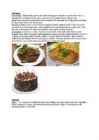
German Sauerbraten: Traditionally made with a beef roasting joint (topside or similar) the meat is marinated for 2-3 days in beer, spices such as cloves, juniper berries, allspice and peppercorns, bay leaves and onions and is braised in the marinade for a long period, resulting in very tender melt-in-the-mouth meat. The Black Forest: cake is one of the most popular German national foods. Cake consists of several layers of chocolate cake, with whipped cream and cherries between each layer. Then the cake is decorated with additional whipped cream and chocolate shavings. A Schnitzel in German is a slice of pork or veal haunch. Dish made with boneless meat thinned with a mallet (escalope-style preparation), coated in bread crumbs and fried. Only if it is made of veal and coated in bread crumbs is it called Wiener Schnitzel; a pork version is
through the following adoption curve: Racehorses AIDS patients (because of muscle wasting) and bodybuilders elite athletes rich people the rest of us The last jump from the rich to the general public can take 1020 years, if it happens at all. It often doesn't. I'm not suggesting that you start injecting yourself with odd substances never before tested on humans. I am suggesting, however, that government agencies (the U.S. Department of Agriculture, the Food and Drug Administration) are at least 10 years behind current research, and at least 20 years behind compelling evidence in the field. More than a decade ago, a close friend named Paul was in a car accident and su ered brain damage that lowered his testosterone production. Even with supplemental testosterone treatments (creams, gels, short-acting injectables) and after visiting scores of top endocrinologists, he still su ered from the symptoms of low testosterone. Everything changed--
Emus are farmed for their meat, oil and leather. The Kangaroo is a common marsupial from the islands of Australia and New Guinea. There are 47 species of them. Kangaroos can hop up to 74 km per hour and go over 9 m in one hop. These shy animals live about 6 years in the wild and up to 20 in captivity. Most of them are active at night. Many kangaroos are in danger of extinction. Kangaroos eat grass, leaves, and roots. They swallow their food without chewing it and later regurgitate a cud and chew it. They need little water; they can go for months without drinking, and they dig their own water wells. The Dingo is Australia's wild dog. It is found in Australia, in all states but Tasmania. They are found throughout the mainland of Australia, close to a source of water. The Dingo is a medium sized dog, with a bushy tail, and red to yellow coat. Dingos do not bark, but they do howl.
Setsubun or Obon. Almost every locale has at least one matsuri in late summer/early autumn, usually related to the rice harvest. Notable matsuri often feature processions which may include elaborate floats. Preparation for these processions is usually organized at the level of neighborhoods, or machi. Prior to these, the local kami may be ritually installed in mikoshi and paraded through the streets. One can always find in the vicinity of a matsuri booths selling souvenirs and food such as takoyaki, and games, such as Goldfish scooping. Karaoke contests, sumo matches, and other forms of entertainment are often organized in conjunction with matsuri. If the festival is next to a lake, renting a boat is also an attraction. Favorite elements of the most popular matsuri, such as the Nada Kenka Matsuri of Himeji or the Neputa Matsuri of Hirosaki, are often broadcast on television for the entire nation to enjoy.
 annaabi.ee











Kõik kommentaarid