Leidsid 33 sarnast õppematerjali, mis on seotud failiga "Travelling". Need materjalid aitavad sul teemat sügavamalt mõista.
travelling, really, place, places, tips, going, greece, enjoy, different, before, round, went, there, gymnasium, eliis, seeing, cultures, living, around, other, languages, know, wear, simply, clothing, walk, cheaper, local, tourist, centre, find, sights, museums, trips, haven, done, neighbour, holiday, class, waiting, italy, australia, years, rhodosAge 16 is a school leaving age. They can leave home, drive a moped, marry with "parents' consent" buy beer. Age 17 can drive a car. Age 18 can vote, get married, drink in pubs. Education is a very important part in the life of British youth. One can't become an independent person without it. When time comes to enter a college a young Englishman chooses one far away from home. It is a necessary part of becoming adult. During the last 30 years there were a lot of different trends in youth movements. All of them were characterized by their own philosophy, way of life, style of dressing. Each tendency was born by the influence of economic and political changes in the society. Those trends are known as the "hippies" the "punks" the "rockers". But certainly there are different traditional youth organizations in Great Britain. Among them -- the Scout Association, the Girl Guides Association, the National Union of Students, the Youth Club
Dear Tom, I talked to your sister and found out, that you are going to take an exam next week. I wanted to give you some advice. Last year I took my exams so I believe I could help you. First off I strongly recommend you to have a good night sleep the night before your exam. Study everything you might need but try not to overdo the studying. After all the exam is to test whether you have learned anything during the years you have spent in school. I believe you'll do just fine with the exams. Best wishes, Betti. Dear Kate,
Dear Kate, I'm writing you to thank you for your letter where you asked whether or not I like travelling and which places I want to see next. Firstly, I simply adore travelling and take every opportunity I can to visit different countries. My last trip took me to the Finland where I met a lot of interesting people. Secondly, there are some countries I am dreaming to visit some day in the future. I would really like to travel to Japan. I would love to visit a country which has very rich traditions and culture. There are very proud and generous people. I would like to see some festivals there and also visit some old castles and temples.Also Japan is known for its robots and technical gadgets. And of course I like to see citylights in the night and go shopping to big centres. Shibuya 109 is a mutli-storey shopping centre just for teenage girs. And Akihabara in Tokyo
Traveling There are many ways how to travel in the world. For example some people like to travel in their own country, other people like to travel trough the world and visit different exotic places. There are also different reasons for travelling. Some travel to learn more about other cultures, learn about other countrys history.Others might travel just to have some fun and meet new people, visit friends and family or just for business.The most common ways to travel are by plane,by car,by train or by bus. Travelling has many positive sides. When people have traveled to a completely different country, then they can compare the life in their own country and the country they are visiting
5. Have you sung at a song festival? 6. Has your school got a choir? 7. When do you last go to a concert? What concert was it? 8. Have you ever been to an openair concert? What was it like? 9. Do you sing at family parties? Where else Estonians like to sing? 10. Have you got a collection of cassettes, CD´s or LP´s at home? 11. Have you watched a ballet on TV? 12. Which do you prefer ballet, drama or musical? 13. How often do you go to the theatre? 14. Do you prefer going to the theatre or watching TV? Why? 15. Do you prefer buying a cheap ticket and getting a seat at the back or spending more money and sitting in the front? Why? 16. Do you prefer going to the theatre with your family or friends? Why? 17. How old were you when you first went to see a puppet show? Do you remember what it was? 18. Who is your favourite actor/actress? 19. What performance or concert would you like to see if it were possible? Why? 20
Estonian teen How do you spend your free time? I'm pretty busy. Every day, I have music school, choir, or basketball training. I have been going to music school for seven years, and I'm going to graduate this spring. I have been going to basketball training for two years. I unfortunately can't go there very often because of music studies. When I'm home, I usually spend my free time on the computer or playing the guitar. What do you like / dislike about living in Võru? I can't tell anything which I particularly do not like. This year I don't like that the school has been moved to another building, which doubles the distance between my home and school. I like that Võru is such a small and quiet town,
Ethnographic interviews with lifestyle travellers in India and Thailand offer an emic account of the practices, ideologies and social identity that characterise lifestyle travel as a distinctive subtype within backpacking. Departing from the drifter construct, which (re)constitutes this identity as socially deviant, the concept of lifestyle allows for a contemporary appraisal of these individuals’ patterns of meaningful consumption and wider insights into how ongoing mobility can lead to different ways of understanding identities and relating to place. Keywords: lifestyle consumption; backpacker; mobility; drifter; identity INTRODUCTION Within the social world of backpacking, there exist a small proportion of tourists who travel as a lifestyle for years on end. Reminiscent of Cohen’s (1972) seminal ‘drifter tourists’, but subverting connotations of aimlessness implicit in this term, these extreme tourists, who I
....................................................................... 3 Food And Drink ......................................................................................................................................... 4 Exam House and Home I live in the center of Tallinn. In villardy street, it is near Kristiine. I have a very nice flat there with four rooms. And I live with my parants. The best thing about my room is that it is really really big and I have a lot of room for my self. If I could change anything about my room, then it would probably be the decorations. Now, one reason why I like living in the center of Tallinn is becouse I like it there . If I could choose my own home, then it would'nt be a mobile home, becouse I think that thows homes are more for traveling then just living. My futre home would be a pink big house with a pink pool in the backyard. I want to have a cute small dog
Edulugude võistlus Success-story competition „Small Town Inhabitants – Educated or Uneducated People“ To begin with, my childhood was quite ordinary, I spent a lot of time in my country home, spending most of my time playing. I have been raised by my mother. As I grew older, I got more and more interested in different things. At one point it occured to me that when I want to be successful in some field, then I really have to educate myself in that filed.When my friends have characterised me then they have mainly mentioned that I am an active person, who has been successful in different fields. I still do not think I am succesful because it is a really complicated definition, but I know that I have succeeded in doing several things. For me the key is my so called success has been that when dealing with a particular thing I have tried to delve into the subject as deep as possible.
10_ She usually _________________________________ (go) to the gym on Friday evenings. Marks: /10 2 Choose the correct tense (present simple or present continuous) in these sentences. 1 How do you usually start/are you usually starting your day? _____________________________________ 2 What time do you go/are you going to bed at weekends? _____________________________________ 3 This Girlzone CD is belonging/belongs to Alan. _____________________________________ 4 I understand/am understanding English, but not Spanish. _____________________________________ 5 Why does she run/is she running? Because she's late for work. __________________________________ 6 She doesn't enjoy/is not enjoying the film. _____________________________________ 7 This milk is tasting/tastes horrible
Maturita Solutions Advanced Workbook Key stand bananas and coffee! It's a bit 3 1 to 8 of Unit 1 uncanny really. Is it something she's 2 about 9 century passed on to me genetically, or is it 3 like 10 assumed / 1A Memories page 3 learned behaviour? Who knows? 4 of thought / 1 See exercise 2 2 5
3 I ... (sleep) when the alarm went off in my sister's room. 4 Dad's mobile phone is switched off because he ... (fly) to Paris. He's on the plane at the moment. 5 I ... (read) an interesting book. It's a collection of memories. 6 Leo was late again. He ... (step) out of his father's car when the bell rang. 7 Helen ... (lie) on the sofa when an ambulance stopped in front of the house. 8 I ... (give) this report from inside the school radio studio. Right now, the two teams ... (take) their places on the football field. 9 Mrs Watson ... (make) her speech when the girls rushed in. --- 4 2. Write the verbs in the past simple, the future simple, or the present perfect tense. Do you remember? I started I'll start I've started / she's started I'm not interested in sport, but lots of my classmates are. Some of them ... (1 do) great things in sport. Lisa ... (2 win) nine swimming competitions since she was 13. John ... (3 be) the school's top runner for the last two years. Next spring he ..
This is Jane Smith. I'm Jane Smith. My name's John Smith. Informal introduction Hi. John. Jane. Hello. Titles: Mr Mrs Miss Ms Ms is a modern form of address for women. It replaces the traditional forms of Mrs and Miss. Greetings Good morning/afternoon/evening! 'How are you?' Very often people expect you to say something positive. Here's a breakdown of how you can express how you really are without complaining too much. · Fine, thanks. / On top of the world, thanks. · OK, thanks · Not so bad, thanks. / Can't complain, thanks. · So so, thanks. / So and so, thanks. · Not so good, actually 1 The English alphabet Spelling Work with your partner and spell out first your name and then some
Examples: USE 3 Near Future · You are watching TV. · Are you watching TV? · You are not watching TV. USE 1 Now Examples: · I am meeting some friends after work. · I am not going to the party tonight. · Is he visiting his parents next weekend? · Isn't he coming with us tonight? Examples: USE 4 Repetition and Irritation with · You are learning English now. "Always" · You are not swimming now. · Are you sleeping? · I am sitting. · I am not standing.
6 went five years The second photo also shows 7 hasn't had 5 had been running his own record students in a classroom. I reckon 8 Did she meet label since 2004 they are about 17 years old. It's a 9 was travelling 2 1 She had completed a physical mixed class of boys and girls. It's 10 was working training regime. difficult to tell what kind of lesson 11 started 2 She hadn't studied basic Nepalese. they're in. Their teacher is handing 12 had lived 3 She had obtained long-term a paper to one student. It could be
you to discuss employment opportunities. Yours faithfully, Nicole Porter Paragraph Plan for Letters · salutation · Paragraph 1 reasons for writing · Paragraphs 2, 3 development · Final paragraph closing remarks · Name · Letters are divided into two categories, formal and informal. There are various types of formal and informal letters . · It is important to think about the person who you are writing to before you begin writing a letter. If the wrong style is used, the letter will look impolite, silly or odd. For example, if you used formal language to write to a close friend, the letter would look odd, or if you used informal language to write a letter to a company, the letter would look impolite. · There are certain characteristics which allow us to distinguish between formal and informal letters. These are: ~ The salutation (e.g. Dear Sir/Madam, Dear Bill)
ManOS Overview Everything below is rooted in my core value of creating selfesteem. My actions today focus on work, girls, travel & having fun. My career is the ultimate leverage point as this creates the money, selfesteem and confidence. The money allows me to travel and the selfesteem & confidence allow me to live the lifestyle that is congruent with drawing in girls. Long term (5+ years), I want my life to offer value to the world by having a beneficial impact on those around me. I am obviously not clear how I will do this, so for now, I am focused on taking the greatest strides possible over the next few years, to better put me in a position to achieve my long term goal. 1. Career Vision I want to earn the rank of manager in my firm within the next 3 years. I want to earn the respect and trust of fellow employees. I�
language arts program whether your students are native English speakers or beginning English language learners. Skill-specific lessons make it easy to locate and prescribe instant reinforcement or intervention. · Illustrated lessons are tightly focused on core concepts of grammar · Nearly 70 practice exercises are included for ready reinforcement · A wealth of examples are provided on every topic · Concise explanations are bolstered by extra grammar tips and useful language notes Book 1 Anne Seaton · Y. H. Mew Three Watson Irvine, CA 92618-2767 Web site: www.sdlback.com First published in the United States by Saddleback Educational Publishing, 3 Watson, Irvine, CA 92618 by arrangement with Learners Publishing Pte Ltd, Singapore Copyright ©2007 by Saddleback Educational Publishing. All rights reserved. No part of this book
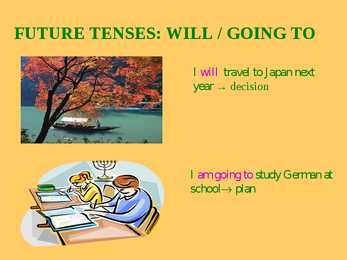
FUTURE TENSES: WILL / GOING TO I will travel to Japan next year decision I am going to study German at school plan WILL/GOING TO The Simple Future has two different forms in English: "will" and "be going to." Although the two forms can sometimes be used interchangeably, they often express two very different meanings as mentioned before. I will probably go to Italy next Summer I am going to fly to Italy next Saturday Future Tense: Will Form Affirmative: I will travel to Madrid in October Interrogative : Will you travel by bus? Negative : I will not travel - won't Will you travel by train or by bus? I won't travel by bus I will probably travel by train
Millions of people all over the world spend their holidays travelling. They travel to see other countries and continents, modern cities. They travel to enjoy picturesque places, to try different food People can travel on foot, by train, by plane, by sea, by ship and by car. All means of travel have their advantages and disadvantages. Of course, travelling by air is the fastest and the most convenient way, but it is the most expensive too. Travelling by train is slower than by plane, but it has its advantages. You can see much more interesting places of the country you are travelling through. Modern trains have very comfortable seats. There are also sleeping cars and dining cars which make even the longest journey enjoyable. Speed, comfort and safety are the main advantages of trains and planes. That is why I prefer travelling by train. Travelling by sea is popular mostly for pleasure trips. On board large ships and small river boats
"traveller" in the United Kingdom. Purpose and motivation Reason for traveling include recreation, tourism or vacationing, research travel for gathering information, for holiday to visit people, volunteer travel for charity, migration to begin life somewhere else, religious pilgrimages and mission trips, business travel, trade, commuting, and other reason, such as to obtain health care or fleeing war or for the enjoyment of traveling. World's best places to visit: Paris and Barcelona Why go: Year after year, the Why go: Known around the world magnetic City of Lights draws new for its legendary football team, travelers to its Eiffel Barcelona is known much more than Tower, Louvre and Notre Dame, but just athletic talent. Touring the city is Paris also keeps experienced a feast for the eyes: Visitors walk travelers coming back for more
Why should tourists visit Estonia? I have always though of my country as a huge ,,multicultural city". We have so many different cultures from different places put into a little place all together that you could almost say we are a huge city not a country. And that has influenced us in a very remarcable way. Since the time we can remember we have been under Danes, Swedes, Germans, Russians, Polans and other. We have taken their traditions into our daily lives and forgotten ours. But still despite the fact that we bearly know our own language structure or our old traditions,we try to awake them once again.
My languages I love different languages. I mean, I really, really love different languages. I also believe and have been told that I pick them up rather easily. That might be true, although I did not pick any Greek up in Greece but that might have been because they spoke so damn fast that I could not tell if it was a word or an entire sentence. The first foreign language I learned was Russian. Considering I was ten when Estonia became a Republic, it makes sense. We began studying Russian in first grade, though it was simplified – "koška" instead of "kot", "medvešonok" instead of "medved", "saichik" etc. Did not make much sense and we mostly played some games in Russian (Tare-tareke etc). Learned as much playing
(NOT I've been learning English since three years.) We've been waiting for ages, since eight o'clock. 13. Don't separate the verb from the object. VERB OBJECT She speaks English very well . (NOT She speaks very well English.) Andy likes skiing very much. (NOT Andy likes very much skiing.) 14. Don't use the present perfect have/has seen, have/has gone etc with words that name a finished time. I saw him yesterday. (NOT I have seen him yesterday.) They went to Greece last summer. (NOT They have gone ... last summer.) 15. English (the language) normally has no article. You speak very good English. (NOT You speak a very good English.) 16. After look forward to, we use ing, not an infinitive. I look forward to seeing you. (NOT I look forward to see you.) We're looking forward to going on holiday. (NOT ... to go on holiday.) 17. Information is an uncountable noun. Can you give me some information? (NOT Can you give me an information?)
Ways of expressing the Future Table of Contents Future Simple ...................................................................... 2 Be going to ........................................................................... 3 Present Continuous .............................................................. 3 Present Simple ..................................................................... 4 Future Continuous ............................................................... 4 Future Perfect....................................................................... 6 Other ways of referring to the future .................................
Anthropology of Tourism Madli Tuvike Anthropology and Tourism Female Adventure Tourism This essay will explain what significance culture has in adventure tourism. There are five paragraphs in this essay, where definitions of adventure travel and human culture are given. First, paragraph will look and define what culture, anthropology and adventure tourism are. Second paragraph will examine how different cultures impact female adventure travel. Third paragraph will point out the problems in adventure tourism. The forth paragraph will give recommendations for the future and some of the possible future problems in female adventure tourism will be looked at. The last paragraph will be a summary of the key findings and recommendations. Tourism is one of the world’s largest industries (Tisdell, 2000, Swarbrooke et al. 2003, Buckley, 2003)
the things you can count (one elephant, two elephants, three elephants, etc). Uncountable nouns are names of the things you cannot normally count (love, air, philosophy, etc). The can usually be used when we mean this. The Indefinite Article – a/an (= one!) can only be used with singular countable nouns. a child, a book, an elephant, an apple On the other hand, singular countable nouns cannot be used without any determiner. Determiners are both articles (a/an and the) and different pronouns (e.g., one, another, each, every, this, that; personal pronouns: my, your, his, her, its, our, their). Only one determiner can be used at a time: My house was deserted. Or: The house was deserted. Another problem is the pollution that the factory causes to the environment. Or: One other problem is the pollution the factory causes to the environment. 2
rooms were also beautiful: big bathrooms and every bedroom had a balcony and huge bed. We tooked a road trip all over the island. We saw Blue eye, sharks and the saline. The best thing of these were the sharks, it was scary but also amazing. I think that you should go ther too, because it has everything you need for a perfect holiday. Anyway, I'd better go now. Write soon. Love , Max Dear Regina, Hi! How are you? Sorry I haven't been in touch for a while but I've been really busy. I've finally got some free time, so I thought i tell you about my last holiday. This holiday was exciting to me, I hope you like it too! This summer I went to paris. We choose this place because this seemed lika a intresting place. The climate is quite similar to Estonian climate. Paris was a lot different, there isn't a lot nature, because it's a big city, you can see a lot of big buildings and beutiful old town. When we were there we went to
But of the tree of the knowledge of good and evil, thou shalt not eat of it: for in the day that thou eatest thereof thou shalt surely die. Genesis 2:17 PREFACE I'd never given much thought to how I would die -- though I'd had reason enough in the last few months -- but even if I had, I would not have imagined it like this. I stared without breathing across the long room, into the dark eyes of the hunter, and he looked pleasantly back at me. Surely it was a good way to die, in the place of someone else, someone I loved. Noble, even. That ought to count for something. I knew that if I'd never gone to Forks, I wouldn't be facing death now. But, terrified as I was, I couldn't bring myself to regret the decision. When life offers you a dream so far beyond any of your expectations, it's not reasonable to grieve when it comes to an end. The hunter smiled in a friendly way as he sauntered forward to kill me. 1. FIRST SIGHT My mother drove me to the airport with the windows rolled down
3 Kuidas su suvevaheaeg oli? - Väga vahva! How was your summer holiday? - It was fantastic! 4 Eelmisel nädalal me kordasime (õpitut). Me ei õppinud uusi reegleid. Last week we did some revision, we didn´t learn any new rules. 5 Kas sa olid eelmisel koolipäeval rohkem elevil kui tavaliselt? Were you more excited than usal on the first day of school? 6 Kes on see poiss, kes seisab uksel? Who is this standing boy in the doorway? 7 Ma olin enne kontrolltööd närvis. I was nervous before the test. 8 Kas see koht on vaba? Is this seat vacant? 9 Uus õpilane punastas, sest oli tähelepanu keskpunktis. The new student blushed, because he was the centre of attention. 10 Ma jäin päikese kätte magama. I fall asleep in the sun. _______________________________________________________________ UNIT 3: Töövihikust harjutus 10. 1 Kui ma end üksildasena tunnen, kuulan ma muusikat. When I feel lonely I listen to music.
Personal statement ,,Whatever course you decide upon, there is always someone to tell you that you are wrong. There are always difficulties arising which tempt you to believe that your critics are right. To map out a course of action and follow it to an end requires courage." - Ralph Waldo Emerson This quato, mentioned before, gives me confidence to do great things myself in life and pursue them into bigger ones one day ahead. In these moments i like to remember what Napoleon Hill once said: ,,If you can´t do great things, do small things in a great way." The things is, that everyone has to start somewhere, to find their own way in this life-that is the reason why i am writing this letter at this very moment, to let you know, that i am ready to make a change. To introduce myself, i would use one word-determined
You asked about (teema, millest on vaja kiri kirjutada) 3. Kirjuta teemast 1-3 lõiku, igas lõigus vähemalt 4-6 lauset. a. Iga lõik eralda taandreaga 4. Viimases lõigus teema lõpetamiseks võid küsida inimeselt kellele kirjutad millega ta tegelenud on või midagi teema kohta. a. Nt. Tell me what have you been up to? / How is school? / Have you met any new people? / Have you visited any interesting places? 5. Lõppu kirjuta (taandrida) Best Wishes, (NB: seal peab lõpus koma olema!) ja järgmisele reale kirjuta nimi.( Nime lõpus ei tohi olla punkti!) a. Nt. (taandrida)Best wishes, Samantha b. Nt. (taandrida)With love, Samantha (Sobib ainult siis kui tüdruk kirjutab kirja või kui poiss kirjutab kallimale!) Kiri näiteks, reisimise kohta: Dear Sam, How are you
Calvin James at Ammende Villa on Saturday 28 September. RSVP by 15 September. 1 Kirjapraktika Portfoolio 2013 c) postcard Hi Dad Being in Portugal has been amazing so far. Jeremy and I have seen so many wonderful things. We've been swimming almost every day. I have also enjoyed the vibrant night life they enjoy here, we went dancing last night. I only wish I could share more of it with you guys. I miss you all so much. Lots of love and kisses to everyone! Love Regina 3. Descriptions a) an object My bed in the dormitory is a bunk bed. It is a huge old light brown wooden piece of furniture. It squeaks when I switch sides or when I climb into it. I sleep on the second level and sometimes I am truly scared for my life. It is not as sturdy as I would like it to be
 annaabi.ee