 50 punkti
Autor soovib selle materjali allalaadimise eest saada 50 punkti.
50 punkti
Autor soovib selle materjali allalaadimise eest saada 50 punkti.
 ~ 1 leht
Lehekülgede arv dokumendis
~ 1 leht
Lehekülgede arv dokumendis
 2011-02-14
Kuupäev, millal dokument üles laeti
2011-02-14
Kuupäev, millal dokument üles laeti
 12 laadimist
Kokku alla laetud
12 laadimist
Kokku alla laetud
 0 arvamust
Teiste kasutajate poolt lisatud kommentaarid
0 arvamust
Teiste kasutajate poolt lisatud kommentaarid
 latimeeria2406
Õppematerjali autor
latimeeria2406
Õppematerjali autor
Anthropology of Tourism Madli Tuvike Anthropology and Tourism Female Adventure Tourism This essay will explain what significance culture has in adventure tourism. There are five paragraphs in this essay, where definitions of adventure travel and human culture are given. First, paragraph will look and define what culture, anthropology and adventure tourism are. Second paragraph will examine how different cultures impact female adventure travel. Third paragraph will point out the problems in adventure tourism. The forth paragraph will give recommendations for the future and some of the possible future problems in female adventure tourism will be looked at. The last paragraph will be a summary of the key findings and recommendations. Tourism is one of the world’s largest industries (Tisdell, 2000, Swarbrooke et al. 2003, Buckley, 2003)
ENVIRONMENTAL PROBLEMS Our environment is constantly changing. However, as our environment changes, so does the need to become increasingly aware of the problems that surround it. With a massive influx of natural disasters people need to be aware of what types of environmental problems our planet is facing. Current environmental problems make us vulnerable to disasters and tragedies, now and in the future. Unless we address the various issues seriously we are surely doomed for disaster. Current environmental problems require urgent attention. 1
Adventure Tourism Project Management Madli Tuvike There is no such thing as a totally sustainable tourism (Swarbrooke, 1999). Tourism as one of the leading industries in the world is contributing to sustainable development (Mintel, 2005). Tourism needs to cope with changing world and world order, also trends that are occurring. Sustainable tourism is one rising industry in tourism market. Swarbroke (1999) and David (2011) are suggesting that sustainable tourism and sustainability is taking wider part in tourism industry. Moreover, Mintel (2005) states that tourism contribution to sustainable development is being recognised increasingly by governments and international organisations. In addition, United Nations World Tourism Organization (UNWTO, a.i.) states that tourism nowadays takes full responsibility of impacts that it is making, such as current and future economic, social and environmental
....................................................................................27 8.1 Photovoltaic energy...................................................................................................... 28 8.2 Solar thermal heat.......................................................................................................29 8.3 Solar thermal power plants......................................................................................... 30 8.4 Solar energy and the environment..............................................................................30 WIND ENERGY.................................................................................................................31 9.1 The History of Wind ..................................................................................................31 9.2 How wind machines work..........................................................................................32 9.3 Types of wind machines.............
Global warming Global warming, also known as the greenhouse effect, immediately received international attention. Scientists, environmentalists, and governments around the world took an interest in the subject. Global warming is called the greenhouse effect because the gases that are gathering above the earth make the planet comparable to a greenhouse. By trapping heat near the surface of the earth, the greenhouse effect is warming the planet and threatening the environment. Many scientists criticized Mr. Hansen's report, and the debate over global warming continues today. Current fears stem largely from the fact that global warming is occurring at such a rapid pace. Models are predicting that over the next century, the global temperature will rise by several degrees. Some scientists still do not think that the effects of global warming are as severe as some people say. They think that droughts, hurricanes, and floods often blamed on global warming might
Mass tourism - a threat or blessing for local communities? Nowadays, it is not a problem to travel from one location to another. Hundreds of tourists visits the most famous and beautiful places all over the world every single day but mass tourism has many disadvantages and fortunately some advantages too. The most important advantages of mass tourism are the financial profits. Thanks to tourism local people are employed in various kind of companies which are connected with tourists and their attractions. Local people also get more options how to be more successful in making money because in popular tourist areas they can start their own business, such as, shops, cafes, pubs, hotels, tent camps and so on. In addition, thanks to the money spent by tourists, local authorities have funds to maintain different buildings and places like, for example, libraries or parks and to
Tourism-good or bad ? Nowadays in many countries, tourism is one of the fastest growing industries and it can bring enormous advantages to countries, especially poor ones. It may seem that tourism bring only benefits, but further consideration shows that it also has disadvantages. To start with, tourism offers many benefits. Tourists spend money on local goods and services ,so the area can get much money to develop the other essential public services, for example education and health. Also tourism services such as roads, bars, hotels, restaurants and other leisure facilities are built. Thanks to it, local people can get more jobs. Finally, tourism allows both the tourist and the local community a chance to experience other cultures.
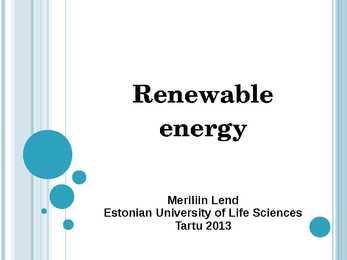
Renewable energy Meriliin Lend Estonian University of Life Sciences Tartu 2013 Topics Renewable energy Solar energy Wind energy Hydroelectric power Geothermal energy Biomass energy Renewable energy Renewable energy comes from sources that naturally renew, or will not run out in our lifetimes. Includes sunlight, wind, water, geothermal heat and various forms of biomass. Renewable energy cannot be exhausted and is constantly renewed. Does not harm the environment. Saves money. Solar energy Solar energy is the technology used to harness the sun's energy and make it useable. Every hour the sun beams onto Earth more than enough energy to satisfy global energy needs for an entire year. Solar energy use has surged at about 20 percent a year over the past 15 years, thanks to rapidly falling prices and gains in efficiency. Solar energy is inexhaustible. Noise free. Does not harm the environment. Click to edit Master text styles Second level
 annaabi.ee







Kõik kommentaarid