Leidsid 33 sarnast õppematerjali, mis on seotud failiga "The Haapsalu Bishop's Castle". Need materjalid aitavad sul teemat sügavamalt mõista.
castle, wall, bishop, meters, century, examples, architecture, construction, centuries, fell, rule, russia, ruins, seven, eight, there, days, lady, canon, secret, singer, find, cathedral, established, 13th, centre, best, castles, located, western, reconstruction, went, throughout, several, changing, development, final, than, hectares, between, maximumHaapsalu Castle Haapsalu Episcopal Castle, is a castle with cathedral in Haapsalu, western Estonia. It was founded in the thirteenth century to be a center for Bishopric of Ösel-Wiek. When there is a full moon in the month of August, it is said that an image of a maiden, the White Lady, appears on the inner wall of the chapel. On full moon nights in August an image of a maiden, The White Lady, is said to appear on the inner wall of the chapel. In 1228, the Archbishop of Riga formed a new diocese consisting of Läänemaa, Saaremaa and Hiiumaa and designated Gottfried, an abbot of Dünamünde Cistercian monastery, as the bishop. These boundaries of the new diocese were permanently fixed by a legate of Pope, Wilhelm of Modena in 1234. The first residence of the diocese was located in Lihula, where with the help of the Order the Bishop transferred the diocese's residence to Vana-Pärnu, wich was burned and destroyed
Edinburgh Castle is an ancient stronghold which dominates the sky-line of the city of Edinburgh from its position atop Castle Rock. It is Scotland's second most visited tourist attraction. Human habitation of the site is dated back as far as the 9th century BC. As it stands today though, few of the castle's structures pre-date the Lang Siege of the 16th century, with the notable exception of St Margaret's Chapel, the oldest surviving building in Edinburgh, which dates from the early 12th century.As with all castles, Edinburgh's fortress has been a centre of military activity. As an ancient fortress Edinburgh Castle is one of the few that still has a military garrison, albeit for largely ceremonial and administrative purposes. The New Barrack Block is now home to the official headquarters of the Royal Regiment of Scotland and 52 Infantry Brigade, as well as home to the regimental museum of the Royal Scots and Royal Scots Dragoon Guards. The Governor of Edinburgh Castle is Major General
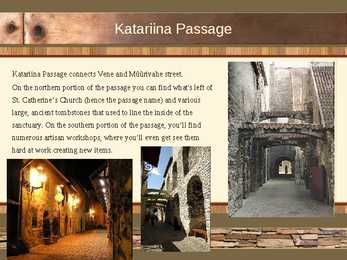
Katariina Passage connects Vene and Müürivahe street. On the northern portion of the passage you can find what's left of St. Catherine's Church (hence the passage name) and various large, ancient tombstones that used to line the inside of the sanctuary. On the southern portion of the passage, you'll find numerous artisan workshops, where you'll even get see them hard at work creating new items. City wall Tallinn's medieval city wall is a sub-facility that was built to protect the lower Tallinn and upper Tallinn (Toompea). The building of the city wall began in 1310th years, and by improving over time it formed the city wall with defensive buildings (towers). It was finished by the end of the 1561. Then it was 2.35-kilometer-long circular wall, which had 27 wall gate, 8 tower gate and 21 other stone fortifications. Many parts of the town wall have survived until today
It is on almost the same latitude east St. Petersburg in Russia, Stockholm in Sweden and Stavanger in Norway, and covers 158 sq km. Tallinn was first marked on a map of the world by the Arab geographer al-Idrisi in 1154, its name then being Kolyvan (probably derived from the name Kalev). In the 13th-century Chronicle of Henricus de Lettis the town was called Lyndanise. Later came Reval (presumably after the old county of Rävala), the name used by the Germans who ruled the country for seven centuries. Russians then modified Reval to Revel. For Estonians, the town came to be called Tallinn from Taanilinn (Danish town) after Danish conquest in the 13th century. Over the course of time, Taanilinn was shortened to Tallinn The place is believed to have been settled by Finno-Ugric peoples about 2500 BC. The Danes, led by King Valdemar II, conquered northern Estonia in 1219. Legend has it that one
Toompea (from German Domberg – Cathedral Hill ) is a limestone hill with an area of about 7 hectares in the central part of Tallinn. It towers about 30-40 m above the surrounding areas. According to the legend it´s the tumulus mound over the grave of the national hero Kalev, erected stone by stone in his memory by his grieving wife Linda. It is the birthplace of Tallinn - a place where in 1229 the Knights of the Sword built a fortress instead of the wooden Estonian stronghold. Toompea Castle is also one of the most potent symbols of the reigning power. Today Toompea is the seat of the Government of Estonia as well as the Riigikogu, both of which are often simply colloquially referred to as Toompea. For centuries there was only one access to Toompea - Pikk Jalg - but there is also another way leading up to Toompea - Lühike Jalg, which was made in the 14th century. At present Pikk Jalg and Lühike Jalg are used only by pedestrians. Until
trade (16%) and transport and communication (14%). History. Tallinn has a great history. It was first marked on a map of the world by the Arab geographer al-Idrisi in 1154, its name then being Kolyvan. In the 13 th- century chronicle of Henricus de Lettis the town was called Lyndanise. Then it was called Reval for some time and finally Estonians started to call the town Tallinn from Taanilinn (Danish town) after the Danish conquest in the 13th century. The Knights of the Sword took Tallinn from the Danes in 1227 and made Toompea their fortress. In the middle of the 14th century Denmark sold its possessions in Estonia to the German Teutonic Order; Toompea became the seat of German-born gentry. A fortified wall was built between the Toompea (the Upper Town) and the Lower Town (inhabited by people of a lower social standing), as there were conflicts between the two. The doors and the gates of the wall were locked at night, a
· Suuremõisa Castle. Suuremõisa Castle was built in the second half of the 18th century on the initiative of Countess EbbaMargaretha Stenbock (17041776). The wings are erected in 1772. There are 64 rooms in the Castle. 6 ponds were dug in the grounds of the Castle and a park and a garden established. In 1796 the Castle was sold to Baron UngernSternberg. The attic of the Castle has doubleceiling, where the Baron used to hide the treasures stolen from ships that had sunk in the Näkimadalad. On 19 October 1802 the Baron killed Karl Johannes Malm, the Captain (of Swedish origin) of his ship "Brig Morian", in this Castle. For this the baron was deported to Siberia. There are currently two schools in the Castle: Suuremõisa Gymnasium and Suuremõisa Technical School. In the latter one can also study how to become a ship's captain.
Introduction Tallinn, the capital city of the Republic of Estonia and of the Harju county, is a town in North Estonia on the coast of the Gulf of Finland. It has nearly half a million inhabitants and covers an area of almost 160 sqkm. It is also an important economic and cultural centre and one of the main ports in the Baltic States. Tallinn is one of the oldest cities on the Baltic Sea. It is unique for its well-preserved architecture from the 13-15 centuries. In contrast to the ancient town-walls and towers, Tallinn of today offers modern hotels, restaurants, sport and cultural centres. Every five years national song and folk dance festivals take place in Tallinn. The yachting regatta of the 1980 Moscow Olympic Games was held at Pirita. History Tallinn means in English "Danish town". The place is believed to have been settled by Finno-Ugric people about 2500 BC. It was first marked on a map of the world by the Arab geographer al-Idrisi in 1154
glass. ● The statue of Liberty, 2009; represents freedom, Estonia has been under many foreign powers, starting with Danes, Sweden, German and Russia. The clock of liberty, 2004. Kiek in de Kök ● The cannon tower, founded in 1475-1483. Kiika kööki, peek into the kitchen, from up there it was possible to peek into the enemy’s kitchen. The walls are 4 m thick, can see the cannons stuck in there. Tallinn City Museum. ● Town Wall (Unesco) - one of the greatest towers of Tallinn’s Town Wall, Old Town declared the UNESCO World Heritage Site in 1997 Toompea ● Toompea is a limestone hill in the central of Tallinn. It towers about 30-40 metres above the surrounding areas. According to the legend, its the tumulus moundn over the grave of the national hero Kalev, erected stone by stone by his grieving wife Linda
It is situated on the northern coast of the country, on the shore of the Gulf of Finland, 80 km south of Helsinki, east of Stockholm and west of Saint Petersburg. Tallinn's Old Town is in the list of UNESCO World Heritage Sites. It is ranked as a global city and has been listed among the top 10 digital cities in the world.The city was a European Capital of Culture for 2011, along with urku, Finland.Tallinn is the oldest capital inNorthern Europe. The city was known as Reval from the 13th century until the 1920s. http://en.wikipedia.org/wiki/Tallinn Old Tallinn The Old Town can historically be divided into two distinct areas: Toompea Hill and the Lower Old Town, which were separated by a dividing wall since medieval times. The elevated area of Toompea Hill with its castle was occupied by the residences of Tallinn's rulers and gentry. The Lower Old Town meanwhile developed as an autonomous merchantile centre, flourishing during the 13th-16th
This is Toompea Castle. The history of Toompea is actually the story of rulers and power in Estonia. The times and rulers changed and so did power and mentalities – each new ruler built and fortified this place according to his needs and taste. Today, visitors to Toompea can find here buildings mostly dating from three periods: the medieval order’s stronghold with its impressive western wall and towers, the most well-known of which is the tower of Tall Herman; the Russian-era government administration building with a facade representing classical styles and opening onto Castle Square; and the building of the Riigikogu, which originates from the time of the First Republic of Estonia and is hidden behind the walls of the castle Time has been generous to Toompea castle. The well-protected fortress has been almost impregnable
Lower Town was a merchantile centre, Tallinn also belonged to the Hansaetic League (1285). It is often referred to as the town of citizens. Any grown-up, married and economically independent person, born in a legal marriage between two free people and having lived in the town for at least 3 months, could apply to the Magistracy for citizenship. Serfs could escape from serdom after having successfully hidden in town for a year and a day. Two parts remained separated until the end of the 19th century. Four Names Lyndanise - mentioned by Henricus de Lettis in his Chronicle; derives from the name Linda - the wife of Kalev and mother of Kalevipoeg Koluvan - mentioned in Russian chronicles; derives from the hero Kalev from our national epic Reval - comes from the German words “REH” and “FALL”, meaning the falling of the deer; could be deers trying to escape from the Danes, running down the Toompea hill
The City of London History The City of London occupies one square mile in the middle of the capital. It once made up the entire town of London, surrounded by the wall first built by the Romans. The Roman Londinium grew up on the northern side of the "London Bridge" in the past. Products such as olive oil, wines and fruit were brought by ships from different parts of the Roman Empire and unloaded onto wooden quays along the river. In AD 61 the native Celtic Iceni tribe, led by Queen Boudicca, rose up against The Romans. They burnt Londinium to the ground but Roman armies eventually defeated Boudicca
graceful bronze statue of a Roe Deer by Jaan Koort (1883-1935), one of the best-known Estonian sculptors, has been standing for several decades. Lai Street stretches from Nunne Street to Pikk Street. Parallel with Pikk Street, Lai Street, too, ends at the Great Coast Gate (first mentioned 1359). Lai Street is very wide considering that it was laid out in the Middle Ages. This is because it sprang up on both sides of former city wall. Lai is quite a peaceful street with few shops. However, it has three museums and two theatres. The main entrance into St Olaf´s Church also faces the street. Several Lai Street houses have kept their Gothic appearance and even interiors, although we can also notice moderate Nordic Baroque, Neoclassicicm, Historicism and even Art Nouveau. The origin of the name "Lai" Lai Street belongs among the oldest streets of Tallinn. Despite its length and width its share in
Jõgeva maakond Endla nature reserve It is located on the borderline of Järva, Jõgeva and West-Viru counties. It is mostly known for various marshes, fens, quaking bogs, lakes, canebrakes, wellsprings, rivers, fen forests, fens and mesotrophic mires, marsh forests, meadows, diverse flora and fauna. Jõgeva town The small town of Jõgeva town is located on the eastern side of Middle-Estonia. You won't find large buildings or breathtaking architecture here, but an overwhelming sense of togetherness and plenty of cultural events, the majority of them geared towards younger people. Jõgeva town was born 130 years ago, thanks to the Tapa-Tartu railway: this is where the first train stopped and a village formed around the railway station. Just half a century later, Jõgeva earned its town rights. There are about 6500 people living in Jõgeva. Jõgeva events
They called their city Londinium. The Roman engineers noticed that the point where the swampy river narrowed would make an ideal crossing point, they built London Bridge. Less than 20 years later the native Iceni tribe, led by Queen Boudicca, rose up against the Romans in revenge for mistreatment and burnt Londinium to the ground. The well disciplined Roman army defeated her forces and Londinium was rebuilt. By AD 100 it had also become the capital of the Roman province. A massive wall was built to protect the city from further attacks. The Roman Empire came under increasing attack across Europe and in AD 410 they retreated. The Romans gave us a language based on Latin, the calendar, law and legal system, the census and also straight roads, central heating and concrete. Anglo- Saxons around AD 400 Anglo- Saxons were warrior farmers from Germany, Denmark and the Netherlands. Later in the 5th century, Anglo-Saxons settled just west of Londinium, around the Strand, and formed
That prehistoric monument is located in the plain of Salisbury, in the county of Wiltshire in the south-west of England. It is built of 150 enormous stones which are set in a purposive circular pattern. Stonehenge was probably built to mark the longest and shortest day of the year because it lies on the line of the midsummer sunrise and the midsummer sunset. That would have enabled people to keep a record of changing of seasons. Although it is still unclear who built it. Hadrian’s Wall is an ancient wall which was built in 2nd century by Hadrian, the emperor of Rome from AD 117 to 138, and it marked the northern border of the Roman Empire in Britain. The wall was 80 Roman miles (117 kilometres) long and it is situated in northern Great Britain and stretched from Solway Firth in the west to the Tyne River near Newcastle in the east. It was built to keep the Caledonians of Scotland out of England.
Christ The Redeemer Or the Statue of Christ Redeemer (Portuguese: Cristo Redentor) is a statue of Jesus Christ with the largest Art Deco architectural style and located in Rio de Janeiro, Brazil. The statue has a height 38 meters and is located at the top of Corcovado Mountain is 710 m high in the Tijuca Forest National Park, overlooking the city. Chichen Itza It is a Mayan archaeological heritage in Mexico is the most complete and still well maintained. According to the Mayan culture of Chilam Balam, the temple complex was built between the years 502-522 AD. Mayans occupy just over 200 years, then they migrate to coastal areas in Campeche
Blandings Castle by P.G. Wodehouse Wodehouse was an acknowledged master of English prose admired both by contemporaries and by modern writers. He has been called "English literature's performing flea", a derogatory description that Wodehouse cherished and adopted as the title of his autobiography. Best known today for the Jeeves and Blandings Castle novels and short stories, Wodehouse was also a talented playwright and lyricist who was part author and writer of fifteen plays and of 250 lyrics for some thirty musical comedies. Wodehouse took a modest attitude to his own works. In Over Seventy (1957) he wrote: "I go in for what is known in the trade as 'light writing' and those who do that humorists they are sometimes called are looked down upon by the intelligentsia and sneered at."
But indeed the only work of prose which can claim a foothold of English literature is `Mandeville's Travels' and it's translated from the French. With the religious works bulk much larger and important writers are Thomas More, Jeremy Taylor, etc. The main tradition of vernacular prose began in England in late 800s with the Anglo-Saxon chronicle and with the group of translations made or inspired by the king himself. However, the best of Anglo-Saxon prose was produced a century later by the monks Wulfstan and Ælric, who left a large number of writings devoted to the exposition of Christian faith. That includes homilies and Saint's Lives. It is now believed that these monks were responsible for developing the form of written English known as Late West Saxon. Ælric was a grammarian, he wrote the first Latin grammar in English. One of the main characteristics is immediacy. 4. The medieval and eliz. world picture
countryside charm to create a comprehensive experience of Estonia beyond the big cities. But the legend of the White Lady of Haapsalu, which is at the heart of the festival, is perhaps the most famous tall tale of the many that are so abundant in Estonia's folklore. It is the story of a poor girl who falls in love with the son of the village elder, and disguises herself as a choirboy in order to sneak into the castle. But, alas, the lord of the manor's son discovers the deception. He is overcome by jealous rage and orders his men to seal the girl inside the thick stone walls while still alive. Turned into an incarnation of undying love, the White Lady now appears every August, on the night of the full moon, in the Dome Church chapel window. Haapsalu is seven-and-a- quarter centuries old this year, and the townsfolk intend to make it a celebration to remember
probably also built the first church there. It was presumably a wooden building located at the site of the present cathedral. However, a serious conflict with the Order of the Brothers of the Sword broke out soon as the latter wanted to gain control of the entire Estonia. The order succeeded in subordinating Tallinn and the whole of North Estonia to its rule in 1227. The monks of the Dominican Order began the construction of a stone church in Toompea in 1229. The first written data on the cathedral date back to 1233, the date of a battle between the order and the pro-papal vassals, who attempted for the last time to turn Tallinn into the centre of the ecclesiastical state, and were defeated. According to the records, the battle had spread to the interior of the church and the bodies of the fallen knights had piled at the altar. The resettling of the Dominican monks from Toompea to
Sculptures and monuments St. John's Lutheran Church St John's Church was probably built in the first third of the 14th century. There is no other brick church decorated with so much terracotta plastic in Europe Eduard Tubin Monument The Eduard Tubin monument, marking the 100th birthday of the composer, was dedicated in 2005. The authors of the statue are sculptor Aili Vahtrapuu, architect Veronika Valk, with sound installations by Louis Dandrel.Eduard Tubin (1905-1982) was a versatile composer and conductor, one of the most recognized symphonists throughout history. He served as concert
History exam *Stonehenge - is a monument located in England. It is one of the most famous prehistoric sites in the world and is composed of earthworks surrounding a circular setting of large standing stones. The surrounding circular, earth bank and ditch, have been dated to about 3100 BC. Stonehenge was produced by a culture with no written language. Many aspects of Stonehenge remain subject to debate. There is little or no direct evidence for the construction techniques used by the Stonehenge builders. *The Celts in Britain and their legacy The Cets lived in Britain in The Iron Age. They were warring tribes who were battleful amongst themselves as well as inter-tribal war. They were not centrally governed. The Celts brought iron working, iron ploughs and metal swords, horses, wheels and chariots - all these things gave them an instant superiority over the native tribes. The Celts built a number of hill forts throughout the region
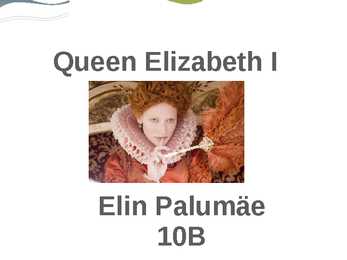
Died - 24 March 1603 (aged 69) Burial - Westminster Abbey Anne Boleyn Queen consort of England Mother of Elizabeth I Tenure - 28 May 1533 17 May 1536 Coronation 1 June 1533 Anne Boleyn was Queen of England from 1533 to 1536 as the second wife of Henry VIII of England and the 1st Marquess of Pembroke in her own right for herself and her descendants. House - House of Tudor Father - Thomas Boleyn, 1st Earl of Wiltshire Mother - Lady Elizabeth Howard Born c.1501/1507 Blickling Hall/ Hever Castle, England Died 19 May 1536 (aged 29-35)Tower of London Religion - Anglican, formerly Roman Catholic King of England Henry VIII Reign - 21 April 1509 28 January House - House of Tudor 1547(37 years) Father -Henry VII of England Coronation - 24 June 1509 (aged 17) Issue Mary I of England Predecessor - Henry VII Henry FitzRoy Successor - Edward VI Elizabeth I of England
Area: 30414 sq mi (78772 km2) Location: Symbols: Tartan Thistles Interesting plase: Edinburgh's Royal Mile Edinburgh's Royal Mile (it is actually one mile and 107 yards from entrance to Edinburgh Castle to the gates of the Palace of Holyrood House) is not only a popular tourist attraction but also provides a fascinating insight into the history of the City and of Scotland itself. It was described by Daniel Defoe as the "Largest, Longest and Finest Street in the World" Edinburgh Castle
adventures. When i was reading that it seemed so real, that i was there to. The city's charms can occasionally be obscured by too many tourists, congested traffic and tacky commercialism. Packed in among thousands of other visitors, trying like crazy to see the city in three days and worrying about getting ripped off, it's not surprising, may think the city is overrated. Just relax, take a deep breath. While the city centre is a mélange of stunning architecture, from Gothic, Renaissance and baroque to neoclassical, art nouveau and cubist, beyond the medieval lanes of the Old Town and the Castle District, there's an entire other cosmopolitan city to explore. Search out the riverside parks, lively bars and beer gardens, music clubs, museums and art galleries. Harness Prague's excellent public-transport system to explore emerging suburbs such as Zizkov, Vinohrady, Smíchov and Holesovice
5. The Angles, Saxons and Jutes. The Angles were one of the main groups that settled in Britain in the post-Roman period, founding several of the kingdoms of Anglo-Saxon England, and their name is the root of the name "England". The Saxons were a confederation of Old Germanic tribes. Their modern-day descendants are generally considered ethnic Germans, Dutch or English.. Saxons participated in the Germanic settlement of Britain during and after the 5th century The Jutes were a Germanic people who were one of the three most powerful Germanic peoples of their time. They are believed to have originated from Jutland in modern Denmark. Were associated with the Saxons. The Jutes, along with some Angles, Saxons and Frisians, sailed across the North Sea to raid and eventually invade Great Britain from the late 4th century onwards, either displacing, absorbing, or destroying the native Celtic peoples there. 6. The Anglo-Saxon invasion
while the Arab scholar alIdrisi was the first one to mark it on a map (as ASTLANDA). To the ancient Scandinavians the land was known as EISTLAND; to modern Scandinavians it is known as ESTLAND. Most contemporary languages use the Latin name ESTONIA. FLAG The Estonian blueblackandwhite national flag was originally the flag of the Estonian Student's Society, consecrated in Otepää Church in 1884. today there is a memorial plaque on the church wall commemorating the event. The Flag Museum attracts tourists who take an interest in the history of the flag. After about half a century, during which it was prohibited by the Soviet authorities, the flag was sen again in public for the first time in Tartu. Many elderly people were carrying the flags they had kept in secret hiding places durin the Soviet years; tears were rolling down their cheeks. On 24 February
Tennis courts, cafes, playgrounds, diving towers, boat rental and catamaran trips are available by the lake. In winter, people can enjoy a snow park and test their skills at snow-tubing. Flag and coat of arms Viljandi's flag is a simple light blue over white. I don't know the significance of the colours (if any), but they are probably derived from the coat of arms. The arms are a white (and golden) flower on a blue field. Trepimägi The stairs of Trepimägi, built during the turn of the century to improve the connection between the town and the lake, start right from beside the Town Hall. There are five flights and 158 steps. Water Tower The old water-tower of Viljandi between the museum and Town Hall has been reconstructed now into an observation tower. Church spires and the Old Water Tower form a silhouette on the lake surface. The Water Tower offers a magnificent view of the whole town
1) The party was ..... Saturday. 2) What are you doing ..... Tuesday? 3) ..... teachers were not amazed by his pranks. 4) Are you going ..... the ball? 5) ..... piano sounds great, don't you agree? 6) Hey, Keith, bring me some of ..... ice cream, too! 7) Linda sat ..... the rock and sang ..... song. 8) ..... school is something you never forget, yet while studying many things just are forgotten. 9) He jumped off ..... cliff and fell ..... the ice-cold ocean. 10) It was ..... noisiest concert ever! 11) What are you doing? Don't you know that ..... fishing isn't allowed here? 12) Neither ...... them moved, they were just staring ..... each other. 13) You must go, Susan, or else I won't go ..... there as well. 14) He laughed ..... her, not feeling any pity at all. 15) Mother listened ..... the radio while Jim was catching ..... butterflies. 16) She was soon bored, so he decided ....
American literature The literary history of this nation when the first humanbeing living in what has since become the U.S used language creatively. · Mid to late 18 century put down · Words are powerful, magical · Words must be remembered · Native Americans stories creation of the world · Attidude thought their land/language · Similar stories Dates and names · America was discovered in 1492 by Columbus · 1497 John Cabot went to Canada · 1579 San Fransisco/St. Fransis · 1607 Jamestown collony/John Smith · 1620 a boat called MayFlower
Stonehenge was produced by a culture that left no written records. Built on Salisbury Plain, in Wiltshire, England some time between 5,000-4,300 years ago. One of the most famous megaliths in the world, dating from prehistoric times. Stonehenge consists of circles of stone arranged in complex patterns, and their origin is still being explored. Some of the stones come from over 200 miles away in Wales. There is little or no direct evidence revealing the construction techniques used by the Stonehenge builders. It was probably associated with sun-worship and other rites of prehistoric people. It appears to function as a kind of astronomical clock. Conceivable reports and implications about a secret government conspiracy, which seeks to hide the irrefutable evidence of extraterrestrial origins. 8. The Roman Conquest. Julius Caesar’s first raid was 55 BC. In 43 the Emperor Claudius launched a full-
 annaabi.ee