The interviews revealed that estonians do not like to rest and relax a lot in Estonia. The majority of young people like to go travelling with their parents to some famous and interesting places. It was found that younger people do not want to go to sunny places, they just want to have interesting time. According to the survey younger people do not have same habits as older people. On the other hand some people just want to go to sunny places and be there for a long time. The older people surveyed said that it is better to rest with their husband or wife and not with small children. Most of the older people surveyed said that they can afford and want to go somewhere every summer. Only one person said that he prefers to stay in Estonia and with his family. The most popular destination is France and the second is Spain. In general most of the people like travelling somewhere far away from home and they like to do it without their children. To sum up, it can
Report A task was given to write a report which conveys the results of a survey about shopping habits of people of different ages and gender. The results of the survey were mostly the same, although there are some differences in answers. How much does one shop? About 1/3 of the 9 people surveyed said that they go shopping once a week. Others said that they shopped at least two times a week and it takes about 30 minutes for men and a hour for women to buy groceries and at least an hour if it's a shopping spree. How much do you spend on your hobbies? All men (4 out of 9 people surveyed) said that the most enjoyable products to shop for are electronics while all the women agreed that clothing and acessories are the most fun things to buy
To express difference between appearance and reality: It may seem, on the surface, apparently, on the face of it, at first sight… Useful vocabulary To introduce: The aim/purpose of this report is(to describe/advise/recommend)… The reason for this report is… This report was written/carried out… This report describes… This report looks at… The aim of this report is to outline the results of a survey which was carried out… It is based on… 500 people were surveyed. This report was administered by… What is it based on - opinion poll, survey etc. bar chart, pie chart etc. To generalize: overall, generally speaking, on the whole, as a rule, as a general rule To describe results of surveys: one in tree… eight out of ten… eighty per cent… 80% are Or expressions: the majority, a minority, a largest proportion, a significant/substantial number of, a small number of, by far the largest
The aim of the report is to find out how Estonian people spend their holidays. It is based on the interviews with people in different ages. How many trips and where The interviews revealed that most people have travelled in Estonian neighbour countries - Finland, Sweden, Latvia and Russia. The majority of young people told that they went to Finland or Sweden, because these kind of trips are cheap. People travel approximately 1-3 times a year. The older people surveyed said that they want to travel more, but their health or money does not allow that. The most popular destinatios is Egypt. The average length of trips is 3-7 days. What kind of transport and accomodation people use. With whom they travel. The majority of young people said that they often use a bus or thumb lift. Older people said that they prefer a comfort, so they use a plane and they stay in a hotel. The interviws reveales that people travel with friend and family. Few people said
The aim of this report, is to describes the holiday habits of Estonians and gives our opinion about the habits of the older people and the younger ones. The Report is based on the people's responses to the survey carried out by the students of the Jõhvi Gymnasium. The interviews revealed that estonians do not like to rest in Estonia. The majority of young people like to spend their holidays in Russia, the Baltic Countries and Spain. Most of the older people surveyed said that they can afford and want to go somewhere, where is warm and enjoyable. The majority of young people like to go travelling with their parents or friends, but the older people prefer go with husband or wife. The most popular activity is beach and swimming pool, old city center, museum and monuments. Came out, that all people prefer to stay in hotels or in camping. Older people prefer traveling by train or car, while younger enjoy traveling by all means of transport.
Furthermore, quite popular was rock music, so we should consider including this genre in to our music festival, but the biggest problem with rock bands is that they have a lot of different musical instruments so we should consider building bigger stage. According to our questioning that we handed out to our gymnasium classes three most popular genres were dance, rock and also pop. The percentages as seen from the table were 29%, 24% and 31%. We should take it into consideration that both surveyed groups wanted to listen to pop and rock music. Antoher thing that surprised our student committee was that classical music is not listened to among our students, which means we can exclude it and still get a lot of visitors. The best side about it is that we can earn more income from the ticket sales by making so. In conclusion, the survey clearly shows that we have to include rock and pop artists and maube dance music. This way highschool students can free their souls by dancing.
Only eight of those questioned eat before school, and half of them have their midday meal at school. Worryingly, as few as four students have both breakfast and school lunch. Still more disturbing is the fact that an alarming proportion--approximately onethird--of the students have neither. Eating brown bread Interestingly enough, bread, a good source of fiber, enjoys popularity among young people. 75 per cent of the students surveyed eat three or more slices of brown bread per day, with only a quarter of respondents restricting themselves to one or two slices. Eating fat As regards fat consumption, the majority of the students eat margarine. Four students prefer butter, and another four eat neither. Conclusion It is noticeable that the eating habits of students in their final year at Freedonian Secondary School are not very healthy.
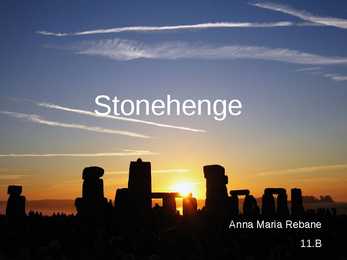
gather to watch the sunrise · the stone circle witnessed many druidic ceremonies, especially during the 19th century · today, much work goes on behind the scenes to ensure that Stonehenge and its unique prehistoric landscape are protected for future generations. Conclusion · No place has generated so much speculation and wild theories as the standing stones of Stonehenge · excavated, x-rayed, measured, and surveyed. · used to predict or even observe astronomical events · built with certain amount of honoring to the unknown · its purpose still remains one of the greatest mysteries in the world Picture slide Thank you!
the first connecting Valga and Pärnu in 1896, then Mõisaküla to Viljandi (1897), later extended via Paide to Tallinn in 1901 PRESENT SERVICES The rail transport system in Estonia consists of circa 1,200 kilometres of railway lines, of which 900 kilometres are currently in public use. The infrastructure of the railway network is mostly owned by the state and is regulated and surveyed by the Estonian Railway Inspectorate (Estonian: Raudteeinspektsioon). All public railways in Estonia are 1,520 mm , the same as in Russia, Belarus, Latvia, and Lithuania. The 1,520 km gauge used in Estonia is also compatible with Finland's 1,524 km gauge. Sometimes it is defined to be 1,524 km, for example when buying track maintenance or vehicles from Finland. Railways in Estonia today are used mostly for freight transport, but also for passenger traffic. Passenger transport is most
sõnavaralehed; tüüplaused/fraasid Lühivormid keelatud, kuiv ja väga ametlik stiil- ei mingeid emotsioone!!! 1) Ärge tehke põhiviga, et kirjutate nagu esseed, kirjutage n.ö. survey report, see on see alapealkirjadega. Leidke ja grupeerige nagu see riigieksami Poku aruanne. 2) kasutage spets sõnavara (vaadake üle sõnavara lehed)--tabelid, mida täitsime--- increase remarkably, significantly, fluctuates, follows upward/ downward trend 7 out of 10; those who were questioned/surveyed; decreases by 10 per cent ja kokku on teil mitu lehte minu antud paljundusi ; seventy per cent of those questioned had no complaints...; a large number (majority) who participated in the survey stated that ...; this is illustrated by the fact that (üldistused).. 3) Alustage alati This report will describe/ The aim of this report is to outline the results of a survey which was carried out... It is based on.... 500 people were surveyed. This report was administered by... Kas on tegu
Tennessee is known as the "Volunteer State" (a nickname earned during the War of 1812 because of the prominent role played by volunteer soldiers from Tennessee, especially during the Battle of New Orleans). Some of the famous Tennesseans are for example tina Turner, Elvis Presley, Dolly Parton and Justin Timberlake. Tennessee is a leading tobacco-producing state. Religion: Christian 82%, Other Religions 3%, Non-Religious 9%. 5% of the people surveyed refused to answer. Demographics In 2000, the five most common self-reported ethnic groups in the state were: American (17.3%), African American (16.4%), Irish (9.3%), English (9.1%), and German (8.3%). The majority of Tennessee´s population lives in urban areas.
Vastused harjutusele 5a: 2) a five-week holiday 3) a hundred-year-old house 4) a ten-day trip 5) a half-hour bus ride 6) a three-star hotel 7) a 20-minute queue 8) a four-page letter 9) a 1,000-piece puzzle 10) a 15-member team 3) PASSIVE VOICE AM/IS/ARE + III PÕHIVORM WAS/WERE + III PÕHIVORM Tee TV lk 36 h 8! Vastused: 1) was attended 2) are soaked 3) were damaged 4) should be baked 5) weren´t hurt 6) is meant 7) were flooded 8) can be booked 9) were surveyed, were published 10) can be hired EXERCISE PASSIVE VOICE Pane laused passiivi! 1) My great-grandfather built this house. 2) The policeman stopped the car. 3) In Canada people speak English and French. 4) The car killed his dog. 5) Robert took these photos. 6) Even the best pupils sometimes make this mistake. 7) Tailors make suits and overcoats. 8) The children do all the housework. 9) My boyfriend gave me this ring. 10) Ken saw the girls.
because the other child is short or fat, is of a different skin colour, or has a lisp, a stutter or a physical disability. Maybe he is a slow learner or wears clothes that differ from the run of the mill. Victims are often smaller or weaker than average, or shy and insecure. Boys bully more than girls, and the tormenting is more often physical. Debra J. Pepler of the LaMarsh Centre for Research on Violence and Conflict Resolution at York University has reported that 23 percent of boys surveyed said they had engaged in bullying, compared to only eight percent of girls. Among victims, however, both genders were equally affected. With girls, bullying often takes more subtle forms, such as whispering campaigns, spreading rumours and shunning--acts designed to destroy friendships. This can be every bit as painful as physical aggression. Many parents are unaware that it is happening because they never discuss it with their kids and
• vulgar – labane • amnesty – armu andmine • interprenter – tõlk • granted – antud • tramped – matkas, kõmpis • seized – konfiskeeriti, võeti ära • savage interior – maagiline/võimas • contrivance – abinõu sisustus • a criminal imbecile – kriminaalne • hair-breadth – juuste laius imbetsill • surveyed – plaanitud • shrugged – õlgu kehitama • collision – kokkupõrge • filthy – räpane • sovereignty – suveräänsus • bid – pakkuma • eventually – lõpuks • farewell – hüvastijätt • pearling luggers – purjelaevad • twinkled – sirama, sädelema • fleet – laevastik • nobleman - aadlik
organization is not supporting their sense of calling, or because the firm might be undermining the individual's vision for successfully enacting their calling. Example Zookeepers. Prof. Jeff Thompson from Brigham Young University conducted research about work as a calling through the Zoo. Results shown that: average income is under 25000$ per year; about 63% rely on another source of income; about 73% of Zookeepers have a bachelor's degree or higher; nearly half of 1330 keepers surveyed volunteered for at least a year before getting hired. Summarizing all this, only 6,5% are seriously thinking of leaving the profession. Some qoutes from interviews with keepers: "There's not much taht they could do to get me to quit"; "I can't think what would cause me to leave"; I don't think there's anything they could do to me that would make me leave". How they explain their choise: "It's a calling for me just because my whole life I've just been interested in animals animals
reputation as the best cheese makers. The Romans reared goats for butchering, and grew artichokes and leeks. Middle Ages With culinary traditions from Rome and Athens, a cuisine developed in Sicily that some consider the first real Italian cuisine. Muslims invaded Sicily in the 9th century. The Arabs introduced spinach, almonds, rice and perhaps spaghetti. During the 12th century, a Norman king surveyed Sicily and saw people making long strings made from flour and water called atriya, which eventually became trii, a term still used for spaghetti in southern Italy. Normans also introduced casseroles, salt cod (baccalà) and stockfish which remain popular. 4 Early modern era The courts of Florence, Rome, Venice and Ferrara were central to the cuisine. Christoforo
Tallinn 2021 TABLE OF CONTENTS 2 1 THE CORNERSTONES OF SURVEY RESEARCH 1.1 Introduction The idea of conducting a survey is deceptively simple. It involves identifying a specific group or category of people and collecting information from some of them in order to gain insight into what the entire group does or thinks; however, undertaking a survey inevitably raises questions that may be difficult to answer. How many people need to be surveyed in order to be able to describe fairly accurately the entire group? How should the people be selected? What questions should be asked and how should they be posed to respondents? In addition, what data collection methods should one consider using, and are some of those methods of collecting data better than others? And, once one has collected the information, how should it be analyzed and reported? Deciding to do a survey
expect. In the setting, even these prizes were valuable, but, still, there were much larger rewards-warm clothing, special mail privileges, increased freedom of movement in camp-that the Chinese could have used to increase the number of essay writers. Yet they specifically chose to employ the smaller rather than the larger, more motivating rewards. Although the settings are quite different, the surveyed fraternities refused to allow civic activities into their initiation ceremonies for the same reason that the Chinese withheld large prizes in favor of less powerful inducements: They wanted the participants to own what they had done. No excuses, no ways out were allowed. A pledge who suffered through an arduous hazing could not be given the chance to believe he did so for charitable purposes. A prisoner who salted his political essay
Most of the Norman nobles had land on both sides of the English Channel, in England and in Normandy. A very small number of Saxon lords kept their lands. All the others lost everything. Many of them fled to lowland Scotland. After each English rebellion there was more land to give away. Over 4,000 English landlords were replaced by 200 Norman ones. By 1086, only two of the greater landlords and only two bishops were English. In 1086, William’s officials surveyed much of England to record the ownership, size and value of each manor. Their records formed the Domesday Book which provided information for William’s tax officers. French became the language of the country’s ruling class for several hundred years. But Anglo-Normans had to talk to the conquered population – traders, craftsmen and peasants, and fairly soon they (the third generation) became bilingual. The Anglo-Norman Empire
Although BIM has been on the market for a number of years, it has not been adopted industry-wide to its full capacity. As of 2009, approximately half of industry 10 representatives were not using any BIM software on projects in the U.S (McGraw Hill 2009). A survey conducted in 2008 by the Structural Engineering Institute’s (SEI) BIM committee, revealed that out of 15,000 SEI members surveyed, approximately 65% said that they will have to use BIM to meet clients’ needs within the next two years; almost 80% said within the next five years. A survey of architects conducted from Dec. 3, 2005, to Jan. 6, 2006 by the American Institute of Architects showed that 74% of the respondents use some level of 3D digital modeling. Of the 74% using 3D/BIM, 98% use it for basic visualizations and design, 34%
Nonexistents by rejecting J3: He posited abstract entities that he called "senses" and argued that a singular term is meaningful in virtue of having one of those over and above its referent--or in the case of a nonreferring singular term, instead of a referent. That is, since the singular term expresses a sense, it is meaningful whether or not it actually refers. Frege's solutions to Negative Existentials and the other two problems will be briefly surveyed in the next chapter. Frege's Puzzle about Identity An identity statement such as (3) Mark Twain is Samuel Langhorne Clemens contains two singular terms, both of which (if the statement is true) pick out or denote the same person or thing. It seems, then, that what the state- ment says is simply that that person is identical with that person, that that person is identical with herself. If so, then the statement is trivial; (3) says no more than "Mark Twain is Mark Twain
Künzel, H.M. 1998. ‘Effect of interior and exterior insulation on the hygrothermal behaviour of exposed walls’, Materials and Structures 31 (1998) 99–103. L1A. The Building Regulations 2000. Conservation of fuel and power in new dwellings. 2006. L2A. The Building Regulations 2000. Conservation of fuel and power in new buildings other than dwellings. 2006. Lech, J.A., Wilby, K., McMullen, E., Laporte, K. The Canadian human activity pattern survey: Report of Methods and Population Surveyed, Chronic Diseases in Canada, 1996, 17. Leis, T. Korterelamu. 2008/2009. õ-a. arhitektuuri konserveerimise ja restaureerimise täiendkoolituse lõputöö. Eesti Kunstiakadeemia 2009. Lemppu, M. 2007. Ehituslik tuleohutus kolme- ja enamakorruseliste puiteluhoonete rekonstrueerimisel. Sisekaitseakadeemia Päästekolledž. Tallinn 2007 Lowe, R.J. Ventilation strategy, energy use and CO2 emissions in dwellings - a theoretical approach
of the university, as well as those who had attended his intensive seminars on achievement in American life. He tracked these people for many years. Many of them took what they had learned and did wonderful things with it. They built profitable businesses and suc- cessful careers. However, many of the graduates failed to turn the informa- tion and ideas they had learned into later success. Why not? When he went back and surveyed them, he found that invariably they had returned to the same group of people they had been associat- 118 ccc_tracy_7_118-135.qxd 6/23/03 2:48 PM Page 119 Put People First ➤ 119 ing with before they had taken the advanced courses on achieve- ment. As a result, they went back to the same old ways, the same old habits, the same old customs and manners of living. Because
cargo of 40 tons of frozen Australian beef A U.S. survey found that approximately 80% and mutton may be said to have truly started of a major retailer ’s customers did this (Payne the international frozen meat trade. This et al. 2002). A similar New Zealand survey meat was sold for up to three times its value reported that while the majority of red meat in Australia and, as stated in the Daily (84.6%) purchased by consumers surveyed Telegraph at the time, “It has been tested by was fresh (rather than frozen), approximately the ordinary method of cooking, and found 64% of the fresh meat they purchased was to be in such good condition that neither by subsequently frozen in the home (Gilbert its appearance in the butchers’ shops, nor by et al. 2007). any peculiarity of flavour when cooked for Currently, meat for industrial processing
26,677 of 100,000 words in a count made by Godfrey Dewey. Inevitably this preponderance will affect the frequency table. H, for example, owes most of its occurrences to the. The second source of redundancy stems from the human laziness that favors sounds easier to pronounce and identify. The voiceless stops /ptk/ require less energy to articulate than the corresponding voiced stops /bdg/ and they average twice the frequency of voiced stops in sixteen widely varying languages surveyed by George K. Zipf. Similarly, short vowels are markedly more frequent than long vowels or diphthongs. In the same way, auditors of English, at least, seem to prefer sounds that are easier to identify. Tests made with nonsense syllables show that listeners seldom confuse consonants produced with the vocal organs held in the same position but used in a different manner (such as /ntrsdlz/), but usually fail to distinguish consonants produced with the
your head and an assault rifle in your eye. Dude, that's a TERRIBLE idea." "You think?" "Suicide bomber jacket? Yes, I think." So the vest remained at home. But that was just one carry-on item. Fortunately, the metal detectors didn't pick up plan B, which wasn't on me but in me. This required some tact. I moved to a restaurant near to my gate to check on things. Something was wrong. Sitting in the darkest corner I could nd, I pulled up the side of my shirt and surveyed the damage. The sensor wasn't working. "Motherf*cker," I muttered as I winced and slowly pulled it out of my abdomen. I held up the two metal prongs I'd inserted under my skin the night before and looked at them from all angles like a diamond. No visible problem. Perhaps the metal detectors screwed it up. The Nicaraguans at the closest table had stopped eating and were all staring at me with mouths agape. "No pasa nada. Soy diabético." Nothing's wrong. I'm a diabetic
 annaabi.ee