Leidsid 33 sarnast õppematerjali, mis on seotud failiga "Report". Need materjalid aitavad sul teemat sügavamalt mõista.
average, wage, sector, there, other, still, social, income, estonians, wages, growth, developing, report, describe, economic, known, highly, developed, growing, words, internet, connection, vote, banks, goes, field, however, lowest, therefore, between, different, layers, means, bigger, than, latvia, higher, aging, families, children, them, reasonfree price system. Therefore, economic decisions are guided solely by the aggregate interactions of a country's citizens and businesses. In addition to mentioned afore, Estonia tends to perform favourably in measurements of civil liberties, education, and press freedom. Living in Estonia has many of its good sides, for instance it is a secure place from nature disasters and it has a beautiful nature. Although, when not to look only through rose-tinted glasses, there are still some minuses in country’s organization. So, what are the beneficial and negative sides of living in Estonia? To start with, a big advantage is a great location between Scandinavia and prosperous Russia which ensures the connections, networks and possible trading options. Close connections and pendulum migration have tightened the cooperation between the countries. For instance, Estonia and Finland have developed common economic space. Right now Estonia's most
Report Purpose The purpose of this report is to give an overview of Estonian population, political factors, technological factors, economic factors and the trends in Estonian economy compared to Germany and to briefly discuss Estonian business environment. Estonian population The total population of Estonia is 1 313 271 according to Statistics Estonia, of which 69.1% are Estonians, 25.1% Russians, 4.9% of which are of different nationalities for example Ukrainians, Belarusians and Finns. Rest are of unknown nationality. 68.5% of population speaks Estonian as a mother language, 29.6% speaks Russian as a mother language and 0.6% Ukrainian. Estonia has only one official language which is Estonian. According to information by the Institute of the Estonian Language there are about 75% of Estonian people who speak Estonian. The most common foreign languages learned by
ESTONIAN BUSINESS ENVIRONMENT Estonia is a country with the population of just a little over 1.3 million people. It has been estimated though, that by the year of 2040 the number will have decreased by 125,000 people. It means that the population of Estonia is decreasing. As young Estonians often like to go study or live abroad, the population is aging as well – young people move away, while older stay there. Many different nationalities live there: besides Estonians there are Russians, Ukrainians, Belarussians, Finnish, Tatars, Latvians, Poles, Lithuanians, Jews, Germans and others. Due to this fact, the most popular languages spoken as a mother language are Estonian, Russian and Ukrainian. Nevertheless, there is still just one official language of Estonia, which is Estonian. Most of the people, approximately 900,000 live in the cities, such as Tallinn, Tartu, Narva. The most common sector that people work in is the service sector.
...................................................................... 35 1.6. Foreign investment treatment .................................................................................... 35 1.7. Corporate forms ......................................................................................................... 37 1.8. Taxation ..................................................................................................................... 39 1.8.1. Corporate income tax (CIT) ............................................................................... 39 1.8.2. Withholding Tax (WHT) ..................................................................................... 41 1.8.3. Value Added Tax (VAT)...................................................................................... 42 1.8.4. Transfer Pricing (TP) ......................................................................................... 43 1.8.5
Finland was a province and then a grand duchy under Sweden from the 12th to the 19th centuries, and an autonomous grand duchy of Russia after 1809. It won its complete independence in 1917. During World War II, it was able to successfully defend its freedom and resist invasions by the Soviet Union albeit with some loss of territory. In the subsequent half century, the Finns made a remarkable transformation from a farm/forest economy to a diversified modern industrial economy; per capita income is now among the highest in Western Europe. A member of the European Union since 1995, Finland was the only Nordic state to join the euro system at its initiation in January 1999. In the 21st century, the key features of Finland's modern welfare state are a high standard of education, equality promotion, and national social security system currently challenged by an aging population and the fluctuations of an exportdriven economy (Central Intelligence Agency, 2012, ISSN 15538133). 2.1
.." Tourism and handicraft in Lõuna-Viljandimaa Lõuna- Viljandimaa captivates senses with its beautiful landscapes. Lõuna- Viljandimaa as we know it today stays in the heart of the historic Mulgimaa. Mulgimaa is the home of mountains, deep valleys and lakes, its natural axis is the beautiful old valley of Halliste. Southern Viljandimaa has been the homeplace of mulgi inhabitants who spoke their own dialect called mulgi language. The speakers of mulgi language can still be found in Southern Viljandimaa and in the past years people have started to pay more attention to learning and developing the dialect. The mulgi inhabitants have always been characterised by strong connection to their old-established traditions and customs. At the same time, the way of life of the local people is characterised by strong families, marriage, children and respect and love for fellow men. The local cultural heritage offers as much variety as the nature
Economy of Estonia The economic growth during the recent years has been very fast. The Estonian economy is diverse industry and transport, as well as commerce and different branches of services are all equally important. Due to the available natural resources Estonian economy largely relies on the branches related to the forest; Estonian energy sector is based on oil shale. Finland and Sweden are the most important trade partners. The Estonian economy profits significantly from the business generated by more than 2 million tourists a year. The important sectors of the Estonian economy are the processing, transport, warehousing and communications, commerce and estate, rental and letting, as well as business services, agriculture, construction and government, education and health care. In
Tallinn English College Topic Estonia Tallinn 2008 1. Introduction Estonia is a small country about the size of Switzerland, or New Hampshire and Massachussetts combined. Estonia is named after the people called "Ests" who lived in the region in the 1 st century AD. The Republic of Estonia is one of the three countries commonly known as the "Baltic States". The other Baltic States are Latvia and Lithuania. 2. Geographical position Estonia is situated in northeastern Europe. Estonia is bounded on the north by the Gulf of Finland, on the east by Russia, on the south by Latvia and on the west by the Baltic Sea. In the north it borders on Finland. The coastline of the Baltic Sea in Estonia is characterized by numerous gulfs and bays, the biggest of them being the Gulf of Finland, the Gulf of Riga and the Gulf of Pärnu. Bays include the
Estonian Economy Estonians earn about half of the average European income, despite the fact that the economic growth during the recent years has been very fast and the differences have been diminishing. Although the extremely vigorous period of economic reforms is now over, the changes that Estonia is presently going through are far more extensive than those in the developed countries. The Estonian economy is diverse industry and transport, as well as commerce and different branches of services are all equally important. Due to the available natural
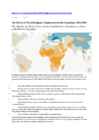
Why Muslims Are Rising Fastest and the Unaffiliated Are Shrinking as a Share of the World’s Population The religious profile of the world is rapidly changing, driven primarily by differences in fertility rates and the size of youth populations among the world’s major religions, as well as by people switching faiths. Over the next four decades, Christians will remain the largest religious group, but Islam will grow faster than any other major religion. If current trends continue, by 2050 … The number of Muslims will nearly equal the number of Christians around the world. Atheists, agnostics and other people who do not affiliate with any religion – though increasing in countries such as the United States and France – will make up a declining share of the world’s total population.
Good morning ladies and gentlemen! Im going to talk about Business in Estonia. I`ve divided my talk into three parts. First Im going to give a short overview of the Estonian business. Second Im going to talk about studying business in Estonia and third Im going to talk about business in industrial sector. FIRST: Estonia is a relatively small country in the northern part of Europe. Estonia is strategically placed in the business corridor, between the Scandinavian countries (EU) and other eastern European countries, including Russia. Estonia has suffered from economic Chrisis as many ohter European countries and compared to ohter bigger countries like Spain and Greece, Estonia has managed to recover from the Chrisis quite well. The number of
Estonia) © Copyright: Wolfgang Drechsler 2005 Within the public sphere, the most important reform movement of the last quarter of a century has been the New Public Management (NPM). It is of particular interest in the post-autistic economics (pae) context because NPM largely rests on the same ideology and epistemology as standard textbook economics (STE) is based (for my take on this, see Drechsler 2000), and it has had, and still has, similar results. Already more on the defensive within public administration (PA) than STE is within economics, NPM also shows that such major paradigm shifts in theory and policy may actually happen. In addition, it occasionally appears that pae-oriented scholars have overlooked the fact that some features in public management reform, state organization, and the economic interpretation of state functions that they advocate
...................................................................................................... 10 2 Introduction. Years ago countries didn’t depend so much on imports and also on export. World has so many organizations controlling countries economics like WTO, The European Union, OPEC, NAFTA, ASEAN, APEC, MERCOSUR, CEEAC, IMF, World Bank and so on. Nowadays because of globalization there are large corporations like Apple, Gazprom and Allianz who rules the world and control the economic outcome with big organizations that are roled by influencial countries like China and USA. This essay is about criticism to IMF and World Bank. Critics of the World Bank and the IMF are concerned about the ‘conditionalities’ imposed on borrower countries. Often the conditionalities are attached without due regard for the borrower countries’ individual
the republic is celebrated on February 20. The national flower is cornflower, national bird is barn swallow and national stone is limestone. It is a land of great natural beauty with a long and varied history and rich culture. It has served as a junction of international trade routes for centuries. History. The oldest marks of habitation on the territory of Estonia date from the 8th millennium BC. Fortified settlements were established in the 1 st century BC. The ancestors of Estonians formed several independent states headed by elected elders. Until the beginning of the 13th century Estonia was politically independent. Then began a long chain of occupation and control by foreign powers. In the 1200s the German crusaders converted Estonia into a Christianity by force and took control over South Estonia. In 1219 Denmark conquered Northern Estonia. About a century later, in 1346 Denmark sold its territory to Germany. By the 1500s German nobles owned much of
Kati-Liis Karu 03.01.2011 The euro in Estonia Joining the European Union in 2004 made people in Estonia think about the changing of currency. We had almost six years to get used to the fact that the Estonian kroon is eventually going to end. In that time there was a lot of discussion about whether we should stick to the kroon or change our money to the euro. Lots of people were afraid that they lose their money during the period of transition - this belief was quite popular among people who still remember the time when the Russian rubles were changed into kroons and did lose much money. Luckily there haven't been any complaints yet. The reason I chose this political concern is its contradictoriness. I myself
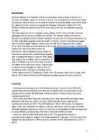
River. Tacitius, the Roman historian, was the first one to mention it (AESTI), while the Arab scholar alIdrisi was the first one to mark it on a map (as ASTLANDA). To the ancient Scandinavians the land was known as EISTLAND; to modern Scandinavians it is known as ESTLAND. Most contemporary languages use the Latin name ESTONIA. FLAG The Estonian blueblackandwhite national flag was originally the flag of the Estonian Student's Society, consecrated in Otepää Church in 1884. today there is a memorial plaque on the church wall commemorating the event. The Flag Museum attracts tourists who take an interest in the history of the flag. After about half a century, during which it was prohibited by the Soviet authorities, the flag was sen again in public for the first time in Tartu. Many elderly people were carrying the flags they had kept in secret hiding places durin the Soviet years; tears were rolling down their cheeks. On 24 February
loudly. What I don't begin to know is the ideal breakdown, according to age, of reading, listening to instruction, and working or hands-on time. What about technology in excess? Before the age of printing and cheap paper, comparatively few people could become learned. Now, theoretically, our electronic age makes learning easier than ever. Well, technology is indisputably better. We can store and retrieve data much more efficiently. We can communicate in a flash. But still, at the basic level, we must be well grounded -- we must possess common sense, civil manners, frank discussion skills, reasoning abilities, and moral fiber. It is possible to be a technological genius, say a computer nerd, without social skills or civil conscience. I'd rather have as a neighbor an illiterate janitor with an easy-going, friendly disposition. Hence, I value what we might call character more than specialist knowledge from an antisocial person. God knows we want
Today more and more disputes are caused by the enormous spread of the English language throughout the world. Some scholars claim that it has already become the first global language. And this statement isn't far from truth. But what does it mean to say that a language is a global language? Why is English the language which is usually cited in this connection? How did the situation arise? And could it change? Or is it the case that, once a language becomes a global language, it is there for ever? [1, pg.2] These are fascinating questions to explore, whether your first language is English or not. A global language is a language that is spoken internationally and is learned and spoken by a large number of people as a second language. A global language is characterized not only by the total number of speakers (native and second language speakers), but also by its geographical distribution, as well as use ininternational organizations and diplomatic relations. [4]
European Union economic 9th May 1951, six Western-Europe countries (Belgium, Italy, Luxembourg, Netherlands, France and Germany) signed a treaty to run their heavy industries coal and steel under a common management. From this economic cooperation agreement, European Union has grown up. For today, the aim of this union has made 180º turn but the reason why more and more countries are joining it is still same to rise the economy. So how does it work? European Union is functioning like an independent country. It collects taxes to reach its objectives. Taxes are collected mainly from member countries GDP (1,1% of countries budget) but as well the import duties on good bought into EU. Also, every member country is paying 0,1%-0,33% of their VAT (value added tax). It is the way how EU gets its budget which is about 120 billion per year. This money is spent mainly to improve
Lee IS has been active since 2002 and during that time has successfully provided a wide range of services and solutions. In the past years the specialty of Lee IS was narrowed down to IS development for specific business domains due to the rising demand and profitability. 2. Business Plan 2.1.Mission Lee IS is set on catering the most effective solution to a given customer and offering the most effective partnership in its support. Effectiveness implies, amongst other things, information being: stored without essential use of paper transmitted without essential burning of fuel processed without essential human labor/endeavor 2.2.Values Simplicity and transparency Taking responsibility for every implemented piece in appreciation of the value of long- term relationships Free and creative thinking precedes rules and standards Confidentiality and respect for others
checks For personal usage everyone may buy goods without limits and extra taxes from a country where it is cheaper. Common money euro enables buyer to compare the prices in member countries where that currency is in use. Travelling to member countries has become simpler because the discomfort and expenses related to changing the currency is forgotten Over two million young people has been studying or practice in some other EU countries via European Union. Union does not decide the content of schooling programs, but guarantee that acquired education and qualification will be accepted in other EU member states. Because pollution doesn't recognize borderlines the member countries of EU have taken common measures in many areas. Therefore it's not surprising that the rivers and beaches of Europe have become cleaner, the mashines pollute less and there have been established strict rules on waste treatment
many Estonian American Socialist and Communist organizations. * The 1920s30s: · Establishment of independent Estonia · Tightening of American immigration laws · Estonian immigration to the United States slowed down dramatically 1924 The Estonian quota fixed at 116; even this small annual quota was not used up *After World War II = In the post World War II years, all three Baltic nations maintained consulates in the United States · About 15,000 Estonians came to the United States · This group was strongly anti-Communist and nationalistic 3. Russian colonization of America. What has preserved from this period to the present? The Russian colonization of the Americas covers the period, from 1732 to 1867, when the Tsarist Imperial Russian Empire laid claim to northern Pacific Coast territories in the Americas. The Russians were primarily interested in the abundance of fur-bearing
A century ago communication across any distance was dependent upon the telegraph or letters. No jets crossed the ocean, no television pictures enabled us instantly to see events in any part of the world, there were no worldwide telephone networks and no computers. It is just a short lifetime since humanity first travelled into space and discovered how fragile our planet looks. FROM FIREWORKS TO THE MOON At first glance you might think that there couldn't possibly be anything common between a 13 th century festival in China and the Apollo 11 moon landing in 1969. However, there is a link and that is that they both relied on the use of rockets. The Chinese first developed rockets by filling bamboo tubes with an explosive made from saltpetre, charcoal, and sulphur. The sealed tubes would be thrown onto fires during celebrations because it was thought that the loud explosions would protect them
Gates, founded of Microsoft; Ted Turner, founded of CNN; Michael Dell, founded of Dell Computers; Steve Jobs, founded of Apple Computer; and Ralph Lauren, founded of Polo. A college education is important for traditional professions, but not for how these people found great wealth. They developed their own successful businesses. So it takes a dream, a lot of determination, a willingness to learn quickly, and the ability to use your God-given assets properly and to know which sector of the CASHFLOW Quadrant to generate your income from. THE DEFINITION OF WEALTH The definition of wealth is: "The number of days you can survive, without physically working(or anyone else in your household physically working) and still maintain your standard of living." For example: If your monthly expenses are $1,000 a month, and if you have $3,000 in savings, your wealth is approximately 3 months or 90 days
In 2006, about 18% of global final energy consumption came from renewables, with 13% coming from traditional biomass, such as wood-burning. Hydroelectricity was the next largest renewable source, providing 3% (15% of global electricity generation),followed by solar hot water/heating, which contributed 1.3%. Modern technologies, such as geothermal energy, wind power, solar power, and ocean energy together provided some 0.8% of final energy consumption. While there are many large-scale renewable energy projects and production, renewable technologies are also suited to small off-grid applications, sometimes in rural and remote areas, where energy is often crucial in human development.Kenya has the world's highest household solar ownership rate with roughly 30,000 small (20100 watt) solar power systems sold per year. Some renewable energy technologies are criticised for being intermittent or unsightly, yet the market
Introduction Estonia, officially the Republic of Estonia (Estonian: Eesti or Eesti Vabariik) is a country in the Baltic region of Northern Europe. It is bordered to the north by Finland across the Gulf of Finland, to the west by Sweden across the Baltic Sea, to the south by Latvia (343 km), and to the east by the Russian Federation (338,6 km). The territory of Estonia covers 45,227 km² and is influenced by a temperate seasonal climate. The Estonians are a Finnic people closely related to the Finns, with the Estonian language sharing many similarities to Finnish. The modern name of Estonia is thought to originate from the Roman historian Tacitus, who in his book Germania (ca. AD 98) described a people called the Aestii. Similarly, ancient Scandinavian sagas refer to a land called Eistland, close to the German term Estland for the country. Early Latin and other ancient versions of the name are Estia and Hestia. Until the late
introduced: the racoon dog, the American mink and the muskrat. A couple of species have been re-introduced The European beaver, who was hunted to extinction by the end of the 19th century. A vital population of them now exists in Estonia once again. Another re- introduced species is the red deer. An attempt has been made in Estonia in recent years to disperse the population of wolves, encouraging their spread in areas where their colonies have disappeared, and restricting their numbers in other places where it is too high. About 350 bird species have been recorded in Estonia. More than 200 of them breed in Estonia. Due to the vast preserved natural landscapes, large raptorial birds, such as the golden eagle and eagle owl have made Estonia their home. It is the small islets, however, that can really be called bird paradise. Undisturbed by man and protected from most smaller predators by the sea, they are real nesting sanctuaries for a diversity of birds.
when the UN Charter had been ratified by a majority of the original 51 Member States. The day is now celebrated each year around the world as United Nations Day. The purpose of the United Nations is to bring all nations of the world together to work for peace and development, based on the principles of justice, human dignity and the well-being of all people. It affords the opportunity for countries to balance global interdependence and national interests when addressing international problems. There are currently 192 Members of the United Nations. The Aims of the United Nations: -To keep peace throughout the world. -To develop friendly relations between nations. -To work together to help people live better lives, to eliminate poverty, disease and illiteracy in the world, to stop environmental destruction and to encourage respect for each other's rights and freedoms. -To be a centre for helping nations achieve these aims. The Principles of the United Nations:
of people from different cultural backgrounds. First and foremost, both coexistence and integration require a high level of tolerance from all those involved. Here, the major obstacle is often xenophobia which may be caused by a wide range of factors. As a rule, xenophobia occurs in big, mostly mono-cultural societies, where strangers are kept at a distance just because they have not been seen around before. On the other hand, xenophobia can result from the hyper-liberal immigration policy in some modern countries. For example France and Sweden which have warmly welcomed a huge amount of immigrants form Asia and Africa during the recent decades. However, instead of striving to integrate with the local population by learning their language and getting to know their culture, they form their own closed community which do not communicate with the indigenous population
Why Estonians work abroad? Many Estonians work abroad because there are more higher remuneration. Peoples go to country , where they want to live , most peoples go to other country because in Estonia are not good wage. Peoples want to get payd good for their job , in Estonia is minimum wage like 350 , but in Finland thats like 1000 or something. Of course Estonians go work to Finland , because they want to get better life. Peoples , who work abroad will get better job and get higher price for it. But it means that , when most peoples go out of Estonia , in 10 years maybe Estonian companies will broke up. Many peoples go work abroad , because in Estonia they dont get not enough wage.Estonians can cause difficulties when working abroad, finding the place, and they can be wickedly exploit.
cost of utilities utilities European Union / EFTA Russia Turkey/Middle East 5. Government incentives 5. Government incentives Social Social security security benefits benefits 4. Educated & skilled workforce 4. Educated & skilled workforce .80 Tax Tax benefits
Estonian history between 1710-1850 and 1850-1918 Contents Contents.................................................................................................................................. 2 17101850.............................................................................................................................. 3 Population and social structure........................................................................................ 4 Serfdom and the intensifying manorial economy ............................................................. 4 Influences of Pietism and the Moravian Brethren............................................................. 5 Enlightenment and enlightened absolutism...................................................................... 6 18501918..................................
PIL regulates relations between states. Thats why PIL is important for international relation students. PIL influences the life of everybody, it doesn't regulate people directly but indirectly (through the decisions of the states), because it's everywhere. It's like air. E.g. when you want to send a letter to Brazil, you put a stamp from your own country and send it from your post office and the letter gets delivered. Why is this so easy, because there are certain international conventions that regulate postal services. E.g. traffic signs are almost the same everywhere, why? Because of certain int conventions that require the states to have more or less unified traffic signs. States apply international regulations to national regulations and they have to be in accordance with each other, the states can always specify these regulations. Therefore, PIL regulates people indirectly.
 annaabi.ee