 10 punkti
Autor soovib selle materjali allalaadimise eest saada 10 punkti.
10 punkti
Autor soovib selle materjali allalaadimise eest saada 10 punkti.
 ~ 5 lehte
Lehekülgede arv dokumendis
~ 5 lehte
Lehekülgede arv dokumendis
 2017-02-09
Kuupäev, millal dokument üles laeti
2017-02-09
Kuupäev, millal dokument üles laeti
 1 laadimist
Kokku alla laetud
1 laadimist
Kokku alla laetud
 1 arvamus
Teiste kasutajate poolt lisatud kommentaarid
1 arvamus
Teiste kasutajate poolt lisatud kommentaarid
 Nikolai Kopli
Õppematerjali autor
Nikolai Kopli
Õppematerjali autor
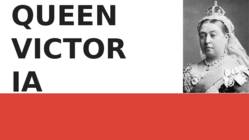
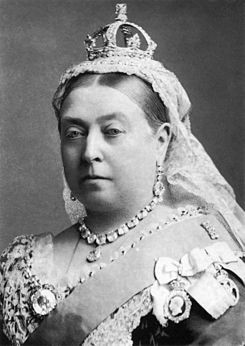
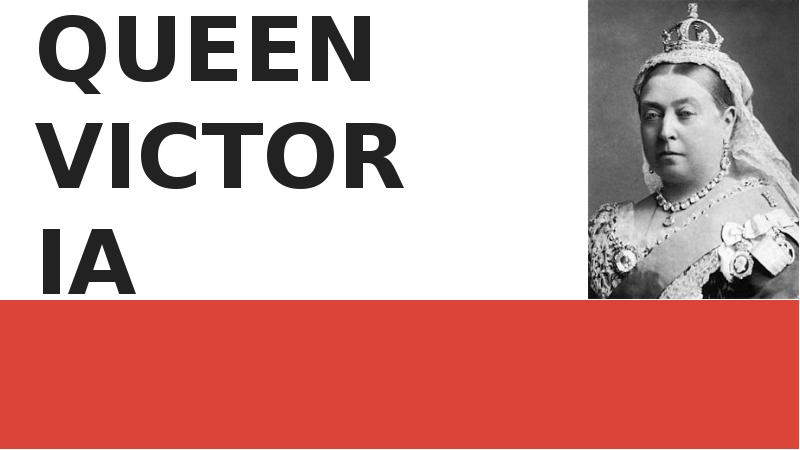
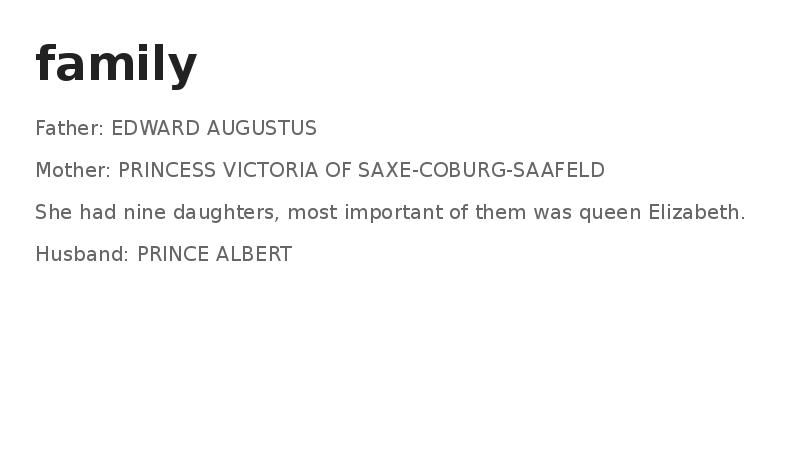
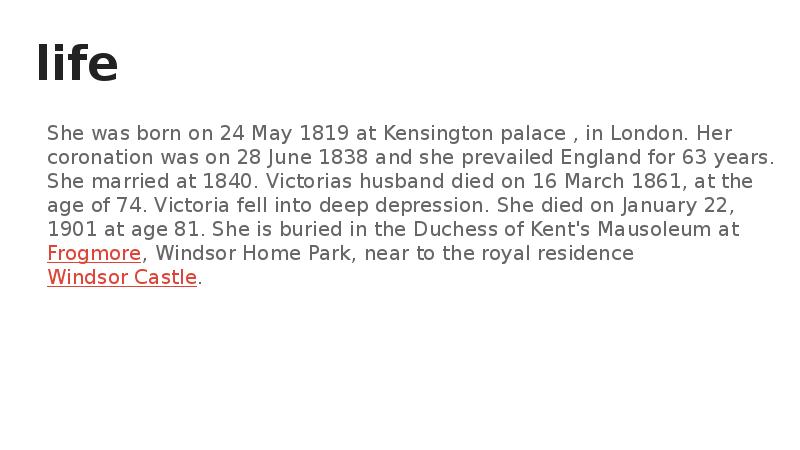
QUEEN VICTORIA & HER TIME Project Mari Murakas Class 11A 2011 Early life of Queen Victoria Victoria was born in London on 24 May 1819, the only child of Edward, Duke of Kent, and Victoria Maria Louisa of Saxe-Coburg. [1] The Duke of Kent was the fourth son of George III and Victoria Maria Louisa was the sister of King Leopold of Belgium. The Duke and Duchess of Kent selected the name Victoria but her uncle, George IV, insisted that she be named Alexandrina after her godfather, Tsar Alexander II of Russia. [2] Victoria's father died when she was eight months old. The Duchess of Kent developed a
Kadri Laur PRG 11B. 26.05.07 Queen Victoria and Victorian England (Queen Victoria is supposed to have said this as a 10-year-old girl on learning that she was likely to become queen in the future: I will be good.) VICTORIA (r. 1837-1901) Victoria was born at Kensington Palace, London, on 24 May 1819. She was the only daughter of Edward, Duke of Kent. The Duke and Duchess of Kent selected the name Victoria but her uncle, George IV, insisted that she be named Alexandrina after her godfather, Tsar Alexander II of Russia. Edward died when Victoria was eight months old, upon which her mother enacted a strict regimen that shunned the courts of Victoria's uncles, George IV and William IV.
Mary I Mary I, called Mary Tudor (1516-1558), Queen of England (1553-1558). Mary was born in London on February 18, 1516, the daughter of Henry VIII by his first wife, Catherine of Aragón. Because Henry divorced Catherine, Mary was declared illegitimate. Nonetheless, Henry included her in his will, and on the death of her half-brother, Edward VI, on
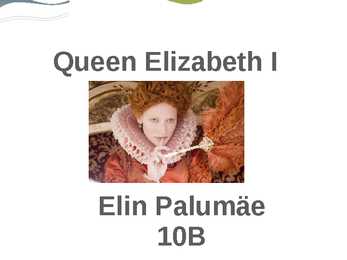
Queen Elizabeth I Elin Palumäe 10B Elizabeth I Reign - 17 Nov. 1558 24 March 1603 (44 years) Coronation - 15 January 1559(25 years) Predecessor - Mary I Successor - James I House - House of Tudor Father - Henry VIII Mother - Anne Boleyn Born - 7 September 1533 Greenwich, England Died - 24 March 1603 (aged 69) Burial - Westminster Abbey Anne Boleyn Queen consort of England Mother of Elizabeth I Tenure - 28 May 1533 17 May 1536 Coronation 1 June 1533 Anne Boleyn was Queen of England from 1533 to 1536 as the second wife of Henry VIII of England and the 1st Marquess of Pembroke in her own right for herself and her descendants. House - House of Tudor Father - Thomas Boleyn, 1st Earl of Wiltshire Mother - Lady Elizabeth Howard Born c.1501/1507 Blickling Hall/ Hever Castle, England Died 19 May 1536 (aged 29-35)Tower of London Religion - Anglican, formerly Roman Catholic King of England Henry VIII Reign - 21 April 1509 28 January House - House of Tudor
4. Latin influence on English *The influence of Latin is noticeable also in the names of European cities: the Latin noun colonia (settlement, colony) may be found in numerous place-names: Lincoln, Colchester, Cologne ; from Latin word castrum (military camp) were derived English affixes -chester and -castle: Manchester, Lancaster, Newcastle; Latin word portus (seaport) in Portsmouth *-tor - person, doer, masculine form. The suffix is attached to the stem: victor (`winner', from the verb vincere `to win'), spectator (spectare). *-orium - place, where the activity marked with the verb occurs: dormitorium (dormire `to sleep'). In English the suffix is -ory: dormitory. *tas - it denotes an abstract notion, derives from the adjective: celebritas (celeber), libertas (liber), universitas (universus). In English the suffix is -ty: celebrity, liberty, university.
Civil war was ended in 1651 and led to execution of Charles I. After that the commonwealth of Britain became but most of the people took Oliver Cromwell as a dictator. So he was killed. After that monarchy was restored in England and Charles II became king. When the commonwealth was in England he escaped, so he survived it. The House of Hanover It succeeded the House of Stuart as monarchs of Great Britain and Ireland in 1714 and held that office until the death of Victoria in 1901. They are sometimes referred to as the House of Brunswick and Lüneburg, Hanover line. First ruler of the Hanovers was George I. He was a good ruler but he did not do many things. Biggest threat to his throne was The Scottish Jocobite Rebellion. It was the attempt of Stuart restoration but it failed. When the Hanovers ruled there was the Napoleon war and also conolization was done all over the world. Biggest names of the time are of course Horatio Nelson and James Cook.
names and faces, the line of succession to the throne, and even the family's rarely- used last name. But let's start from the beginning. The House of Windsor is the reigning royal house of the United Kingdom and the other Commonwealth realms. The dynasty is of German paternal descent and was originally a branch of the House of Saxe-Coburg and Gotha, itself derived from the House of Wettin, which succeeded the House of Hanover to the British monarchy following the death of Queen Victoria, wife of Albert, Prince Consort. The name was changed from Saxe-Coburg and Gotha to the English Windsor (from "Windsor Castle"[1]) in 1917 because of anti-German sentiment in the British Empire during World War I.[2] There have been four British monarchs of the house of Windsor to date: three kings and the present queen, Elizabeth II. During the reign of the Windsors, major changes took place in British society. The British Empire participated
Catholic while the Protestants were being murdered, Parliament was so angered that it invited the Protestant William of Orange and Mary (James II's daughter) to take the Crown. This Glorious Revolution (1688) was accompanied by a Bill of Rights, which made it obligatory for the sovereign to rule with Parliament's assistance and outlawed Catholicism for all Englishman, including the King. In 1707 the Act of Union united English and Scottish Parliaments. The last monarch of the Stuarts was Queen Anne. The House of Hanover At the beginning of the 18th century the English parliament asked George of Hanover, a Protestant descendant of James I, to become king. George I was a controversial king who spent most of his time in Hanover, leaving the country in the care of the Cabinet. This was eventually headed by Sir Robert Walpole, Britain's first Prime Minister and the first to live at 10 Downing Street. During the reigns of George I and George II, Parliament assumed almost
 annaabi.ee







Kaasa seilasid Maarja-Liis Ilus, Liisi Koikson, Marko Matvere ja ansambel Udupasun. (Y)
Kõik kommentaarid