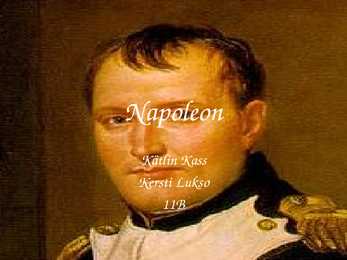
between royalists, revolutionaries, and Corsican nationalists · conflict with Pasquale Paoli · appointed artillery commander of the French forces besieging Toulon Early Career · imprisoned in the Chateau d'Antibes in August 1794, but was released within two weeks · engaged to Desiree Clary Coronation as Emperor · the arrest of Duke of Enghien · crowned himself Emperor in1804 · was crowned King of Italy · declared the Papal States War of the Third Coalition · Royal Navy · Grande Armee · Battle of Trafalgar · Napoleon defeated Austria and Russia at Austerlitz Thank you for listening!
Himself His birth name was Michelangelo di Lodovico Buonarroti Simoni, but commonly known as Michelangelo. He was born on March 6th 1475 Caprese near Arezzo, Republic of Florence. Today, Caprese is known as Caprese Michelangelo. A young boy Michelangelo was sent to Florence to school. The young artist showed no interest in his schooling, preferring to copy paintings from churches and seek the company of painters. He was fantastically gifted. He died on February 18th 1564 in Rome, Papal States when he was 88 year-old. Michelangelo was an Italian sculptor, painter, architect and poet and engineer of the High Renaissance. He field sculpture, painting, architecture and poetry. He is the best-documented artist of the 16th century. He told his apprentice, Ascanio Condivi: "However rich I may have been, I have always lived like a poor man." Works Two of his best-known works, the Pietà and David, were sculpted before he turned thirty.
tillukese nöbininaga tütarlaps. Ta oli meeter kuuskümmend pikk ja kaalus 64,3 kg. Võimlas õblukese Evelyni ja kõhetu Sabine kõrval tundis Greeteke end kohutavalt priskena, hullemana kui mõni pontsik. Kodus mamma, papa, Hansukes ja Tirsu kõrval tundis ta end pigem saleda ja sihvakana. Kõigil Sackmeieridel olid omad veidrused. Greetekese mammala oli kombeks oma pulloveri puusatelt alla poole tõmmata, et oma pekkivolte varjata seda tegi ta umbes sada korda päevas. Papal oli aga vuntsikiiks. Ta keeras nendest alalõppmata kaarekesi ja sabakesi. Hansuke oli Greetekese 12.a vend, kes tundis end hästi, üksnes siis, kui oli vasaku nimetissõrme paremasse ninasõõrmesse toppinud. 6.a Tirtsul veidrusi veel ei olnud. Arvatavasti oli ta nendeks veel liiga väike. Greetekesel endal oli kohe mitu veidrat harjumust. Talle meeldis oma spanjelpruune juuksesalke näksida ning ta punus nendest tuka sisse väikseid patsikesi. Ta sikutas oma sõrmi, kuni liikmed naksusid
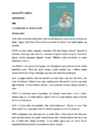
Characters Robert Langdon A professor of symbology at Harvard University and the main protagonist of the novel. He is flown to CERN to help investigate the murder of Leonardo Vetra. Vittoria Vetra The adopted daughter of Vetra. She, like her father, works with CERN. Her research focuses on biology and physics. The reader learns early in the novel that Vittoria worked with her father in their research of antimatter. Camerlengo Carlo Ventresca The Camerlengo (Papal Chamberlain) during the conclave. He murdered the pope, who is later revealed to have been his biological father. Other book characters: Leonardo Vetra, Cardinal Saverio Mortati, Commander Olivetti, Captain Rocher, Hassassin In May 2009 released film Thank you for your attention By Alina Semjonova
Õigemini ta tahtis koeraputkat, mille ta oleks ka võinud mõnelt koolipoisilt tellida aga tal oli väimees, kes sellega piisavalt hästi hakkama sai. Ta ei saanud ehitust iniseneri hoolde jätta, sest tihti juhtus äpardusi. Inseneri härral ei olnud tööd. Vestmanil läksid kõik asjad korda peale ühe, ta maksis väimehe eest liiga soolasi hinda. Vestman oli sellepärast kurb, et Sander pakkus külakoolmeistritele konkurentsi. Matilde ütles ka sõna sekka ja ei lubanud papal Ludvigit kiusata, kuna ta pidid töötama oma raamatu kallal. Vestmanile meeldiks see, kui tema väimehest räägitakse avalikult. Ludvig ei olnud oma raamatuga kuigi kaugel. Ta ei saanud raamatut kirjutada, teda segati koguaeg-kord papa siis Matilde. Võibolla ilmub raamat kevadeks vastas Sander. Ta on junma kolm aega lubanud, millal raamat peaks ilmuma, külaelanikud ka juba ootavad seda ja ei usu enam, et raamat ilmub
Põhimõtteks oli "Kelle maa, selle usk", s.t iga vürst määras oma alamate usu Philipp Melanchthon Lutheri sõber "Praeceptor Germaniae" ehk "Saksamaa õpetaja" panus haridusse (õpikute ja koolikorralduste koostamine, gümnaasiumide ja ülikoolide asutamine) "Usk on kultuuri süda" esitas 1521. aastal esimese luterlaste usu süstemaatilise esituse teose Loci communes (ühised mõisted) Abistas Piibli tõlkimisel Print shows Luther burning papal bull of excommunication, with vignettes from Luther's life and portraits of Hus, Savonarola, Wycliffe, Cruciger, Melanchton, Bugenhagen, Gustav Adolf, & Bernhard, duke of Saxe-Weimar. 1 print : lithograph, color. Lutheri panus haridusse Reformatsioon tõi kaasa rahvakoolide laia leviku ja koos sellega kirjaoskuse kasvu Luther leidis, et andekatele tuleb anda rohkem haridust. Nt lõi kirjaoskuse levik eelduse nii mõnelegi andekale noorele läbimurdeks kõrgemate
Papa, Kertu ja Stennu vanemad oli väga mures. Õnneks saabusid päästjad viimasel minutil ja kõik sai päästetud. Kaldal andsid lapsed selgitusi. Nad seletasid, et leidsid kirja ja pildi, mille Sten- Erik oli tasku pannud ja otsustasid mängida mereröövleid. Ta näitas kirja ja pilti ka teistele. Kõik imestasid. Isa avastas, et kirja saatja oli tema isa, kes Siberisse saadeti ning Papa tundis vanaisa sõjaväe aegadest. Vanaisa Johannes oli kirjas lubanud majas elada edasi Papal, kui ta tagasi ei peaks tulema. Isal hakkas kahju ning lepiti kokku, et keegi koli välja. Papa hoiab maja korras, valvab lapsi kui Sten- Eriku vanemad on tööl. Lõpuks otsustati ka koerale nimi panna, tundub, et koer jääb neile alles. TEOSE VÄÄRTUS Teos peegeldab erinevaid sotsiaalseid tasandeid, mida on raske lastele selgitada. Raamat on selle tundma õppimiseks väga hea vahend. Lisaks täiendab Hanno laste sõnavara väljenditega, mida teistest raamatutest ei pruugi leida
The 1st was Martin Luther's posting of his Ninety-five Theses on a church door in Wittenberg, Germany, in 1517, an act which heralded the Reformation. The 2nd event was brought about by the desire of Henry VIII for a male heir and his wish to divorce Catherine of Aragon, who had borne only one child, Mary. When the Pope refused to end the marriage, Henry, with an eye also to seizing the vast and wealthy holdings of the Church, overthrew papal jurisdiction, married Anne Boleyn, and was declared, with Parliament's help, head of the English Church. Thus England became a Protestant nation. 8. Why was the time of Queen Mary's reign a troubled time? Mary was a devout Catholic. Her attempts to restore Catholicism to the country resulted in internal turmoil and much bloodshed. 9. In what way was Elizabeth I able to keep peace and order in the country? Under Elizabeth, order was restored and England entered upon her most glorious age.
Main claim 2000 euros b. And final claim 4000 euros 6. Probate - the legal process of deciding if a person's will has been made correctly and if the information it contains is correct 7. Divorce - an official or legal process to end a marriage a. Custody for mothers b. Fathers need to pay alimony c. Visitation right for fathers – külastusõigus isale 8. Canon law - ecclesiastical law, especially (in the Roman Catholic Church) that laid down by papal pronouncements a. Ecclesiastical – kiriku-, kiriklik, kristlik b. Papal – paavstilik, paavstiga seonduv c. Pronouncement - väljakuulutamine 9. Will (land)- used to talk about what is going to happen in the future, especially things that you are certain about or things that are planned a. Begueath testament b. Testament dispositions – testamentlikud korraldused c. Holograph form – testament peab olema kõik käsitsi kirjutatud 10
man should be hanged twice for the same offense. In midevil times most of the people were alliterate. The greatest writer of the time was Chaucer, who wrote many poems and verse and also wrote literature. Another tale tells of William Tell, who shot an arrow through an apple while standing on his son's head. The Renaissance was an age in which more individuals felt the value of their human being. Martin Luther was nailed to the church door at Wittenberg for selling papal indulgences. He died a horrible death, being excommunicated by a bull. It was the painter Donatello's interest in the female nude that made him the father of the Renaissance. It was an age of great inventions and discoveries. Gutenberg invented the Bible. Sir Walter Raleigh is a historical figure because he invented cigarettes. Another important invention was the circulation of blood. Sir Francis Drake circumcised the world with a 100-foot clipper.
The Summoner brings persons accused of violating Church law to ecclesiastical court. This Summoner is a lecherous man whose face is scarred by leprosy. He gets drunk frequently, is irritable, and is not particularly qualified for his position. He spouts the few words of Latin he knows in an attempt to sound educated. The Pardoner (est: INDULGENTSIMÜÜJA): Describe his personality and looks? How did he make his money? How religious was he? Pardoners granted papal indulgences--reprieves from penance in exchange for charitable donations to the Church. Many pardoners, including this one, collected profits for themselves. In fact, Chaucer's Pardoner excels in fraud, carrying a bag full of fake relics--for example, he claims to have the veil of the Virgin Mary. The Pardoner has long, greasy, yellow hair and is beardless. These characteristics were associated with shiftiness and gender ambiguity in Chaucer's time.
His Dialogue Concerning the Two Chief World Systems, Ptolemaic and Copernican, was cleared by Church censors, one of whom was Galileo's former student, and was published at Florence in 1632. As the title suggests, Galileo grounded his manifesto in the form of a dialogue rather than a treatise. The dialogue, Galileo reasoned, was a device through which an argument for Copernican theory could be made without violating the papal decree of 1616. Two of the conversants Salviati and Sagredo are sympathetic to Copernican theory. Simplicio, the third participant, represents Aristotle and the Scholastics and is presented as fool. Galileo's enemies were quick to inform the Pope that the official cosmology of the Roman Catholic Church had been put in the mouth of Simplicio. The Pope ordered an investigation and so in August 1632, less than six months after it
Ta nagunii käis üle päeva valdades. Luurajad andsid infot edasi morsega. Virve oli tavaliselt see, kes hoidis nendest teisi inimesi eemal. See luureaparaat on siiani soo põhjas, millega infot edastati. Luurajad mängisid Virvele kavalere. Hiljem oli papaga neil siuke kokkulepe, et poisid võisid külas käia. Nende poiste eesnimed olid varjunimed. Virve teadis ainult ühe poisi õiget nime ja elukohta. Eestlased olid vabad ja võisid vabalt liikuda talust tallu. Papal jäi Venemaale minemata kuna riigipiir pandi kinni. Keeled on minu vanavanaema jaoks rasked olnud. Isegi eesti keele kirjutamine on olnud talle raske. See on tal selgeks õpitud. Lõuna-Eestis on ju suhteliselt palju murret. Virve abiellus Heino Kännuga. Heino oli pikk poiss, iga töö peale valmis, väga lahtiste kätega. Ta tegi tööd siis kui pidi, ega ta eriti ei viitsinud, aga kui tegma hakkas, siis tegi kiirelt ja hästi. Heino sündis 13 juuli 1927 ja suri 1962 aasta mais
the site of the present cathedral. However, a serious conflict with the Order of the Brothers of the Sword broke out soon as the latter wanted to gain control of the entire Estonia. The order succeeded in subordinating Tallinn and the whole of North Estonia to its rule in 1227. The monks of the Dominican Order began the construction of a stone church in Toompea in 1229. The first written data on the cathedral date back to 1233, the date of a battle between the order and the pro-papal vassals, who attempted for the last time to turn Tallinn into the centre of the ecclesiastical state, and were defeated. According to the records, the battle had spread to the interior of the church and the bodies of the fallen knights had piled at the altar. The resettling of the Dominican monks from Toompea to downtown was one of the results of the battle. Having acquired North Estonia again in 1238, King Valdemar of Denmark appointed
Highly efficient tax system, real rulers were advisors and noblemen Harold Godwinson The last Anglo-Saxon king, nominated as successor by Edward Strong ruler, skilled general Defeated the Norman invaders, was killed in the battle of Hastings William the Conqueror took his place The Battle of Hastings 1066 Edward had promised his throne to William, Harold swore an oathe but was elected as a king William took a crusade against him with papal blessing Battle took place betwwen Anglo-Saxon army by Harold, and Norman army by William Eng army was exhausted from fighting with Harold Hardrada of Norway and they, strong at first, fell. Ther Norman Conquest Started in 1066, risings against Norman rule every year from 1067 to 1070 The Normans had live like an occupation unit, build castles New ruling class, culture, language- French Higly developed feudals ystem, royal power
The tradition and style of the Roman Empire still dominated, but slowly the peculiar medieval book culture emerged. Before the invention and adoption of the printing press, almost all books were copied by hand, which made books expensive and comparatively rare. Smaller monasteries usually had only a few dozen books, medium-sized perhaps a few hundred. By the 9th century, larger collections held around 500 volumes and even at the end of the Middle Ages, the papal library in Avignon and Paris library of Sorbonne held only around 2,000 volumes. 3/15 Burgundian author and scribe Jean Miélot, from his Miracles de Notre Dame, 15th century. The scriptorium of the monastery was usually located over the chapter house. Artificial light was forbidden for fear it may
Chapels, shops, tollhouses, and towers adorned fortified bridges such the 1355 Pont Valentré at Cahors (France) or the Monnow Bridge (1272, 1296) at Monmouth, Wales (UK), which were built with defensive ramparts, firing slits, and drawspans. Christian religious orders formed after the fall of the Roman Empire greatly assisted travellers by building bridges. In western and central Europe, religious groups managed popular financial institutions, with Papal sanction, both for bridge construction and for hospitals. The influence of these groups lasted from the end of the 12th to the early 14th century, and their perseverance ensured the construction of major bridges over wide rivers as the Rhône and the Danube. The bridge over the Rhône at Avignon (1187), for example, a wooden deck on stone piers, was built by such an order under the inspired vision of a young shepherd, later canonized as St Bénézet for his accomplishment
over the question of the supremacy of courts. Henry claimed that the clerks should be tried in royal courts. To his surprise, Becket refused to agree. Becket fled to France after defying Henry. Four foolish knights seeking to please the king, killed Becket in front of the altar, where he was praing. However, Henry was very sad to hear about his friends death. *The Anglo-Norman invasion of Ireland, the Pale King Henry II gained papal approval to invade Ireland. However, the invasion of Ireland was not motivated by religion. The invasion force captured Wexford on the Norsemen. Despite the ongoing negotiations Dublin fell and the establishment of a small Anglo-Norman colony, known as The Pale, marks the start point of foreign rule over Ireland. Without too much of a fight all Irish kings gave in to Henry II. The Anglo-Norman authority outside the protected colony, The pale, was non- existent
Soro, who was perhaps the West's first great cryptanalyst. Soro, appointed cipher secretary in 1506, enjoyed remarkable success in solving the ciphers of numerous principalities. His solution of a dispatch of Mark Anthony Coloana, chief of the army of the Holy Roman Emperor Maximilian I, requesting 20,000 ducats or the presence of the emperor with the army, gave an insight into Colonna's problems. So great was Soro's fame that other courts sharpened their ciphers, and as early as 1510 the papal curia was sending him ciphers that no one in Rome could solve. But Venice had no monopoly. In 1589, Henry of Navarre, who was destined to become the most popular king in the history of France (he coined the slogan "A chicken in every peasant's pot every Sunday"), ascended to the throne as Henry IV and found himself embroiled still more fiercely in his bitter contest with the Holy League, a Catholic faction that refused to concede that a Protestant could wear the crown
Köler ka. Ja mina ei usu mitte, et armas jumal laseks Vene keisri põrgu minna. Milleks siis jumal ta laskis keisriks saadagi, kui ta ikkagi peab põrgu minema! Tee inimesest keiser ja siis anna ta kuradi kätte." ,,Jäta juba kord oma targutused ja mine," ütles pr. Malmberg. ,,Ära võta keisri nime oma suhu, sest sa tead, mis papa selle kohta ütleb: see on poliitika ja poliitikast ei pea rääkima." ,,Papal on ju kõik poliitika ja millestki ei tohi rääkida," vastas Ramilda. ,,Tema meelest on taevas ja põrgu ka poliitika ja sellepärast ei tohi ma temalt kunagi küsida, kas Köler saab taeva või läheb põrgu." ,,Ei, armas laps, kui Köler läheb põrgu, siis pole sest midagi, las ta aga läheb; aga kui keiser läheb põrgu, siis on see poliitika," seletas pr. Malmberg. ,,Aga kui keiser läheb taeva, kas siis on poliitika?" küsis Ramilda.
 annaabi.ee