Leidsid 33 sarnast õppematerjali, mis on seotud failiga "Natural wonders". Need materjalid aitavad sul teemat sügavamalt mõista.
cave, canyon, located, years, grand, meters, mount, vesuvius, north, iran, formed, caves, walls, extend, several, deep, lakes, east, italy, volcano, within, hundred, carved, river, period, miles, depth, than, cliffs, moher, parish, county, clare, ireland, highest· The State Tree is the Western Hemlock. · The State flower is the Coast Rhododendron. The state flag and the state seal are similar. Passed in 1923, Washington state law describes the flag as having dark green bunting with a state seal in the center. It is the only state flag that is green. It is also the only state flag with a picture of a president. Oregon · Oregon is a state in the Pacific Northwest region of the United States. Oregon is located on the Pacific coast between Washington to the north, California to the south, Nevada on the southeast and Idaho to the east. The area was inhabited by many indigenous tribes before the arrival of traders, explorers and settlers. · The Oregon Territory was created in 1848 after American settlement began in earnest in the 1840s. Oregon became a state (33rd) on February 14, 1859. · Oregon enjoys a diverse landscape including a scenic and windswept Pacific coastline,
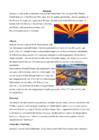
the southwestern corner of Colorado. Climate Southern Arizona is known for its desert climate, with very hot summers and mild winters. Northern Arizonafeatures forests of pine, Douglas fir, and spruce trees; the Colorado Plateau; some mountain ranges (such as the San Francisco Mountains); as well as large, deep canyons, with much more moderate summer temperatures and significant winter snowfalls. There are ski resorts in the areas of Flagstaff, Alpine, and Tucson. In addition to the Grand Canyon National Park, there are several national forest, national parks, and nation monuments. About midway through February, the temperatures start to rise again, with warm days, and cool, breezy nights. The summer months of June through September bring a dry heat ranging from 90120 °F (3249 °C), with occasional high temperatures exceeding 125 °F having been observed in the desert area.November through February
6 stops in the USA Annika Allik 10A Põltsamaa Co-Educational Gymnasium Las Vegas ... is the largest city in Nevada state ... is the largest center for adult entertainment in the entire world The major attractions in Las Vegas are the casinos and the hotels The most famous hotel casinos are located on Las Vegas Boulevard on the portion of that road known as the Las Vegas Strip Fremont street in 1920s and today New York City ... is the most populous city in the United States ... is famous for the Statue of Liberty, Empire State building, United Nations, museums, Broadway theaters, restaurants, Times Square, nightlife and shopping In 2010, New York City had a record number of tourists with 48.7 million Time square in 1922 and 2010
It has summer while we have winter, and the other way round. Sometimes Australia is called the island continent. There is a good reason why. It is an island. It is 1800 miles from the mainland of Asia and almost half way round the world from Europe. More than 6000 miles of ocean separate it from the America. Australia is the world's smallest, flattest and driest continent. It is also the oldest some of the rocks are more than 3,000 million years old. It is the 6th largest country. Its territory is 7 700 000 km2. Australia is an island continent, washed by the South Pacific Ocean, The Australia Sea, the Timor Sea, the Indian Ocean, the Southern Ocean and the Tasman Sea. As a result, its seasons are the opposite of ours. Australia consists of six states, two major mainland territories, and other minor territories. The states are New South Wales, Queensland, South Australia,
The capital city is Washington D.C. Although the United States has no official language at the federal level, English is the de facto national language. English is the most common language for daily interaction among both native and non-native speakers. Spanish is the second language. The largest city is the New York City. The Government is Federal constitutional republic and the president is George W. Bush. 2. Geographical position The United States of America is located on the continent of North America. It has borders with two countries Mexico and Canada. There are also the Atlantic Ocean, the Pacific Ocean and the Gulf of Mexico surrounding the big country. There are 50 states in America. Most of the people live in towns. The biggest state is Alaska; next by size are California, Alaska and Montana. Six states - Maine, Vermont, New Hampshire, Connecticut, Rhode Island and Massachusetts are called New England. They are all small states in the USA that lie in the north- east
Representatives. There are a hundred people in the Senate (two from each state) and 435 people in the House of Representatives. At the head of the Judicial branch is the Supreme Court, which has nine judges. The leading parties in America are the Democrats and the Republicans but there are also other parties. Location The United States of America is situated in the central part of the North American continent. Its western coast is washed by the Pacific Ocean and its eastern coast is washed by the Atlantic Ocean and in the south its coast is washed by the Gulf of Mexico. The coastline is even. There are no big islands belonging to the U.S. except the Hawaiian Islands which lie halfway the continents of America and Asia. The biggest peninsulas are the Florida Peninsula and Alaska. The United States of America has got three neighbours Mexico in the south, Canada in
and it is bordered by three oceans: the Arctic, the Pacific and the Atlantic Oceans. The population of Canada is about 31 million people. About 77% of the people live in cities which lie in a band about 100 miles wide above the border of the United States. The capital of Canada is Ottawa. Other large cities are Montreal, Toronto, Vancouver, Winnipeg and Quebec. 2. Geographical position Canada is a huge country in the continent of North America. It is bordered with the Atlantic Ocean in the east, the Pacific Ocean in the west, the United States of America in the south and the Arctic Ocean in the north. Canada is a vast country, with a territory of 3.8 million square miles of land and fresh water it is the second biggest country in the world after Russia. Canada covers most of the northern part of North America. Canada has over 151,480 miles of coastline
the sixth largest nation, its territory is 7,686,850 sq km and its population reaches today over 20,5 million people. It is the only nation to govern an entire continent and its outlying islands. Australia's capital is Canberra, the only city with its own territory. It was built in the early 1900s just to be the capital. The official language is English and the official name of Australia is the Commonwealth of Australia. Australia is located on the Southern Hemisphere (because of that Australia is also called "A land down under"). 2 . Geographical position Australia is an island continent and it is located between the Indian and South Pacific oceans south east of Asia. From the north it is bordered by the Timor Sea and the Torres Strait. From the east by the Coral Sea and the Tasman Sea. Australia's coastline is about 37,000 km long. The Great Australian Bight washes the southern coast
Canada. Canada is a very big country in the continent of North America. It is about 10 million square kilometres and that makes it the second largest country in the world after Russia. Quebec (the province) is six times as big as the UK. Canada borders the Atlantic Ocean, the Pacific Ocean, the Arctic Ocean and the USA. The capital of Canada is Ottawa and other main cities are Toronto, Montreal and Vancouver. It is a very developed country. Montreal is the largest city and it is called the Paris of North America because most of the people there speak French
the Senate (77 members) and the House of Representatives(148 members). Australia's Flag and Coat of Arms. Australia's flag has a Brittish flag, five stars that represent the constellation Southern Cross and a large star for the country's states and territories. The coat of arms features a kangaroo and an emu, golden whattle blossoms, a shield with the coats of arms of the six states of Australia and a star for the states and territories. Landforms Only 5% of the land is above 600 meters. Most of the land is empty. Most of the people live in the south and in east. 2/3 of Australia is a desert with hills and big saltlakes. The biggest deserts are the Great Sandy Desert, the Gibson Desert, the Simpson Desert, The Great Victoria Desert. The biggest mountain ranges are the Great Divining Range, the Australian Alps, the Blue Mountains and the New England Range. The outback is flat and hot centre of Australia. The nearest neighbor may be a hundred kilometers away
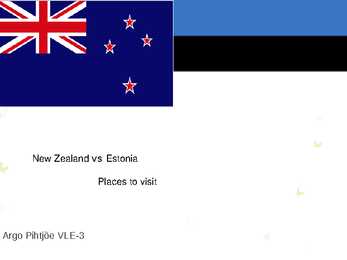
Full name: Republic of Estonia Full name: New Zealand Population: 1.3 million (UN, 2010) Population: 4.3 million (UN, 2010) Capital: Tallinn Capital: Wellington Area: 45,227 sq km (17,462 sq miles) Area: 270,534 sq km (104,454 sq miles) Major languages: Estonian Major languages: English, Maori Major religion: Christianity Major religion: Christianity Life expectancy: 69 years (men), 79 Life expectancy: 79 years (men), 83 years (women) (UN) years (women) (UN) Monetary unit: euro Monetary unit: 1 New Zealand dollar Main exports: Machinery, textiles, wood ($NZ) = 100 cents products Main exports: Wool, food and dairy GNI per capita: US $14,060 (World products, wood and paper products Bank, 2009) GNI per capita: US $26,830 (World Bank, 2009) Top ten places to visit in
No one knows when the pizza was invented, but the people of Naples made it populaar. · Most of Italy's natural flora and fauna has disappeared due to centuries of cultivation. Most of its natural wildlife has also disappeared due to over-hunting · No other country in Europe has as many volcanoes as Italy. This is because the Italian peninsula stands on a fault line. Three major volcanoes (Etna, Stromboli, and Vesuvius) have erupted in the last hundred years · The world's first operas were composed in Italy at the end of the sixteenth century. HOLLAND/ Neatherland · Holland has the highest museum density in the world, with almost 1000 museums. The Van Gogh Museum and the Kröller-Müller Museum of Holland house the largest Van Gogh collections in the world. · Hollanders usually have a bunch of flowers in their living rooms. · The landscape of Holland is dotted with windmills, which have become its hallmark.
Vancouver, Winnipeg and Quebec. Canada has two official languages English and French. It's interesting to know that about 61% of Canadians name English and 24% French their mother tongue. There are also many other languages spoken in Canada such as: Italian, Chinese, German, Polish, Ukrainian, Greek and Dutch. There are also many native languages such as Algonquian. The British and the French as the main settlers from Europe fought for hundreds of years before they managed to build up a country which was based on recognizing the cultural diversity of different nations in Canada. All the communities living in the country are encouraged to remember their origins and hold their own ethnic events and national festivals. Cultural diversity makes Canada even more interesting. In spite of this, in recent years there is a strong movement in French-speaking Quebec to become an independent country.
Like the US and Canada, Australia was an English speaking colony of Great Britain. Today Australia is a modern developed country with a diversified economy. Australia is an island continent of 7.7 million square kilometres, which makes it a little smaller than the USA. Located in south of Asia, between The Pacific and Indian Oceans, Australia is the World's driest continent. Although large areas of the centre are desert, Australia has a wide range of climate from tropical in the north to temperate in the south east, where it frequently snows in winter. Geographical position The coasts of Australia are surrounded by the Pacific Ocean, the Indian Ocean and the Southern Ocean. Four seas are surrounding Australia, which are the Timor Sea and Arafura Sea in the north of Australia, the Coral Sea in the north-east of Australia and the Tasman Sea, near the island of Tasmania, in the south-east of Australia. Government
written in 1814 by Francis Scott Key. There are 6 time zones. From east to west they are: Eastern Standard Time, which is 5 hours behind Greenwich Time, Central Standard Time, Mountain Standard Time, which is 7 hours behind Greenwich Time, Pacific Standard Time. Alaska and Hawaii have their own time zones: Alaska Standard Time and Hawaii Standard Time. Geographical Position The USA lies in the Northern Hemisphere in North America. It covers a big part of the continent and is also the third largest country in the world. The country consists of 50 states, but two of them lie separately. One of them is Alaska, which is near the Arctic Circle. And the other state is Hawaii, which is a group of island is the Pacific Ocean. The USA shares the border with Canada in the north and Mexico in the south. In the east the coast is washed by the Atlantic Ocean and in the west by the Pacific Ocean
Tallinn English College Report of Canada 8a Teacher: Merike Sisask Composer: Kärt Kalvet 2010 Canada, Kärt Kalvet 8a Canada General Information Canada is in North America. It's area is 9220970 sq km. Canada's population is 313.612.000 people. Canada is divided into 10 provinces and 3 territories. The capital of Canada is Ottawa. Canada has constitutional monarchy. The head of state in Canada's government is the Queen of England. There are two main languages in Canada: English and French. Canada's curreny is Canadian dollar (1 dollar=100 cents[Can$]). The highest peak of Canada is Mount Logan, 5959 metres. The lowest point is sea level
If you want to make clear that you are speaking about the country, you may call it the Commonwealth of Australia. It’s the official name of the country. Australia is the smallest continent, but one of the largest countries on Earth. It’s 6th largest country. Its area is about 7.6 million sq km. One third of it is occupied by deserts. It’s both the flattest and, except for Antarctica the driest. Neighbouring countries include Indonesia, East Timor and Papua New Guinea in the north, the Solomon Islands, Vanuatu in the northeast, and New Zealand in the southeast. Its capital is Canberra. Other big cities are Melbourne, Sydney, and Brisbane. National language in Australia is English. Monetary unit is Australian dollar. Their national holiday is on the 26th of January. In 1788 on the 26th of January the first fleet arrived at Botany Bay and established a penal colony near modern-day Sydney. Geographical Position Australia is located in the Southern Hemisphere. It’s the
such as orangutangs. Animals are also killed for fur(tigers, leopards, cheetahs) *Climate change: It has been recently suggested that warmer global temperatures may be affecting animals. In fact, it has been suggested that the golden toad became extinct because of the warmer climate. The Animals *T-REX: Tyrannosaurus rex was one of the largest land carnivores of all time. His weight was about 7 tons.He had a massive skull balanced by a long, heavy tail. Fossils of T. rex have been found in North American rock formations. More than 30 specimens of T. rex have been identified, some of which are nearly complete skeletons. He became extinct 65 million years ago. *QUAGGA: One of Africa's most famous extinct animals, the quagga was a subspecies of the plain zebra. The quagga was hunted to extinction for meat. The last wild quagga was probably shot in the late 1870s, and the last specimen in captivity died on August 12, 1883 at the Artis Magistra zoo in Amsterdam.
democracy. The Parliament consists of two houses: the 76-member Senate and the 148- member House of Representatives. The Prime Minister is elected by the House of Representatives and the Cabinet. The current Prime Minister is Kevin Rudd. History, discovery: Though nobody had seen it, people thought long before the seventeenth century, that there was a land in the southern ocean. It was called the Unknown South Land. But more than 60 000 years before the arrival of the European settlers, Aboriginal people inhabited most areas of the nowadays Australian European settlement. There were estimated 300,000 Indigenous Australians living on the continent. The Dutch navigator Janszoon was the first to find the South Land. He sighted the coast in 1606. Then Abel Tasman visited an island off the southern coast of Australia in 1642 and the island was named Tasmania after him. In 1770 British sailor James Cook came to
The United Kingdom The United Kingdom consists of England, Scotland, Wales and North Ireland and it is situated in the Atlantic Ocean near the mainland of Europe. The population of the UK is 58.6 million and area is 244,110 sq km. Britain has a temperate humid climate. Its characteristic features are mild winters, warm summer, no temperature extremes, abundant rain all year round and frequent changes of weather. The mild climate is partly due to the warm Gulf Stream and partly to the south westerly winds. Occasional winds from the east in winter may
CANADA Canada is a vast country, second largest country of the world after Russia. It stretches from the Atlantic Ocean in the east to the Pacific Ocean in the west and to the Arctic Ocean in the North. Canada Covers most of the northern part of North America and its geography is very diverse. Canada's area is about 10 million square kilometers and its population is 31 000 000. Its capital is Ottowa and other main cities are Toronto, Montreal and Vancouver. Almost 75 % of canadians lives within 300 kilometer of the USA border, because the climate is softer in the South. 89 % of Canada is almost unhabited. Its official languages are English and French, but many other languages are spoken too
New Zealand New Zealand is an island country. It is in the south-western Pacific Ocean comprising two main island, North- and the South Island with lots of smaller islands. New Zealand is notable for its geographic isolation. It's about 1,600 kilometers from Australia and its closest neighbours to the north are New Caledonia, Fiji and Tonga. New Zealand's total land area is 268,021 square kilometers. The country extends more than 1600 kilometers along its main,north - north-east axis and has about 15,000 kilometers of coastline. The South Island is the largest land mass of New Zealand and is divided along its lenght by the Southern Alps and the highest mountain Mount Cook is 3,754 meters high. There are 18 peaks over 3000 meters in the South Island. The highest North Island mountain
Alice Tärk, 9b Tallinn 2007 FACTFILE Area: 45 228 sq km Poplulation: under 1.4 million Capital: Tallinn Language: Estonian Currency: Eesti kroon (EEK) Main religion: Lutheran National holiday: 24 February (anniversary of the republic) National flower: Cornflower National bird: Barn Swallow National stone: Limestone LOCATION The Republic of Estonia is the northernmost and smallest of the three Baltic States. It is located on the eastern shores of the Baltic Sea in the north east of Europe. To the east the country borders Russia. Latvia is the countries neighbour to the south. From the west the coast of Estonia is washed by the Baltic Sea and from the north by the Gulf of Finland. The length of the coastline is approximately 3 800 km. The longest distance from east to west is 350 km, while north to south Estonia stretches 240 km. THE NAME
Australia Australia is the only country in the world that covers an entire continent, yet also the smallest and the driest of all the continents. It's almost the same size as continental USA, being the sixth largest country in the world. It's also the oldest some of the rocks are more than 3,000 million years old. Australia is often called `Down Under', because it lies in the Southern Hemisphere. As a result, its seasons are the opposite of ours. Australia, Tasmania and a number of smaller islands form the Commonwealth of Australia. Because of the country's great size, the climate in Australia ranges from tropical regions of the Northern Territory to the cool temperate conditions in the southeast and Tasmania, where it often snows in winter. In the north, half the year is `wet' and half is `dry'
Rome from AD 117 to 138, and it marked the northern border of the Roman Empire in Britain. The wall was 80 Roman miles (117 kilometres) long and it is situated in northern Great Britain and stretched from Solway Firth in the west to the Tyne River near Newcastle in the east. It was built to keep the Caledonians of Scotland out of England. Windsor Castle, which is one of the official residents of British monarch, is located in the English country of Berkshire. It is the largest in habited castle in the world and the oldest in continuous occupation, since it dates back to the time of William the Conqueror. The castle’s area is approximately 484,000 square feet (44, 955 square metres). The castle has been garrison fortress, home, official palace and sometimes prison for most of the Kings and Queens of England/Great Britain. During the war, the castle has been heavily fortified but
NEW ZEALAND Geography: New Zealand is situated midway between the Equator and the South pole in the southern Pacific Ocean. It consists of two large islands, North Island and South Island, plus several smaller ones of which Stewart Island is the largest. North and South Islands are separated by the 32km wide Cook Strait. The total land area is 270,535 sq Km, about the size of Italy, the United Kingdom or the US state of Colorado. North Island is volcanically active with three active volcanoes. South Island has the high snow covered mountain peaks and glaciers of the Southern Alps, a range running almost 500Km along the Island. The longest river is the Waikato on North Island (425 Km), the largest inland stretch of water is Lake
Wales, Germany, Ukraine and Scandinavia. In Edmonton and Calgary there are also historic Chinatowns, and Calgary has Canada's third largest Chinese community. Geographical features Alberta covers an area of 661,848 square kilometres, an area about 5% smaller than Texas or 20% larger than France. This makes it the fourth largest province after Quebec, Ontario, and British Columbia. To the south, the province borders on the 49th parallel north, separating it from the U.S. state of Montana, while on the north the 60th parallel north divides it from the Northwest Territories. To the east the 110th meridian west separates it from the province of Saskatchewan, while on the west its boundary with British Columbia follows the 120th meridian west south from the Northwest Territories at 60°N until it reaches the Continental Divide at the Rocky Mountains.
The UK contains a number of small islands. The largest islands that belong to the United Kingdom are the Isle of Man in the Irish Sea and the Isle of Wight which lies off of England's southern coast. The largest groups of islands are the Shetland Islands, the Orkney Islands and the Hebrides. Geographical Position The UK is situated in the Northern Hemisphere. The United Kingdom is bordered by the Atlantic Ocean in the west, the North Sea in the east, the Norwegian Sea in the north, and the English Channel, also known as La Manche, in the south and it also separates the country from the continent of Europe. The neighbours of the United Kingdom are Iceland in the north-west, Norway in the east and France in the south. Britain also has many dependant territories which are scattered throughout the world and are the remains of the huge former British Empire. Today Britain assists them, but they may become independent whenever they wish
dark peat lands and unruffled lakes. The island may be divided into the following parts: * Southeast Ireland * Cork and Kerry * the Lower Shannon * the West of Ireland * Northwest Ireland * the Midlands * Northern Ireland Southeast Ireland Kilkenny the country's loveliest inland city Kilkenny castle The Irish parliament often met in the castle in the 13th century. It was in the possession of the AngloNorman Butler family for 500 years The Irish National Heritage Park an openair museum. Provides a good introduction to the country's history Cork and Kerry Lakes of Killarney one of the main attractions Splendid scenery Rich in ruined castles and abbeys The town of Cork a city built on water. Boasts the lively October jazz festival and a bohemian spirit Bantry House the home of the White family since 1739. It houses an eclectic collection of art and furnishing from all over Europe The Lower Shannon
Lõuna- Viljandimaa captivates senses with its beautiful landscapes. Lõuna- Viljandimaa as we know it today stays in the heart of the historic Mulgimaa. Mulgimaa is the home of mountains, deep valleys and lakes, its natural axis is the beautiful old valley of Halliste. Southern Viljandimaa has been the homeplace of mulgi inhabitants who spoke their own dialect called mulgi language. The speakers of mulgi language can still be found in Southern Viljandimaa and in the past years people have started to pay more attention to learning and developing the dialect. The mulgi inhabitants have always been characterised by strong connection to their old-established traditions and customs. At the same time, the way of life of the local people is characterised by strong families, marriage, children and respect and love for fellow men. The local cultural heritage offers as much variety as the nature. Many rare work and mythological motives are retained in folk songs
I. Portugal ABOUT Photo Location of Portugal (dark green) Portugal (Portuguese: Portugal, IPA: [putua]; officially the Portuguese Republic, Portuguese: República Portuguesa) is a country located in Southwestern Europe, on the Iberian Peninsula. It is the westernmost country of mainland Europe, and is bordered by the Atlantic Ocean to the west and south and by Spain to the north and east. The Atlantic archipelagos of the Azores and Madeira are
Petroleum is found in porous rock formations in the upper strata of some areas of the Earth's crust. There is also petroleum in oil sands (tar sands). Known oil reserves are typically estimated at around 190 km3 (1.2 trillion (short scale) barrels) without oil sands, or 595 km3 (3.74 trillion barrels) with oil sands. Consumption is currently around 84 million barrels (13.4×10⁶ m3) per day, or 4.9 km3 per year. Which in turn yields a remaining oil supply of only about 120 years, if current demand remain static. Chemistry Octane, a hydrocarbon found in petroleum. Lines represent single bonds; black spheres represent carbon; white spheres represent hydrogen. Petroleum is a mixture of a very large number of different hydrocarbons; the most commonly found molecules are alkanes (linear or branched), cycloalkanes, aromatic hydrocarbons, or more complicated chemicals like asphaltenes. Each petroleum variety
Estonia Where it is? Republic of Estonia is a state in the Baltic region of Northern Europe .It is bordered to the north by the Finland, to the west by the Baltic Sea, to the south by Latvia (343 km), and to the east by lake Peipus and Russia (338.6 km). Across the Baltic Sea lies Sweden in the west and Finland in the north. Towns Tallinn is the capital and the largest city of Estonia. It lies on the northern coast of Estonia, along the Gulf of Finland. There are 33 cities and several town-parish towns in the country. In total, there are 47 linna, with "linn" in English meaning both "cities" and "towns". More than 70% of the population lives in towns. History • Estonia was settled near the end of the last glacial era, beginning from around 8500 BC
 annaabi.ee