Imperial contributions had strengthened the British war effort, and victory brought to country mandates over new territories, such as Palestine, Iraq, and some territories in Africa. World War I, known also as the First World War, Great War and War to End All Wars was a global military conflict. Over 15 million people were killed. It was one of the deadliest conflicts in human history. The proximate cause was the 28 June 1914 assassination of Franz Ferdinand of Austria by some Bosnian-Serb nationalist. The war soon spread worldwide. As the result, it was the end of four major imperial powers. The Treaty of Versailles which was signed at the end of WWI and it is often said that it eventually lead to the beginning of World War II in 1939. World War II In late 1938, Britain tried to avoid another world war by signing the Munich Pact. The pact gave Germany ,,permission" to invade Sudetenland in Czechoslovakia. In March 1939,
peoples in Bosnia and Herzegovina to no longer be part of Austria-Hungary but instead be part of Serbia. But in a more general way, the nationalism of the various countries throughout Europe contributed not only to the beginning but the extension of the war in Europe. Each country tried to prove their dominance and power. Assassination of Archduke Franz Ferdinand: In June 1914, a Serbian nationalist assassinated him and his wife while they were in Sarajevo, Bosnia which was part of Austria-Hungary. This was in protest to Austria-Hungary having control of this region. Serbia wanted to take over Bosnia and Herzegovina. This assassination led to Austria- Hungary declaring war on Serbia. When Russia began to mobilize due to its alliance with Serbia, Germany declared war on Russia. Thus began the expansion of the war to
language and religion. Arab nationalism was always a threat for the French and Brits, but since the Arabs had been separated for such a long time nobody thought that it would happen but in just some years many Arab colonies started to fight against and try to get rid of their British and French masters. The first Arab League was put together and thanks to the Second World War the Brits and French were weaker and gave the nationalists an advantage. So the nationalist oraganised riots and with the help of US and USSR (which were against colonial power) they managed to free some of the countries under the French and British power. b)The Front de la Liberation Nationale aka FLN was a merger of other smaller groups and the Organisation Secrete, to obtain independence for Algeria from France. It grew into an army and declared a war copying the tactics that the French used during German occupation. The FLN was
Rejected the white liberal National Students' Association The apartheid state followed those in exile with spies and parcel bombs. UDF : broad coalition of groups; Linked to Congress movement, trades unions and churches; Mobilized urban uprisings against apartheid state best known member Arch-Bishop Desmond Tutu Progressive party: committed to a qualified non-racial franchise Helen Suzman Main opposition to NP in Parliament before 1994 Later became the Democratic Party Inkatha: Zulu Nationalist party ; Led by Chief Mangosuthu Buthelezi co-operated with the apartheid state by governing the Kwa Zulu homeland but refused to accept `independence' Rejected the armed struggle Later called Inkatha Freedom Party (IFP) Transition Why did NP leaders not fight to the end to retain power? Why was it possible to negotiate a transition instead of fight a civil war? Authoritarian to democratic
p o l i t i c a l s ys t e m , " ) . The main political party in Russia is called the United Russia. It was founded in 2001 as a result of troubles between many political parties. They describe themselves as centrists. It is created by Vladimir Putin and supports him in the Duma and the Federation Council. The main opposition party is the Communist Party of the Russian Federation led. There are three other parties that have seats in the State Duma. They are the ultra-nationalist Liberal Democratic Party of Russia, the fake opposition party A Just Russia, and the nationalist People's Union ( " T h e russian government," ) The Russian Judiciary system consists of the Constitutional courts, the Supreme Court, and the Superior Court of Arbitration. The Constitutional Court is a court of limited subject matter jurisdiction. The court has power to rule on violations of constitutional rights, to examine
fundamentalists (Zürcher, E.J., Linden, H., 2004). It is not only in the member states, but also in Turkey itself, that public and political manifestations of Islam raise controversy. Evidence for this can be found in the countless "headscarf incidents" in Turkey, as well as in the periodic interventions by the Turkish army against democratically elected leaders with overt religious affiliations. Many supporters of Turkish nationalist and secular parties fear that it is precisely the religious fundamentalists who would be given free rein should the military, as a result of EU pressure, be forced to withdraw completely from politics. They are wary of demands by the European Parliament that Turkey should adopt a "more relaxed position" towards Islam in particular and religion in general. Other groups, too, such as emancipated young woman, atheists and gays, distrust the
and opinions about student-teacher interaction on Facebook M Murumaa-Mengel, A Siibak - The Digital Future of Education, 2014 - irie.net ... the USA where some school boards have gone even so far as to prohibit parents who are teachers from" friending" their own children who happen ... Paper presented at Internet research 11.0: Sustainability, Participation, Action (Gothenburg, Sweden ... LSE, London: EU Kids Online ... Cite Save More Being Publicly Private: Extreme Nationalist User Practices on Social Networks A Siibak - Security in Cyberspace: Targeting Nations, …, 2014 - books.google.com ... secure the existence of our people and a future for white children', http://archive. ... Herzog, S.(2011),'Revisiting the Estonian cyber attacks: digital threats and multinational responses', Journal ... meet bits: social media, the mobile web and augmented revolution', Future Internet, 4: ... Cite Save Nimi:ANNERIIN TRUU Õpperühm:IK 12 9
He wrote The Crime of the Congo in 1909, a long pamphlet in which he denounced the horrors in that country. He became acquainted with Morel and Casement, taking inspiration from them for two of the main characters in the novel, The Lost World (1912). He broke with both when Morel became one of the leaders of the pacifist movement during the First World War, and when Casement committed treason against the UK during the Easter Rising out of conviction for his Irish nationalist views. Conan Doyle tried, unsuccessfully, to save Casement from the death penalty, arguing that he had been driven mad and was not responsible for his actions. Conan Doyle was also a fervent advocate of justice, and personally investigated two closed cases, which led to two imprisoned men being released. The first case, in 1906, involved a shy half-British, half-Indian lawyer named George Edalji, who had allegedly penned threatening letters and mutilated animals
and political agendas – it is more political than the previously mentioned subcultures. The central idea of the punk movement is an antiestablishment and antiauthoritarian ideal – anarchy. However, anarchy does not refer to a lack of order i.e. a state of chaos – it is more along the lines of a utopian society of individual freedoms. However, some punks may also share views with nationalist politics, or be apolitical altogether (not interested in politics at all). Gender equality, neutrality. Punk rockers also support nonconformity, not selling out and a DIY mentality (do it yourself – being crafty), as well as gender equality, individualism, antiracism, antihomophobia, environmentalism, animal rights, etc. Classical punk rock is a loud and aggressive music genre, which is usually played very raw
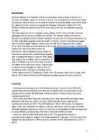
It was retaken by the Red Army in 1944, after which Estonia was constituted as one of the 15 Soviet Socialist Republics. Four decades passed until Mikhail Gorbachev who, as Communist Party General Secretary, offered the prospect of change for the Baltic States. A key part of the perestroika (economic reform) program was the devolution of power to the republics. Estonia led the way among the Baltic States, assisted by the collaboration between nationalist groups and the Communist Party, who joined together in a People's Front (analogous bodies emerged in Latvia and Lithuania) to orchestrate change. Having asserted the right to make their own legislation, measures to establish an Estonian currency preparatory to full economic autonomy and to restore Estonian as the official language quickly followed. In March 1990, the Estonian Communist Party voted in favor of full independence from the Soviet Union
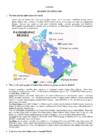
shown how vulnerable the principal Canadian cities were to American attack. Also, the Ottawa River and the Rideau Canal network meant that Ottawa could be supplied by water from Kingston and Montreal without going along the potentially treacherous US-Canada border. Originally called Bytown after Colonel John By of the Royal Engineers who supervised the building of the Rideau Canal. 22. Development of nationalist and separatist movements in Quebec. Referendums for separation from Canada. The separatist movements in Quebec seeked independence from Canada for the province of Quebec. It spawned a variety of political parties, such as the Parti Québécois and the Bloc Québécois. There have also been terrorist organizations that used violence to promote independence for Quebec but their violent tactics were denounced by the Parti Québécois
on own, sometimes sponsored by local or abroad org, hundreds of thousands. Many also leaving from C and W Europe. Hundreds of thousands E of Urals where almost no Js were before 1941, not GULag inmates, free SU citizens, living marginally, some employed. During war, major food and housing shortages, no infrastructure. Exiled suspect pops, class, natl enemies, tens of thousands from Crimean, Germans, Bulgarians, Tatars, once war started 41. Nationalist, including Zionist, leaders sent E as chauvinists, more efficient sovietization, 5th column potentiality, 50-60,000 Js, most survived the war. Factory owners, bank managers, large shopowners, ideological enemies. Also religious enemies, rabbis, cultural leaders, writers. Another group rounded up were refugees from Germ-occupied Poland, tens of thousands of mostly young Js. Couldn't go S, Czechoslovakia annexed, Romania fascist and anti-Semitic, sea lanes closed, mostly E
in Protestant churches or chapels. Some were crowded to suffocation such was his draw, 5 as for example at his hugely popular London Reception Speech held at Alexander Fletcher's Finsbury Chapel in London in May 1846. He remarked that there he was treated not "as a color, but as a man." He met and befriended the Irish nationalist Daniel O'Connell. When Douglass visited Scotland, the members of the Free Church of Scotland, whom he had criticized for accepting money from U.S. slave-owners, demonstrated against him with placards that read, "Send back the nigger". Douglass was able to win back his freedom after British sympathizers paid the slaveholder who legally still owned him. Pre-Civil War In 1851, Douglass merged the North Star with Gerrit Smith's Liberty Party Paper to form
Criollos were more commonly called filipinos ("from the Philippines") or insulares ("from the islands") according to the original meaning of the word. The criollo class was below that of the peninsulares born in spain, but out-ranked the people of mixed Austronesian-Spanish descent, and the Christianized native Austronesian peoples. 9 The meaning of filipino changed drastically during the Philippine Revolution for Independence against Spain in 1896. It was adopted by nationalist movements and transformed into a national designation that encompassed the entire population of the Philippines, especially the descendants of the native Austronesian peoples. In fact, the meaning of Filipino today is the opposite of its colonial meaning, since it tends to refer only to the predominantly native Austronesian population and excludes the mestizos of mixed Spanish descent, as well as the non-
The concept of dominant-party system, or one-party dominant system, refers to "a category of parties/political organizations that have successively won election victories and whose future defeat cannot be envisaged or is unlikely for the foreseeable future" (Suttner 2009: 277). Dominant party regimes are often seen as the contemporary forms of authoritarian rule. For Samuel Huntington, this phenomena is the cause of modernization--social differentiation, economic development, and nationalist struggle--which have created cleavages that could only be repaired through concession, co-optation, and/or organization (Remington and Reuter 2008: 504). Yet, one might say that what distinguishes dominant party systems from totalitarian single-party systems is the fact that dominant parties can still occur within democratic countries where other political parties are tolerated and allowed to operate in a more or less free political landscape. It is just because of the overwhelmingly strong
border) to the Mediterranean Sea. Their Austrian and Slovenian domains, however, were lost when Otakar II died and his army was thrashed at the 1278 Battle of Moravské Pole (fought near modern-day Dürnkrut in Austria) by the Austrian Habsburgs. Hussite revolution The late 14th and early 15th centuries witnessed the Church-reform movement led by Jan Hus. Hus' eventual conviction for heresy and his death at the stake in 1415 sparked a nationalist rebellion in Bohemia led by the Hussite preacher Jan Zelivsk. In 1419 several Catholic councillors were flung from the windows of Prague's New Town Hall by Zelivsk's followers, thus introducing the word 'defenestration' (the act of throwing someone or something out of a window) to the political lexicon. After the death in 1419 of Holy Roman emperor and king of Bohemia Wenceslas IV, Prague was ruled by various Hussite committees. In 1420 combined Hussite forces led by military
run government departments. There are normally about a hundred members of the government, in that sense. The other meaning is more limited. It refers only to the most powerful of these politicians, namely the PM and other members of the Cabinet. Conservative party (right wing) and Labour Party (left wing), plus Liberal Democratic party (formed in late 1980s, center or slightly left from center). In addition, smaller nationalist parties such as Plaid Cymru and Scottish National Party. 24. University Degrees in Britain. Most important universities. 25. Canterbury Cathedral Canterbury Cathedral is located in Canterbury, Kent, which has long been the religious center of the country, the seat of the spiritual head of the Church of England for nearly five centuries. Canterbury Cathedral is a mixture of Gothic types and a World Heritage Site. It is
Tallinn to join in the celebrations. Visitors from other countries converge in Tallinn to experience the powerful singing, lively dances and intricate, colourful folk costumes at first hand. If you're interested in seeing this spectacular live performance, or maybe even taking part in a festival, the next event happens in 2004, 2009 and 2013. The song festivals began in 1869, part of the romantic and nationalist movement in Europe. They developed a network of interactions among people along with making folk customs more widely known and practiced. The solidarity that the continued performance of the song festivals fostered, along with the logistics of moving large numbers of people around the country, served the Estonians well in their enormous demonstration for freedom in 1989, the Baltic Chain.
the social ladder and limited participation in politics. 7|Page 18501918 The national awakening The development of Estonia in the second half of the 19th century is characterized by general modernization; the reorganizing of a static agrarian society into a modern European society, industrialization, urbanisation and the success of the newly emerged nationalist awareness. The new passport regulation (1863) gave them first identification documents. It increased their freedom of movement and encouraged emigration to Russia. The 1866 peasant township law freed the peasants' local government councils from the landlords' authority and granted them extensive rights to decide their own economic and social affairs. In the 1860s, Estonian peasants began buying farmsteads from the estates, at free market prices
Á should be able to speak English, French, or German. Although the speakers' level of proficiency in these languages is duly mentioned for each of them, this unusual and widely spread gift for communication in Western languages, after a long period of nationalist dictatorship, is never questioned by the travellers. It is never correlated with broader notions of openness to the foreign, hospitality, generosity, and wish for acceptance into wider global spaces. Such qualities are only presented as part of the `positive side' of the
eliminated French influence in India and established the British East India Company as the most important political force on the Indian Subcontinent. The beginning of World War I, the United Kingdom, France, and the Netherlands added to their empires vast expanses of territory in the Middle East, the Indian Subcontinent, and South East Asia. None of the colonial powers possessed the resources to withstand the strains of both world wars and maintain their direct rule in Asia. Although nationalist movements throughout the colonial world led to the political independence of nearly all of the Asia's remaining colonies, decolonisation was intercepted by the Cold War. *The House of Wettin (kings, centuries) was a dynasty of German counts, dukes, and kings that ruled the area of today's German states for more than 800 years. As Queen Victoria married Prince Albert from the house of Wettin, her descendants were members of the house name of Wettin
för social misär och enformigt industriarbete skrev På våren 1889 utkom Heidenstams roman Endymion, som han i ett brev till Strindberg beskrev som "ett sorgespel utan kulisser och ridå". Intrigen är enkel; en far och hans dotter från USA reser i Österlandet tillsammans med en doktor. De tre representerar olika urtyper; pappan är realisten, doktorn är en cyniker som ser Österlandet i ett perspektiv ovanifrån, medan dottern är en sökare och romantiker som träffar en nationalist och upprorsman och känner sig dragen både till honom och till hela Österlandet. År 1889 kom von Heidenstams nästa bok, Renässans, som är en programförklaring där Heidenstam menar att den litterära naturalismen har spelat ut sin roll ("skomakarrealism"). Den som vill skapa något nytt måste opponera sig mot invanda uttryckssätt och en ung talang behöver inte upprepa sig. Underförstått i skriften är att Heidenstam ser sig själv som den nya litteraturens talesman och anförare
of all nations to existence, and the advancement of the church in the spiritual life of the nation. Carl Robert Jakobson (1841-1882), as well as being a journalist, writer and educationalist, was an active politician and ideologist; his ideal was to have a free Estonian farmer, independent of the German landlord, achieving this status through the redemption of his land. The original literature of the period well represented the time; nationalist ideas together with protests against the privileges of the Baltic-German nobility stood in the forefront. Historical topics were often written in prose, for example, stories by Eduard Bornhöhe (1862-1923), Tasuja (Avenger), novels by Andres Saal (1861-1931), such as 1 Its subject matter included articles about Estonian and European music, musicians, folk music, composing, etc. Vambola. These were romantically inspired scenes from the heroic and desperate
 annaabi.ee