Leidsid 33 sarnast õppematerjali, mis on seotud failiga "Greenwich". Need materjalid aitavad sul teemat sügavamalt mõista.
green, greenwich, mean, vista, place, maritime, museum, royal, janar, aava, rauno, sign, henry, elizabeth, unesco, heritage, upload, means, situated, river, thames, giving, established, outside, summer, landmarks, first, queen, sark, centre, naval, observatory, churchGREENWICH Greenwich is a district of south-east London, England, located in the Royal Borough of Greenwich and situated 5.5 miles (8.9 km) east south-east of Charing Cross. Greenwich is notable for its maritime history and for giving its name to the Greenwich Meridian (0° longitude) and Greenwich Mean Time. The town became the site of a royal palace, the Palace of Placentia from the 15th century, and was the birthplace of many in the House of Tudor. The town became a popular resort in the 17th century and many grand houses were built there. The maritime connections of Greenwich were celebrated in the 20th century. Greenwich area is the most famous thing about London. Greenwich is the Old Royal Observatory from where time all over the world is measured. The Greenwich Time Ball is the bright red Time Ball on top of Flamsteed House
the British Empire became powerful and rich. During the reign of Victoria, London expanded enormously as industry came to Britain and railways were built linking much of Britain to the capital. In 1834 the Houses of Parliament at Westminster Palace burned down. They were gradually replaced by nowadays Houses of Parliament designed by Charles Barry. The early part of the 19th century was the golden age of steam. The first railway in London was built from London Bridge to Greenwich in 1836, and a great railway boom followed. Major stations were built in London. During the Victorian time, a large part of the city was ventilated through the sewers. Sewage was dumped right into the Thames. When tunnels and pipes were built to direct the sewage outside the city, outbreaks of diseases were drastically reduced. By the 1840's gas lights were being used to light streets all over London. The World's first Underground railway opened in 1862. At first carriages were pulled by
down for yourself in this MSWord document. Don't forget to "take" photos - you are supposed to recognise the landmarks later on! At the end of the tour send the worksheet to yourself so that you could use it again. Good luck with exploring the city! DAY 2. The route: Westminster Abbey The Houses of Parliament London Eye 10 Downing Street St Paul's Cathedral The Tower of London Tower Bridge Globe Theatre Greenwich Observatory Destination 1: Westminster Abbey When was Westminster Abbey founded? (see its homepage: http://www.westminster-abbey.org/home ) 960 When was the last royal wedding held in Westminster Abbey? Whose was it? 29 April 2011 Prince William and MissCatherine Middleton How many monarchs have been buried in Westminster Abbey? 17 Destination 2: The Houses of Parliament What is the other name for the Houses of Parliament? Palace of Westminster
narrow crooked streets in the town but after the fire it became a well-planned city with wide streets, beautiful squares and parks. It started on the second of September, from a bakery shop in Pudding lane and lasted for about 5 days. It destroyed 89 percent of the city . The fire spread very quickly, because the houses were side by side. After the fire of 1666, the face of London changed forever. London is famous for its large parks. The most famous parks are Bushy Park, Green Park, Greenwich Park, Regents park, Richmond Park, St James's park and Hyde park. Hyde Park is the best known because it's the largest and finest park in London. Its territory is 140 hectares. It is famous for its public speakers who stand on a box, a table or just a chair and talk to little crowds about all sorts of political, social and other ideas. The Greenwich Park is also special, because it is surrounding the national sea museum. The Regents Park is known, because there is the London zoo
boundaries, but the name "London" has long applied more to the whole metropolis that has grown up around it. London has been an important settlement for over two millenniums. It is also one of the world's leading business, financial and cultural centres and its influence in politics, education, entertainment and even fashion contribute to its status as a major global city. London is a major tourist attraction with four world heritage sites, several royal parks and numerous iconic landmarks such as the Houses of Parliament, Towe Bridge, the Tower of London, Westminster Abbey and the London Eye. 2. History Although there is some evidence of a permanent settlement before the Romans came in 43 A.D., it is more accepted by historians that the Romans were the first. The settlement was called Londinium. The first London lasted for just seventeen years, for around AD 61, a tribe of Celts led by Queen Boudica stormed London, burning it to the ground
Soon the flourishing city Londinium came into existence. The Romans rebuilt the town into a centre of great importance. After the Romans withdrew from Britain in the Picts, Scots, Jutes, Angles and Saxons invaded London. It started to expand again under the Saxon kings. London was described as a commercial centre into which goods from all parts of the world flew by land and sea. King Alfred the Great repopulated and fortified the city. Edward the Confessor started to build a new royal palace at Westminster and raised London to the level of capital. William the Conqueror started the construction of the Tower of London and his successor William II enlarged it and constructed Westminster Hall. The two centres which were to characterise the English capital for many years emerged: The City of L and Westminster. In 1193 Londoners elected Henry Fitzalwin their first Mayor and in 1209 a stone bridge was built to replace the earlier wooden one, which was the first real London Bridge
Also, Big Ben, the 150-years-old great bell of the clock at the north-eastern end of Palace of Westminster and is also the largest four-faced chiming clock in the world, and the Tower of London, a historic fortress and scheduled monument in Central London on the north bank of the River Thames, are great tourist attractions as well as St. Paul’s Cathedral, The British Airway’s London Eye, Westminster Abby and Piccadilly Circus. Tourists also love to visit Greenwich, which is best known for giving its name to the Greenwich Meridian (0° longitude) and Greenwich Mean Time. Foods and drinks English cuisine is formed by country’s history, its temperate climate and geography. The food of England has historically been characterised by its simplicity of approach and a reliance on the high quality of natural produce. The traditional English breakfast is a hot cooked meal of bacon, eggs, sausages, fried bread, mushrooms and baked beans
London hosted the 1908 and 1948 Summer Olympic Games and will host the 2012 Summer Olympic Games. Samuel Johnson, author of the first complete dictionary, famously wrote about the city, citing "You find no man, at all intellectual, who is willing to leave London. No, Sir, when a man is tired of London, he is tired of life; for there is in London all that life can afford." Greater London contains four World Heritage Sites: the Tower of London; the historic settlement of Greenwich; the Royal Botanic Gardens, Kew; and the site comprising the Palace of Westminster, Westminster Abbey and St. Margaret's Church. London's population draws from a wide range of peoples, cultures, and religions, and over 300 languages are spoken within the city. As of July 2007, it had an official population of 7,556,900 within the boundaries of Greater London making it the most populous municipality in the European Union, with a population more than double that of its nearest rival
billion. London hosted the 1908 and 1948 Summer Olympic Games and will host the 2012 Summer Olympic Games. Samuel Johnson, author of the first complete dictionary, famously wrote about the city, citing "You find no man, at all intellectual, who is willing to leave London. No, Sir, when a man is tired of London, he is tired of life; for there is in London all that life can afford." Greater London contains four World Heritage Sites: the Tower of London; the historic settlement of Greenwich; the Royal Botanic Gardens, Kew; and the site comprising the Palace of Westminster, Westminster Abbey and St. Margaret's Church. London's population draws from a wide range of peoples, cultures, and religions, and over 300 languages are spoken within the city. As of July 2007, it had an official population of 7,556,900 within the boundaries of Greater London making it the most populous municipality in the European Union, with a population more than double that of its nearest rival
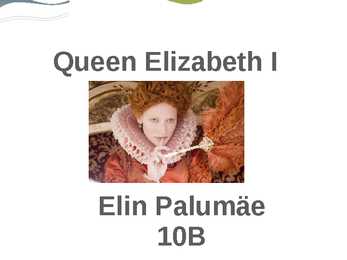
Queen Elizabeth I Elin Palumäe 10B Elizabeth I Reign - 17 Nov. 1558 24 March 1603 (44 years) Coronation - 15 January 1559(25 years) Predecessor - Mary I Successor - James I House - House of Tudor Father - Henry VIII Mother - Anne Boleyn Born - 7 September 1533 Greenwich, England Died - 24 March 1603 (aged 69) Burial - Westminster Abbey Anne Boleyn Queen consort of England Mother of Elizabeth I Tenure - 28 May 1533 17 May 1536 Coronation 1 June 1533 Anne Boleyn was Queen of England from 1533 to 1536 as the second wife of Henry VIII of England and the 1st Marquess of Pembroke in her own right for herself and her descendants. House - House of Tudor Father - Thomas Boleyn, 1st Earl of Wiltshire Mother - Lady Elizabeth Howard Born c
Writers & Poets: William Shakespeare, Daniel Defoe, Charles Dickens, Rudyard Kipling, Dame Agatha Christie Philosophers &Economists: Francis Bacon, John Locke Inventors & Scientists: Isaac Newton, Charles Darwin Actors,Actresses & Filmmakers: Sir Charlie Chaplin, Dame Elizabethe Taylor, AlfredHitchock, Hugh Grant, Orlando Bloom, KeiraKnightley, Daniel Radcliffe Musicians & Singers: Sir Elton John,Phil Collins,George Michael,Robbie Williams King Henry VIII Born: June 28, 1491 at Greenwich Palace Parents: Henry VII and Elizabeth of Y ork House of Tudor Ascended to the throne: April 21, 1509 aged 17 years Crowned: June 24, 1509 at Westminster Abbey Married: (1) Catherine of Aragon 1509-1533 Divorced (2) Anne Boleyn 1533-1536 Beheaded (3) Jane Seymour 1536-1537 Died (4) Anne of Cleves 1540 Divorced (5) Catherine Howard 1540-1542 Beheaded (6) Catherine Parr 1543-1547 Survived Children: Three legitimate who survived infancy; Mary, Elizabeth and Edward
There are four seasons. The seasons are the opposite of our seasons. When we have summer then in Australia is winter. In Australia droughts and floods are pretty usual. The draught is caused by El Nino, a weather pattern which happens when the Southern Pacific Ocean heats up. This causes the wind direction to reverse. An El Nino occurs every four or five years, causing drought and bushfires. Droughts are followed by floods. Australia has three time zones. In Western Australia is equal to Greenwich Mean Time plus 8 hours. In New South Wales, Victoria, Queensland, and Tasmania and in Australian Capital Territory time is equal to Greenwich Mean Time plus 10 hours. In South Australia, Northern Territory, Broken Hill, NSW time is equal to Greenwich Mean Time plus 9 ½ hours. Plants A rich variety of plants can be found in the natural landscapes of Australia. A lot of species can be found in wet tropical forests in the north and in temperate rainforests in the south.
The Romans. They burnt Londinium to the ground but Roman armies eventually defeated Boudicca. The city was rebuilt and was gradually surrounded with a wall of stone and brick which lasted for many centuries. During the archeological excavations in 1954 the Roman Temple of Mithras was revealed. It was a pagan temple dedicated to the Persian Sun-god. The Temple was later reconstructed only a short way from its original site and the relics are displayed in the Museum of London in the Barbican. At the end of the fourth century AD the Roman Empire began to crumble and the Roman armies were recalled from Britain to defend Rome itself. Once they had left Anglo-Saxons invaded and settled in Britain. They were farming people who preffered to live outside towns. For a while London probably lay in ruins, but it eventually developed again, partly because of its position on the river was good for trading. The Tower of London
British Crown dependencies and British overseas territories. It alone possesses legislative supremacy and thereby ultimate power over all other political bodies in the UK and its territories. Its head is the Sovereign of the United Kingdom (currently Queen Elizabeth II) and its seat is the Palace of Westminster in the City of Westminster, one of the Boroughs of the British capital - London. Tower of London The Tower of London, officially Her Majesty's Royal Palace and Fortress of the Tower of London, is a historic castle located on the north bank of the River Thames in central London. It lies within the London Borough of Tower Hamlets, separated from the eastern edge of the square mile of the City of London by the open space known as Tower Hill. It was founded towards the end of 1066 as part of the Norman Conquest of England. St. Paul`s Cathedral
A weekend in London Made by .... 6.d klass We will stay at the fabulous 5 Star Athenaeum Hotel in Mayfair which is close to Green Park and Buckingham Palace. It's creative and friendly. There are the colossal Living Wall and the beautifully refurbished spa and gym downstairs. There are also floor to ceiling windows, flat screen TV and complimentary mini bar soft drinks and snacks. Saturday At first we will go visit Buckingham Palace which is the official London residence and principal workplace of the British monarch. We would also like to see the nearby park where are a lot of birds and squirrels.
mountain peaks. There are two big mountain ranges, one of them is the Rocky Mountains and the other is The Appalachian Mountains. The Capital of The USA is Washington D.C. Other big and famous cities are New York, Los Angeles, Houston, Chicago and Las Vegas. The national anthem of the United States is "The Star-Spangled Banner", with lyrics written in 1814 by Francis Scott Key. There are 6 time zones. From east to west they are: Eastern Standard Time, which is 5 hours behind Greenwich Time, Central Standard Time, Mountain Standard Time, which is 7 hours behind Greenwich Time, Pacific Standard Time. Alaska and Hawaii have their own time zones: Alaska Standard Time and Hawaii Standard Time. Geographical Position The USA lies in the Northern Hemisphere in North America. It covers a big part of the continent and is also the third largest country in the world. The country consists of 50 states, but two of them lie separately
Originally known as, the building which forms the core of today's palace was a large townhouse built for the Duke of Buckingham in 1703 on a site which had been in private ownership for at least 150 years. During the 19th century it was enlarged, principally by architects John Nash and Edward Blore, forming three wings around a central courtyard. Buckingham Palace finally became the official royal palace of the British monarch on the accession of Queen Victoria in 1837. · Harrods is London's most famous department store, is named after Charles Henry Harrod, who opened a family grocers shop on the site in 1849. The store occupies a 5-acresite and has over one million square feetof selling space in over 330 departments .
LANDMARCS HYDE PARK: Hyde Park is one of the largest parks in central London, England and one of the Royal Parks of London, famous for its Speakers' Corner. The park is divided in two by the Serpentine. The park is contiguous with Kensington Gardens; although often still assumed to be part of Hyde Park, Kensington Gardens has been technically separate since 1728, when Queen Caroline made a division between the two. THE TOWER OF LONDON: Her Majesty's Royal Palace and Fortress, more commonly known as the Tower of London (and historically as The Tower), is a historic fortress and scheduled monument in central London, England, on the north bank of the River Thames. It is located within the London Borough of Tower Hamlets and is separated from the eastern edge of the City of London by the open space known as Tower Hill. It is the oldest building used by the British government. [1]
(settlement, colony) may be found in numerous place-names: Lincoln, Colchester, Cologne ; from Latin word castrum (military camp) were derived English affixes -chester and -castle: Manchester, Lancaster, Newcastle; Latin word portus (seaport) in Portsmouth *-tor - person, doer, masculine form. The suffix is attached to the stem: victor (`winner', from the verb vincere `to win'), spectator (spectare). *-orium - place, where the activity marked with the verb occurs: dormitorium (dormire `to sleep'). In English the suffix is -ory: dormitory. *tas - it denotes an abstract notion, derives from the adjective: celebritas (celeber), libertas (liber), universitas (universus). In English the suffix is -ty: celebrity, liberty, university. *-tudo - characteristic or condition, derives from the adjective: longitudo (longus), fortitudo (fortis). In English -tude: longitude, fortitude. 5
Town, near the harbour. During the reconstruction of the gate in the early 16th century, the cannon tower Fat Margaret was added. The round tower, with 155 loopholes, a diameter of 25 meters, and a height of about 20 meters, was built to protect the harbour. It got its name from the fact that it was indeed the stoutest tower in the city wall. Through history, the cannon tower has also served as a storehouse for gunpowder and weapons, and as a prison. Fat Margaret now houses the Estonian Maritime Museum. The viewing platform on the roof affords a lovely view onto the Old Town and the bay. The Down Hall Tallinn's original Town Hall was established sometime in the 13th Century, and was replaced by the current Gothic monument, hewn from limestone, in 1402-1404. The Hall served its function as the home of the city administration for an incredible 700 years, right up until 1970. It remains an incredible building inside and out. From within, admire vaulted roofs and brightly
Charles II took power. Eventually, the houses on the bridge created a congestion that resulted in serious safety hazards. The houses and shops were no longer inhabited, and in the early 18th century a system of traffic was developed to maintain order on the busy structure. The mayor of London asked that bridge passengers travel in particular directions, creating the system of traffic that still remains in place in London today. The history of the London Bridge structure in place today began in 1967 and was opened by Queen Elizabeth II on March 17th, 1973. The modern bridge has sleek lines and is adorned with red lights. Guests travelling to London may choose to make a stay at the London Bridge Hotel, or possibly visit the bridge Monument to the Great Fire of London or the Monument tube station. No matter how you choose to spend your time viewing the London Bridge, the contrast of a modern thoroughfare to
In 1867, with the union of three British North American colonies through Confederation, Canada was formed as a federal dominion of four provinces. It is a bilingual and multicultural country, with both English and French as official languages. Geography: Covering most of the northern part of the North American continent and with an area larger than that of the United States, Canada has an extremely varied topography. In the east, the mountainous maritime provinces have an irregular coastline on the Gulf of St. Lawrence and the Atlantic. The St. Lawrence plain, covering most of southern Quebec and Ontario, and the interior continental plain, covering southern Manitoba and Saskatchewan and most of Alberta, are the principal cultivable areas. They are separated by a forested plateau rising from Lakes Superior and Huron. Westward toward the Pacific, most of British Columbia, the Yukon, and part of
LONDON The history of the town is very closely linked with the history of the country itself. The name probably comes from the celtic words Llyn, which means a lake, and Dun, which means a fort or a strong place. Although the site was not important during the Celtic period (400 BC 43 AD) During the Roman occupation Londinium, as it was called then, was not influential politically, but was, however an important crossing point for the romans over the river Thames. Londinium was at a very good place, so it soon became a trading centre. In AD 61 the city was devastated by Boudicca, who led a revolt againt the Roman conquest of Britain. The city was burned down and its inhabitants massacred. London was rapidly rebuilt, becoming the capital of the province Britannia. AD 122 Roman walls were built around it as a Around AD 400 the Anglo-Saxons invaded Britain. They destroyed the roman towns and formed many kingdoms that were hostile to one another. London fell into ruins. King Egbert
Changing the Guard · Perhaps the epitome of London's surviving pageantry can be found in the ceremonial Changing of the Guard. · A hugely popular spectacle, the Changing of the Guard takes place at a range of royal locations in and around · London daily during the summer and on alternate days for the rest of the year. · There is no ticketing, so make sure you get there early. · Ever since 1660 Household Troops have guarded the Sovereign Palaces. · The Palace of Whitehall was the main residence until 1689 and was guarded by the Household Cavalry. · The court moved to St James's Palace in 1689 and when Queen Victoria moved into
In the 13th-century Chronicle of Henricus de Lettis the town was called Lyndanise. Later came Reval (presumably after the old county of Rävala), the name used by the Germans who ruled the country for seven centuries. Russians then modified Reval to Revel. For Estonians, the town came to be called Tallinn from Taanilinn (Danish town) after Danish conquest in the 13th century. Over the course of time, Taanilinn was shortened to Tallinn The place is believed to have been settled by Finno-Ugric peoples about 2500 BC. The Danes, led by King Valdemar II, conquered northern Estonia in 1219. Legend has it that one day, when the Danes were about to lose a bloody battle, the sky suddenly opened and a red flag with a white cross on it dropped down upon them from the heavens. This is allegedly how the Danes obtained their national flag, the Dannebrog in a battle against the Estonians.
gabled houses, half-hidden courtyards and grandiose churches is, quite rightly, the city's biggest tourist draw. And the fact that it's all neatly packaged within a mostly-intact city wall and dotted with guard towers gives it an extra dose of fairytale charm. http://www.tourism.tallinn.ee/eng/fpage/explore/attractions/old_town Kiek in de Kök Those interested in walls, towers, cannons and the like should drop into this museum of the town's defences. Visitors of this museum will see examples of Medieval fire power, displays detailing how the city's system of fortification walls and towers developed through the centuries and an exhibit on crime and punishment in old Tallinn. The name of this massive, 38m-high cannon tower literally means "Peek into the Kitchen." It was so high that Medieval guards joked they could see right down the chimneys and into the kitchens of the houses below.
There are 675 members of the Lords. The main job of the House of Lords is to ´double check` new laws to make sure they are fair and will work. Many people think that the House of Lords should be abolished. The House of Commons have 659 members who have been elected by the British public. The members are called MPs (Members of Parlament). Each MP represents one of the 659 areas in the UK and is a member of a political party. The House of Commons is the most important place for discussing policies and making laws. The party which wins the most seats in the General Election forms the government. The leader of the winning party becomes Prime Minister, his first job is to choose his Cabinet, consisting of the most important ministers in the government. Each member of the Cabinet is a minister responsible for a government department. The Cabinet meets at the Prime Minister's house 10 Downing Street. Cabinet
In 1947 she married Prince Philip, Duke of Edinburgh, with whom she has four children: Charles, Anne, Andrew, and Edward. In 1992, which Elizabeth termed her annus horribilis ("horrible year"), Charles and Andrew separated from their wives, Anne divorced, and a severe fire damaged part of Windsor Castle. Revelations continued on the state of Charles's marriage to Diana, Princess of Wales, and they divorced in 1996. The following year, Diana died in a Paris car crash, and the media criticised the royal family for remaining in seclusion 4 in the days before her funeral. Elizabeth's personal popularity rebounded after she
Kew Gardens Introduction The reasons for choosing the subject: · Interesting · Close to nature · Something new · An exciting place to visit · UNESCO World Heritage Site How to find Kew Gardens? · South bank of the River Thames, near Richmond · About 10km south-west of London · Public transport is recommended: environment, parking General Information · Created in 1759 (by the Prince of Wales) · Employs more than 650 scientists · The living collections: over 30,000 different plant species · The herbarium: over 7 million preserved plant species
and Northern Ireland and of Her other Realms and Territories Queen, Head of the Commonwealth, Defender of the Faith. 2. The Queen’s working day. Starts after breakfast. Reads the newspapers which are prepared by the Press Secretary, and a report on the previous day’s proceedings in the Parliament and the letters she receives. Also phone calls. Once a month she attends the Privy Council in order to give Royal Assent to various items of government legislation. Discusses domestic matters with the Master of the Household. Towards the end of the day, there is always another pile of official papers and reports waiting to be read or acted upon. The business on constitutional monarchy never ends. 3. Who is the present heir to the throne? Speak about his education. Who are the 2nd and 3rd in line? Present heir is Prince Charles, The Prince of Wales
Four Names Lyndanise - mentioned by Henricus de Lettis in his Chronicle; derives from the name Linda - the wife of Kalev and mother of Kalevipoeg Koluvan - mentioned in Russian chronicles; derives from the hero Kalev from our national epic Reval - comes from the German words “REH” and “FALL”, meaning the falling of the deer; could be deers trying to escape from the Danes, running down the Toompea hill Tallinn - the word origins from estonian language, could mean “taani-linn”, “tali-linn” or “talu- linn”; Reval was replaced when Estonia became independent Symbols Flag - blue black white tricolor; blue represents sky, black the soil, and white our freedom. Danneborg - red flag with a white cross fell from the sky during the battle in 1219. It is also set into the small coat of arms of Tallinn. Great coat of arms - three lions, a knight, and Danish queen; leaves around
and covers an area of almost 160 sqkm. It is also an important economic and cultural centre and one of the main ports in the Baltic States. Tallinn is one of the oldest cities on the Baltic Sea. It is unique for its well-preserved architecture from the 13-15 centuries. In contrast to the ancient town-walls and towers, Tallinn of today offers modern hotels, restaurants, sport and cultural centres. Every five years national song and folk dance festivals take place in Tallinn. The yachting regatta of the 1980 Moscow Olympic Games was held at Pirita. History Tallinn means in English "Danish town". The place is believed to have been settled by Finno-Ugric people about 2500 BC. It was first marked on a map of the world by the Arab geographer al-Idrisi in 1154. The Estonians were the first to build a stronghold on the spot of the Toompea Hill, but the real Tallinn was built by the Danes who conquered the north of Estonia in 1219
ASTLANDA). To the ancient Scandinavians the land was known as EISTLAND; to modern Scandinavians it is known as ESTLAND. Most contemporary languages use the Latin name ESTONIA. FLAG The Estonian blueblackandwhite national flag was originally the flag of the Estonian Student's Society, consecrated in Otepää Church in 1884. today there is a memorial plaque on the church wall commemorating the event. The Flag Museum attracts tourists who take an interest in the history of the flag. After about half a century, during which it was prohibited by the Soviet authorities, the flag was sen again in public for the first time in Tartu. Many elderly people were carrying the flags they had kept in secret hiding places durin the Soviet years; tears were rolling down their cheeks. On 24 February 1989, Estonia, still part of the Soviet Union, hoisted its tricolour on the tower of Pikk Hermann in Tallinn
 annaabi.ee