Leidsid 33 sarnast õppematerjali, mis on seotud failiga "Final task FINISHED". Need materjalid aitavad sul teemat sügavamalt mõista.
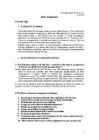
learning, policy, schools, work, develop, teacher, haridus, strategy, higher, year, real, development, train, quality, profession, digital, different, student, skills, there, language, important, really, know, even, subject, almost, access, change, teachers, 2019, exam, years, managed, than, university, students, term, program, training, specialTable of Contents Abstract 3 Introduction 4 Chapter 1: Citizenship, Children`s Rights and Participation: from the UN to the UK 6 Chapter 2: Citizenship Education in Wales………………………………………………14 Active Citizenship in Cadle Primary School: A Case Study 20 Conclusion 29 Bibliography 32 Appendices Appendix 1: The United Convention of the Rights of the Child Appendix 2: Interview with Jamie Richards, the Head Teacher of Cadle Primary School 2 Abstract: Children inherently have had a rather tenuous relationship with citizenship. Similarly to how women were once viewed, children have not been considered as subjects of rights due to their perceived incompetence and irrationality. Currently, children are not considered as being rational and capable of exercising responsibility until the age of majority, the age of 18.
Education Education is so multifaceted that it is difficult for me to know where to begin discussing it, or how to prioritize the many factors. Relaying my own experience is easy: I had a standard classroom approach, supplemented by inordinate reading. In only the briefest and least memorable instances did I receive any individual tutoring. Education is commonly thought of as the job of schools. Adults cry "educate our children!" Everyone has opinions about the best way to do the job. It is of urgent importance, and all the numerous factors are much studied, debated, and new (or old) ideas continually tested or retested. Some people say "it's as simple as . . . " and then name their pet peeve or passion. My view is not of an education specialist, but of one who loves sharing what I learn, and owes much to educators
UNIVERSITY OF TARTU DEPARTMENT OF ENGLISH Using Blogs as a Platform in the Teaching of English as a Foreign Language Research paper Tartu 2010 ABSTRACT This work analyses the usefulness of blogging in teaching English as a foreign language. The definition of the term `blog' is provided along with the advantages and disadvantages of blogs' usage in practice. The analysis of language skills developed by students throughout the use of blogs for learning purposes is given in the paper with possible limitations that blogs have. Author of this paper also shares personal comments about the experience in the field. In this paper it is also
I totally disagree with this statement. There are just other values in a town with a small population density. Values concerning family life are coming more forth, career and such kind of personal ambitions are kept in the backround. Also it is often mentioned that making a successful career in a small town is largely impossible, because of the lack of different resources and opportunities. By these it is commonly ment a uncompetitive education and few opportunities to develop extracurricular activities. In my opinion it is again a misunderstanding. I am at the moment eighteen years old and I have spent all my life in a beautiful small town called Tartu. From the early age I have been interested in photography and the world in general. Photography is a pretty expensive hobby and starting with it was quite difficult in the beginning. I had to take photographs with really poor cameras and more than once I heard how somebody was laughing over me because of my
They spend more time at the computers or laptops or iPads etc. than read books or move outside. And another thing is that teachers are less capable in using technological appliances. But the latter mentioned fact is an advantage for us teachers as well. It gives us an opportunity to provide our students to experience success. They can help and assist us if we need some technological help. Another thing is that in schools, in classes generally students are not allowed to use their appliances, so it means they have to communicate verbally as well. I think that teachers should be creative to blend so-called digital learning/teaching with old-fashioned learning/teaching. · Sir Ken Robinson: Do schools kill creativity? Sir Ken Robinson claims in the clip that " creativity in education is as important as literacy, we should treat it with the same status." I totally agree with all what he said
social activities. The National Union of Students was founded in 1922. It operates through local branches in colleges and universities. It promotes the educational, social and general interests of students. But certainly the most numerous is the Scout Association, founded in 1908 for boys and in 1910 for girls by Lord Baden-Powel. The Scout movement is to encourage a sense of adventure and of responsibility for others among young people. The programme of training is planned to develop intelligence and practical skills, to promote health and a sense of service. Scout training is complementary to the ordinary education. Scouts train in mapping, signalling, first aid and all the skills that arise from camping and similar outdoor activities. British scouts take part in international scout meetings, which are held approximately every four years. The membership in this or that youth organization is not compulsory in Great Britain.
and high school levels). At these levels, school curricula, funding, teaching, and other policies are set through locally elected school boards with jurisdiction over school districts. School districts are usually separate from other local jurisdictions, with independent officials and budgets. Yet in Estonia our school system mainly stands on government. Public schools gets their funding from government and it's controlled directly by the municipal government. Only private schools are self funding and are quite independent, exception is learning program of course. Similar are school boards, what are also locally elected. In USA compulsory education requirements can generally be satisfied by educating children in public schools, state-certified private schools, an approved home school program or in an orphanage. In most public and private schools, education is divided into three levels: elementary school, middle school
applied in the late 17th century to those individuals who were opposed to the Puritan wing of the Church of England. It is first and foremost associated with the Anglo-Catholic movement of the later 19th century (from 1833 onwards). High Churchmen placed great emphasis on liturgy and the sacraments, especially the weekly or daily celebration of the Eucharist as well as on the three orders of ministry (deacon, priest and bishop). Archbishop In Christianity, an archbishop is a bishop of higher rank or office. Like popes, patriarchs, metropolitans, cardinal bishops, diocesan bishops, and suffragan bishops, archbishops are in the highest of the three traditional orders of bishops, priests, also called presbyters, and deacons. An archbishop may be granted the title, or ordained as chief pastor of a metropolitan see or another episcopal see to which the title of archbishop is attached. Bishop is an ordained or consecrated member of the Christian clergy who is generally entrusted
studing, but in Estonia this is only first step of educational life. After primary school in Estonia you have two ways to walk: high school or industrial school, where they get profession. Youngsters in United States of America and Great Britain have easier to make choice choosing a profession, because there they start to prepare people to get a job very early. High schools in Estonia teaches every subject almost equally, so everyone have to study everything, except for some schools that are oriented to teach few subjects in depth (IT classes, art classes etc). It´s much easier to make future career plans and to find suitable profesion if school teaches how to manage in real life with practical activities like different projects, presentations and so on. I think USA and Great Britain schools are very developed in teaching pupils how to think and find answers on their own because their school system supports learning through projects, teamwork, presentations
Positive sides of outdoor learning Essay "Tell me and I forget. Teach me and I remember. Involve me and I learn." Benjamin Franklin In the last few years outdoor education has become more and more popular worldwide and in Estonia too. While there are many definitions for outdoor education, I think the best way to
Close connections and pendulum migration have tightened the cooperation between the countries. For instance, Estonia and Finland have developed common economic space. Right now Estonia's most important trading partners are Finland, Sweden, Russia and Germany which Estonia is mainly influenced by. Maintaining good relations between neighboring countries and being a member of EU has opened the possibility not only for good trading business but also to take the opportunities to travel and work abroad more easily improving Estonians human capital. Furthermore, Estonia has really outstanding level of education. Compared to other countries, our students get more thorough education and have good knowledge of languages. Based on the OECD’s Education at a Glance 2014 at least 90% of 25-64years old Estonians have secondary education, while average of OECD is 75%. Their level of education is more appreciated on the job market both in homeland and abroad. Moreover, due to countrys
(marketing innovation). “Is the implementation of an new marketing method involving significant changes in product design or packaging, product placement, product promotion or pricing” Oslo Manual 2005 A distinctive look for a product and appeal a new market segment; Celebrity endorsements; personalized IS; New brand, etc. P.S. Seasonal, regular and routine changes. 4. Changes in the structure of the enterprise or in the ways of organizing work (organizational innovation) “is the implementation of a new organisational method in the firm’s business practices, workplace organization or external relations”. Oslo Manual 2005 P.S. Mergers and acquisitions! National innovation system (NIS) The national innovation systems approach stresses that the flows of technology and information among people, enterprises and institutions are key to the innovative process
kid everybody called Vene-Russ and we spent a lot of time playing mean tricks on him. Well, there's that. And I also learned a lot of Russian from my mother's lover who was a Russian military officer and pretty much my father figure at the time. I tried to teach him Estonian and learned some Russian instead. My Russian studies in school have always been very hectic and making very little sense. Teachers kept changing all the time, teaching methods kept changing as well and learning Pushkin by heart does not work wonders with one's speaking skills, really. (Although I still can recite one of his poems...) The point is, I actually really like Russian. I've never been good at it, but I like the language and I really wish I knew it better. I can speak some, but not read much. As soon as the characters stop talking to each other, I'm stuck and can barely understand anything. Most of my Russian skills my
Tallinna Mustamäe Humanitargümnaasium Valeria Jefremenkova ENGLISH AS A GLOBAL LANGUAGE INGLISE KEEL KUI ÜLEMAAILMNE KEEL Research work Supervisor: Jevgenija Kozlova Tallinn 2016 1 Table of Contents СONTENT…………………………………………………………………………………...2 INTRODUCTION…………………………………………………………………………...3 CHAPTER I……………………………………………………………………………….....5
A basic education is provided free of charge for young people in nearly all developed and democratic countries. However, when it comes to university, or higher education, there are many different approaches taken. In some countries (such as Finland and Sweden) higher education is still free. In other countries, higher education is purchased like any other service. In many countries (such as the UK and the USA), fees are charged to students but how much of the cost of education these cover varies greatly. Often governments offer loans and financial support to help students pay these fees. However, more and more people want to go to university, putting student funding systems under pressure. So should Governments charge fees for higher education, or provide it for free?
reforming. Nowadays, the main focus seems to be on subjects like maths, physics, chemistry etc. because of current IT-era demands more knowledge in those regions than in humanities. I agree that Estonia's government's steps towards making maths and physics our school- system's top priority is quite right, but I think that there can be a lot more done to improve our educational structure. I find that Estonian schools should pay more attention to teaching our children current state in our political landscape. Kids, who go to school, are our future and soon-to-be full- right voters in national elections. They will become old and independent enough to be a part of deciding process over their country's future. So, it is very important that they would know which political party stands for what beliefs and who are the politicians in Estonia who are leading our country
free. Being a Capitalist Nigger puts you in control of every aspect of your life – you are in charge and nobody else. You want your children to have good grades in school? Then practice Capitalist Niggerism because then you will not blame the teachers for failing your children or blame the nationwide testing services for using non-black questions in their testing. You will be in control because you will totally understand that everything that happens to your child at school is a result of the learning environment you have provided him or her at home. You want to succeed in creating wealth, join Wall Street. Don’t make excuses that Blacks don’t know how to invest their money. Go after the Caucasians. Use their guilt to your advantage. Another important point which I raised in this book concern the long study I have conducted regarding the economic behaviour of East Indians and Pakistanis. It is an economic doctrine I have christened the
Art-based learning We can see that art-based learning is not a regular method in school. Although I barely can understand why. It seems to me, that it is rather interesting way of learning. I also would like to point out, that childrens emotional memory is strong and pleasant things will be understood and remembered more. Therefore I would like to discribe the method thoroughly. Only in the past few hundred years has reading been the primary way of teaching religion. For centuries, religious education relied on hearing and seeing. Religious education can benefit by returning to the ages-old methods of hearing and seeing to complement reading. This method
You can always go there. It's good to go home when somebody is waiting you to come home. There shouldn't be noisy at home. Home makes a good home for each other's trust, helpfulness and good relations with other family members. I love my home. 5. How people make choices about where they live? Every person is different. Some people like sun and sea and that kind of person's usually go to live in tropical countries. People must choose the best climate for him. And the work shouldn't be far from home. But it's everybody's own decision what they like or not. ENGLISH SPEAKING COUNTRIES 1. What is your favourite food? I'm quite choosy human. I don't eat many things like mushrooms, carrots, eggs, fish etc. My favourite food is French fries with salad. In general, I like fast food. But fast food is not always the best choice. Fast food is not healthy at all. But I eat fast food only then when I'm in a bigger city, because in Kanepi are no fast food places. 2
form of public entertainment. In the late 18th century the British army suffered two serious defeats at battles in Seringapatam, in India. The main reason for these defeats was that the Indian prince, Haidar Ali's army included a corps of rocket throwers. They used very large bamboo rockets which had a range of hundreds of metres. The British were determined to learn from their mistakes and a British officer, William Congrieve, began work on developing even bigger and better rockets. Within a few years Congrieve had developed 14 kg iron rockets that could be fired over 3200 m. These rockets were successfully used against Napoleon in the battle of Waterloo and during the US War of Independence. By the 1889s other applications for rockets were being developed. They were used for signalling, for whaling, and even for rescuing people from sinking ships. If a boat got into trouble near to the shore, a
and education. In 1973, the late Ellis Page and colleagues at the University of Connecticut programmed the first successful automated essay scoring engine, "Project Essay Grade (PEG)" (1973). The technology was foretold some six years earlier in a landmark Phi Delta Kappan article entitled, "The Imminence of Grading Essays by Computer" (Page, 1966). At the time the article was provocative and a bit outrageous, though in hindsight, it can only be deemed prophetic. As a former high school English teacher , Page was convinced that students would benefit greatly by having access to technology that would provide quick feedback on their writing. He also realized that the greatest hindrance to having secondary students write more was the requirement that, ultimately, a teacher had to review stacks of papers. While PEG produced impressive results, the technology of the time was too primitive to make it a practical application. Text had to be typed on IBM
male 78 years and female 84 years. Environmental problems: air pollution from vehicle emissions and open-air burning; acid rain; water pollution from increased use of agricultural fertilizers. Education: The education system in Switzerland is very diverse, because the constitution of Switzerland delegates the authority for the school system mainly to the cantons. The Swiss constitution sets the foundations, namely that primary school is obligatory for every child and is free in public schools. The minimum age for primary school is about six years in all cantons but Obwalden, where it is five years and three months. After primary schools, the pupils split up according their abilities and intentions of career paths. Roughly 20% of all students attend secondary schools leading, normally after 12 school years in total which grants access to all universities. The other students split in two or more school-types (depends on the canton)
university play a role in contributing to a succesful outcome? Kaisa Kamenik In Mike Nichols 1967 cult film „The Graduate“, Dustin Hoffman character Benjamin Braddock, who has just graduated from college, is facing basically same questions as posed in the title of this essay. Everyone is asking what is he going to do with his life now, but he is very uncomfortable aswering them and at that point he doesn’t care as well. Being a third year history student in University of Tartu, I am wondering over the same questions and find myself often thinking what is expected of me after graduating and how has university played a role in my development for almost three years now. When asked what is the main purpose of university, most people would say that it is preparing students for different proffessions, which would later be the driving force of the country. But I think it is more complicated than that
USA school system Most children enter the public education system around ages five or six. They may begin in preschoolpreschool, kindergartenkindergarten or first gradefirst grade. They normally attend 12 grades of study over 12 calendar years of primary and secondary education before graduating, earning a diploma that makes them eligible for admission to higher educationhigher education. Education is only mandatory until age 16, however. There are generally five years of primary (elementary) school, during which students customarily advance together from one grade to the next as a single cohort or "class", three years of middle school, which may have cohorts, and four years of high school. There is some variability in the arrangement of grades. In the U.S., ordinal numbersordinal numbers (e.g., first gradefirst grade) are used for identifying grades
under or unemployment 15%to 70% and the public debt grew from 240 million to 16 billion (Perkins, 2004, lk 239). This essay is going to explore how this kind of thing could have happened? The idea is not to blame well-known organizations. The idea is to observe and explain what happened to Ecuador and discuss if the criticism about this matter is grounded. In this essay author is going to use a book “ Confessions of an Economic Hitman“ by John Perkins that spent a year on New York Times bestseller list in 2004 and caused lot of discussion all over the world. Author also uses other sources what you can find from literature. In the first part author is going to write about the basics of liberalism. In the second part writer is going to give a brief overview of IMF and World Bank and the criticism about these organizations. In the third part essay explores the Ecuador case and looks it through the realism
2 Educational system in Croatia divided into: 1. Early childhood education 2. Primary education 3. Secondary education 4. Higher education 3 Early childhood education There are three stages of early childhood education: • from when the child is 6 months old to when they're one • from the ages of one to three • from the age of three until the child stars attending primary school Even though these three stages are not compulsory, every child must attend kindergarten for a year prior to primary school.
European Union Research Compose: x X School 2009/10 What is European Union? The European Union (EU) is an economic and political partnership between 27 democratic European countries. EU population is almost a half milliard European union stands for caring and fair community. All EU members are devoted to peace, democracy, human rights respecting and working together to spread these values all the world. History The beginning of EU might consider the year 1951, when European Coal and Steel Community (ECSC) was constitute. Six countries joined with it for peace: Belgium, Netherlands, Luxembourg, Italy, France and Germany. With that move, coal and steel industry were put under one organisation, so war was almost impossible between these six country. Cooperation in different areas improved, when in 25. March 1957 Treaties of Rom , European Economic Community and European Atomic Energy Community memorandum of association were signed
found something he/she feels passinoate about and practiced a lot. Of course there are some super kids, who haven’t practiced that much but are still very good at what they’re doing. Just not that much as much we think there are. I mean, for a kid it’s easy to look talented. Ken Robinson gave his son as an example - the part where his son plays Joseph and switches the lines with other actor on a premiere. I can give my cousin as an example. She wants me to make her a choreography every year around the Christmas. One year she forgot everything, except the beginning and the end, so she improvised everything in between. I was really proud of her, cause at first I thought she’s gonna freek out and run away. But she didn’t. Kids, they’re fierce. If they don’t remember anything, they’ll make it up. They’re more afraid to just stand and watch the silent crowd than to be wrong. Ken says that kids are not afrayd to be wrong. But by the time they start going to
results, you have the right road map in your hands.You have before you the DNA of your future. All you need to create a wonderful fu- ture for yourself is to read this book, decide how you are going to apply it to your own life, write out a plan, and then go forth with en- thusiasm and make it happen. I have a confession to make. I am one of Brian’s raving fans. I have studied him, his brilliant work, and the extraordinary results he has achieved. I am also one of his close colleagues and friends. We have worked together on many platforms, and met and talked with each other on numerous occasions. Brian is one of the finest thinkers and writers on inner develop- ment and personal success in the world. I know; I have sold over 82 million books aimed at helping people get the most out of themselves.
State or public education In Estonia the most of children attend state schools. However, in the last ten years the number of private schools has increased. What are the main differences between private and state secondary schools? Firstly, private schools are not free and parents ought to pay for their children is learning in a public school. But state schools are free and parents do not have to pay for education. Secondly, private schools are more strict than state schools. Another vital aspect is that public schools have a more strict evaluation system and there is a lot of homework. However when we compare state and public schools then it is seen that the results of examinations for students of private schools are higher than in state schools. On the one hand i know that well-off families prefer public education because it will give their children more opportunities.
If I were the Minister of Education in Estonia If I were the minister of education in Estonia, I would change many things. Firstly, I would rather spend our money on building schools and purchasing new equipment for teaching, than wasting it on our tough national examinations, because there are a lot of schools that would need a new building. Secondly, English would be taught as a second language at schools. It must be a compulsory subject, because most of the world's population is talking English. I would have all the textbooks revised so that they would be updated with latest happenings and etc. Especially history, because we are learning from textbooks that are missing a lot of information that has been discovered after the book was printed. Also I would change most of the subjects for optional, that students can choose the best subjects for them. I think that the absences wouldn't be so
Guide for foreigner". Analyzing the answers I see the stratification of society, where one side is set extremely negative, but I am glad that there are positive opinions about living in Estonia. But everything in order: The first group of people are inclined to say that in Estonia is difficult even for local people and what to say about those who come from abroad. The problem is particularly acute elderly (old people). Their pensions are small, wherefore they are often forced to work. When people say about government, they responds terms like "corruption" and "incompetence". It is sad to state the fact that the percentage of dissatisfied respondents is higher than the percentage of people who satisfied of their life. The second group of people are more positive. They like to live in Estonia. However, this people is too agreeable that "It is necessary to work and be able to survive." However, still there is a
His most important preserved printings are the 40 copies of the Bible. By the end of the 15 th century there were about 1000 print-shops in Europe already. The oldest Estonian book dates back to 1535. Libraries form a vital part of education. They make available-through books, films, recordings and other media- knowledge that has been accumulated through the ages. People in all walks of life use libraries to get information for their work. Libraries also play an important role in preserving people's cultural heritage. For example, some libraries have rare books, authors' and composers' manuscripts or works by artists. Today's libraries differ very much from the ones from the past - not only in the contents and services, but also in physical layout and atmosphere. Library derives from the Latin word "liber" which means book. It shows that libraries were
 annaabi.ee