are inherently undemocratic, it is vital to define what is meant by the term ‘democratic’. In his Gettysburg address Abraham Lincoln referred to a government which was ‘of the people, by the people, for the people’and it is by this criterion that democracy is often judged. These principles are reflected in having equal access to power and in being equal before the law. It must be considered not only whether law making powers are granted to elected persons, but also whether the balance of power between institutions within the European Union promotes the ideals of democracy. Firstly,the democratic nature of the European Union must be measured by the extent to which its institutions (particularly those with executive and legislative power) are elected bodies of persons. The European Union is governed by seven institutions; the European Parliament, the European Council, the Council of the European Union (the Council), the European
to propose new Life peers . The other members of the House of Lords are 96 hereditary Lords from the "nobility" of the United Kingdom, and 26 Bishops of the Anglican Church. As mentioned above, the House of Lords can not block bills proposed by the Government in the House of Commons, and can only delay some bills . It is rare that the House of Lords use of this prerogative, other than in exceptional cases; for the Lords to act against the wishes of an elected government would be constitutionally unacceptable. Thus, almost all the bills from the House of Commons are approved quickly by the Lords, and returned for a "second reading" with some proposals for modifications or improvements. It is up to the House of Commons to accept or reject these proposals. The essential role of the House of Lords is to discuss non controversial subjects, or examine in detail projects for which the House of Commons does not have time. Given its experience
President of Estonia Kadi Hõim Form 10 The President of the Republic (in Estonian: Eesti Vabariigi President) is the head of state of the Republic of Estonia. Estonia is a parliamentary republic, therefore President is mainly a symbolic figure and holds no executive power. Presidential Flag of Estonia The President is elected by the Parliament or a special electoral body for a five-year term. The electoral body is convened in case no candidate secures a two-third-majority in Parliament after three rounds of balloting. The President can not be elected for more than two consecutive terms. History Estonia didn't have a president from 1918 to 1938. This institution was intentionally left out of the first Estonian constitution, for its authors tried to
Tax policy After regaining independence in 1990, Lithuania is a fully functional parliamentary democracy. The chief of state is the president, and the head of the government is the premier. The president is directly elected by the people and serves a 5-year term. The parliament, known as the Seimas, has 141 members who are elected for 4-year terms. Of these, 71 are directly elected by the people and 70 are elected by proportional vote. The tax burden, at some one-third of the GDP is moderate by international standards and will further be reduced as the liberalization progresses. These are mainly income and value-added taxes . Tax revenues come from a variety of sources. Goods that are imported into Lithuania face import duties that range from 10 to 100 percent (but average 15 percent on most goods). The highest tariffs are on tobacco, automobiles, jewelry, and gasoline.
was deported to Leningrad with his family. In 1941, he was arrested. In time he ended up in psychiatric hospital, where he died in 1956. Konstantin Päts giving a speech in 1919. Lennart Meri (1929-2006). His reign as the second president of Estonia started in 1992 and ended in 2001. He started out as a writer and filmmaker. Through his political activeness he got the position of Foreign minister in 1990. In 1992 he became the president of Estonia. In 1996 he was re-elected and stayed on his position as the president until election in 2001. He died in 2006 because of brain tumor. "In his nine years as head of state, Meri both restored the presidency and built up the Republic of Estonia in the widest sense," president Rüütel had said. Arnold Rüütel (1928-). Before his position as president he was a teacher at the Tartu School of Mechanization of Agriculture from 1955 to 1957. In 1957, he was appointed as head expert
the United Kingdom. In 1066, William of Normandy brought a feudal system, where he sought the advice of a council before making laws. In 1215, this council got the Magna Carta from King John, which established that the king may not levy or collect any taxes , save with the consent of his royal council, which slowly developed into a parliament. In 1265, Simon de Montfort, 6th Earl of Leicester called the first elected Parliament. The Laws in Wales Acts of 153542 annexed Wales as part of England and brought Welsh representatives to Parliament. Groundbreaking women in Parliament Countess Constance de Markievicz(first female MP elected in 1918). Nancy Astor was the first elected female MP to take up her seat in Parliament (1919). She was the Conservative MP for Plymouth Sutton until 1945. Margaret Bondfield was the first woman to hold a ministerial position in government.
In appearance Quebec remains the most European of North American cities. Canada is a parliamentary democracy and a constitutional monarchy. The head of state is Queen Elizabeth II. The governor-general is officially the representative of Queen Elizabeth II. The prime minister is the leader of the political party in power and is the head of the cabinet. There are two Houses of Parliament: the House of Commons and the Senate. The members in the House of Commons are elected in general elections. On average, members of Parliament are elected every four years. General elections are called by the Governor General when the Prime Minister so advises or when the government loses the confidence of the House. The House of Commons consists of 308 members. Members of the Senate are elected by the Prime Minister. The Senate has 105 members and they serve until the age of 75. Canada is one of the wealthiest nations in the world. International trade makes up a large
His goal was to establish an open communication channel to the West, and at the same time to represent Estonia more widely on the international scene. In 1992, Lennart Meri left his post as Minister of Foreign Affairs, and was the Estonian Ambassador to Finland for a short period of time. In the autumn of the same year he was nominated for president of Estonia. He lost in the first round big to Arnold Rüütel, but got a second round, and he turned out to be elected. On September 20, 1996, Lennart Meri was elected the President of the Republic of Estonia for the second term of office. As President, he made a lot to introduce Estonia and helped to establish a stable democracy in the country. Lennart Meri was chosen the European of the Year in 1998 by French newspaper La Vie. During his work as a writer and a politician, Lennart Meri was elected a Foreign Member of the Kalevala Society, a Corresponding Member of the Finnish Literary Society; he
His goal was to establish an open communication channel to the West, and at the same time to represent Estonia more widely on the international scene. In 1992, Lennart Meri left his post as Minister of Foreign Affairs, and was for a short period of time the Estonian Ambassador to Finland. In the autumn of the same year she was nominated for president of Estonia. She lost in the first round of the big Arnold Rüütel, but got a second round, and it turned out to be elected. On September 20, 1996, Lennart Meri was elected the President of the Republic of Estonia for the second term of office. As President, he made very much to introduce Estonia and helped to establish a stable democracy in the country. Lennart Meri was chosen the European of the Year in 1998 by French newspaper La Vie. During his work as a writer and a politician, Lennart Meri was elected a Foreign Member of the Kalevala Society, a Corresponding Member of the Finnish Literary Society; he
Parliament, the law-making body, consists of three elements: the Monarchy, the House of Commons and the House of Lords. They meet together only on occasions of ceremonial significance, such as the state opening of Parliament. The Monarch's principle function is to carry out certain ceremonial duties. The Queen is regarded as national symbol and also as a symbol of the unity of the Commonwealth. The British monarch must be Protestant. The House of Commons consists of 650 elected members, called Members of Parliament. Its main purpose is to make laws by passing Acts of Parliament, as well as to discuss current political issues. The House of Lords consists of around 740 non-elected members. Its main legislative function is to examine and revise bills from the Commons. The judicial role of the House of Lords as the highest appeal court in the UK has ended. The Supreme Court of the UK assumed jurisdiction on points of law for all civil and criminal cases.
Estonian state system The Resolution of the National Independence of Estonia was adopted on August 20, 1991. The Constitution of Estonia is the fundamental law of the Republic of Estonia and it was adopted in June 1992. Estonia is a Democratic Parliamentary Republic where the supreme power is vested in the people. The head of State of Estonia is the President of the Republic who can be elected for two five-year terms. The Legislature. The Parliament of Estonia is called Riigikogu and it is elected by people for a four year term. The election is universal, uniform and direct. Voting is secret. The Riigikogu is comprised of one hundred and one members. The Riigikogu has three main functions: legislation, reviewing the activities of the executive power, representation. The members of the Riigikogu have the rights to form factions. The Executive. The Executive of Estonia consists of the body of the Prime Minister and cabinet of ministers.
monarchy. The head of state in Estonia is president who currently is Toomas-Hendrik Ilves and the head of state in United Kingdom is queen Elizabeth the second. Estonian president has a serving time of 5 years then in United Kingdom monarch rules the country till he or she dies, of course there are special occasions for that too. Second of all I want to talk about parliaments: Estonian parliament is unicameral and has 101 members and is elected for four years, when the British parliament is bicameral and has 1455 members currently and is elected for five years. Bicameral parliament means that there are two separate assemblies. There are quite a few minor differences that Iam not going to mention because otherwise it would take me much longer than two minutes to talk about them. Now i want to talk about similarities. I previously talked about parliaments and that leads me to the
Nevertheless, there is still just one official language of Estonia, which is Estonian. Most of the people, approximately 900,000 live in the cities, such as Tallinn, Tartu, Narva. The most common sector that people work in is the service sector. People in Estonia are also involved in other sectors of industry, such as wood, construction, electronic and energy. Estonia is a democratic parliamentary republic. It has a single-chamber parliament with 101 members that are elected by the people in every four years. It is called Riigikogu. The parliament determines the income and expenses of Estonia as well as presents statements and declarations to the people of Estonia. It also has the right to accept new laws and ratify national treaties. It also elects the President and appoints other high officials. The President of Estonia is elected for five years and can be elected for maximum two terms in a row. Estonia
1) · Monarch: a ruler of a state, such as a king or queen, who has a right to rule by birth, and does not have to be elected. · Monarchy: the system by which a state is ruled by a king or queen. Also a state ruled by a king or queen. Monarchy is the oldest form of government in the United Kingdom. · There are many monarchy contries like Canada , denmark , norway, Sweden, United kingdom, Thailand, and so one 2) · The British monarchy is known as a constitutional monarchy. This means that, while The Sovereign is Head of State, the ability to make and pass legislation resides with an elected Parliament.
could be substantial, while your part in traffic congestion shrinks. 6. Live Near Your Place of Work or School --- If it takes more than 30 minutes to walk to your workplace or school, perhaps you could move closer. 7. Demand Higher Fuel Efficiency Standards --- The gas-guzzling of most cars and trucks is an embarrassment for our country. We're being thoughtless about our children's needs and future. Each of us needs to demand that our elected officials set much higher fuel- efficiency standards. 8. Demand Better Transportation Planning --- Right now, most government transportation managers are focused on building more roads and highways. They are not promoting wiser, healthier, more efficient transportation methods. Each of us needs to demand that our elected officials support alternative, better transportation methods, as well as strict landuse zoning to reduce urban sprawl. 9
A year out of Harvard, in 1881 he ran for a seat in the state legislature. After a few years of living in the Badlands, Roosevelt returned to New York City, where he gained fame for fighting police corruption. He was effectively running the US Department of the Navy when the Spanish American War broke out; he resigned and led a small regiment in Cuba known as the Rough Riders, earning himself a nomination for the Medal of Honor. After the war, he returned to New York and was elected Governor; two years later he was nominated for and elected Vice President of the United States. In 1901, President William McKinley was assassinated, and Roosevelt became president at the age of 42, taking office at the youngest age of any U.S. President in history. As an outdoorsman and naturalist, he promoted the conservation movement. On the world stage, Roosevelt's policies were characterized by his slogan, "Speak softly and carry a big stick"
The main ones are: *the European Parliament (representing the people of Europe); *the Council of the European Union (representing national governments); *the European Commission (representing the common EU interest). Unfortunately affiliation to European Union empade independence in country. The EU support its companios if it's necesarry. The main authorities The European Parliament is the only directly-elected body of the European Union. The 736 Members of the European Parliament are there to represent you, the citizen. They are elected once every five years by voters right across the 27 Member States of the European Union on behalf of its 500 million citizens. Parliament plays an active role in drafting legislation which has an impact on the daily lives of its citizens: For example, on environmental protection, consumer
The state system of Cuba Timmo Kuuskla Introduction Socialist republic New constitution 1992 Communist Party "leading force of society and of the state" The first secretary President of Cuba Raul Castro Government February 24, 2008 Lot of duties Elected by National Assembly of People's Power For five years The National Assembly of People's Power Legislative parliament of the Republic of Cuba Supreme body of State power 614, 31 Council ministers For 5 years Twice a year Recent 20 january 2008 The Supreme Court of Cuba Highest judicial branch
Education in the United States is mainly provided by the public sector, with control and funding coming from three levels: federal, state, and local. Child education is compulsory. A sub-type of compulsory education is public education. Public education is universal at the primary and secondary levels (known inside the United States as the elementary and high school levels). At these levels, school curricula, funding, teaching, and other policies are set through locally elected school boards with jurisdiction over school districts. School districts are usually separate from other local jurisdictions, with independent officials and budgets. Yet in Estonia our school system mainly stands on government. Public schools gets their funding from government and it's controlled directly by the municipal government. Only private schools are self funding and are quite independent, exception is learning program of course. Similar are school boards, what are also locally elected
to 1944. The Soviet Union incorporated Estonia in the autumn of 1944. A large proportion of the population fled abroad. Many others were arrested and deported to Siberia. Estonia regained independence by the way of the Singing Revolution of 1988 and has been fully independent since 1991. In 2004, Estonia became a NATO member state and an EU state. The legislative power in Estonia belongs to the Parliament (Riigikogu), which is elected for four years by the citizens of Estonia and consists of 101 members. Parliament regulates taxation and adopts the State budget. Only permanent residents of Estonia who are at least 18 years of age have the right to vote and to choose the members of Parliament. The top executive institution in the country, the Government of Estonia headed by the Prime Minister, conducts the nation's daily domestic and foreign policy, and directs the work of government institutions.
High School in Saint Petersburg. In 1896, he graduated as an extern in the Estonian Governorate High School of Tallinn. In 1907, Otto married to Lydia Hindrikson. Their first two childrens, daughter Hella and son Hans died early. Daughter was 4 and son was 3 years old, but their second daughter Lydia died in 1966 after the war. Lydia Hindrikson died on 29 July 1934. Otto worked as a lawyer in Tallinn and Narva, he got a lot of population and he was therefore elected to a member of Tallinn city council from 1904 to 1905. He was also active in Estonian national organizations and became and activist on self-government reform. In 1905 Revolution, Otto was forced to flee abroad and then he lived in many European countries, like Switzerland. He returned to Estonia in 1090 and worked as an attorney, defending participants of the Revolution. In 1917, Otto served as the Chairman
Inagurated at age 46, Bill was the third-youngstes president. Born and raised in Arkansas, Bill became both a student leader and a skilled musician. He met and later married Hillary Rodham Clinton, who has served as the United States Secretary of State since 2009 and was a Senetor of New York from 2001 to 2009. They both recived a law degree from Yale Law School. As a Governor of Arkansas, Bill overhauled the state's education system. Clinton was elected president in 1992, defeating president George H. W. Bush. In 2004, he released his autobiography ,,My Life". Clinton left office with the highest end-of-office approval rating of any U.S. president since World War II.
Andrus Ansip Council of the European Union Location is Brussels (Belgium) Founded in 1958 At meetings of the Council ministers of EU Member States will meet with the aim of discussing, amending and adopting legislation and coordinating policies. discussions and voting European Parliament Location: Strasbourg (France), Brussels (Belgium), Luxembourg Founded in 1952 Tasks: legislative, supervisory and budgetary responsibilities 751 members will be elected for 5 years President: Antonio Tajani Parliament has three main roles: - Legislative - Supervision - Budgetary Parliament has two main stages: - Committees - drafting legislation. - Plenary sessions - adoption of legislation. Thank you for your attention
with honors in 1979. He was only one of three black students at the school. This is where Obama first became conscious of racism and what it meant to be an AfricanAmerican. After high school, Obama studied at Occidental College in Los Angeles for two years. He then transferred to Columbia University in New York, graduating in 1983 with a degree in political science. Obama entered Harvard Law School in 1988. In February 1990, he was elected the first AfricanAmerican editor of the Harvard Law Review. After working at Business International Corporation (a company that provided international business information to corporate clients), Obama moved to Chicago in 1985. There he worked as a community organizer with low-income residents in Chicago's Roseland community. Obama published an autobiography in 1995 Dreams From My Father: A Story of Race and Inheritance. And he won a Grammy for the audio version of the book.
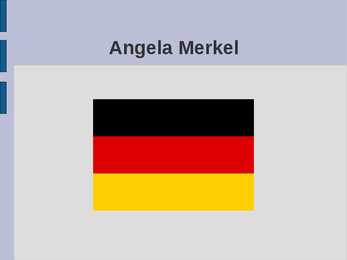
Merkel, but got divorced in 1982. In 1988 she married a chemistry professor, Joachim Sauer. Angela and Joachim Career path Angela Merkel stepped into politics in 1989 She joined the Christian Democratic Union (CDU) in 1990 In April 2000 Angela Merkel was chosen to lead the CDU Career path From 22nd November 2005 Chancellor of Germany. In September 2009, Merkel was re-elected to a second term as German chancellor. References http://lifestyle.iloveindia.com/lounge/angela-merkel-1511 http://en.wikipedia.org/wiki/Angela_Merkel http://www.biogs.com/famous/merkel.html
died in hospital. Buried in San Diego cemetery. History · His first short story, "Blackmailers Don't Shoot", was published in 1933 in Black Mask, a popular pulp magazine. His first novel, The Big Sleep, was published in 1939. In addition to his short stories, Chandler published just seven full novels during his lifetime. All but Playback have been realized into motion pictures, some several times. In the year before he died, he was elected president of the Mystery Writers of America. Works · The Big Sleep (1939) · Farewell, My Lovely (1940) · The High Window (1942) · The Lady in the Lake (1943) · The Little Sister (1949) · The Long Goodbye (1953) · Playback (1958) Thanks for your attention!
The USA The United States of America (also called the United States, America, and the States) is a federal constitutional republic. The country is situated mostly in central North America, where its forty-eight contiguous states and Washington D.C., the capital district, lies between the Pacific and Atlantic Oceans, bordered by Canada to the north and Mexico to the south. The state of Alaska is in the northwest of the continent, with Canada to the east and Russia to the west across the Bering Strait. The state of Hawaii is an archipelago in the mid-Pacific. The country also possesses several territories in the Pacific and Caribbean. The United States is the world's oldest surviving federation. It is a constitutional republic and representative democracy. The government is regulated by a system of checks and balances defined by the U.S. Constitution, which serves as the country's supreme legal doc...
Besides natural resources, fishing and hunting are very popular hobbies there, as many people earn their living by doing these things. System of government and politics Queen Elizabeth II is still the head of state in Canada. She is represented by a Governor General. There is a two-chamber parliament, and a system of provincial government with substantial autonomy. Parliament is made up of the Crown, an elected House of Commons and an appointed Senate. Each Member of Parliament in the House of Commons is elected by simple plurality in an electoral district or riding. Members of the Senate, whose seats are apportioned on a regional basis, are chosen by the Prime Minister and formally appointed by the Governor General, and serve until age 75. In conclusion Canada has a parliamentary government with strong democratic traditions and also a constitutional monarchy.
The national flag of Estonia is a tricolour: horizontally blue, black and white, called "sinimustvalge". The President of Estonia is Toomas Hendrik Ilves and the Prime Minister is Andrus Ansip. Estonia has been occupied several times during its history. The last occupiesation happened 16 June 1940 and it was declared 20 August 1991. Republic of Estonia has only one offical language - the Estonian language. Estonia is a constitutional democracy, with a president elected by its parliament. The elections are held every four years. Estonia became a member of the European Union 1 May 2004 and NATO's on 29 March 2004. In 1632 a university were established in the city of Tartu. Since then its called the University Town of Estonia. Everyone should visit Estonia at least once in a lifetime. We have an extraordinarily beautiful Old Town, interesting culture, nice people and many more.
The colonies formed a Continental Congress in 1774. In 1776, the Continental Congress decided to break away from England, form an alliance with France, and form a Union of the colonies. Thomas Jefferson wrote a Declaration of Independence. It was adopted on July 4. This meant war. Britain lost the war and lost America. It recognized the United States as a separate country in 1783. When Independence was declared in 1776, the 13 colonies became 13 States. In each State, the elected Assembly became the basis for a democratic government. Throughout the 1800s, new States kept joining the Union. And America kept gaining new territories. Soon it stretched all the way to the Pacific Ocean. While America expanded to the west, the Northern and Southern States argued over whether slavery should be allowed in the new western States. In 1860, Abraham Lincon was elected President. He was against slavery and promised to stop it from spreading any further.
the Soviets into the 1950s. In the "Singing Revolution" of the 1980s, Estonians showed their desire for independence in peaceful mass meetings. In 1989, 2 million people from the three Baltic countries linked hands in a human chain stretching from Tallinn to Vilnius in Lithuania. Independence was proclaimed(declared) on Aug. 20, 1991.Within weeks Estonia was recognized as a free and independent country On June 20, 1992, the kroon replaced the rouble. In September 1992 Estonians elected their first president and parliament in more than 50 years. On 14 September 200 In May 1993, the Council of Europe voted Estonia a full member. On May, 1, 2004 Estonia joined the European Union. Wordlist 1. vallutama Eestit 2. pärinema 12 sajandist 3. ühinema millegagi 4. nõudma iseseisvust 5. rahareform 6. välja saatma Siberisse 7. ,,metsavennad" 8. ulatuma Tallinnast vilniusesse 9. välja kuulutama iseseisvust 10. tunnustama 11. Kroon asendas rubla 12
Estonians was obstructed. St. George's Night Uprising · St. George's Night Uprising denotes a series of rebellions in 13431345 by the indigenous Estonianspeaking population of Northern and Western Estonia against rulers of foreign (mainly German) origin. · On St. George's Night (April 23) 1343, Estonians in Harria started a large uprising. They renounced Christianity, and killed mercilessly everybody with German ancestry · Insurgents elected their own leaders who were called "kings" in German chronicles. · On May 14th, the leaderless insurgents of Harria lost the battle of Kanavere against the Order troops. · The rebellion on the island of Oesel lasted two years Estonian Declaration of Independence · Estonian Declaration of Independence, also known as the Manifesto to the Peoples of Estonia is the founding act of the Republic of Estonia from 1918
Kadrina Secondary School 2016 GENERAL INFORMATION Muslim (Moslem) Quran Allah Second-largest Fastest-growing religion 1.7 billion followers 23% of the global population HISTORY 7th century Originated in Mecca Spread in the Arabian peninsula Prophet Muhammad Islamic Golden Age (8th – 13th century) DENOMINATIONS SUNNI Largest, 75-90% of population Caliph should be elected Righteous and acts according to Quran Hadith SHIA Second-largest, 10-20% of population Muhammad appointed his son-in-law as his successor Only descendants could be Imams (leaders) Son-in-law first Imam Rejecting the legitimacy of the previous three Caliphs ISIS Islamic State of Iraq and Syria Salafi jihadist militant group Fundamentalist, Wahhabi doctorine 1999 50000 – 260000 Videos of beheadings
Director Winston University 601 S Martin Luther King Jr Dr Winston-Salem, NC 27110, USA Dear Sir or Madam, I am writing to apply for a place at Winston University to receive a degree in History. I am 19 years old, graduated from La Serna High School this past fall, and I am ready to start a new chapter in my life. Starting from my sophomore year, I took all AP classes and obtained four A levels my senior year in Spanish, History, Anatomy and Theology. I was elected to our school’s Associated Student Body where I had the responsibility of caring for our school’s financial activities as the treasurer. I also received Honors and a Seal of Biliteracy. History has had always a big part of my life. I knew I wanted to be a history teacher at the age of 13 when I was in junior high in Yorba Linda. Since then, I have read tons of history-based books and mostly focused on the Postclassical era. Last semester
- The President The Executive Branch - The Supreme Court The Judicial Branch 7. The Bill of Rights is the first 10 amendments made to the Constitution in 1791. 8. The Departments can be compared to: - The Congress can be compared to the Parliament - The President can be compared to the Government Functions of the State Department: it is responsible for international relations (security, economics) 9. The President is elected indirectly by the people through state electors (winner is the one who gets the majority of electoral votes). Popular vote is the total vote of the people; electoral vote is the total vote of the electors. It is possible to win the electoral vote and lose the popular vote. 10. The Senators and the Representatives are elected directly. Each state has 2 senators, 1/3 of the senators is elected every two years for 6 years. The representatives are in
emergencies *Maret Maripuu Sotsiaalminister secures the financial subsistence and a good job, secures social subsistence and sevelopment *Urmas Paet Välisminister is responsible for the relations between Estonia and foreign states, safeguards Estonia's security and welfare Parlament: it is a permanently functioning unicameral legislative body consisting of 101 members, the Parlament sits in Toompea Castle, members of the Parlament are elected for a 4- year term by private ballot in free elections. Government: it wields executive power, it issues orders and regulations, submits bills to the Parlament for passage into law and foreign treaties for ratifications, drafts the state budget for submission to the Parlament abd effects it after adoption. The President nominates a minister candidate for the post of Prime Minister. Court system: it is a 3-tier system. The chancellor of justice examines all new laws, regulations
Unlike many Conservatives at that time, she had no difficulties in presenting her speeches as she talked with force and confidence on issues that mattered to the voters. Starting a Family and Career In Dartford Margaret met her future husband Denis Thatcher who was a local businessman. The couple married in 1951 and they had twins Mark and Carol in 1953. In the 1950s Margaret Thatcher trained as a lawyer, specialising in taxation. She was elected to Parliament in 1959 as Member of Parliament for Finchley, which was a constituency represented in the House of Commons. In 1961 Thatcher became the Parliamentary Secretary at the Ministry of Pensions and National Insurance. She also got the job of Conservative spokeswoman on housing and land. Thatcher was one of few Conservative Members of Parliament to support decriminalising male homosexuality, and she voted in favour of legalising abortion.
added to the company's management, and was silent about the company's famously anti-labour union practices. Hillary Clinton received sustained national attention for the first time when her husband became a candidate for the Democratic presidential nomination of 1992. Bill Clinton said that electing him woult get ''two for the price of one'' or ''buy one, get one free'', referring to the prominent role his wife would assume. First Lady of the United States After Bill Clinton was elected president of the United States in 1992, Hillary's involvement in political issues, both in the United States and in foreign countries, increased. She began to remold the role of the First Lady. Hillary Clinton remained an advocate for many of the programs and issues to which she earlier devoted her time and professional skills. She provided leadership in a number of areas, including the Task Force on National Health Care, which was responsible for
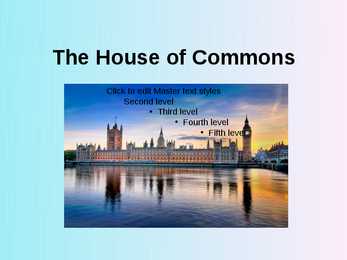
The House of Commons Click to edit Master text styles Second level Third level Fourth level Fifth level The House of Commons is the lower house of the Parliament of the United Kingdom, which also comprises the Sovereign and the House of Lords. It consists of 650 elected members called Members of Parliament. The House of Commons was originally far less powerful than the House of Lords, but today its legislative powers greatly exceed those of the Lords. The full, formal style and title of the House of Commons is The Honourable the Commons of the United Kingdom of Great Britain and Northern Ireland in Parliament assembled. Role The House of Commons main purpose is to make laws by passing Acts of
Federalism: distribution of responsibilities between central and regional government Bundesrat Bundestag · Four year fixed term Second Chamber (cf House of Lords) Represents German Länder (= devolved regions) in national politics · 656 members, half 16 Länder send delegations with voting weights in loose proportion elected from to population constituencies, half 69 members in total from regional party Can veto over 50% of laws (and require reconsideration of the rest) lists Extra check on government · `Working' parliament Esp. with tendency for `divided government', different party not `debating' majorities in Bundestag and Bundesrat parliament Separation of powers federalism
• "Forged from the Love of Liberty" https://www.youtube.com/watch?v=7au6DJfG7zY Independence day • 1 August 1976 Polity/ Government/Head of state • Trinidad and Tobago is a republic with a two-party system and a bicameral parliamentary system based on the Westminster System. The head of state of Trinidad and Tobago is the President, currently Anthony Carmona. The head of government is the Prime Minister, currently Keith Rowley. The President is elected by an Electoral college consisting of the full membership of both houses of Parliament. Capital city • Port of Spain Largest city • Chaguanas Official language • Official language is English Top10 non-English languages spoken • Trinidadian Creole 1million • Tobagonian Creole 300000 • French Creole 1.2million • Caribbean Hindustani 15000 Flag • The flag was chosen by the Independence committee in 1962. Red, black and white symbolise the warmth of the
bird is barn swallow and national stone is limestone. It is a land of great natural beauty with a long and varied history and rich culture. It has served as a junction of international trade routes for centuries. History. The oldest marks of habitation on the territory of Estonia date from the 8th millennium BC. Fortified settlements were established in the 1 st century BC. The ancestors of Estonians formed several independent states headed by elected elders. Until the beginning of the 13th century Estonia was politically independent. Then began a long chain of occupation and control by foreign powers. In the 1200s the German crusaders converted Estonia into a Christianity by force and took control over South Estonia. In 1219 Denmark conquered Northern Estonia. About a century later, in 1346 Denmark sold its territory to Germany. By the 1500s German nobles owned much of Estonia's land
4) the European Commission 5) the Court of Justice of the European Union 6) the European Central Bank 7) the Court of Auditors Most EU institutions were created with the establishment of the European Coal and Steel Community (ECSC) in the 1950s. Much change since then has been in the context the shifting of the power balance away from the Council and towards the Parliament. The European Parliament The European Parliament (EU Parliament or the EP) is the directly elected parliamentary institution of the European Union. Together with the Council of the European Union (the Council) and the European Commission, it exercises the legislative function of the EU and it has been describedas one of the most powerful legislatures in the world. The Parliament is composed of 766 members, who represent the second largest democratic electorate in the world (after the Parliament of India). It has been directly elected every five years by universal suffrage since 1979.
It was made 31 May 2004. The flags design was made by Frederick Brownell. Politics South Africa has three capital cities: Cape Town, the largest of the three, is the legislative capital; Pretoria is the administrative capital; and Bloemfontein is the judicial capital. South Africa has a bicameral(kahekojaline) parliament: the National Council of Provinces (the upper house) has 90 members, while the National Assembly (the lower house) has 400 members. Members of the lower house are elected on a population basis by proportional representation Province Capital Area (km²) Population (2007) Eastern Cape Bhisho 169,580 6,527,747 Free State Bloemfontein 129,480 2,773,059 Gauteng Johannesburg 17,010 10,451,713 KwaZulu-Natal Pietermaritzburg 92,100 10,259,230 Limpopo Polokwane 123,900 5,238,286 Mpumalanga Nelspruit 79,490 3,643,435 Northern Cape Kimberley 361,830 1,058,060
is called Prime Minister's Question Time and can be one of the most interesting discussions in British politics. Everyone wants to know what has been decided behind the closed doors of the Cabinet Room! Britain is administered from the Palace of Westminster in London. This is also known as the Houses of Parliament. Parliament is made up of two chambers - the House of Commons and the House of Lords. The members of the House of Lords are not elected; they qualify to sit in the House because they are bishops of the Church of England. aristocrats who have inherited their 'seats' from their fathers, people with titles, or senior judges of the legal system. There has been ta lk of reform this century because many Britons think that this system is undemocratic. The House of Commons, by contr'ast, has 651 seats which are occupied by Members of Parliament (MPs) who are elected by the British public. The
Congress, the Northwest Ordinance also protected civil liberties and outlawed slavery in the new territories. The following three principal provisions were ordained in the document: (1) a division of the Northwest Territory into "not less than three nor more than five States"; (2) a three-stage method for admitting a new state to the Union—with a congressionally appointed governor, secretary, and three judges to rule in the first phase; an elected assembly and one nonvoting delegate to Congress to be elected in the second phase, when the population of the territory reached "five thousand free male inhabitants of full age"; and a state constitution to be drafted and membership to the Union to be requested in the third phase when the population reached 60,000; and (3) a bill of rights protecting religious freedom, the right to a writ of habeas corpus, the benefit of trial by jury, and other individual rights. In addition the ordinance
The Queen has the final say on whether a bill becomes law. Parliament represents the peopleParliament is made up of three parts: The Queen, The house of lords and the house of commons. The House of Lords is made up of people who have inherited family titles and those who have been given titles because of their outstanding work.(675)( they 'double check'new laws, to make sure they are fair and will work. The House of Commons has 659 members who have been elected by local residents to represent an area of the country in Parliament. 27. (most important place for discussing policies and making laws.) There are 2 main parties that have contolled by the government since 1945. state and people are kept as distant as possible, expect for elections, the two largest political parties have been the Conservative Party and the Labour Party. Government runs the country and is also elected by the
Eventually, those colonies became the provinces of Ontario and Quebec. Today, more than five million French-speaking descendants of those settlers live in Quebec. In 1867, four colonies (Ontario, Quebec, New Brunswick, Nova Scotia) were united into the Dominion of Canada. In the following years, the others followed. Only Newfoundland, discovered first by the British, remained independent until 1949. Canada is a democratic country. Political representatives are elected by citizens 18 years old and over. Canada has 3 levels of government: federal, provincial and municipal. The federal representatives are called Members of Parliament or MPs. Provincial representatives are called Members of the Legislative Assembly. Municipal representatives are called councillors. The responsibilities of the different levels of government are specified in Canada's constitution. The Queen of England is the head of state in Canada's government. She appoints a
September, Where's My Prince. The book is a booklist top ten Romance Novel for youth in 2004. Many well-known public magazines for e.g. The New York Times, Publishers Weekly and Voya, have given positive feedback to this book. The book is about a 17 years old high-school girl, named Jan Miller, who feels, like she has the most boring life ever, a teenage girl can have. She doesn't really like her parents and her best friend is lately been elected as an official It Girl. Te best friend seems to have a perfect life, that Jan would actually like to have. For many years, she has been in love with Tom, a classmate, but then, there comes Josh and suddenly Ian is in love with him. It starts at an English class, where Jan plays Juliet and Josh Romeo. They also meet sometimes by Josh, because his mother asks her to babysit Joshes little sister. At the same time Rebecca, the perfect best friend, starts going out with older guy
Education: Today's education in Estonia is divided into general, vocational and hobby education. The education system is based on four levels which include the pre-school, basic, secondary and higher education. The number of comprehensive schools is 601. There are 11 universities in Estonia, including 5 private universities. Applied higher education is provided in 13 schools. 41 schools provide vocational education. Government: Head of state is the President who is elected by the parliament for five- year term. Toomas-Hendrik Ilves is currently in his second term. Head of Government is the Prime Minister, currently Andrus Ansip. Economy: The national currency in Estonia is Euro. The average wage and gross wage in Estonia is 913. Average net income is 717 euros. Unemployment rate in Estonia is 13.3 % National symbols of Estonia: Estonian flag represents the republic of Estonia. It is a blue-black-white 105x165cm rectangle
 annaabi.ee