 10 punkti
Autor soovib selle materjali allalaadimise eest saada 10 punkti.
10 punkti
Autor soovib selle materjali allalaadimise eest saada 10 punkti.
 ~ 9 lehte
Lehekülgede arv dokumendis
~ 9 lehte
Lehekülgede arv dokumendis
 2015-01-20
Kuupäev, millal dokument üles laeti
2015-01-20
Kuupäev, millal dokument üles laeti
 3 laadimist
Kokku alla laetud
3 laadimist
Kokku alla laetud
 0 arvamust
Teiste kasutajate poolt lisatud kommentaarid
0 arvamust
Teiste kasutajate poolt lisatud kommentaarid
 kassikulles
Õppematerjali autor
kassikulles
Õppematerjali autor
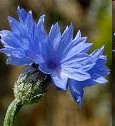
Tallinna Inglise Kolledz Estonia Topic Alice Tärk, 9b Tallinn 2007 FACTFILE Area: 45 228 sq km Poplulation: under 1.4 million Capital: Tallinn Language: Estonian Currency: Eesti kroon (EEK) Main religion: Lutheran National holiday: 24 February (anniversary of the republic) National flower: Cornflower National bird: Barn Swallow National stone: Limestone LOCATION The Republic of Estonia is the northernmost and smallest of the three Baltic States. It is located on the eastern shores of the Baltic Sea in the north east of Europe. To the east the country borders Russia. Latvia is the countries neighbour to the south
(339 km) to the south and Russia (229 km) to the east. It is separated from Finland in the north by the narrow Gulf of Finland and from Sweden in the west by the Baltic Sea. Estonia has been a member of the European Union since May 1, 2004 and of the NATO since March 29, 2004. The area of Estonia is about 45000 square kilometres and the population is about 1.4 million people. The capital of Estonia is Tallinn and the official language is Estonian. The currency is Eesti kroon. The main religion is Lutheran. Anniversary of the republic is celebrated on February 20. The national flower is cornflower, national bird is barn swallow and national stone is limestone. It is a land of great natural beauty with a long and varied history and rich culture. It has served as a junction of international trade routes for centuries. History. The oldest marks of habitation on the territory of Estonia date from the 8th millennium BC
Tallinn English College Topic Estonia Tallinn 2008 1. Introduction Estonia is a small country about the size of Switzerland, or New Hampshire and Massachussetts combined. Estonia is named after the people called "Ests" who lived in the region in the 1 st century AD. The Republic of Estonia is one of the three countries commonly known as the "Baltic States". The other Baltic States are Latvia and Lithuania. 2. Geographical position Estonia is situated in northeastern Europe. Estonia is bounded on the north by the Gulf of Finland, on the east by Russia, on the south by Latvia and on the west by the Baltic Sea. In the north it borders on Finland. The coastline of the Baltic Sea in Estonia is characterized by numerous gulfs and bays, the biggest of them being the Gulf of Finland, the Gulf of Riga and the Gulf of Pärnu. Bays include the Narva Bay, Matsalu Bay, Kolga Bay, Kunda Bay, Tallinn Bay etc. Estonia has over 1500 islands, the largest being
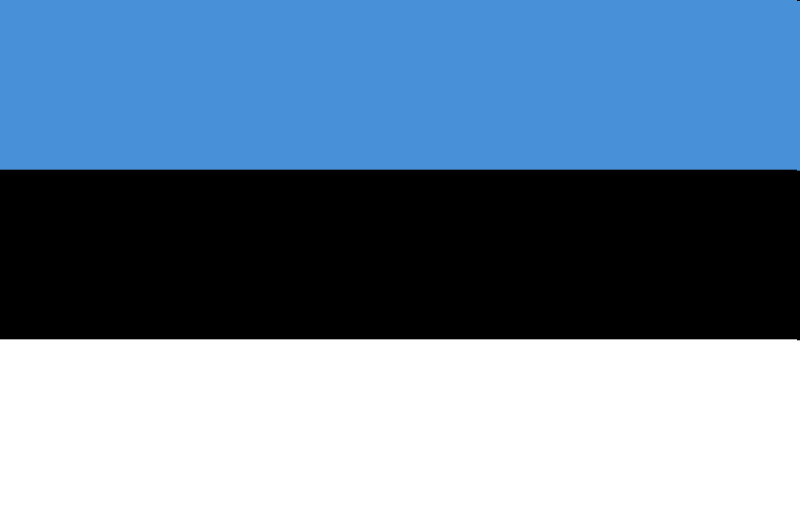
ESTONIA Estonia is a country in northeastern Europe in the northernmost of the three Baltic states. Estonia’s area includes some 1,500 islands and islets; the two largest of these islands are Saaremaa and Hiiumaa. Situated in northeastern Europe, Estonia juts out into the Baltic Sea, which surrounds the country to the north and west. To the east Estonia is bounded by Russia, predominantly by the Narva River and Lakes Peipus. To the south Estonia is bounded by Latvia. (Stranga, 2021) Estonias current population is 1 327 100 and the city with the largest population is Tallinn with 394 000 people. The population density of Estonia is 31 people per km2. (Estonia Demographics, s.a) One of the most cherished national symbols of Estonia is the blue-black-white colour national flag. The Estonian flag was born in the national-romantic student circles of the University of Tartu during the final quarter of the 19th century. The blue, black and white tricolour was consecrated by the members of
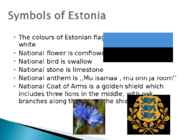
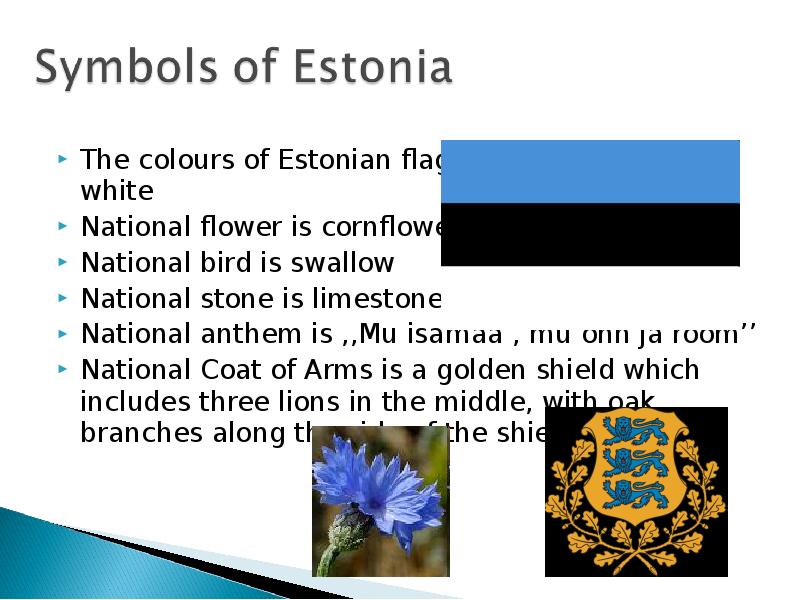
Economy 6 Culture 6 Biggest towns 7 Language 8 3 Facts and figures The Republic of Estonia is a small country. Covering only 45, 228 sq km it is slightly bigger than Denmark, Belgium or Switzerland. Estonia's population is under 1.4 million. The official language is Estonian but since very many Russians live here Russian is also wide spread. The capital of Estonia is Tallinn. The currency used in Estonia is Eesti kroon. The Estonian national flag is blue-black-white. It was originally the flag of the Estonian Students' Society. The flag was first consecrated in Otepää Church in 1884. For a while, during the Soviet occupation, the flag was banned but it was again seen in public in Tartu in May 1988. The national flower is cornflower, the national bird is barn swallow and the national stone is limestone. The Estonian national anthem called "My Native Land, My Pride and Joy" was composed in
Mona Maria Tammik 11B Welcome to Estonia Hello, my name is Mona and I will be your guide today. I will show you around this schoolhouse and tell you about the tiny yet amazing country called Estonia. Estonia is a country in Eastern Europe. It's a small country beside the Baltic Sea. Our neighbours are Finland, Russia, Latvia and Sweden. Estonia's surface area is 45,227 square kilometres. The population of Estonia is around 1,3 million. We have four seasons in Estonia. The air is very humid and it rains quite often, especially in spring and autumn. The weather is is influenced by a humid continental climate. We usually have long winters and plenty of snow, but sometimes we haven't even had snow. Summers are mostly warm and beautiful in Estonia. Estonia is well known for its amazing countryside. We don't have any big mountains, but we do have over a thousand islands
Estonia Anna-Kaisa Adamson Estonia, officially the Republic of Estonia, is a state in the Baltic region of Northern Europe. It is bordered to the north by the Gulf of Finland, to the west by the Baltic Sea, to the south by Latvia, and to the east by the Lake Peipsi and the Russian Federation. The territory of Estonia covers 45,227 km2. The capital, Tallinn, has around 400000 inhabitants.Tallinn's ability to blend medieval architecture with Scandinavian modernity with all the comforts you'd expect from a modern, competitive and innovative capital. Estonian language, does not belong to the Indo-European group. It belongs to the Finno-Ugric language family, which also includes Finnish and Hungarian. Estonian dialects are divided into two groups, Northern and Southern, usually associated with biggest cities of those regions Tallinn, the capital, in the north and Tartu
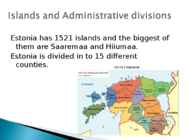
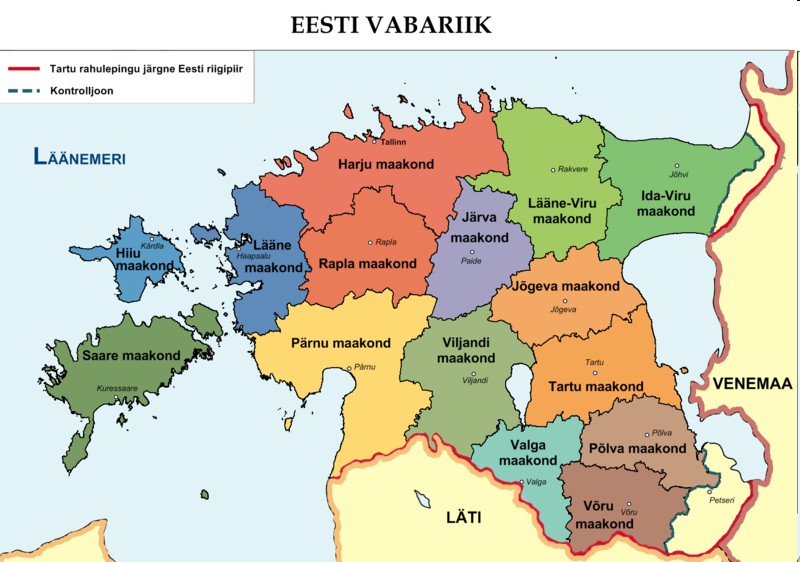
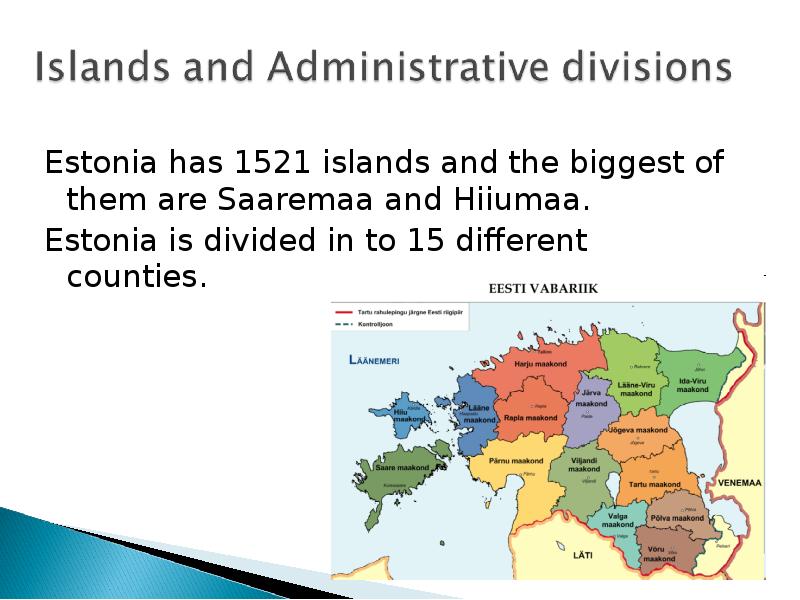
Introduction of Estonia The Republic of Estonia is beautiful country which is located in northeastern Europe, bordering the Baltic Sea on the west, the Gulf of Finland on the north, Latvia on the south, and Russia on the east. Estonia is the smallest of the Baltic countries. Administrative division: Estonia has an area of 45,226 square kilometers and Estonia is administratively divided into counties. There are 15 counties in Estonia. The capital is Tallinn which is located in Harjumaa. Counties are divided into 194 rural municipalities. Population: The population of Estonia was estimated at 1.34 million in January 2011, with a density of 30 persons per square kilometer. According to the last census the number of inhabitants has decreased. In 2010 the birth rate was 11,82 per 1,000 population, while the death rate was exactly the same, so population growth rate is 0%. The proportion of urban population is 69.4 %. And the proportion of rural p
 annaabi.ee

















Kõik kommentaarid