 10 punkti
Autor soovib selle materjali allalaadimise eest saada 10 punkti.
10 punkti
Autor soovib selle materjali allalaadimise eest saada 10 punkti.
 ~ 2 lehte
Lehekülgede arv dokumendis
~ 2 lehte
Lehekülgede arv dokumendis
 2015-09-24
Kuupäev, millal dokument üles laeti
2015-09-24
Kuupäev, millal dokument üles laeti
 2 laadimist
Kokku alla laetud
2 laadimist
Kokku alla laetud
 0 arvamust
Teiste kasutajate poolt lisatud kommentaarid
0 arvamust
Teiste kasutajate poolt lisatud kommentaarid
 wimin
Õppematerjali autor
wimin
Õppematerjali autor
Sculptures and monuments St. John's Lutheran Church St John's Church was probably built in the first third of the 14th century. There is no other brick church decorated with so much terracotta plastic in Europe Eduard Tubin Monument The Eduard Tubin monument, marking the 100th birthday of the composer, was dedicated in 2005. The authors of the statue are sculptor Aili Vahtrapuu, architect Veronika Valk, with sound installations by Louis Dandrel.Eduard Tubin (1905-1982) was a versatile composer and conductor, one of the most recognized symphonists throughout history. He served as concert master and conductor at the Vanemuise Theatre
Collection The collection that consists of 55 823 titles is displayed in the following branches: · the permanent exhibition of classics of Estonian art (18th century II World War), the permanent exhibition of Estonian art from 1945-1991 and contemporary art at Kumu Art Museum; · ecclesiastical Medieval and Baroque art from the period between 13th 18th century, silverware of guilds, craft corporations, Brotherhood of the Black Heads and churches at Niguliste Museum; · European and Russian art from the period between 16th 20th century in the Kadriorg Palace, and a valuable collection of the 16th 20th c. art from Western Europe, Russia and China, donated to the museum by Johannes Mikkel, at Mikkel Museum at Kadriorg Art Museum; · Art of Adamson-Eric (19021968), one of the most outstanding Estonian painters of the 20th century, at Adamson-Eric Museum;
Estonian sculptors, has been standing for several decades. Lai Street stretches from Nunne Street to Pikk Street. Parallel with Pikk Street, Lai Street, too, ends at the Great Coast Gate (first mentioned 1359). Lai Street is very wide considering that it was laid out in the Middle Ages. This is because it sprang up on both sides of former city wall. Lai is quite a peaceful street with few shops. However, it has three museums and two theatres. The main entrance into St Olaf´s Church also faces the street. Several Lai Street houses have kept their Gothic appearance and even interiors, although we can also notice moderate Nordic Baroque, Neoclassicicm, Historicism and even Art Nouveau. The origin of the name "Lai" Lai Street belongs among the oldest streets of Tallinn. Despite its length and width its share in the city's inner traffic is fairly modest. The extraordinary width of the street is likely due to
It was built to a design by Mikhail Preobrazhensky in a typical Russian Revivalstyle between 1894 and 1900, during the period when the country was part of theRussian Empire. The Alexander Nevsky Cathedral is Tallinn's largest and grandest orthodox cupola cathedral. It is dedicated to Saint Alexander Nevsky who in 1242 won the Battle of the Ice on Lake Peipus, in the territorial waters of present-day Estonia. The late Russian patriarch, Alexis II, started his priestly ministry in the church. Interior of the Cathedral. The Alexander Nevsky Cathedral crowns the hill of Toompea where the Estonian folk hero Kalevipoeg is said to have been buried according to a legend. (There are many such legendary burial places of him in Estonia.) The cathedral was built during the period of late 19th century Russification and was so disliked by many Estonians as a symbol of oppression that the Estonian authorities scheduled the cathedral for demolition in 1924, but the decision was
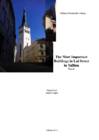
Tallinn Mustamäe College G2K Jaana-Kristiina Jõgevest The Four oldest churches of Tallinn Report Supervisor: Ingrid Teigar Tallinn 2009 The Dome Church The Danes began fortification of Toompea after the conquest of Tallinn in 1219 and probably also built the first church there. It was presumably a wooden building located at the site of the present cathedral. However, a serious conflict with the Order of the Brothers of the Sword broke out soon as the latter wanted to gain control of the entire Estonia. The order succeeded in subordinating Tallinn and the whole of North Estonia to its rule in 1227. The monks of the Dominican Order began the construction of a stone church in Toompea in 1229
named before the qonquest, marking the destination they finally led, like Harju and Viru Street. Foreigners usually had different names for such streets. The streets were paved since the beginning of the 14th century. Pikk Jalg was among the first to be paved. Town Hall Square got its cover in 1310. There were no streetlights. The houses had no numbers and were known by the owner's name. Churches The Cathedral of St. Mary the Virgin (the Dome Church) was consecrated in 1240. The church suffered in the fire of 1684 and was largely reconstructed. A Baroque tower was added in the 18th century and the dated weather-vane (1779) crowning the spire is the only original one on Toompea today. Among other functions, the church served as a burial ground for the rich and the noble. The church also features grave slabs, an oaken Baroque altar by Christian Ackermann and a number of monuments to famous people (e.g. Pontus de la Gardie. Karl Horn and Admiral Adam Johann Krusenstern)
The origins of Fat Margaret's name are a mystery. Some theories insist it was named for one of its larger cannons, while others hint at a cook called Margaret who once worked here. In any case, the tower has served a number of different functions throughout its history. It has been used a storehouse for gunpowder and weapons, and as a prison. Now it's home to the Estonian Maritime Museum, which provides a detailed look at the nation's seafaring past. 3 churches of the lower town Niguliste - 13th-century Gothic church-turned art museum. Destroyed during World War II and rebuilt during Soviet times, the church now houses a fascinating collection of medieval religious art, with altars from the 15th and 16th centuries, a collection of Baroque and Renaissance chandeliers, and a 'silver chamber.' The church is also known for its acoustics Holy Spirit - 13th-century church adjacent Town Hall Square sports an impressive Baroque
the right to own property, and so on. Peter the Great wanted to open a window onto Europe for Russia so he started the Northern War in 1700. Estonia remained under Russian rule and the Baltic-German nobility vowed allegiance to the Tsar; the barons were restored their former privileges. In 1870 a railway line was opened from St. Petersburg to Tallinn. Tallinn grew into a major port and an industrial centre. Estonians became conscious of their national identity. Tartu was the centre of the movement of national awakening. On 24 February 1918, Estonia was proclaimed an independent democratic republic. Tallinn developed into a modern European capital. A period of prosperity followed, but independence only lasted for 20 years. During World War II Estonia was occupied by both German and Russian invaders, and Tallinn suffered heavily. The bombing of the city by the Soviet air forces on 9 March 1944 left over 20,000 people homeless
 annaabi.ee








Kõik kommentaarid