The famous Canadians Jason Day (born May 19, 1981) is a Canadian mixed martial arts fighter born in Lethbridge, Alberta, Canada, and has fought for several MMA associations, including the Ultimate Fighting Championship, TKO Major League MMA, Rumble in the Cage, King of the Cage, and many others. He is also the former TKO Middleweight champion.He is one of the few practitioners of the Eddie Bravo "Rubber Guard" system in mixed martial arts, in which a fighter can avoid taking heavy damage when fighting from his back, by using his legs and arms to hold his opponent very close to him in order to stifle his attacks. This was demonstrated best in his fight against Alan Belcher in UFC 83. Day fought his second fight in the UFC on June 7, 2008 at UFC 85 in London. His opponent was Michael Bisping who defeated Day in the first round. Also on June 6, 2009 he showed another example of his training with Eddie Bravo when h...
Total area is 9,984,670 square kilometres (3,855,100 square miles) The largest city is Toronto Canada Canada is a bilingual country : they speak both English and French The monarch is the Queen of England It's ten provinces and three territories extend Canada's national anthem is `' O Canada '' How Canada got it's name? Canada's name comes from `' kanata, '' the Iroquois-Huron word for `' village '' or `' settlement '' Aboriginal people, First Nations and Inuit Aboriginal Canadians, also known as Indigenous Canadians, are the indigenous people within the boundaries of present - day Canada. The first largest group were the Indians. Nowadays the term `' First Nations `' is used instead of `' Indian '' Some 4,000 years ago another group of people arrived in Canada. They called themselves the Inuit, which means `' the people '' First Nations First Narions were divided into 6 groups : Woodland First Nations, Iroquoian First Nations, Plains First Nations,
We say "eh?" a lot. We live in igloos. We all speak French. We ride polar bears.. There is no summer; it's always cold and snowy Everyone watches/liked/plays hockey. We're polite. They hate Americans. It snows non stop in canada Canada beer is better than American beer Canadians pronounce the word "about" ..."aboot They wear funny hats They eat blubber Canada hokey players are mullets Canadians are fat They don't have water toilets They are all monarchists All Canadians snowboard They all are jealous of Americans Canada is where Avril Lavigne and Eskimos come from Peaceful hippies They put maple syrup on EVERYTHING They don't have roads Canadians drive dog sleds everywhere They have monopoly money They have no army They have beavers everywhere They have police horses They are afraid of dark They are all lumberjacks They have a lot of geese They don't lock their front door when they are at home They have a lot of mooses
Canada is a big country. It’s covering 9.9 million square kilometrs, making it the world’s second-largest country by land area. Canada stretches nearly a quarter of the way around the globe and covers six of the world’s 24 time zones. Canada has the longest coastline in the world, so it meets three oceans: the Pacific, the Atlantic and the Arctic. Canadians are multicultural. They are proud of the many cultures that exist side by side in their country. It has two official languages, English and French. The Canadian population is made up mainly of British and French origins. However Canada is not like Britain, or France, or the USA. The way of life there is very varied. It has influenced by immigrants from all over the world. Canadians prefer British English spellings, such as theatre, centre, colour and harbour
CANADA FACTFILE Area: 10 million square km Population: 35 million Capital: Ottawa Official languages: English, French Currency: Canadian dollar Number of Native Canadians: 800 000 75% of Canadians live in cities/towns. 80% live within 200 (160) km of US border. Largest city: Toronto (4.7 million) Northern Canada: mainly forest, tundra, ice and snow Western Canada: Rocky Mountains Highest mountain: Mount Logan (5 951 m) West-central Canada: prairie grassland Most important river: St Lawrence Longest river: Mackenzie (4,241 km) Niagara Falls: largest falls in the world Also 2 million lakes, over 60% of the world's lakes Industry: mining, oil and gas, paper, motor vehicles, fishing
Canada's birthday is on the first of July and its motto is: "From sea to sea". The first inhabitants were the ancestors of the Aborigines. Today Canada is the home of over a million Aboriginal people. They came to Canada about 25 000 years ago. First Europeans came to Canada about 1000 years ago. The first Europeans in Canada were the Vikings. The population of Canada is about 33 million. Canada has two official languages: English and French. About 65% of Canadians speak only English and about 20% of them speak only French. English and French have equal status in federal courts, Parliament, and in all federal institutions. The public has the right to receive federal government services in either English or French. About 77% of the Canadians live in cities or towns. Montreal and Toronto are the two largest cities in Canada. Toronto has more than 3 million people and is Canada's business centre. It's also famous for its skyscrapers
Governor General appointed by the monarch Parliamentary democracy Similar parliamentary system to other Commonwealth realms Federation "One Dominion under the name of Canada" with the Constitution Act of 1867 GEOGRAPHY Located in North America, north of USA Territory - 9,984,670 km2 World's second largest country CLIMATE Due to large territory, climate varies in greatly ECONOMY One of world's wealthiest nations 1,406,000 GDP 9th in the world About ¾ of Canadians employed in service industry Unusually high importance of primary sector Logging and oil industry two of Canada's most important One of world's most important agricultural suppliers World leader in many natural resources Gold, nickel, aluminum, lead, zinc, uranium One of few developed countries that are net exporters of energy LANGUAGES RELIGION SYMBOLS Flag Coat of Arms Anthem "O Canada!" O Canada! Our home and native land! True patriot love in all thy sons command.
They crossed the Bering Strait from Siberia to Alaska. Some of those people followed the Yukon River and found their way south. Others followed the MacKenzie River which opened the way to the plains of the interior, and then travelled on to the Great Lakes and the St. Lawrence River. The third group of people inhabited the Arctic regions. The first two groups were called Indians, the group that settled in the north were called Eskimos. These people are the only true native Canadians, the rest are new Canadians who have been transplanted from other parts of the world, especially from Europe. The first European visitors to North America were Norsemen who settled briefly in the 11th century. John Cabot, a Venetian seeking riches for England, made the next known voyage in 1497. He took back word that the sea was full of fish which could be taken not only with a net but in baskets let down into the water.
Canada is a federation of 10 provinces and 2 territories. The population Canada is slightly larger than the United States, but has only about a tenth as many people. About 28 million of people live in Canada. About 80% of the population live within 320 km of the southern border. Much of the rest of Canada is uninhabited or thinly populated because of severe natural conditions. Canada's people are varied. About 57% of all Canadians have some English ancestry and about 32% have some French ancestry. Native people American Indians and Eskimos make up about 2% of the country's population. 77% of Canada's people live in cites or towns. The Capital of Canada Ottawa is the capital of Canada. One third of its people are French- speaking. Ottawa is the capital of Canada and is located on the banks of the Ottawa, Rideau and Gatineau
The two principal river systems are the Mackenzie and the St. Lawrence. The St. Lawrence, with its tributaries, is navigable for over 3,058 km. The largest lake situated entirely in Canada is Great Bear Lake at 31,328 km2 in the Northwest Territories. The largest lake which is at least partly in Canadian territory is Lake Superior Climate Canada's climate is as diverse as its landscape. Generally, Canadians enjoy four very distinct seasons, particularly in the more populated regions along the US border. Daytime summer temperatures can rise to 35°C and higher, while lows of -25°C are not uncommon in winter. More moderate temperatures are the norm in spring and fall. Summers can be hot and dry on the prairies, humid in central Canada, and milder on the coasts. Spring is generally pleasant across the country. Autumns are often crisp and cool,
Canada is a vast country, second largest country of the world after Russia. It stretches from the Atlantic Ocean in the east to the Pacific Ocean in the west and to the Arctic Ocean in the North. Canada Covers most of the northern part of North America and its geography is very diverse. Canada's area is about 10 million square kilometers and its population is 31 000 000. Its capital is Ottowa and other main cities are Toronto, Montreal and Vancouver. Almost 75 % of canadians lives within 300 kilometer of the USA border, because the climate is softer in the South. 89 % of Canada is almost unhabited. Its official languages are English and French, but many other languages are spoken too. Like Italian, Chinese, German, Polish, Ukrainian, Dutch and Creek. There are also many native languages such as Algonquian. Most of the canadian's speak English (67 %), but French is very largely spoken too (26 % of the canadians).
all federal institutions. The public has the right, where there is sufficient demand, to receive federal government services in either English or French, and official language minorities are guaranteed their own schools in all provinces and territories. English and French are the mother tongues of 59.7% and 23.2% of the population respectively, and the languages most spoken at home by 68.3% and 22.3% of the population respectively. 98.5% of Canadians speak English or French (67.5% speak English only, 13.3% speak French only, and 17.7% speak both). English and French Official Language Communities, defined by First Official Language Spoken, constitute 73.0% and 23.6% of the population respectively. Although 85% of French-speaking Canadians live in Quebec, there are substantial Francophone populations in Ontario, Alberta and southern Manitoba, with an Acadian
Canada is worlds... largest uranium supplier second richest country third largest diamond producer National symbols of Canada ice hokey maple lacrosse July the 1st 1881 first longdistance telephone call 1927 first radio broadcast 1958 television network 1980 "O Canada" Avarage Canadian is... hospitable tolerant following a live and let live philosophy with strong sense of community and duty Canadians invented basketball baseball glove lacrosse Lacrosse mix between soccer and hockey 10 players 3 attackmen, 3 midfielde, 3 defensemen and 1 goalkeeper Canada has worlds longest coastline onetenth of the worlds forests longest national highway in the world Great Slave Lake deepest lake in North America in the 1930s, there was discovered gold max depth of 614 m Canadian Rockies highest point is Mount Robson
It is a member of the Organization for Economic Cooperation and Development (OECD) and the G8, and is one of the world's top ten trading nations Canada is a mixed economy Economy The largest foreign importers of Canadian goods are the United States, the United Kingdom, and Japan Like other First World nations, the Canadian economy is dominated by the service industry, which employs about three quarters of Canadians. Canada is unusual among developed countries in the importance of its primary sector, in which the logging and petroleum industries are two of the most important The Canada 2006 Census counted a total population of 31,612,897, an increase of 5.4 percent since 2001 Population in Canada increased from 1990 to 2008 with 5.6 million and 20.4 % According to the OECD/World Bank population statistics between 19902008
kilometers and it is bordered by three oceans: the Arctic, the Pacific and the Atlantic Oceans. The population of Canada is about 31 million people. About 77% of the people live in cities which lie in a band about 100 miles wide above the border of the United States. The capital of Canada is Ottawa. Other large cities are Montreal, Toronto, Vancouver, Winnipeg and Quebec. Canada has two official languages English and French. It's interesting to know that about 61% of Canadians name English and 24% French their mother tongue. There are also many other languages spoken in Canada such as: Italian, Chinese, German, Polish, Ukrainian, Greek and Dutch. There are also many native languages such as Algonquian. The British and the French as the main settlers from Europe fought for hundreds of years before they managed to build up a country which was based on recognizing the cultural diversity of different nations in Canada. All the communities living in the
Two official languages at the federal level: English, French. Canada's linguistic diversity extends beyond the two official languages. In Canada, about 14% of the population are reported speaking a language other than English or French most often at home and about 5% reported speaking such a language on a regular basis as a second language. Canada is also home to many indigenous languages. Taken together, these are spoken by less than one percent of the population. About .6% Canadians report an Aboriginal language as their mother tongue. New Brunswick, Yukon (and some other provinces) English and French. The Northwest Territories 11 languages: Chipewyan, Cree, English, French, Gwich'in, Inuinnaqtun, Inuktitut, Inuvialuktun, North Slavey, South Slavey, Tlch. Nunavut - Inuit language (Inuktitut, Inuinnaqtun), English, French. Quebec French. 17. What is meant by the terms `anglophone', `francophone', `allophone', `heritage language', `distinct
Jim Carry, Ellen Page, Ryan Gosling and Myke Myers are some of the famous movie acters from Canada Deadmau5 is a famous DJ from Canada Nature Canada has a very various landscape Canada has around 31,700 large lakes Canada is geologically active, having many earthquakes and potentially active volcanoes The national animals in Canada are beaver and canadian horse Culutre and traditions Historically, Canada has been influenced by British, French, and aboriginal cultures and traditions Many Canadians value multiculturalism and see Canada as being inherently multicultural Popular food is French fries with maple syrup National sport is ice hokey Famous sights are Lake Louise, Banff and Montreal Interesting facts Canada is the second largest country in the world Canada is a developed country and one of the wealthiest in the world Youtube video: https:// www.youtube.com/watch?v=HfTkZmKK1b 0 Used literature http://en.wikipedia.org/wiki/Canada http:// www.famousbirthdays.com/birthplace/canada
E.I. join Canada 1885 North-West Rebellion; the Canadian Pacific Railway is completed 1905 The provinces of Alberta and Saskatchewan are created 191418 World War I 1916 Women win the vote in Manitoba, Saskatchewan, and Alberta 1919 The Winnipeg General Strike 192939 The Great Depression 193945 World War II 1949 Newfoundland joins Canada 195053 Korean War 1959 St. Lawrence Seaway (major transportation route) officially opens 1960 Québec's Quiet Revolution begins; Native Canadians given the vote 1967 Canada's 100th birthday; Expo 67 World's Fair in Montréal 1970 October Crisis: political kidnappings, Ottawa suspends civil rights 1980 Québec referendum on "sovereignty-association" defeated 60% to 40% 1982 Constitution comes home -- with a Charter of Rights and Freedoms 198790 Meech Lake Accord is put forward -- and collapses 1992 Charlottetown Accord is rejected by a national referendum 1995 Québec referendum on sovereignty is narrowly defeated
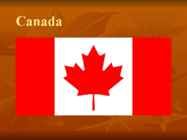
General is Michaelle Jean. The Prime Minister is really the head of government in Canada. Stephen Harper is currently the PM. National symbols. The use of the maple leaf as a Canadian symbol dates back to the early 18th century, and is on its current and previous flags, the penny, and on the coat of arms. The national colours are red and white which also appear on the flag. The national animal is the beaver and it is because the fur trade. Maple syrup is very important for Canadians also. Hockey is the official winter sport. Canada's official colours are red and white. The colours appear on the flag. History. Almost a thousand years ago men from Norway sailed across the Atlantic Ocean and "discovered" America about 4 centuries before Columbus. In 985 AD Vikings who wanted to go to Greenland from Iceland were blown off their course and they reached Canada. It is thought that they reached Labrador. They saw forested
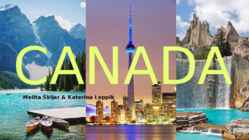
CANADA Melita Skljar & Katerina Leppik CANADA is a country, consisting of ten provinces CAPITAL CITY - O T T A W A Population is 883 391 FLAG- Maple Leaf Largest city: Toronto Athem: "O Canada" Official languges: English and French Area: 9,984,670 km2 (2nd after Russia) Population: 34,319,000 SPORTS Canada's official national sports are hockey in the winter Hockey is the sport most played by Canadians, with 1.65 million participants Lacrosse Best summer game Other popular spectator sports include curling and football, that is played professionally in the Canadian Football League (CFL) CANADA's HOLIDAYS The most important holiday is Canada Day It is Canada's national birthday The first Canada Day was on July 1st, 1867 It is celebrating with Fireworks, parades, barbecues, concerts, carnivals,
-ir currency now is euro, before was the irish pound; What is the longest river in Republic of Ireland?: The River Shannon at 240 miles.; Population: 4,400,000; The official language of the Republic of Ireland is Gaelic but English is the principal language of communication and commerce.; Ireland uses the `common law' legal system also used by the United States, Canada and United Kingdom.; republic of Ireland occupies just 83% of the total island of Ireland. -can - Canadians call their currency The Loonie.; 16 percent of Canada's population are immigrants.; Quebec is the biggest of Canada's main provinces and covers 1,365,128 square kilometres.; Life Expectancy Canadian men born in the last few years can expect to live to around 77 years and women to 84 years.; 4.1 percent of Canadians suffer from diabetes.; The average person in Canada watches 14 hours of television per week.; There are around 11.5 million households in Canada. Of these, 6
The prime minister and the cabinet or any Member of Parliament can present bills which are passed by the House of Commons They become laws when they are approved by the Senate and signed by the governor-general. The Senate is an appointed body, not elected body of men and women. The prime minster appoints them. There are five main political parties in Canada. Canada is blessed with many natural resources: oil, natural gas, coal, gold, silver, iron ore, zinc, nickel, copper, uranium. Canadians export wheat and other grains meat, dairy products, sugar products and forestry products such as paper and pulp. Canada also has a manufacturing industry producing automobiles and automobile parts and chemicals. The most important customers for export are the United States, Japan, the United Kingdom and Germany Schooling in Canada is free and universal. It's compulsory from the ages of 7 to 14. Schools are described as elementary and secondary, some provinces have junior high or middle
The main idea of the essay is stated in a single sentence called the thesis statement. You must limit your entire essay to the topic you have introduced in your thesis statement. 2. Provide some background information about your topic. You can use interesting facts, quotations, or definitions of important terms you will use later in the essay. Example: Hockey has been a part of life in Canada for over 120 years. It has evolved into an extremely popular sport watched and played by millions of Canadians. The game has gone through several changes since hockey was first played in Canada. Supporting Paragraphs What are supporting paragraphs? Supporting paragraphs make up the main body of your essay. What do they do? They develop the main idea of your essay. How do I write them? 1. List the points that develop the main idea of your essay. 2. Place each supporting point in its own paragraph. 3. Develop each supporting point with facts, details, and examples.
of the entire land area of the world. So the population density is 3.5 persons per sq.km. There are 10 provinces and 3 territories. The biggest provinces are Alberta, British Columbia and Manitoba. The biggest city is Montreal with 3.8 million people. The capital Ottowa has only 1.2 million people and is listed fourth biggest city. 32% of population is Canadian, 21% is English and 15.8% is French. First Nationist are only 4%. 80% of Canadians live in 3 urban areas concentrated in the Quebec City- Windsor Corridor, the British Columbia Lower Mainland, and the Calgary-Edmonton Corridor. 80% of the population live within 150km of the US border; 90% lives within 300km of the US border. Most First Nations live in reservations in the southern part of the country. If you look at the map of the world, you will notice what a huge country Canada is. It is the second largest country in the world, xceeded only by Russia. From St
g. The water from the bathroom tap is not very nice to drink 2.Other uses of the: -when there is only one of something, e.g. the sun, the Prime Minister, the Pacific Ocean -before cinema/theatre/radio, e.g. We went to the cinema last night.(But you cannot say We watched the television.) -when reffering to a species or an invention, e.g. The whale is almost extinct. Alexander Bell invented the telephone. -in front of nationality words, e.g. the Canadians, the Japanese -with some adjectives when reffering to the group in general, e.g. the old, the rich, The poor, the sick, the unemployed. -with superlatives, e.g. It's the biggest cinema in London. -with names of newspapers, e.g. The Guardian, The Times, The Daily Mail -with countries, regions or groups of islands which are plural e.g. the USA, the Bahamas, the Middle East, The Netherlands -with names of oceans, seas, rivers and canals, e.g. the Atlantic Ocean,
corbeaux (people of [the] crows). It means "children of the large-beaked bird," a name given by their neighboring tribe, the Hidatsa. The bird, perhaps now extinct, was defined as a fork- tailed bird resembling the blue jay or magpie. In 1743 near present-day Hardin, Montana, the Absaroka first encountered people of European descent - the two La Vérendryes brothers from French Canada. The explorers called the Apsáalooke beaux hommes (handsome men). The Crow called the French Canadians baashchíile (persons with yellow eyes). The Crow Indian Reservation in south-central Montana is a large reservation covering approximately 2,300,000 acres (9,300 km2) of land area, the fifth-largest Indian reservation in the United States. The reservation is primarily in Big Horn and Yellowstone counties with ceded lands in Rosebud, Carbon, and Treasure Counties. The 2000 census reported a total population of 6,894 on reservation lands. Its largest community is Crow Agency.
during the war After the war variety of sizes and designs were produced and used. The transport and storage of different sizes pallets made it costly and ment higher labor costs. So in 1968, the distribution managers of several major Canadian grocery companies met to establish a standard pallet. The result was the 48 X 40 four-way entry wood pallet, known as the GPMC (Grocery Product Manufacturers of Canada) pallet. This standard pallet became the most common and widespread. Like Canadians, Europ also needed this standardization and the first to do so were European railways. It was taken on by other transport branches and by storage companies. With the success of EURo-pallets, many low quality pallets came into the market. This led to the creation of The European Pallet Association in 1991. Only certified companies are allowed to produce these types of pallets. SLAID 3 How to make sure what pallet you have? All the information is burnt on the pallet. Pallets
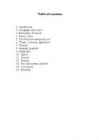
1. Introduction 2. Geographical position 3. Mountains, lowlands 4. Rivers, lakes 5. The territories and provinces 6. Towns, economy, agriculture 7. Climate 8. Animals, plantlife 9. Population 10. Sports 11. Culture 12. History 13. Political system, symbols 14. Conclusion 15. Materials 1. Introduction If you had to use two words to describe Canada, they might be large and diverse. Canada is the second largest country in the world, bordered by three oceans, and across the country, Canadians experience many different landscapes from rolling plains and mountains to the cold tundra of the north. Despite Canada's great size, it is one of the world's most sparsely populated countries. This fact, coupled with the grandeur of the landscape, has been central to the sense of Canadian national identity. 2. Geographical position Canada is the second largest country in the world after Russia. In the Arctic, Canada reaches almost as far north as Greenland
) was an unofficial anthem of the Canadian province of Ontario. The song was written as the signature tune for a movie of the same name that was featured at the Expo 67 Ontario pavilion. "Something to Sing About" is a patriotic song written by folk singer Oscar Brand that sings the praises of the many different regions of Canada. There was once a movement for it to replace O Canada as the Canadian national anthem. The Bold Canadian was a patriotic song for Canadians that originated during the War of 1812. It celebrated the conquering of Detroit in Michigan Territory. The Island Hymn is the patriotic song of the Canadian province of Prince Edward Island.
As they did so, the carried away much soil from Canada and pushed it down into the United States. Stretching west from the Great Lakes and Hudson Bay there are great prairies. West of the prairies there is a mountain Wonderland. The Canadian Rockies are higher than the Rockies in the United States. Industry Furs, farms, forests, and fisheries make up much of Canada's wealth. But the Country is also rich in minerals. Canada has copper, lead, silver, gold and other minerals. Thousands of Canadians earn their living as fishermen. The farms of eastern Canada are rather small. Potatoes are an important crop. Population About 27 million people live in Canada. About 80% of them live within 300 kilometres of Canada's southern border. Much of the rest of Canada is uninhabited or thinly populated because the country has rugged terrain and a severe climate. Canada's people are varied. About 38% of all Canadian's are of British descent and 32% are of French descent.
He had never told his mother he was being bullied. A few months later, on November 10, another 14-year-old, Dawn-Marie Wesley of Mission, B.C., hanged herself with a dog leash in her bedroom. She too left a note for her family. It read: "If I try to get help, it will get worse. They are always looking for a new person to beat up, and they are the toughest girls.If I ratted, there would be no stopping them. I love you all so much!" Most Canadians remember the tragic 1997 murder of Reena Virk, a high-school student whose battered body was recovered from the Gorge Waterway, near Victoria. Her head and internal organs had been severely damaged by a beating that rendered her senseless before she was deliberately drowned. One girl and a boy were convicted of second-degree murder, and six girls were found guilty of aggravated assault. Her death is an example of bullying taken to its ultimate expression
The main waves of Loyalists came to what is now Canada in 1783 and 1784. 11. In which province is Scottish culture preserved? In 1910 an incredible 62,000 Scots emigrated to Canada. Tens of thousands of Scots men, women and children boarded ships to make the journey to Canada in the first half of the 20th century. Nova Scotia Gaelic is still spoken in Nova Scotia, hundreds of years after the first Scots settlement was founded.21st century Scots Canadians celebrate their Scots origins and share their traditions with people from around the world. Scots culture is not a museum piece; it is a living thing that grows and thrives as it is touched by other cultures and other traditions. In 2006, in the Canadian Census, 4.7 million Canadians reported that they were of Scottish origin. Today, there are almost as many Scots Canadians as there are people in the whole of Scotland. 12. Which important minerals are found in Alberta?
Towering mountains, crystal-clear lakes, and lush, green forests make Canada's far west a beautiful region. Farther inland, fields of wheat and other grains cover Canada's vast prairies. Thes fertile farmlands contrast vividly with the Arctic wastelands to the north. Most of the largest towns and industrial areas lie near the Great Lakes and the St Lawrence River in central Canada. In the east, fishing villages and sandy beaches dot the Atlantic coast. Across the country, Canadians experience many different landscapes from rolling plains and mountains to the cold tundra of the north. Geographically, Canada can be divided into five major regions : the Pacific Region, the Prairie Provinces, Central Canada, the Atlantic Provinces, and the North. The Pacific Region includes Canada's westernmost province, British Columbia. The region is known for its mild coastal climate, its forests, and its spectacular mountains, including the famous Rockies
moss. Typical animals are: eagles, black bears, coyotes, deer and chipmunks. 7. Population The population of Canada is about 31 million people. About 77% of the people live in cities which lie in a band about 100 miles wide above the border of the United States. The capital of Canada is Ottawa. Other large cities are Montreal, Toronto, Vancouver, Winnipeg and Quebec. Canada has two official languages English and French. It's interesting to know that about 61% of Canadians name English and 24% french their mother tongue. There are also many other languages spoken in Canada such as: Italian, Chinese, German, Polish, Ukrainian, Greek and Dutch. There are also many native languages such as Algonquian. The British and the French as the main settlers from Europe fought for hundreds of years before they managed to build up a country which was based on recognizing the cultural diversity of different nations in Canada
Coniferous trees grow in tundra. A mix of coniferous and deciduous forests grow in Central Canada and in the Atlantic provinces. There are also the prairies. 95% of the land has been converted into farmland and it is basically a treeless area. Uniting Canada There were several reasons for uniting Canada. · Strong defence against any American aggression and the Fenians · Trade network involving the cities in Canada · Canadians wanted to build a railway line · The British didn't have enough money to support Canadian colonies In July 1, 1867 the Dominiom of Canada was created. The Dominiom of Canada consisted of Ontario, Quebec, Nova Scotia and New Brunswick provinces. Yukon was the last province to join the Dominiom. John Macdonald was the first prime minister of Canada. Another important feature about Canada is its railway. The railway was completed in 1885.
Foreign trade is responsible for about 45 percent of the nation's gross domestic product (GDP). Free trade agreements between the 2 nations have increased trade by eliminating tariffs. Each day approximately US$1 billion worth of goods crosses the U.S.- Canadian border. To understand the scale of U.S.-Canadian trade, it is important to point out that the United States sends more products to Canada than it does to all of Latin America. Canada, Kärt Kalvet 8a Like Americans, Canadians tend to have high levels of disposable income . This disposable income drives the Canadian economy as consumers spend their excess wages on a variety of products and services. This creates demand for increased production and the development of new products, which also means more and better-paying jobs. Also like the United States, advertising has a major impact on Canadian consumer spending. Television is the number-one form of advertising in Canada.
In medals won, the United States ranks third all-time in the Winter Games; 218 (78 gold, 81 silver and 59 bronze), and first in the Summer Games, with 2321 (943 gold, 736 silver and 642 bronze). 6. Sports in Canada A wide variety of sports are played in Canada. Its official national sports are ice hockey and lacrosse. Hockey is a national pastime, and is by far the most popular spectator sport in the country. It's also the most popular sport Canadians play, with 1.65 million active participants. After hockey, other popular spectator sports include Canadian football and curling. Golf, baseball, skiing, soccer, volleyball and basketball are also widely played at youth and amateur levels. Lacrosse is Canada's oldest sport and official summer sport. As a country with a generally cool climate, Canada has enjoyed greater success at the Winter Olympics than the Summer Olympics. 7. Sports in Australia
(,,winner"), interesting (,,ineresting")) we are dealing with = T-deletion · Schedule, hostile and some other words are pronounced depending on social variation and region. (Great degree of influence from AmEng) · Again(st), sometimes /gen/, sometimes /geIn/ · Been [bin] · Shone [sho:n] follows BrEng variant · Tomato [tomæto] different from both AmEng and BrEng Grammar: · Younger geneation follows AmEng forms and older BrEng forms. · Canadians use the Q tag ,,eh?" · Sneek Snuk · Dive Dove Vocabulary: · General trend towards American vocabulary, but not fully, therefore there would be both variants in the dictionary. Candy=Sweet, for example. · They developed a vocabualry that they needed to use in a special environment. The environment was different from Britain/US. · Indian language borrowings (ex: moose) 12) Australian English (peculiarities of pronounciation, grammar, vocabulary) Pronounciation:
America- land of economic opportunity Irish, German, French, British immigrants · Different waves of immigration Irish - 1840, 207 000 Irish started to emigrate in large numbers as Britain eased travel restrictions because of the Irish Potato Famine. In 1848, bad crops and failed revolutions led to emigration of 435,000 Germans, 267,000 British and 77,000 French immigrants Immigration patterns of the 1930s were dominated by the Great Depression Between 1840 and 1930, 900,000 Canadians left Quebec to emigrate to the United States The 1910s marked the high point of Italian, Swedish and Norwegian immigration · Jewish immigration Have been present in the USA since 17th century MAIN REASONS: The Russia anti-Semitism policy and the pogroms The desire to give the children better education and happy life USA dream - Freedom and gold Modern vehicles like steam engines and trains 8 · Ellis Island In 1600, Gull Island by the Mohegan tribe
aspects of their lives before and during their backpacking, as well as their future aspirations. 6 Participants often went to great lengths to explain why they travel as a lifestyle choice. The narratives of participants in India and Thailand were remarkably consistent. The 25 participants represented a range of 13 nationalities (Table 1), with English, Australians, Israelis and Canadians being the most common. All but four of the participants travelled alone, 11 were female and education levels were from high school dropout to masters degree holder. Participant age ranged from 23 to 50, with an average age of 30. Following transcription and repeated readings of the empirical material, formal interpretation was carried out using an inductive thematic analysis approach (Patton, 2002). This approach
disaster. D-Day 1944, Operation Overlord Allied invasion of normandy on the western front during WW II. Greatest operation in war history 6 June 1944 the thousands Allied troops parachuted from the skies, landed by glider and stormed the beaches. Landing was a brilliant success. Near 200, 000 participated one way or another The Second front was launched against the main enemy The Americans captured Cherbourg, British Caen, canadians distroyed German army at Falaise. The Allies took Paris. On 8May the war formally ended Winston Churchill A politician, wartime prime minister, he had an army career, also worked as a journalist. First became conseravtive Member of Parliament, soon joined Liberal party. 1939 first Lord of Admiralty 1940 Prime minister Maintained a difficult alliance with Soviet Union. Lost power in post-war elections
possessions, disrespect of your women, but then turn around to complain about his unfairness. Today in Africa, if you are Caucasian, you are God’s incarnate. In Africa, if you are Caucasian, it means being the following: Europeans (British, French, German, Italian, Israeli, Russians, Turkish, Greek, Belgian, Nordics, Australians and New Zealanders); Asians (Chinese, Indians, Pakistanis, Japanese) and of course Americans and Canadians (excluding Blacks of course). If you are one of these groups, you are accorded the respect and worship reserved for God. Being seen in the company of a Caucasian person accords you instantly respectability and credibility. It accords you intelligence. 23 If you want to be successful, bring in a Caucasian partner. If you had been having difficulty securing a contract, send in your new partner and then you will have easy ride
followed that violation of confidence, and under the realization that he had traded his soul for a few thousand dollars. He returned from China in 1940, and, after a brief at- *At different times. tempt to be a restaurateur in Washington, went to Canada to set up a cryptanalytic bureau which dealt largely with spy ciphers. He was reportedly forced out under pressure either from Stimson, then Secretary of War, or from the British, though the Canadians did not want to part with him. From 1941 to the end of the war he served as an enforcement officer in the food division of the Office of Price Administration. His popular The Education of a Poker Player, in which he offered an informal course of instruction in the game, appeared in 1957. On August 7, 1958, he died of a stroke at his home in Silver Spring, Maryland, and was buried with military honors in Arlington National Cemetery.
 annaabi.ee