Leidsid 33 sarnast õppematerjali, mis on seotud failiga "Tokyo". Need materjalid aitavad sul teemat sügavamalt mõista.
tokyo, japan, market, center, present, visit, imperialstrict, station, shop, japanese, palace, island, fish, located, major, part, building, since, could, today, speak, know, good, islands, percent, live, represent, ward, shopping, residence, including, museum, square, refer, tait, first, following, ameya, south, glad, previous, lesson, absent, goingJapanese festivals are traditional festive occasions. Some festivals have their roots in Chinese festivals but have undergone dramatic changes as they mixed with local customs. Some are so different that they do not even remotely resemble the original festival despite sharing the same name and date. There are also various local festivals (e.g. Tobata Gion) that are mostly unknown outside a given prefecture. It is commonly said that you will always find a festival somewhere in Japan. Matsuri is the Japanese word for a festival or holiday. In Japan, festivals are usually sponsored by a local shrine or temple, though they can be secular. There is no specific matsuri days for all of Japan; dates vary from area to area, and even within a specific area, but festival days do tend to cluster around traditional holidays such as Setsubun or Obon. Almost every locale has at least one matsuri in late summer/early autumn, usually related to the rice harvest.
The Great Wave off Kanagawa The Great Wave off Kanagawa , also known as The Great Wave or simply The Wave, is a woodblock print by theJapanese artist Hokusai. An example of ukiyo-e art, it was published sometime between 1830 and 1833[1] (during the Edo Period) as the first in Hokusai's series Thirty-six Views of Mount Fuji(Fugaku sanjrokkei (?)), and is his most famous work. This particular woodblock is one of the most recognized works of Japanese art in the world. It depicts an enormous wavethreatening boats near the Japanese prefecture of Kanagawa. While sometimes assumed to be a tsunami, the wave is, as the picture's title notes, more likely to be a large okinami literally "wave of the open sea." As in all the prints in the series, it depicts the area around Mount Fuji under particular conditions, and the mountain itself appears in the background. COPIES
Three of the four orders of reptiles are native to Australia: Testudines, Squamata and Crocodilia. The only missing extant order are the tuataras, which are endemic to New Zealand. Australia has a large diversity of reptiles, with over 860 species. The most diverse group are the snakes and lizards. The snakes and lizards are especially diverse in the arid areas of Australia, where diversity of other fauna is generally low. Spinifex grass is a major habitat which allows them to remain in a relatively cool, moist area. Australia has a large array of reptiles which can be dangerous to humans. All of the top ten most venomous snakes are native to Australia, [2] and the world's largest reptile, the Saltwater Crocodile is native to Australia. It is often said to be the most dangerous to humans. This crocodile is an opportunistic
Olympia is the state capital of Washington. Washington is sometimes referred to as Washington State or the State of Washington to distinguish it from Washington, D.C., the capital of the U.S., which is often shortened to Washington. Washington is the 18th largest with an area of 184,827 sq/km and the 13th most populous state with over 7 million people. Approximately 60 percent of Washington's residents live in the Seattle metropolitan area, the center of transportation and business. The remainder of the state consists of deep temperate rainforests in the west, mountain ranges in the west, central, northeast and far southeast, and a semi-arid basin region in the east, central, and south, given over to intensive agriculture. Washington is the second most populous state on the West Coast and in the Western United States after California. Economy The 2014 total gross state product for Washington was $425
boundaries; but since at least the 19th century, the name "London" has also referred to the whole metropolis that has developed around it. Today the bulk of this conurbation forms the London region of England and the Greater London administrative area, with its own elected mayor and assembly. London is one of the world's most important business, financial and cultural centres and its influence in politics, education, entertainment, media, fashion and the arts contributes to its status as a major global city.Central London is the headquarters of more than half of the UK's top 100 listed companies and over 100 of Europe's 500 largest companies. The city is a major tourist destination for both domestic and overseas visitors, with annual expenditure by tourists of around £15 billion. London hosted the 1908 and 1948 Summer Olympic Games and will host the 2012 Summer Olympic Games. Samuel Johnson, author of the first complete dictionary, famously wrote about the
the name "London" has also referred to the whole metropolis that has developed around it. Today the bulk of this conurbation forms the London region of England and the Greater London administrative area, with its own elected mayor and assembly. London is one of the world's most important business, financial and cultural centres and its influence in politics, education, entertainment, media, fashion and the arts contributes to its status as a major global city. Central London is the headquarters of more than half of the UK's top 100 listed companies (the FTSE 100) and over 100 of Europe's 500 largest companies. The city is a major tourist destination for both domestic and overseas visitors, with annual expenditure by tourists of around £15 billion. London hosted the 1908 and 1948 Summer Olympic Games and will host the 2012 Summer Olympic Games. Samuel Johnson, author of the first complete dictionary, famously wrote about the city,
The ancient City of London, to which the name originally belonged, still maintains its medieval boundaries, but the name "London" has long applied more to the whole metropolis that has grown up around it. London has been an important settlement for over two millenniums. It is also one of the world's leading business, financial and cultural centres and its influence in politics, education, entertainment and even fashion contribute to its status as a major global city. London is a major tourist attraction with four world heritage sites, several royal parks and numerous iconic landmarks such as the Houses of Parliament, Towe Bridge, the Tower of London, Westminster Abbey and the London Eye. 2. History Although there is some evidence of a permanent settlement before the Romans came in 43 A.D., it is more accepted by historians that the Romans were the first. The settlement was called Londinium.
It dates back to the time of William the Conqueror. and, dating back to the time of William the Conqueror, is the oldest in continuous occupation. It is occupied but only in the weekends. During the week the Queen's residence is Buckingham Palace. Kew Palace Kew Palace is royal palace located in Kew Gardens. It is the smallest of the royal palaces. Currently no one lives there and it's open to the public. The City The City of London also called `one square mile' is the historical center of London. Until the 18th century, the City of London was all of London. Today, this area is the financial center of Europe. It has only about 6000 residents and is almost deserted during the weekend.One of London's most famous landmarks- St paul's cathedral is in the City. Besides this you can also find the oldest remains of the London Wall, built by the Romans The Lord Mayor is elected for one year and the position is unpaid and apolitical. It is an exceptionally demanding role
Some of the things you will learn in THE CODEBREAKERS • How secret Japanese messages were decoded in Washington hours before Pearl Harbor. • How German codebreakers helped usher in the Russian Revolution. • How John F. Kennedy escaped capture in the Pacific because the Japanese failed to solve a simple cipher. • How codebreaking determined a presidential election, convicted an underworld syndicate head, won the battle of Midway, led to cruel Allied defeats in North Africa, and broke up a vast Nazi spy ring. • How one American became the world's most famous codebreaker, and another became the world's greatest. • How codes and codebreakers operate today within the secret agencies of the U.S. and Russia. • And incredibly much more.
automobiles, trains and airplanes. Etymology The term "travel" originates from the Old French word travail. The term also covers all the activites performed during a travel (movement). A person who travels is spelled "traveler" in the United states, and "traveller" in the United Kingdom. Purpose and motivation Reason for traveling include recreation, tourism or vacationing, research travel for gathering information, for holiday to visit people, volunteer travel for charity, migration to begin life somewhere else, religious pilgrimages and mission trips, business travel, trade, commuting, and other reason, such as to obtain health care or fleeing war or for the enjoyment of traveling. World's best places to visit: Paris and Barcelona Why go: Year after year, the Why go: Known around the world magnetic City of Lights draws new for its legendary football team,
holdovers from the agricultural endowment of the Americas. In the U.S., farms spread from the colonies westward along with the settlers. In cooler regions, wheat was often the crop of choice when lands were newly settled, leading to a "wheat frontier" that moved westward over the course of years. Also very common in the antebellum Midwest was farming corn while raising hogs, complementing each other especially since it was difficult to get grain to market before the canals and railroads. After the "wheat frontier" had passed through an area, more diversified farms including dairy cattle generally took its place. Warmer regions saw plantings of cotton and herds of beef cattle. In the early colonial south, raising tobacco and cotton was common, especially through the use of slave labour until the Civil War. In the northeast, slaves were used in agriculture until the early 19th century. In the Midwest, slavery was prohibited by the
fell in love. They got married and got 9 children, 40 grandchildren. At first he was unpopular, after he made many great changes he became popular. He was the president of the Royal Society of Arts for 18 years. After his death Victoria built many memorials and Royal Albert Hall in 1871, there are more than 350 performances every year. The Albert medal, the Prince Consort´s Library. Lisanna: "Yoko Ono" She was born in 1933 in Tokyo, Japan in a wealthy family. In 1953 she moved to the USA, she was an excellent student and studied music and philosophy. She has studied in 4 schools, her art is influenced by avant-garde. She has won many awards. She has been married 3 times. In 1975 she got a son Sean. She has released 26 albums, 7 of them with John. Son Sean is a singer, songwriter and an actor. Danek: "Manchester" First mentioned in the 1st century. It´s an industrial city. There is canal system,
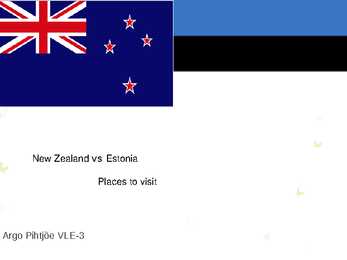
New Zealand vs Estonia Places to visit Argo Pihtjõe VLE-3 Some facts: Full name: Republic of Estonia Full name: New Zealand Population: 1.3 million (UN, 2010) Population: 4.3 million (UN, 2010) Capital: Tallinn Capital: Wellington Area: 45,227 sq km (17,462 sq miles) Area: 270,534 sq km (104,454 sq miles) Major languages: Estonian Major languages: English, Maori Major religion: Christianity
concert calls. Two-thirds of the old wall have survived, making it one of the most special medieval sights in Tallinn. The Tallinn Town Hall The Town Hall, the centre of administration and judicial power, was definitely the most important public building in the Middle Ages. The Tallinn Town Hall was first recorded in 1322, but there must have been some kind of a hall in the last quarter of the 13th century already, as Tallinn got its urban rights in 1248. The present Town Hall was built in 1401-1404, but was renovated in the 17th century. The last renovation took place in the 1970s when it got its original appearance. The weather vane was put on the spire in 1530. (The original vane is now a museum-piece). The main facade overlooks Town Hall Square and rests upon an open arcade. The Town Hall is a 2-storeyed structure with a basement and 11 rooms in all. The ground floor
2010 CONTENTS 1. Contents 2. Introduction 3. Compendium about Prague 4. Important about Czech Republic and Prague 5.-7. History 8. Independence 9. Main sights 10. the Czech Republic 11. List of famous people from Prague 12. Geography 13. Weather and climate 14. Population 15. Culture 2 INTRODUCTION The Czech Republic lies at the heart of Central Europe and at its center is the beautiful and historic city of Prague. With a population of some 1.3 million residents, the city lies on either side of the Vltava River in the middle of Bohemia that is one of the three historic Czech territories; the others being Moravia and Silesia. The city has seven "Chapter Divisions" or districts. 3
flat prairie and farmland, and features deep gorges and striking landforms. Dinosaur Provincial Park, near Brooks, Alberta, showcases the badlands terrain, desert flora, and remnants from Alberta's past when dinosaurs roamed the then lush landscape. Agriculture Agriculture has a significant position in the province's economy. The province has over three million head of cattle and Alberta beef has a healthy worldwide market. Nearly one half of all Canadian beef is produced in Alberta. Alberta is one of the prime producers of plains buffalo (bison) for the consumer market. Sheep for wool and mutton are also raised. Wheat is primary farm crop, with Alberta leading the provinces in spring wheat production; other grains are also prominent. Much of the farming is dryland farming, often with fallow seasons interspersed with cultivation. Continuous cropping (in which there is no fallow season) is
and rivers--over 60% of the world's lakes are in Canada. Canada is rich in lakes and rivers. The largest lake is the Great Bear Lake (31,153 km²). The Great Lakes are a group of five large lakes on or near the United States- Canadian border. They are the largest group of fresh water lakes on the earth and the Great Lakes-St. Lawrence system is the largest fresh-water system in the world. They are sometimes referred to as inland seas. Rivers in Canada flow into five major ocean drainage basins: the Pacific, Arctic and Atlantic oceans and Hudson Bay. The St. Lawrence is Canada's most important river, providing a seaway for ships from the Great Lakes to the Atlantic Ocean. The longest Canadian river is the Mackenzie, which flows 4 241 kilometres through the Northwest Territories. Canada is quite mountainous. The highest point is Mount Logan with 5.959 m. It is the second-highest peak in North America. Mt. Logan is located within Kluane
*After World War II = In the post World War II years, all three Baltic nations maintained consulates in the United States · About 15,000 Estonians came to the United States · This group was strongly anti-Communist and nationalistic 3. Russian colonization of America. What has preserved from this period to the present? The Russian colonization of the Americas covers the period, from 1732 to 1867, when the Tsarist Imperial Russian Empire laid claim to northern Pacific Coast territories in the Americas. The Russians were primarily interested in the abundance of fur-bearing mammals on Alaska's coast, as stocks had been depleted by overhunting in Siberia. By the middle of the 19th century, profits from Russia's American colonies were in steep decline. Faced with the reality of periodic Indian revolts, the political ramifications of the Crimean War, and unable to fully colonize the Americas to their satisfaction, the
The doors and gates in the wall were locked at night. Tallinn joined the German-dominated Hanseatic League in 1285 and became a junction of trade between East and West: furs, honey, leather and seal fat moved west, while salt, cloth, herring and wine moved east. Its geographical position was very favourable, with its wide bay protected by the two outlying islands of Aegna and Naissaar for a large port. Tallinn developed along three lines: fortress, port and market town. Tallinn grew rapidly and had developed into a well-known trading centre by the 15th century. Unfortunately, prosperity did not last long due to the weakening of the Hanseatic League, epidemics, hunger and wars. Sweden finally managed to take control of the whole of Estonia in 1629. Their rule ended after the Northern War in 1710 when Estonia was joined to the Russian Empire. Life changed for the better thanks to the opening of a railway line from St. Petersburg to Tallinn in 1870
1. The National Mall is a large, open park area in the center of the city. Located in the center of the Mall is the Washington Monument. Also located on the mall are the Lincoln Memorial, the National World War II Memorial at the east end of the reflecting pool, the Korean War Veterans Memorial, the Vietnam Veterans Memorial, and the Albert Einstein Memorial. The National Archives houses thousands of documents important to American history including the Declaration of Independence, the United States Constitution, and the Bill of Rights
Canadian mining companies. While overall mineral production is dispersed throughout Canada, fuel production is concentrated in the west, with a few major exceptions. Canada is a major exporter of energy and fuels. In 1998, natural gas was the main export with 34.2 percent of total, petroleum was next at 28.6 percent, hydroelectricity at 20.7 percent, coal at 11.4 percent, and atomic energy at 5.1 percent. The United States has traditionally been Canada's largest market for energy exports, purchasing 90 percent of the nation's fuel and energy exports. Energy production accounts for 8 percent of the nation's economy. Approximately 65 percent of energy production is in Alberta, which is also the home of the nation's oil industry. The number-two producer was British Columbia at 13 percent, followed by Saskatchewan at 8 percent, and Quebec at 5 percent. The atomic industry is centered in Quebec. Economy Canada has the seventh-largest economy in the world
McKinley with its 6194m. The lowest point is the Death Valley - 86m. Between the mountains are the central lowlands called the prairie and eastern lowlands called the Mississippi valley. One of the most famous mountains in the USA is Mount Rushmore in South Dakota because of the faces of presidents Washington, Jefferson, Lincoln and Roosevelt that have been cut in the rock. Lakes and rivers The Mississippi is the major river of North America and the United States. It flows from north-western Minnesota south to the Gulf of Mexico. It is a significant transportation artery and when combined with its major tributaries (the Missouri and the Ohio rivers) it becomes the third largest river system in the world (at 6,236 km). The western tributaries are the Red River, the Arkansas and the Missouri. The eastern tributaries are the Tennessee and the Ohio. Its name means the Father of Waters in the red Indian
millennia ago. Oak and maple grows in nature only in the southern part of Finland. The Archipelago Sea, between the Gulf of Bothnia and the Gulf of Finland, is the largest archipelago in the world by number of islands; estimates vary between 20,000 and 50,000. Similarly, Finland has a diverse and extensive range of fauna. There are at least sixty native mammalian species, 248 breeding bird species, over seventy fish species and eleven reptile and frog species present today, many migrating from neighbouring countries thousands of years ago. Large and widely recognised wildlife mammals found in Finland are the Brown Bear (the national animal), Gray Wolf, elk and reindeer. Other common mammals include the Red Fox, Red Squirrel, and Mountain Hare. Some rare and exotic species include the flying squirrel, Saimaa Ringed Seal and the Arctic fox, which is considered the most endangered.
Forestry and the Forest Industry in Japan Today I'm going to do a presentation about a book called ,,Forestry and the Forest Industry in Japan", edited by Yoshiya Iwai. --------------------- Participants in private forestry are classified into six categories: forestry households; companies; shrines and temples; joint holdings; various groups and cooperatives; and habitual joint holdings. Except for shrines and temples, these groups manage forests to produce income
and prepared. 5slaid In 2001 he appeared in another BBC documentary, Fragments of Genius, for which he was filmed flying over London aboard a helicopter and subsequently completing a detailed and perfectly scaled aerial illustration of a four-square-mile area within three hours; his drawing included 12 historic landmarks and 200 other structures. 6 slaid Stephen took on his largest project to date in May 2005, when he returned to Tokyo to make a panoramic drawing - the largest of his career (10.0m) - of the city. Two months later he drew a similarly detailed picture of Rome including the Vatican and St. Peter's Cathedral, entirely from memory. 7slaid Contrary to the popular misconception that Stephen is only interested in capturing architecture and classic american cars, he often draws portraits of celebrities and close friends in his private sketchbook. Stephen started creating caricatures of his teachers at
4 2. Panasonic 2.1 Introduction Panasonic Corporation is one of the largest electronic product manufacturers in the world, comprised of over 556 companies. It manufactures and markets a wide range of products under the Panasonic brand to enhance and enrich lifestyles all around the globe. 2.2 Company Information Company Name: Panasonic Corporation Head Office Location: 1006, Kadoma, Kadoma City, Osaka 571-8501, Japan President: Fumio Ohtsubo Foundation: March, 1918 (incorporated in December, 1935) Net Sales: *9,068.9 (billions of yen) Number of Employees: *305,828 No. of Consolidated Companies: *556 2.3 Business Segments Panasonic is comprised of 14 business domain companies. Each company has its own distinct R&D, production and sales divisions that respond to its own business segment, such as AV, home appliances, industrial solutions, and other electronic and consumer
States. White House was built in 1792-1800 and it became the official president residence. The Civil War 18611865 was between the Union (Abraham Lincoln) and the Confederacy (Robert E. Lee) and the reason was that the north side (Union) was against slavery in the south side (Confederacy). The war was won by the Union and it ended slavery. The racism against black people remained. America took part in both World Wars. In World War II Japan bombed Pearl Harbors in 1941 and in 1945 America dropped two nuclear weapons on Hiroshima and Nagasaki which ended the war. In 1963 after John F. Kennedy death gave Martin Luther King his I Have a Dream speech which is a key factor that ended most of the racism in America. In 2001, 11th September Islamic terrorists crashed into the twin towers (WTC). Osama bin Laden and al-Qaeda are thought responsible for the
The UK & London The United Kingdom (or the UK) is a short way of saying the United Kingdom of Great Britain and Norther Ireland. The UK is situated north-west of the European continent between the Atlantic Ocean and the North Sea. The UK consists of England, Wales, Scotland and Northern Ireland. Its highest point is Ben Nevis in Scotland followed by Snowdon in Wales. The Severn is the longest river in the United Kingdom. Other important rivers are the Trent, the Mersey, the Tyne, etc. Lough Neagh which lies in the centre of Northern Ireland is thr UK's largest freshwater lake. The climate in the UK is variable. The weather changes so frequently that it is difficult to forecast. It is not unusual for people to complain that the weathermen were wrong. Fortunately there is no extreme weather conditions, it is never very cold or very hot. The first inhabitants were Iberians and Celts who settled on the land and were often at war with each ot
Irland-s standing high is due, in part, to its rapid integration into the European Union wich greatly expended its International trade and investment flows. Everybody dosnt like globalization. They fear it. Because it causes change and change can cause Hardship. U.S Domestic production consumed at home 82% and Exports 18%. A chapter about the open economy, there I found out whats happening in tuna Fish . It means fresh and good tuna, costs a lot! Mostly becouse of sushi lovers and Japanese market demanding.First tuna will go to Japanese Tokyo and from there goes all around the world.Exports and Imports - an open economy differs from the closed economy because consumers and investors will find it advantageous to import some goods from foreign producers. There are many ohter International payments in addition to those related to exports and imports of goods and services. For example, transfers occur across bordersas well as within economies.
During the 19th century it was enlarged, principally by architects John Nash and Edward Blore, forming three wings around a central courtyard. Buckingham Palace finally became the official royal palace of the British monarch on the accession of Queen Victoria in 1837. · Harrods is London's most famous department store, is named after Charles Henry Harrod, who opened a family grocers shop on the site in 1849. The store occupies a 5-acresite and has over one million square feetof selling space in over 330 departments . · Hyde Park is one of the largest parks in central London, England and one of the Royal Parks of London, famous for its Speakers' Corner. It covers 142 hectares. The park was the site of The Great
Economy. Canada is a very large country blessed with many natural resources. From trees in the forests across the country we make pulp and paper. From mines we extract coal, gold, silver, iron, uranium and many other minerals. On the prairies we grow grain, raise cattle and extract oil and gas from beneath of the ground. From the oceans on our east and west coast we take fish and other seafood. In Japanese restaurants customers may buy Alberta beef and British Columbia salmon. In Russia people sometimes eat bread from Canadian wheat. In the United States many of the newspapers are made from Canadian pulp and people use Canadian oil and gas in their cars. Because Canada has a relatively small population and abundant natural resources much of our international trade is in exporting those resources and buying manufactured goods.
Ottawa Ottawa is the capital of Canada and a municipality within the Province of Ontario. Located in the Ottawa Valley in the eastern portion of Southern Ontario, the city lies on the southern banks of the Ottawa River, a major waterway forming the local boundary between the Provinces of Ontario and Quebec. The 2006 Census recorded the population at 812,129, making it the fourth largest municipality in the country and second largest in Ontario. Connected by several bridges to its Quebec neighbour , the City of Gatineau on the northern shores of the Ottawa River, the two cities had a combined 2006 population of over 1,130,000, making it the country's fourth largest metropolitan area. On December 31, 1857, Queen Victoria was asked to choose a common capital for the Province of Canada (modern day Ontario and Quebec) and chose Ottawa. While Ottawa is now a major metropolis and Canada's fourth largest city, at the time it was a sometimes unruly logging
power. 7.1 The science of electricity In order to understand how electric charge moves from one atom to another, we need to know something about atoms. Everything in the universe is made of atoms--every star, every tree, every animal. The human body is made of atoms. Air and water are, too. Atoms are the building blocks of the universe. Atoms are so small that millions of them would fit on the head of a pin. Atoms are made of even smaller particles. The center of an atom is called the nucleus. It is made of particles called protons and neutrons. The protons and neutrons are very small, but electrons are much, much smaller. Electrons spin around the nucleus in shells a great distance from the nucleus. If the nucleus were the size of a tennis ball, the atom would be the size of the Empire State Building. Atoms are mostly empty space. Picture 7.1. Nucleaus and electrons 21
 annaabi.ee