Leidsid 33 sarnast õppematerjali, mis on seotud failiga "The Houses of Parliament". Need materjalid aitavad sul teemat sügavamalt mõista.
parliament, chamber, palace, westminster, part, there, building, located, lords, debate, royal, nearly, years, century, fire, laid, than, towers, south, stephen, clock, north, built, during, today, government, tour, visit, houses, monarch, live, henry, moved, since, around, 19th, medieval, originally, confessor, became, except, burnt, present, designedHOUSES OF PARLIAMENT Houses of Parliament also known as the Palace of Westminster is one of the most attractive buildings in London. It stands on the site where Edward the Confessor had the original palace built in the first half of the eleventh century . In 1547 the royal residence was moved to Whitehall Palace, but the Lords continued to meet at Westminster, while the commons met in St. Stephen's Chapel. Ever since these early times, the Palace of Westminster has been home to the English Parliament. In 1834 there was a huge fire that destroyed much of the old palace. All that remained was the chapel crypt, The Jewel Tower and Westminster Hall. It was Lord Melbourne, the Prime Minister, who saved the great hall by arranging for the fire engines to be brought right into the hall and personally supervising the fire fighting operation. The magnificent Gothic Revival masterpiece you see today was built between
The Houses of Parliament The Houses of Parliament also known as The Palace of Westminister or Westminister Palace was built in 11th century by man called Charles Barry .It is located on the north back of the River Thames. In 1834 most of it burned, so in 1840 The Palace of Westminister was rebuilt. It is the meeting place of the two houses of the Parliament of the United Kingdom - the House of Lords and the House of Commons. The Houses of Parliament is composed of 1100 rooms, 100 staircases and three miles of corridors. Parliament takes breaks during Christmas, Easter and over the summer. The Palace of Westminster features three main towers The Central Tower, The Victoria Tower and The Clock Tower, also known as Big Ben. The Central Tower stands over the middle of the building, immediately above the Central Lobby. This tower is proof that after the fire in 1834, the palace can still look good. The Victoria Tower is the most striking
West. Alfred's men took London in 886 and repaired the walls of the old Roman city. In 1016 the Vikings attacked London again but the Saxons fought them off. The attacks ceased when the Danish king Cnut came to power in 1017. Cnut managed to unite the Danes with the Anglo-Saxons, and invited Danish merchants to settle in the city. London prospered under Cnut, but on his death the city reverted to Anglo-Saxon control under Edward the Confessor. He built a wooden palace at Westminster, were the parliament met later. This is why Westminster became the seat of government not the city of London itself. Edward the Confessor also built Westminster Abbey. He ruled until his death in 1065, after which King Harold was crowned. Norman period( Medieval London) 1066 In 1066 in the Battle of Hastings the Normans were victorious and William was crowned King. William granted the citizens of London special privileges, but he also built a castle in the southeast corner of the city to keep them under control
Westminster Today For centuries, Westminster was the political and religious center, but today Westminster is the center of government. Westminster Hall was built in 1099 by the son of William the Conqueror and is one of the largest medieval halls. It was part of the Westminster Palace, which was destroyed by a fire in 1834. The Houses of Parliament that we see today were rebuilt in the 19th century after the fire. The Big Ben clock tower is the largest four-sided ringing clock in the world and it is also one of the London's most famous symbols. Some think that Big Ben is the name of the clock on the tower, but actually it is the name of the big 13-ton bell that rings every fifteen minutes. The most historic religious building in Britain is Westminster Abbey, a beautiful church across the street from the Houses of Parliament
LANDMARCS HYDE PARK: Hyde Park is one of the largest parks in central London, England and one of the Royal Parks of London, famous for its Speakers' Corner. The park is divided in two by the Serpentine. The park is contiguous with Kensington Gardens; although often still assumed to be part of Hyde Park, Kensington Gardens has been technically separate since 1728, when Queen Caroline made a division between the two. THE TOWER OF LONDON: Her Majesty's Royal Palace and Fortress, more commonly known as the Tower of London (and historically as The Tower), is a historic fortress and scheduled monument in central London, England, on the north bank of the River Thames. It is located within the London Borough of Tower Hamlets and is separated from the eastern edge of the City of London by the open space known as Tower Hill. It is the oldest building used by the British government. [1]
London London is the capital of Great Britain. It is situated on the river Thames. The Thames is a river flowing through southern England and connecting London with the sea. The Thames has a length of 346 kilometres (215 miles). The first bridge was the tower bridge, built in the 12th century. The second bridge was built in the year 1750. .The river Thames divides London into the northern and the southern part. The port of London is one of the greatest trade centres in the world. The river Thames is certainly the most famous water body in London. London is also the seat of the government of Great Britain. It is one of the largest cities in the world with its population of about seven million. Before the great fire in 1666 there were many wooden houses and narrow crooked streets in the town but after the fire it became a well-planned city with wide streets, beautiful squares and parks
1. Ancient Britain: the Celtic tribes. 2000 years ago there was an Iron Age Celtic culture throughout the Br Isles. It seems that the Celts, who had been arriving from Europe from the 8th cent BC onward, intermingled with the peoples who were already there. The Celts were extremely talented people, creative and artistic. More than 1 Celtic tribe invaded Br. The descendants of ancient Celts live in Wales, Scotland, Cornwall and Ireland. They lived in primitive society. Druids priests, more powerful than chiefs. Acted like prophets. 2. Stonehenge From prehistoric period. Was built on Salisbury plain between 2500 and 1500 bc. One of the most famous and mysterious archaeological sites in the world
It is also wise to use Google Maps Street View simultaneously it gives you the wonderful feeling of strolling the streets and landmarks. Take the following questions with you, find answers to them and put them down for yourself in this MSWord document. Don't forget to "take" photos - you are supposed to recognise the landmarks later on! At the end of the tour send the worksheet to yourself so that you could use it again. Good luck with exploring the city! DAY 2. The route: Westminster Abbey The Houses of Parliament London Eye 10 Downing Street St Paul's Cathedral The Tower of London Tower Bridge Globe Theatre Greenwich Observatory Destination 1: Westminster Abbey When was Westminster Abbey founded? (see its homepage: http://www.westminster-abbey.org/home ) 960 When was the last royal wedding held in Westminster Abbey? Whose was it? 29 April 2011 Prince William and MissCatherine Middleton How many monarchs have been buried in Westminster Abbey
London important sights guide Roman period 20th century · Big Ben is the nickname for the great bell of the clock at the north end of the Palace of Westminster in London and is often extended to refer to the clock or the clock tower as well. It is the largest four-faced chiming clock and the third-tallest free-standing clock tower in the world. The clock first ticked on 31 May 1859. The pendulum is installed within an enclosed windproof box sunk beneath the clockroom. It is 3.9m long, weighs 300 kg and beats every 2 seconds
THE U.K Different Parts The United Kingdom is a short way of saying the United Kingdom of Great Britain and Northern Ireland. The UK is the political name for those countries which share a parliament in London. All of them were at one time independent kingdoms with their own monarch. Now they are all part of the same kingdom and share the same monarch. The UK consists of Northern Ireland, Scotland, England and Wales. The peoples of these countries are British subjects; they hold British passports and therefore their nationality is British. The british Isles is the geographical name for all the islands off the west coast of Europe. These islands also include The Republic of Ireland, which is politically independent of the Britsh government
grown up around it. London has been an important settlement for over two millenniums. It is also one of the world's leading business, financial and cultural centres and its influence in politics, education, entertainment and even fashion contribute to its status as a major global city. London is a major tourist attraction with four world heritage sites, several royal parks and numerous iconic landmarks such as the Houses of Parliament, Towe Bridge, the Tower of London, Westminster Abbey and the London Eye. 2. History Although there is some evidence of a permanent settlement before the Romans came in 43 A.D., it is more accepted by historians that the Romans were the first. The settlement was called Londinium. The first London lasted for just seventeen years, for around AD 61, a tribe of Celts led by Queen Boudica stormed London, burning it to the ground. The next heavily-planned London
1. The Queen’s official title. Elizabeth the Second, by the Grace of God, of the United Kingdom of Great Britain and Northern Ireland and of Her other Realms and Territories Queen, Head of the Commonwealth, Defender of the Faith. 2. The Queen’s working day. Starts after breakfast. Reads the newspapers which are prepared by the Press Secretary, and a report on the previous day’s proceedings in the Parliament and the letters she receives. Also phone calls. Once a month she attends the Privy Council in order to give Royal Assent to various items of government legislation. Discusses domestic matters with the Master of the Household. Towards the end of the day, there is always another pile of official papers and reports waiting to be read or acted upon. The business on constitutional monarchy never ends. 3. Who is the present heir to the throne
generally taken in a number of subjects by pupils in secondary education in England and Wales over two years (three years in certain schools). It was introduced in the UK in 1988 to replace O-level and CSE examinations. One of the main changes to previous educational qualifications in the United Kingdom was to allow pupils to complete coursework during their two years of study, which was marked by their teachers and contributed to their final examination grade. There has been a move recently from doing coursework and modular examinations for part of the course when pupils would take exams throughout the course to an end of year exam after the two years of study (a 'linear' series). The exams are being revised to make them more difficult such as testing skills from a whole text in English instead of part of a text. Coursework has now been replaced by Controlled Assessments in certain subjects, in which the student completes a number of assessed pieces of
Its highest point is Ben Nevis in Scotland followed by Snowdon in Wales. The Severn is the longest river in the United Kingdom. Other important rivers are the Trent, the Mersey, the Tyne, etc. Lough Neagh which lies in the centre of Northern Ireland is thr UK's largest freshwater lake. The climate in the UK is variable. The weather changes so frequently that it is difficult to forecast. It is not unusual for people to complain that the weathermen were wrong. Fortunately there is no extreme weather conditions, it is never very cold or very hot. The first inhabitants were Iberians and Celts who settled on the land and were often at war with each other. In AD 43 the Roman Emperor Claudius invaded, and made Britain a Roman province. They stayed for three hundred years, and built villas, roads and towns. Many Roman remains can be visited in Britain today. The Romans finally abandoned Britain in AD 410 and a long period of invasion by Nordic peoples
Changing the Guard · Perhaps the epitome of London's surviving pageantry can be found in the ceremonial Changing of the Guard. · A hugely popular spectacle, the Changing of the Guard takes place at a range of royal locations in and around · London daily during the summer and on alternate days for the rest of the year. · There is no ticketing, so make sure you get there early. · Ever since 1660 Household Troops have guarded the Sovereign Palaces. · The Palace of Whitehall was the main residence until 1689 and was guarded by the Household Cavalry. · The court moved to St James's Palace in 1689 and when Queen Victoria moved into Buckingham Palace the Queen's Guard remained at St James's Palace and a detachment guarded Buckingham Place, as it does today. Trooping the Colour
Describe the British Parliament Works in a large building called the Palace of Westminster aka The Houses of Parliament. There are offices, committee rooms, restaurants, bars, libraries and even some places of residence. Two large rooms: The House of Lords meet in one and the House of Commons in the other. The British Parliament is divided into two houses, but the House of Commons is obviously more important and only they are considered to be the MPs. In the House of Commons there are just two rows of benches facing each other. On the left sit the members of the governing party and on the right sit the opposition. The Speaker sits between them and controls the action. The arrangement of the benches encourages confrontation between the government and the opposition. There is no place for somebody who isn't neither in the opposition nor in the government side. Usually peeps like this sit in the opposition furthest from the Speaker. || There are no tables for the MPs
one million inhabitants. Cultural life London is the worldclass centre. It has more than40 theatres, where audiences enjoy everything from musicals to William Shakespeare's plays. The city also contain many cinemas, concert halls, museums and art galleries. Royal residence English (later British) kings and queens have lived in London for almost 1,000 years. There are several royal palaces in the capital. St James's Palace was built by King Henry VIII in the 16th century. Since 1837 the monarch has lived in Buckingham Palace LONDON'S EARLY HISTORY The Romans invaded England in 43 AD. They landed in Kent, made their way to the River Thames and sailed up it. Then they settled in a place on the north bank, where the river was not to wide. This settlement was called Londinium
including St Paul`s Cathedral. The fire began in the kitchen of the King`s baker Thomas Farriner in Pudding Lane and lasted for five days. London is the capital of England and the United Kingdom. By now London has swallowed up many of the small towns and villages that once surrounded it. London is on the same latitude as Warsaw. London is a city were more than 7 million inhabitants live. In London there are famous Telephone booths and taxis. Also there are red double- decker buses. The quick and easy way is use the underground trains. The cheapest is to buy a Travelcard. London hosted the 1908 and 1948 Summer Olympic Games and will host the 2012 Summer Olympic Games. Many visitors come to see the famous sights, museums and galleries; others come for the shopping. The famous sopping street is Oxford Street. It is the most famous street in London where you can buy souvenirs, clothes, and so on
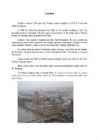
London March 28th Parliament of the United Kingdom The Parliament of the United Kingdom, commonly known as the UK Parliament or British Parliament, is the supreme legislative body in the United Kingdom, British Crown dependencies and British overseas territories. It alone possesses legislative supremacy and thereby ultimate power over all other political bodies in the UK and its territories. Its head is the Sovereign of the United Kingdom (currently Queen Elizabeth II) and its seat is the Palace of Westminster in the City of Westminster, one of the Boroughs of the British capital - London. Tower of London
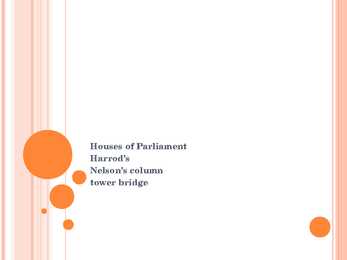
Houses of Parliament Harrod's Nelson's column tower bridge NIMI .... Houses of Parliament The Houses of Parliament, otherwise known as The Palace of Westminster, stands on the site where Edward the Confessor had the original palace built in the first half of the 11th century. In 1547 the royal residence was moved to Whitehall Palace, but the Lords continued to meet at Westminster, while the commons met in St. Stephen's Chapel. Ever since these early times, the Palace of Westminster has been home to the English Parliament. Harrod's One of the world's most famous department stores, established in 1849 as a humble grocery store employing two assistants. Today, it offers everything from food to fashion, furniture to sportswear plus 20 instore restaurants serving every kind of cuisine imaginable from pizza to sushi. Services range from piano tuning to fitting saddles. Mustsee sights include the Food Halls, the Egyptian Hall and the Pet Department
Big Ben When most people heat the words "Big Ben" they immediately conjure up an image of the striking Victorian Gothic structure of the clock tower of the Palace of Westminster (the Houses of Parliament). Let's clear up a common misconception first; technically speaking, the name "Big Ben" does not refer to the famous tower, nor to the four huge clock faces of this London landmark; instead, it refers to the largest of the five bells inside the clock tower, whose chimes are such a familiar sound to listeners to BBC radio over the years.
London Topic Tallinn 2008 2 General information London is the capital of the United Kingdom. It covers the area of about 1000 square kilometres and its population is about 7 million. London is located on the river Thames. It is divided into 32 boroughs and the City. Currency used in London is British Pound. London is one of the most popular tourist destination in the world. It is also world's leading business, financial and cultural centre. Subway is commonly used to move around in London. Climate London has a temperate marine climate. It has daily high temperatures during summer. The warmest month is July. The coolest month is January. Winders are seldom below freezing.
Great coat of arms - three lions, a knight, and Danish queen; leaves around Old Thomas - quardian of Tallinn, put on top of the spire of Tallinn Town Hall in 1530; boy that excelled springtime contests thrown by Baltic German elite, because of his low-born status was unable to receive a prize, therefore was granted the position of town guard. Right now there’s third Old Thomas, first one can be seen at Tallinn City Museum. Toompea as a symbol of power Toompea palace - wooden fortification was originally built in the 9th century, Danes made the castle the centre of secular power; Toompea palace hosts the parliament of the Republic of Estonia, designed by Eugen Habermann and Herbert Johanson. The parliament has 101 members and is chosen for 4 years. Stenbock House - the official seat of the Estonian Government since 2000; the building started in 1787, originally meant to be a courthouse. After russians ran out of fund, house went into
It is about the men (and women) who lost their lives fighting in the World Wars. It's celebrated then, because that's the day WWI was ended with a treaty. 4. Which powers does the Queen of the UK have? The Queen has to sign all the bills for them to pass. She is the one who opens the Parliament every fall for the next session. She is however more of a representative than an actual decision maker these days. 5. What is the British Parliament made up of? What are their roles? It's made of 3 parts: the monarch, the House of Commons and the House of Lords. The House of Lords can ask the House of Commons to rewrite parts of the bill. The bill needs the Queen's signature to pass. The House of Commons writes the bills. 6. What do you know about the Wars of the Roses? It was a war between two families, one had a red rose as their symbol and the other had a white rose as their symbol
THE CITY OF LONDON History The City of London occupies one square mile in the middle of the capital. It once made up entire town of London, surrounded by the wall first built by Romans. The Romans also built a bridge over the Thames and there has been one in the same area ever since. The Roman Londinium grew up on the northern side of the bridge. In AD 61 the native Celtic tribe, led by Queen Boudicca, rose up against the Romans. They burnt down Londinium to the ground and killed most of its inhabitants. Roman armies eventually defeated Boudicca and Londinium was rebuilt. At the end of the fourth century AD the Roman Empire began to crumble and the Roman armies were recalled from Britain to defend Rome itself
century) King Albert the Great London is the capital Edward the Confessor London began to develope Westminster Abbey and royal palace. 2 parts: Westminster and the City.. The Normans (1066 the 14th William the Conqueror century) the White Tower. Charter. Courts.
lose a bloody battle, the sky suddenly opened and a red flag with a white cross on it dropped down upon them from the heaven. This is how the Danes obtained their national flag. In 1346 the Danish king sold his Estonian lands to the Teutonic Order, who a year later resold them to the Livonian Order. The Germans renamed Tallinn and called it Reval. Toompea became the seat of the German-born gentry. A fortified wall was built between Toompea (the Upper Town) and the Lower Town, as there were conflicts between the two. The Lower Town was the home of simple people, the artisans and the merchants. The doors and gates in the wall were locked at night. Tallinn joined the German-dominated Hanseatic League in 1285 and became a junction of trade between East and West: furs, honey, leather and seal fat moved west, while salt, cloth, herring and wine moved east. Its geographical position was very favourable, with
displayed in the Museum of London in the Barbican. At the end of the fourth century AD the Roman Empire began to crumble and the Roman armies were recalled from Britain to defend Rome itself. Once they had left Anglo-Saxons invaded and settled in Britain. They were farming people who preffered to live outside towns. For a while London probably lay in ruins, but it eventually developed again, partly because of its position on the river was good for trading. The Tower of London There is more of London's history in the Tower than anywhere else in London. It is the oldest surviving building in the capital. The Tower of London was begun by William the Conqueror in 1078 as a castle and a palace but even before the site had been used by the Romans and Anglo-Saxons. The tower comprises not one, but 20 towers, the oldest, the White Tower, dates back to the 11 th Century. The Roman stone wall, parts of which can still be seen on the territory of the
people homeless. During the Russian occupation which followed (and which lasted for five decades) attempts were made to Russify the local people. Large scale industry was developed in Tallinn, workers were resettled from Russia and new blocks of flats sprang up on the outskirts to provide housing for the newcomers. Tallinn was the biggest grain-handling port in the Soviet Union. Russian speakers outnumbered Estonians in Tallinn. Estonia re-established its independence on 20 August 1991. There is still a large block of granite on Toompea which recalls the days when people barricaded Lossiplats (Castle Square) to prevent Soviet tanks gaining access. Today, Tallinn is the largest city in Estonia, with a population of about 400,000. Tallinn boasts a wonderful medieval Old Town where the atmosphere of the 15th and 15th centuries can still be strongly felt. Its narrow cobbled streets, medieval buildings with various decorative elements,
TOOMPEA Toompea (from German Domberg – Cathedral Hill ) is a limestone hill with an area of about 7 hectares in the central part of Tallinn. It towers about 30-40 m above the surrounding areas. According to the legend it´s the tumulus mound over the grave of the national hero Kalev, erected stone by stone in his memory by his grieving wife Linda. It is the birthplace of Tallinn - a place where in 1229 the Knights of the Sword built a fortress instead of the wooden Estonian stronghold. Toompea Castle is also one of the most potent symbols of the reigning power. Today Toompea is the seat of
British Parliament Structure and Functioning of the British Parliament today Britain is a parliamentary monarchy . The British Parliament is a bicameral parliament , that is to say that it is made up of two chambers, or two "Houses"; above the two Houses, but in an essentially formal role , there is the Sovereign - king or queen - also known as "the crown." Role of the Sovereign The British monarch has all authority, but no power. The Sovereign appoints the Prime Minister, and every year opens the sessions of parliament, in a historical and ritual ceremony called the State Opening of Parliament . Historically, this ceremony used to take place in the Autumn; but since 2012, it has been brought forward to May. This is the only regular time when the members of both Houses come together
London Eye 1. When was London Eye first opened to the public?- It was first opened to the public on 9March 2000. 2. In example, what was it called before?- In example, it was called The Merlin Entertainments London Eye/ The British Airways London Eye. 3. Does it attracts people to visit or not? Why?- Yes it does, because it’s an entertaining and easy way to have a great view of London. Big Ben 1. How big anniversary it had on 31 May 2009?- It had 150th anniversary. 2. How many steps are there inside?- There are 334 steps inside. 3. After who was the bell inside called?- It was called in honour of Sir Benjamin Hall. Tower of London 1. What is the oldest tower?- The oldest tower is White tower. 2. How many years was it in use as a prison?- it was 852 years in use as a prison. 3. Who initiated the construction of the Tower?- William the Conqueror initiated the construction of the Tower. Hyde Park 1. Who opened the park to the general public?- Charles I opened the
4. How many people approximately speak English? Approximately 600 million 5. Who (which tribes) gave the base of the English language?Germanic tribes- Anglo-Saxons. 6. Describe Wales.- Wales is a mountainous country on the western side of Great Britain. The national game of Wales is Rugby. Flag- Red dragon on a green and white field. They have their own language Cymraeg ( Welsh) . Anthem- Land Of My Fathers. Official animal- Dragon. There used to be a lot of coalmines. 7. What are the symbols of the 4 constituent countries? England- The three national symbols of England are St.George's cross; The red Rose and the Three Lions Crest; The oak is national tree; Northen Ireland- Shamrock; St.Patrick ;Scotland-thistle, St.Andrew 's cross . ; Wales-daffodil, leek, Prince of Wales's feathers; St.David, red dragon 8. How did the Romans influence Britain? The Romans built the first bridge(in London), the capital(London) is a
 annaabi.ee