 50 punkti
Autor soovib selle materjali allalaadimise eest saada 50 punkti.
50 punkti
Autor soovib selle materjali allalaadimise eest saada 50 punkti.
 ~ 6 lehte
Lehekülgede arv dokumendis
~ 6 lehte
Lehekülgede arv dokumendis
 2014-01-19
Kuupäev, millal dokument üles laeti
2014-01-19
Kuupäev, millal dokument üles laeti
 3 laadimist
Kokku alla laetud
3 laadimist
Kokku alla laetud
 0 arvamust
Teiste kasutajate poolt lisatud kommentaarid
0 arvamust
Teiste kasutajate poolt lisatud kommentaarid
 Johann Ortin Õun
Õppematerjali autor
Johann Ortin Õun
Õppematerjali autor
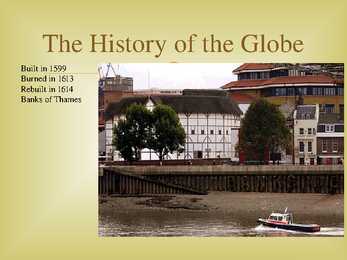
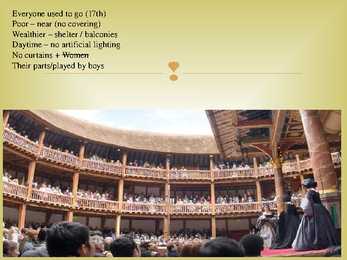
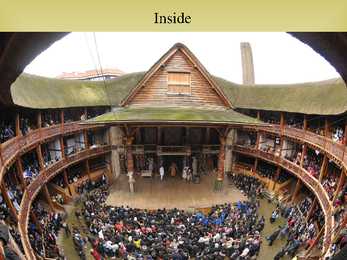
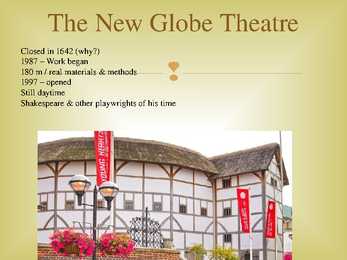
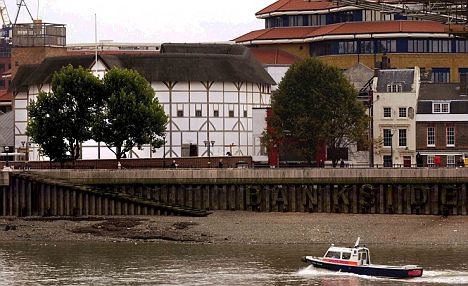
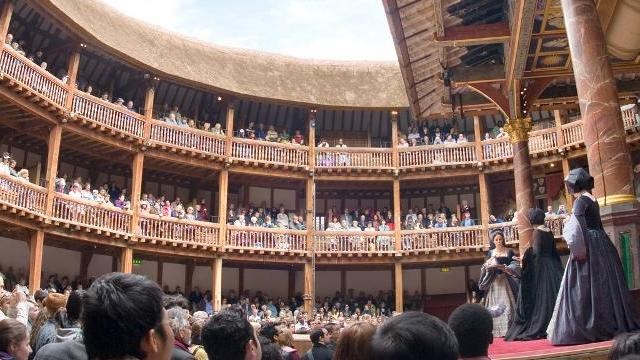
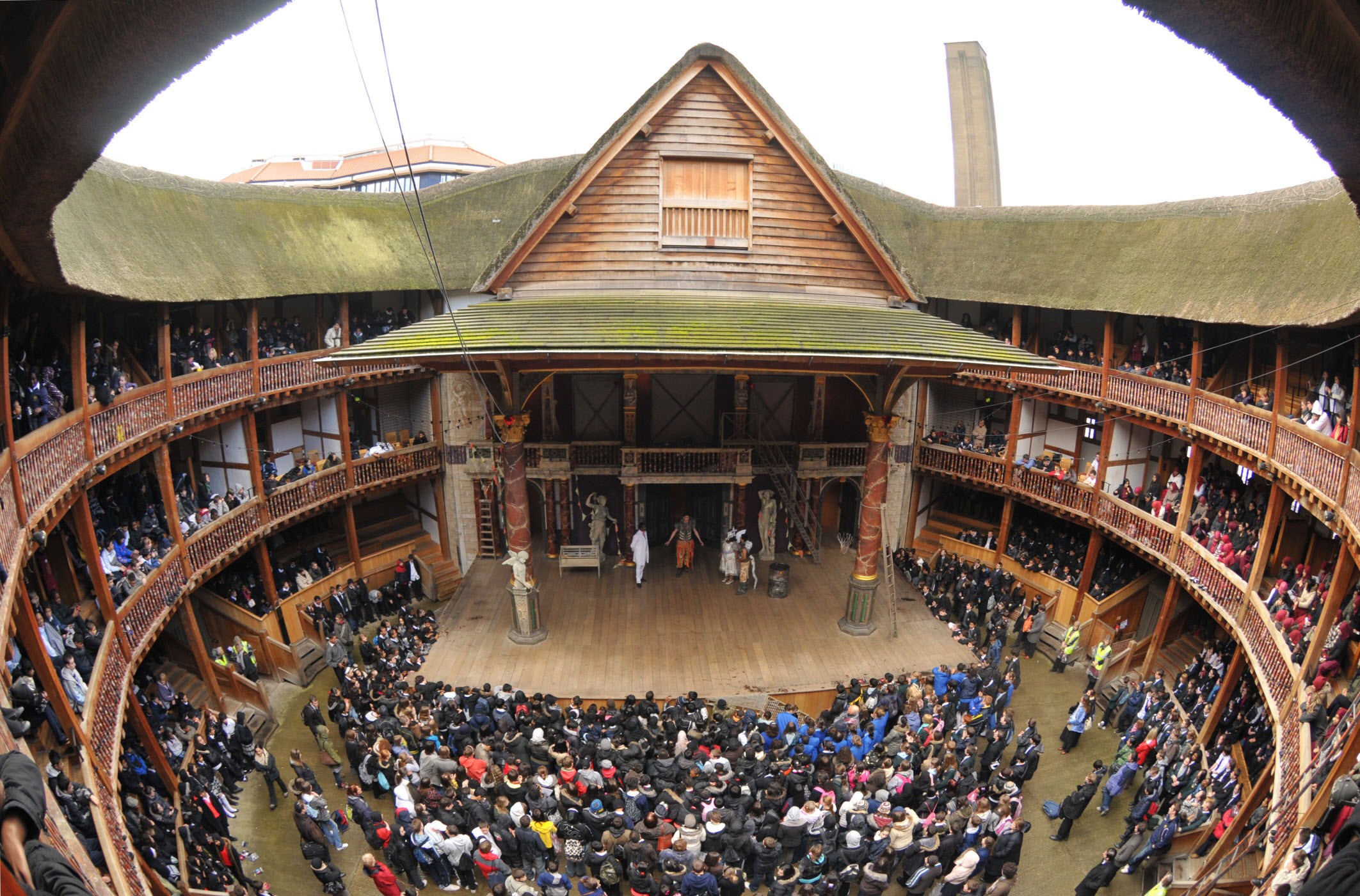
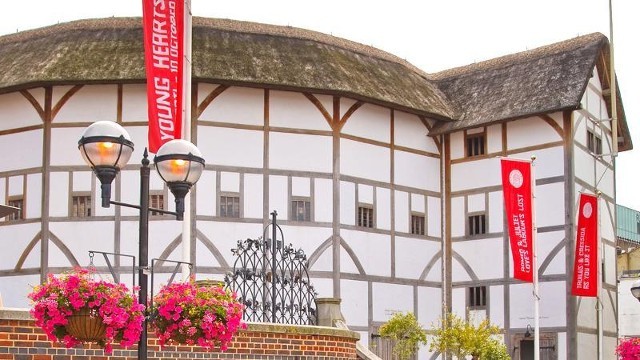
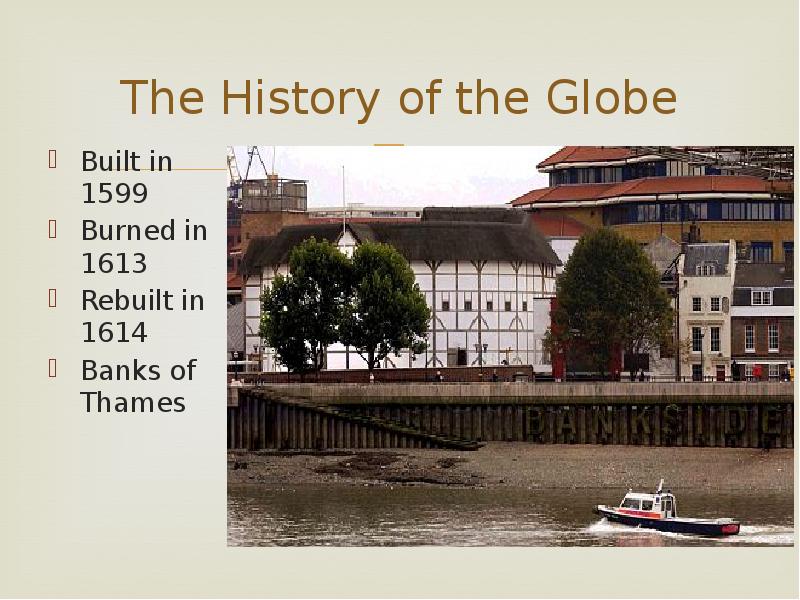
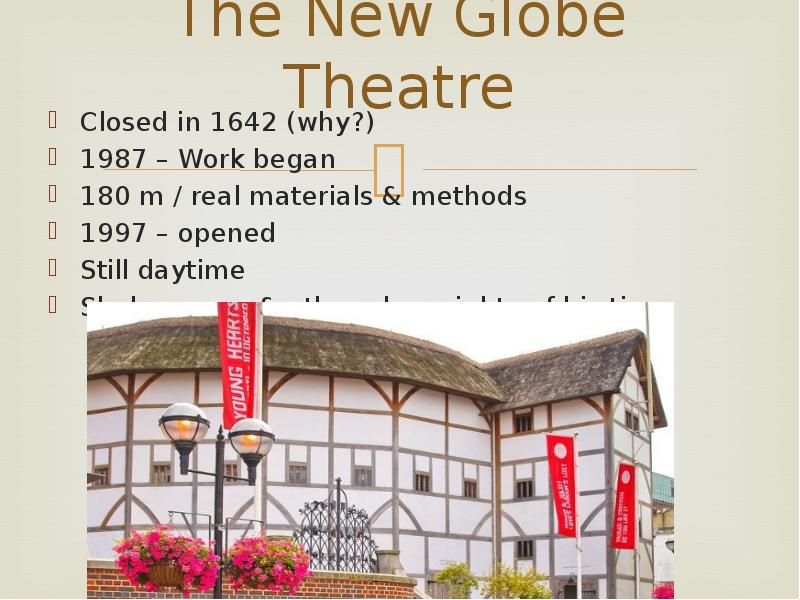
Globe Theater The Globe Theatre was a theatre in London associated with William Shakespeare. He wrote there many of his greatest plays. It was first built in 1599 by Shakespeare's playing company, the Lord Chamberlain's Men, and was destroyed by fire on 29 June 1613. It was rebuilt in June 1614 and closed in 1642. It stood on the bank of the River Thames in Southwark, London, England, UK. In 1987, though, after many years of careful research, work began to build a new theatre as much like the original as possible
GLOBE THEATRE. Liis-Mariin Remmelg The Globe Theatre was a theatre in London associated with William Shakespeare. It was built in 1599 by Shakespeare's playing company, the Lord Chamberlain's Men, on land owned by Thomas Brend and inherited by his son, Nicholas Brend and grandson Sir Matthew Brend, and was destroyed by fire on 29 June 1613. A second Globe Theatre was built on the same site by June 1614 and closed The Globe was owned by actors who were also shareholders in Lord Chamberlain's Men. Two of the six Globe shareholders, Richard Burbage and his brother Cuthbert Burbage, owned double shares of the whole, or 25% each; the other four men, Shakespeare, John Heminges, Augustine Phillips, and Thomas Pope, owned a single share, or 12.5%. On 29 June 1613 the Globe Theatre went up in flames during a performance of Henry VIII. A theatrical cannon, set off during the performance,
unsuccessful. They made their way to the river Thames and sailed up it. The Romans knew it was important to control a crossing point at the river Thames, so they decided to build a settlement on the north bank. Although small settlements had been built on the banks of the Thames, the Romans were the ones who built the first city. They called their city Londinium. The Roman engineers noticed that the point where the swampy river narrowed would make an ideal crossing point, they built London Bridge. Less than 20 years later the native Iceni tribe, led by Queen Boudicca, rose up against the Romans in revenge for mistreatment and burnt Londinium to the ground. The well disciplined Roman army defeated her forces and Londinium was rebuilt. By AD 100 it had also become the capital of the Roman province. A massive wall was built to protect the city from further attacks. The Roman Empire came under increasing attack across Europe and in AD 410 they retreated.
Magalhaesi väin between South America and Tulemaa saar. He circumnavigated the Earth. Copernic claimed that the sun was the centre of the universe and other planets went around it. Establishment of Protestant churches movement was started by Martin Luther. Different branches of this movement in France Calvinism, Chatolic. Constant conflic between them in Ulster ( North-Ireland). In the 15th century printing was diccovered in Germany. 1476 a man called Caxton opened the first printing shop in London. Books became cheaper. Until that books were copied by clergyman. More books could be produced. Literacy spread, knowledge of reading. By te end of Renaissance half of the people could read. Monasteries wasn't so important anymore. Grammar schools came. Students are taught English, Latin, Ancient History, Greek, Religion and Arithmetic. One of the oldest schools was Stratford, Shakespeare taught there. Art and Literature
London Topic Tallinn 2008 2 General information London is the capital of the United Kingdom. It covers the area of about 1000 square kilometres and its population is about 7 million. London is located on the river Thames. It is divided into 32 boroughs and the City. Currency used in London is British Pound. London is one of the most popular tourist destination in the world. It is also world's leading business, financial and cultural centre. Subway is commonly used to move around in London. Climate London has a temperate marine climate. It has daily high temperatures during summer. The warmest month is July. The coolest month is January. Winders are seldom below freezing. Rainfall is regular, but most often in the form of drizzle occurring throughout the year. Snow
London important sights guide Roman period 20th century · Big Ben is the nickname for the great bell of the clock at the north end of the Palace of Westminster in London and is often extended to refer to the clock or the clock tower as well. It is the largest four-faced chiming clock and the third-tallest free-standing clock tower in the world. The clock first ticked on 31 May 1859. The pendulum is installed within an enclosed windproof box sunk beneath the clockroom. It is 3.9m long, weighs 300 kg and beats every 2 seconds. The clockwork
· In 1582, at the age of 18, he married Anne Hathaway (26), the daughter of a farmer who lived about a mile from Stratford · Daughter Susanna (born in 1583) and twins, Hamnet and Judith (born in 1585; Hamnet died in 1596) · From 1585 to 1592, a period some scholars call ,,the lost years" · From 1592 the recors about Shakespeare are much fuller. · Sometime during the lost years Shakespeare moved to London and became part of the city's busy theatrical life · By 1594 he was a shareholder, or part owner, in one London's most popular acting companies, the Lord Chamberlain's Men, and at least six of his plays had been produced · In 1599 the company built the Globe Theatre, the most famous of Elizabethan theatres · After Queen Elizabeth's death in 1603, the Lord Chamberlain's Men were sponsored by King James and became known as the King's Men
The Tudor dynasty o 1485-1603, Henry VII, Henry VIII, Mary I, Elizabeth I o Wars of the Roses o Social reforms, political reforms(Parliament split into two houses: the House of Lords and the House of Commons.) o Henry VIII established the Church of England. o Spanish Armada was defeated by Sir Francis Drake. o Sir Walter Raleigh- exploration, the beginning of the British Empire o The Renaissance culture began, for example Shakespeare, who created the Globe Theatre. A wealthy and prosperous period in history. Analysis of 17th century The 17th century was not a stable century for the country and it's people. A. In politics it was unstable because : o the link between religion and politics became intense-protestantism, especially Puritanism, had grown in englang and puritans regarded the luxorious lifestyle of the king as immoral
 annaabi.ee











Kõik kommentaarid