Leidsid 33 sarnast õppematerjali, mis on seotud failiga "Sights in Estonia". Need materjalid aitavad sul teemat sügavamalt mõista.
built, castle, ruins, sights, kadriorg, palace, russian, tsar, designed, italian, foreign, collection, olav, church, 1267, named, norwegian, king, building, maritime, powerful, 13thperson, born in a legal marriage between two free people and having lived in the town for at least 3 months, could apply to the Magistracy for citizenship. Serfs could escape from serdom after having successfully hidden in town for a year and a day. Two parts remained separated until the end of the 19th century. Four Names Lyndanise - mentioned by Henricus de Lettis in his Chronicle; derives from the name Linda - the wife of Kalev and mother of Kalevipoeg Koluvan - mentioned in Russian chronicles; derives from the hero Kalev from our national epic Reval - comes from the German words “REH” and “FALL”, meaning the falling of the deer; could be deers trying to escape from the Danes, running down the Toompea hill Tallinn - the word origins from estonian language, could mean “taani-linn”, “tali-linn” or “talu- linn”; Reval was replaced when Estonia became independent Symbols
Legend has it that one day, when the Danes were about to lose a bloody battle, the sky suddenly opened and a red flag with a white cross on it dropped down upon them from the heavens. This is allegedly how the Danes obtained their national flag, the Dannebrog in a battle against the Estonians. In the middle of the 14th century Denmark sold its possessions in Estonia to the German Teutonic Order. Toompea became the seat of the German-born gentry. A wall was built to separate the Upper Town and the Lower Town. In 1285 Tallinn joined the Hanseatic league and became a junction of trade between East and West. Tallinn is said to be built on salt, as it was an important trading commodity. In the 16th century Tallinn had a population of about 7,000 8,000 making it one of the biggest cities in northern Europe. In 1629 Sweden took control of the whole of Estonia. Though hard times
whose polity continues in the Roman Catholic church today. However, from the Reformation the church has been part of the Lutheran tradition. In 1950 St. Olaf’s Church became a Baptist church.The Baptist congregation continues to meet at St Olaf’s today. Pictures of St. Olaf’s Church cc St Olaf’s Church Tower According to some sources St Olaf’s Church was the tallest building in world from 1549 to 1625, till the Eiffel Tower was built. In 1590 the total height of the tower was 115 meters. After several rebuildings, the height of the tower is now 123,5 meters. In summer visitors can climb winding staircaise to the tower’s viewing platform to enjoy the views of the city.Did you know that there are 232 steps up to the viewing platform.The tower has been hit by lightning around ten times, three of which led to extensive fires in 1625, 1820 and 1931. Kadrioru Palace
Art Museum of Estonia Art Museum of Estonia was founded on November 17th, 1919, but it was not until 1921 that it got its first permanent building the Kadriorg Palace, built in the 18th century. In 1929 the palace was expropriated from the Art Museum in order to rebuild it as the residence of the President of Estonia. The Art Museum of Estonia was housed in several different temporary spaces, until it moved back to the palace in 1946. In September, 1991 the Kadriorg Palace was closed, because it had totally deteriorated by then. At the end of the year the Supreme Council of the Republic of Estonia decided to guarantee the construction of a new building for the Art Museum of Estonia in Kadriorg. Untill then the Knighthood House at Toompea Hill served as the temporary main building of the Art Museum of Estonia. The exhibition there was opened on April 1, 1993. Art Museum of Estonia premanently closed down the exhibitions in that building in October 2005.
Tallinn is a small port town in which the population is 371 000 people, and the area is only 159,2 km².( square kilometers). Tallinn, the capital of Estonia, is named after taani linnus, which means Danish castle. The Castle in question was built by King Waldemar of Denmark in the 13th century. The settlement quickly developed itself into a busy port. -The Old Town In medieval age Tallinn was called Reval and it was as big as the Tallinns Old Town is now. Uniqueness of Tallinn is that it is one of very few European cities, where the historical lay-out is kept in it's original form , and has a lot of monuments of that time. Thanks to that in 1997 Old Tallinn has been included in the list of a world heritage of UNESCO.
Every five years national song and folk dance festivals take place in Tallinn. The yachting regatta of the 1980 Moscow Olympic Games was held at Pirita. History Tallinn means in English "Danish town". The place is believed to have been settled by Finno-Ugric people about 2500 BC. It was first marked on a map of the world by the Arab geographer al-Idrisi in 1154. The Estonians were the first to build a stronghold on the spot of the Toompea Hill, but the real Tallinn was built by the Danes who conquered the north of Estonia in 1219. Legend has it that one day, when the Danes were about to lose a bloody battle, the sky suddenly opened and a red flag with a white cross on it dropped down upon them from the heaven. This is how the Danes obtained their national flag. In 1346 the Danish king sold his Estonian lands to the Teutonic Order, who a year later resold them to the Livonian Order. The Germans renamed Tallinn and called it Reval.
London History The Romans AD 43- AD 410 The Romans finally invaded Britain in AD 43 from Kent. The Romans lead by Julius Caesar attempted to invade Britain twice before that in 55 and 54 BC but the invasions were unsuccessful. They made their way to the river Thames and sailed up it. The Romans knew it was important to control a crossing point at the river Thames, so they decided to build a settlement on the north bank. Although small settlements had been built on the banks of the Thames, the Romans were the ones who built the first city. They called their city Londinium. The Roman engineers noticed that the point where the swampy river narrowed would make an ideal crossing point, they built London Bridge. Less than 20 years later the native Iceni tribe, led by Queen Boudicca, rose up against the Romans in revenge for mistreatment and burnt Londinium to the ground. The well disciplined Roman army defeated her forces and Londinium was rebuilt
London important sights guide Roman period 20th century · Big Ben is the nickname for the great bell of the clock at the north end of the Palace of Westminster in London and is often extended to refer to the clock or the clock tower as well. It is the largest four-faced chiming clock and the third-tallest free-standing clock tower in the world. The clock first ticked on 31 May 1859. The pendulum is installed within an enclosed windproof box sunk beneath the clockroom. It is 3.9m long,
THE CITY OF LONDON History The City of London occupies one square mile in the middle of the capital. It once made up entire town of London, surrounded by the wall first built by Romans. The Romans also built a bridge over the Thames and there has been one in the same area ever since. The Roman Londinium grew up on the northern side of the bridge. In AD 61 the native Celtic tribe, led by Queen Boudicca, rose up against the Romans. They burnt down Londinium to the ground and killed most of its inhabitants. Roman armies eventually defeated Boudicca and Londinium was rebuilt. At the end of the fourth century AD the Roman Empire began to crumble and the Roman armies
Kunda Gymnasium Rait Türkel Old Tallinn Report Instructor:Teacher Kristi Aron Kunda 2012 Introduction Like most cities with an eight-hundred-year-old past, Tallinn is a patchwork of historic areas. The city's pride and joy is without a doubt its Medieval Old Town, but equally enchanting is the Kadriorg district, a throwback to the time when Estonia was ruled by the Russian Tsars. Tallinn is the capital and largest city of Estonia. It occupies an area of 159.2 km2 with a population of 416,470. It is situated on the northern coast of the country, on the shore of the Gulf of Finland, 80 km south of Helsinki, east of Stockholm and west of Saint Petersburg. Tallinn's Old Town is in the list of UNESCO World Heritage Sites. It is ranked as a global city and has been listed among the top 10 digital cities in the world
Tallinn Tallinn is a beautiful city in NorthEstonia. It is washed and influenced by the Gulf of Finland in the north. Tallinn has a lot on sights and I'm going to introduce some of them. Town Hall Square the square in front of Tallinn's Town Hall functioned as a marketplace for centuries, dating back to times even before the Town Hall itself was built. Through the years this served as a place of celebrations as well as executions. St. Olav's Church was the tallest church in Medieval Europe. The earliest data on St. Olav's Church come from 1267. Little is known about the building of this Gothic
Then it was called Reval for some time and finally Estonians started to call the town Tallinn from Taanilinn (Danish town) after the Danish conquest in the 13th century. The Knights of the Sword took Tallinn from the Danes in 1227 and made Toompea their fortress. In the middle of the 14th century Denmark sold its possessions in Estonia to the German Teutonic Order; Toompea became the seat of German-born gentry. A fortified wall was built between the Toompea (the Upper Town) and the Lower Town (inhabited by people of a lower social standing), as there were conflicts between the two. The doors and the gates of the wall were locked at night, a procedure which carried on until the end of the 19th century. Tallinn joined the German-dominated Hanseatic League in 1285 and became a junction of trade between East and West: furs, honey, leather and seal fat moved west,
The City of London History The City of London occupies one square mile in the middle of the capital. It once made up the entire town of London, surrounded by the wall first built by the Romans. The Roman Londinium grew up on the northern side of the "London Bridge" in the past. Products such as olive oil, wines and fruit were brought by ships from different parts of the Roman Empire and unloaded onto wooden quays along the river. In AD 61 the native Celtic Iceni tribe, led by Queen Boudicca, rose up against The Romans. They burnt Londinium to the ground but Roman armies eventually defeated Boudicca. The city was rebuilt and was gradually surrounded with a wall
Sculptures and monuments St. John's Lutheran Church St John's Church was probably built in the first third of the 14th century. There is no other brick church decorated with so much terracotta plastic in Europe Eduard Tubin Monument The Eduard Tubin monument, marking the 100th birthday of the composer, was dedicated in 2005. The authors of the statue are sculptor Aili Vahtrapuu, architect Veronika Valk, with sound installations by Louis Dandrel.Eduard Tubin (1905-1982) was a versatile composer and conductor, one of the most recognized symphonists throughout history
The famous German writer August von Kotzebue (1761-1819), the life and soul of the theatre, lived in Tallinn for several long periods. (Otto von Kotzebue, the son of August von Kotzebue, accompanied explorer Adam Johann von Krusenstern on his Journey around the World of 18031806.) Estonian was heard from a theatre stage for the first time. Early in the 19th century city architect Carl Ludwig Engel (helped rebuild Helsinki and also built the palace at 8 Kohtu Street on Toompea) designed a sumptuous hall for the theatre, but it was destroyed in a fire. Another fire devastated the theatre in 1902, after which it moved out from Old Town. The premises came into the possession of the Puppet Theatre in 1955. In 1991, the whole building was given to the theatre. Renovation works took place in 2001-03. 5 17 Lai Street Lai 17, so-called Menshikov House was completed about 1685 in the Dutch Baroque style. The family coat-of-arms
Names of town ● Lindanise - it was first used in 1219, derived from mythical Linda, the wife of Kalev and the mother of Kalevipoeg, national hero. ● Koluvan - found in old Russian chronicles, the name possibly deriving from the Estonian mythical hero Kalev ● Reval - used after 1219; comes from two german words ‘reh’ and ‘fall’, meaning the falling of the deer - as they fall down the Toompea hill, probably when escaping from the Danish occupation or just the hunters. ● Tallinn - used after Estonia gained its independence in 1918, origin is definitely estonian; meaning Taani-linn, tali- linn. Liberty Square
· Suuremõisa Castle. Suuremõisa Castle was built in the second half of the 18th century on the initiative of Countess EbbaMargaretha Stenbock (17041776). The wings are erected in 1772. There are 64 rooms in the Castle. 6 ponds were dug in the grounds of the Castle and a park and a garden established. In 1796 the Castle was sold to Baron UngernSternberg. The attic of the Castle has doubleceiling, where the Baron used to hide the treasures stolen from ships that had sunk in the Näkimadalad. On 19 October 1802 the Baron killed Karl Johannes Malm, the Captain (of Swedish origin) of his ship "Brig Morian", in this Castle. For this the baron was deported to Siberia. There are currently two schools in the Castle: Suuremõisa Gymnasium and Suuremõisa Technical School. In the latter one can also study how to become a ship's captain.
l Town rights - 1248 l Mayor - Edgar Savisaar l Aera - Total 159.2 km2 (61.5 sq mi) l Population - (1 Mar 2012) Total - 416,470 Denisty - 2,614.0/km2(6,766.6/sq mi) Tallinn Coat of arms Flag Top 5 Attractions 1. Kiek in de Kök Visitors to the museum will see examples of Medieval firepower, displays detailing how the city's system of walls and towers developed through the centuries and an exhibit on crime and punishment in Old Tallinn. 2. Kadriorg Palace - Kadriorg Art Museum A trip to Tallinn isn't a trip to Tallinn without a visit to this magnificent northern baroque palace, built by Peter the Great for his wife, Catherine I, in 1718. The grandiose palace with its surrounding manicured gardens is home to the foreign art collection of the Art Museum of Estonia. The Kadriorg Art Museum displays hundreds of 16th- to 20th-century paintings by Western and Russian artists, as well as prints, sculptures and other works. 3. Estonian Open Air Museum
The county of Saaremaa Siiri Tabri Kaia Vask Saaremaa - an exciting island Saaremaa - the biggest island of Estonia is known as a good recreation place with unique nature and a lot of sights. Saaremaa has retained its uniqueness due to its location and insulation. Junipers, dolomite, windmills and the famous local home- brewed beer are considered the symbols of Saaremaa. Rich nature. Because of its mild maritime climate and soil rich in lime, Saaremaa has very rich flora and fauna. In Saaremaa a great number of Roman snails, rare butterflies and beautiful orchids can be found. Each year hundreds of thousands of migratory birds visit
Tallinn Mustamäe College G2K Jaana-Kristiina Jõgevest The Four oldest churches of Tallinn Report Supervisor: Ingrid Teigar Tallinn 2009 The Dome Church The Danes began fortification of Toompea after the conquest of Tallinn in 1219 and probably also built the first church there. It was presumably a wooden building located at the site of the present cathedral. However, a serious conflict with the Order of the Brothers of the Sword broke out soon as the latter wanted to gain control of the entire Estonia. The order succeeded in subordinating Tallinn and the whole of North Estonia to its rule in 1227. The monks of the Dominican Order began the construction of a stone church in Toompea in 1229
The Celtic period (400 BC Name: Celtic words (Llyn (a lake) + AD 43) Dun (a fort or strong place) ) Not important The Roman occupation (AD 43 Londinium not important Boadicea a revolt against - AD 410) politically. An important trading the Roman conquest centre. Devastation AD 61. Rebuilt. Roman walls built in AD 200. Anglo Saxons (AD 400 Destroyed the Roman towns. Many 1066) kingdoms. London in ruins. King Egbert one Flourishing. Attacks by Vikings. kingdom England (the 9th century) King Albert the Great
... Gümnaasium English Project Sights of Estonia Student: .............................. Class: 6 ... Teacher: ............... Harjumaa 2011 1 1. Steamer-icebreaker Suur Tõll The ship was built in 1914 in Stettin (Szczecin) by Vulkan-Werke A. G. Suur Tll is the only pre-war steam ship of the Republic of Estonia remained up to now and, at the same time, the biggest icebreaker in the world preserved through two world wars. All the 3 original steam engines as well as most of the original arrangement of space and late Jugendstil interior of the officers' rooms are preserved. In 1914 the first home port of the ship was Tallinn
are not a garlic enthusiast. Enjoy the fair and its concerts and buy local handicraft, home made gourmet food and hand made bread as souvenirs. · The festival year ends with the national poetry days, "Tähetund" (StarHour), dedicated to the Estonian poet, Betti Alver. Most Estonian actors say that Betti Alver poetry days were among their very first public performances. Põltsamaa Põltsamaa is the city of wine, bridges and roses. Põltsamaa Castle was started in 1272. In the course of centuries the fort suffered damage. In 1770 the old convent building was replaced by a rococo palace. The ruins of the castle, destroyed in 1941, are being conserved. The courtyard has been converted into a stage of outdoor events. Mustvee Mustvee, a town located on the shore of Lake Peipsi, is best characterised by its motto five churches, two cultures, one nation. Tourist destinations: Elistvere
of Saint Petersburg. Tallinn was founded in the 12th century and has been under the rule of Denmark, Sweden, and Germany as well as Russia, and all left their mark on the city's architecture. It is one of the best preserved medieval towns in northern Europe, and makes a beautiful impression from the sea, with its ancient city walls, church spires, and red-tile roofed homes. Tallinn has previously been named as Kolõvan, Lindanise and Reval. Most well-known sights in Tallinn are Freedom Square, Kadriorg Palace, Rotermann Quarter, Tallinn Song Festival Grounds, Toompea Castle and Town Hall Square, the Old Town of Tallinn and many more. Tallinn's Old Town is in the list of UNESCO World Heritage Sites. At the Old Town, you pass beneath the arches of Tallinn's ancient stone walls and enter a world of cobblestones, narrow alleys, and medieval buildings. It's a fun place to explore on foot. Today, the city is growing rapidly, with modern buildings joining the old.
Tennis courts, cafes, playgrounds, diving towers, boat rental and catamaran trips are available by the lake. In winter, people can enjoy a snow park and test their skills at snow-tubing. Flag and coat of arms Viljandi's flag is a simple light blue over white. I don't know the significance of the colours (if any), but they are probably derived from the coat of arms. The arms are a white (and golden) flower on a blue field. Trepimägi The stairs of Trepimägi, built during the turn of the century to improve the connection between the town and the lake, start right from beside the Town Hall. There are five flights and 158 steps. Water Tower The old water-tower of Viljandi between the museum and Town Hall has been reconstructed now into an observation tower. Church spires and the Old Water Tower form a silhouette on the lake surface. The Water Tower offers a
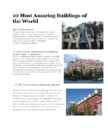
10 Most Amazing Buildings of the World The Crooked House Though it looks like some sort of painting by a drunk painter. But this is a real house located in Rezydent Shopping Center in Sopot, Poland. It is claimed to be the most photographed building in Poland. It is spread to an area of 4,000 square meters. Designed by Architect: Szotynscy Zaleski 2. Forest Spiral - Hundertwasser Building Architect: Heinz M. Springmann This is a residential building complex located in Darmstadt, Germany. The building has a unique façade which doesn’t follow a regular grid pattern and the windows appear as if they are dancing out of line and appear out of order. It was designed by Viennese artist Friedensreich Hundertwasser and finally planned and implemented by architect Heinz M. Springmann
The statue architect was Tiit Trummal. The designer of statue was Mati Karmini. This was opened on 1 September, 1998. Town Hall Theatre "Vanemuine" In this theatre where took place first Estonian performances. June 24, 1870, the fifth anniversary of the society, was represented by the play of Lydia Koidula «Saaremaa onupoeg» At first the theatre was on the Jaama street. This building was burned in 1903. In 1906 was built a new building on the street Aia. In 1944, during World War II, the building was completely burned. The theater moved into the building of the former German Theatre Tartu, which is now part of the theater Vanemuine and is known as "small house ". At the old place was built and in 1967 opened a new building with room for 682 people, now known as the "big house". Concert hall (842 seats) was opened in 1970. "Small House" was destroyed by fire in 1978 and renovated in 1991. "Vanemuine"
After thorough reforms in Estonian economy the people living in villages and small towns are searching for new possibilities for self-realisation and one of the outputs is tourism. This can also be seen in Southern Viljandimaa as there are continuously more establishments providing accommodation, caterers and organisers of active holidays. Many tourism maps have been put beside the road as well as many hiking trails have been built and marked. History of Estonia Human settlement in Estonia became possible 11,00013,000 years ago, when the ice from the last glacial era melted away. The oldest known settlement in Estonia is the Pulli settlement, which was located on the banks of the river Pärnu, near the town of Sindi, in southern Estonia. According to radiocarbon dating, it was settled around 11,000 years ago, at the beginning of the 9th millennium BC
world´s most famous fortresses, and one of Britain ´s most visited historic sites. Despite a grim reputation for a place of torture and death, there are so many more stories to be told about the Tower. This powerful and enduring symbol of the Norman Conquest has been enjoyed as a royal palace, served as an armoury and for a few years in the 1830s even housed a zoo! An intriguing cast of characters have played their part: including the dastardly jewel-thief Colonel Blood, tragic Lady Jane Gray and maverick zoo keeper Albert Cops. SCOTLAND Capital: Edinburgh Flag: Area: 30414 sq mi (78772 km2) Location: Symbols: Tartan
1. Fat Margareta - 16. Cent. Tallinn's most impressive defensive structures, the Great Coastal Gate (Suur Rannavärav) and Fat Margaret's Tower. They were built not only to defend the city from the seaward side of town, but also to impress any visitors arriving via the harbour. Fat Margareta used to be a prison. It is a town wall's building. Now it's home to the Estonian Maritime Museum, which provides a detailed look at the nation's seafaring past. 2. The Great Coastal Gate - with the Viru Gates, are the last of six gates that controlled access to the town in Medieval times. 3. Kolm Õde - a hotel
politically, but was, however an important crossing point for the romans over the river Thames. Londinium was at a very good place, so it soon became a trading centre. In AD 61 the city was devastated by Boudicca, who led a revolt againt the Roman conquest of Britain. The city was burned down and its inhabitants massacred. London was rapidly rebuilt, becoming the capital of the province Britannia. AD 122 Roman walls were built around it as a Around AD 400 the Anglo-Saxons invaded Britain. They destroyed the roman towns and formed many kingdoms that were hostile to one another. London fell into ruins. King Egbert united all the small kingdoms and formed one kingdom named Englad. Later king Alfred the Great chose London to be the capital of the country. During the reign of Edward the Confessor Westminster Abbey and the royal palace were built.
various English kings, London once again prospered as an international trading centre. However, Viking raids began in the late 10 th century and reached a head when they took the city under Danish king Canute and forced the then-English king to flee. Years later, following a victory at the Battle of Hastings, William the Conqueror was crowned King of England in the newly-finished Westminster Abbey in 1066. William granted the citizens of London special privileges while building a castle in the corner of the city to keep them under control. This castle was expanded by later kings and is now known as the Tower of London. The city grew in wealth and population during the Middle Ages. In 1100 its population was around 18,000 but after 200 years it had grown to nearly 100,000. However disaster struck during the Black Death, when London lost nearly a third of its population. After the defeat of the Spanish Armada, stability in politics allowed the city to grow even more
Old Tallinn Old Town, a medieval walled city filled with old buildings and fortifications. The sheltered bay and the easily defended Toompea Hill made it a natural place to settle. Sometime about 1050 A.D. a fortress was built atop the hill, the first of many. In 1219 the Danes showed up as part of the Northern Crusade to subjugate the Baltics and convert the local pagans to Christianity whether they wanted to or not. The Danes improved the fortifications and expanded the town, which became part of the Hanseatic League, a trading organization of a hundred northern cities. The Danes sold Tallinn to the Livonan Order, a branch of the Teutonic Knights, in 1346. The Swedes came next in 1561
 annaabi.ee