Leidsid 33 sarnast õppematerjali, mis on seotud failiga "Report: estonian ecnomy". Need materjalid aitavad sul teemat sügavamalt mõista.
rate, employment, there, german, country, unemployment, other, parliament, elect, political, economic, economy, germany, language, government, work, power, compared, than, sector, president, erle, include, living, executive, year, network, capita, material, quarter, wage, come, russian, speak, foreign, employed, electronic, increase, republic, primeESTONIAN BUSINESS ENVIRONMENT Estonia is a country with the population of just a little over 1.3 million people. It has been estimated though, that by the year of 2040 the number will have decreased by 125,000 people. It means that the population of Estonia is decreasing. As young Estonians often like to go study or live abroad, the population is aging as well – young people move away, while older stay there. Many different nationalities live there: besides Estonians there are Russians, Ukrainians, Belarussians, Finnish, Tatars, Latvians, Poles, Lithuanians, Jews, Germans and others. Due to this fact, the most popular languages spoken as a mother language are Estonian, Russian and Ukrainian. Nevertheless, there is still just one official language of Estonia, which is Estonian. Most of the people, approximately 900,000 live in the cities, such as Tallinn, Tartu, Narva. The most common sector that people work in is the service sector.
Economic Country Review: Finland, Estonia and Hungary Girli Vasiljev Report Business Economics, RB1X 06.05.2012 Abstract 06.05.2012 Experience and Wellness management Author Group Girli Vasiljev RB1X Title of report Number of pages Economic Country Review: Finland, Estonia 20 and Hungary Teacher Kalevi Torunen The goal of this paper is to compare the economic performance of Finland, Estonia and Hungary. First, a general overview on the countries will be given. After, economic indicators (real GDP growth rate, inflation, unemployment, household consumption, investment, current account, government budget and deficit) of the three countries will be compared to draw a conclusion. Keywords
Tallinn English College Topic Estonia Tallinn 2008 1. Introduction Estonia is a small country about the size of Switzerland, or New Hampshire and Massachussetts combined. Estonia is named after the people called "Ests" who lived in the region in the 1 st century AD. The Republic of Estonia is one of the three countries commonly known as the "Baltic States". The other Baltic States are Latvia and Lithuania. 2. Geographical position Estonia is situated in northeastern Europe. Estonia is bounded on the north by the Gulf of Finland, on the east by Russia, on the south by Latvia and on the west by the Baltic Sea. In the north it borders on Finland. The coastline of the Baltic Sea in Estonia is characterized by numerous gulfs and bays, the biggest of them being the Gulf of Finland, the Gulf of Riga and the Gulf of Pärnu. Bays include the
The territory of Estonia covers 45,227 km² and is influenced by a temperate seasonal climate. The Estonians are a Finnic people closely related to the Finns, with the Estonian language sharing many similarities to Finnish. The modern name of Estonia is thought to originate from the Roman historian Tacitus, who in his book Germania (ca. AD 98) described a people called the Aestii. Similarly, ancient Scandinavian sagas refer to a land called Eistland, close to the German term Estland for the country. Early Latin and other ancient versions of the name are Estia and Hestia. Until the late 1930s, the name was often written as Esthonia in most English speaking countries. Estonia is a democratic parliamentary republic and is divided into fifteen counties. The capital and largest city is Tallinn. With a population of only 1.4 million, it is one of the least-populous members of the European Union. Estonia was a member of the League of Nations from 22 September 1921, has been a member of the
Introduction of Estonia The Republic of Estonia is beautiful country which is located in northeastern Europe, bordering the Baltic Sea on the west, the Gulf of Finland on the north, Latvia on the south, and Russia on the east. Estonia is the smallest of the Baltic countries. Administrative division: Estonia has an area of 45,226 square kilometers and Estonia is administratively divided into counties. There are 15 counties in Estonia. The capital is Tallinn which is located in Harjumaa. Counties are divided into 194 rural municipalities. Population: The population of Estonia was estimated at 1.34 million in January 2011, with a density of 30 persons per square kilometer. According to the last census the number of inhabitants has decreased. In 2010 the birth rate was 11,82 per 1,000 population, while the death rate was exactly the same, so population growth rate is 0%
The old farmhouses and mansions can still be seen in many places in Southern Viljandimaa. As a result of the hard work and the tenacity of the local inhabitants, Mulgimaa developed into an area known as prosperous and rich by its cultural heritage. The masters working in the villages played an important role in the development. The local foods such as sauerkraut stew, curd cake and ,,kama" (a meal made with sour milk and a mixture of ground grains) are popular even nowadays. There is even a song that says: "It is good to live in Mulgimaa / The nature is beautiful and the land is fructuous/ There are glorious groves and large wealthy Estonian farms". As for now, the large-scale industry has become more and more dominating in agriculture. After thorough reforms in Estonian economy the people living in villages and small towns are searching for new possibilities for self-realisation and one of the outputs is tourism. This
Estonia Estonia is a small country in Northern Europe with an area of about 45 000 sq km. As a part of the East-European Plain, the country has a rather flat surface. The highest and most diverse region in Estonia is in the south-eastern part of the country. At 318 metres, Suur Munamägi is not only the highest point in Estonia, but of all the Baltic countries. There are about 1500 islands in Estonia, the biggest of which being Saaremaa and Hiiumaa. Sixty-four species of mammals have been recorded in Estonia, three of them have been introduced: the racoon dog, the American mink and the muskrat. A couple of species have been re-introduced The European beaver, who was hunted to extinction by the end of the 19th century
Estonia. Estonia, officially the Republic of Estonia is a country in Northern Europe. It is the smallest of the three Baltic countries. Estonia has land borders with Latvia (339 km) to the south and Russia (229 km) to the east. It is separated from Finland in the north by the narrow Gulf of Finland and from Sweden in the west by the Baltic Sea. Estonia has been a member of the European Union since May 1, 2004 and of the NATO since March 29, 2004. The area of Estonia is about 45000 square kilometres and the population is about 1.4 million people
Milestones in Estonian History The Estonians are a Finno-Ugric people who came from the area near the Urals and the Volga and Oka rivers. They migrated westward to the Baltic shores some 5, 000 years ago. In the ninth century A.D. Viking ships invaded Estonia and the country became a vital link in the sea-trade between East and West. By the 12th century, the Arabian geographer al-Idrisi had placed the city on his maps. In the 13th century, Tallinn joined the Hanseatic League, the union of European commercial towns that stretched from London to Novgorod. Pärnu, Viljandi and Tartu were also members. Estonia became a vital link in the sea-trade between East and West. The oldest preserved book written in Estonian, a catechism, dates from 1535. Tartu
FACTFILE Area: 45 228 sq km Poplulation: under 1.4 million Capital: Tallinn Language: Estonian Currency: Eesti kroon (EEK) Main religion: Lutheran National holiday: 24 February (anniversary of the republic) National flower: Cornflower National bird: Barn Swallow National stone: Limestone LOCATION The Republic of Estonia is the northernmost and smallest of the three Baltic States. It is located on the eastern shores of the Baltic Sea in the north east of Europe. To the east the country borders Russia. Latvia is the countries neighbour to the south. From the west the coast of Estonia is washed by the Baltic Sea and from the north by the Gulf of Finland. The length of the coastline is approximately 3 800 km. The longest distance from east to west is 350 km, while north to south Estonia stretches 240 km. THE NAME The name EESTI was apparently derived from the word AISTI, the name given by ancient Germans to the peoples living northeast of the Vistula River
Life in Estonia through the eyes of an economics student With a population of 1 313 271 people, Estonia is one of the least populous member states of the European Union. However, according to the IMF, it is a developed country with an advanced and high-income economy. Estonia follows market economy system which ensures the little government intervention and the determination of prices of goods and services in a free price system. Therefore, economic decisions are guided solely by the aggregate interactions of a country's citizens and businesses. In addition to mentioned afore, Estonia tends to perform favourably in measurements of civil liberties, education, and press freedom.
Tartu 2013 TABLE OF CONTENTS INTRODUCTION ................................................................................................................... 4 1. UKRAINE ...................................................................................................................... 5 1.1. General information ..................................................................................................... 5 1.1.1. Country Profile ..................................................................................................... 5 1.1.2. Post-Independent Ukraine. Economy and politics ............................................... 6 1.1.3. Key Macroeconomic indicators ......................................................................... 14 1.1.4. Foreign Direct Investments ................................................................................ 16 1.1.5
......................................................................7 10. History..........................................................................................................8 11. Conclusion....................................................................................................9 12. References....................................................................................................10 Introduction I chose finland because there are friendly people and beautiful nature. Finland is bigger than Estonia. There lives over 5 milj. people. Finland capital is Helsingi and there lives about 2 milj. people. Highest top is 1328m. Finland is bordersed with Sweden to the west, Russia to the east and Norway to the north. It is the eight largest city in Europe. Most Finns speak Finnish. The second language is Swedish. Finland is rated the sixth most peaceful country in the World. In Finland there are more than 60000 lakes.
Kerli Uue 10.r The Republic of Estonia Estonia is a democratic parliamentary republic divided into 15 counties. The capital and largest city is Tallinn. Estonia's neighbours are Latvia, Russia and Finland. The parliment is named ,,The Riigikogu." The Estonian parliament has 101 members and influences the governing of the state primarily by determining the income and the expenses of the state. The Riigikogu elects and appoints several high officials of the state, including the President of the Republic. The Parliament of Estonia is elected by people for a four year term by proportional representation. The Government of Estonia is formed by the Prime Minister of Estonia, nominated by the president and approved by the parliament
established the relationships between Estonia, Livonia and the Russian Empire. The Baltic Landesstaat reached its full development. The freedom of action in the new provinces was naturally granted to one of the most firm ideological pillars of the tsarist empire -- the Russian orthodox church; though as the Landeskirche in the Estonian and Livonian territories, the Lutheran church long maintained a de facto predominance. The most important organ of Baltic German local government was the Diet, consisting of all the noble families who had been `selected' in a list of the eligible. Although jealously guarding their privileges, the knighthoods still never became entirely closed. Between sessions of a Diet, the legislative power of the knighthoods belonged to the Council of the Diet. The towns were governed by the Town Councils, which supplemented their ranks from among the representatives of merchants and lawyers. The
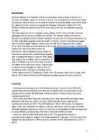
Estonia Topic Tallinn 2007 2 List of Contents page Facts and figures 3 Geography 3 Climate 3 Nature 4 History 5 Economy 6 Culture 6 Biggest towns 7 Language 8 3 Facts and figures The Republic of Estonia is a small country. Covering only 45, 228 sq km it is slightly bigger than Denmark, Belgium or Switzerland. Estonia's population is under 1.4 million. The official language is Estonian but since very many Russians live here Russian is also wide spread. The capital of Estonia is Tallinn. The currency used in Estonia is Eesti kroon. The Estonian national flag is blue-black-white. It was originally the flag of the Estonian Students' Society. The flag was first consecrated in Otepää Church in 1884. For a while,
is that over two-thirds of the world's scientists are able to read in English. Three quarters of the world's mail is written in English and eighty per cent of the world's electronic information is stored in English. The biggest countries where English is spoken as the first language are: Great Britain, Canada, United States of America and Australia. Estonian on in comparison to English is a language that is spoken only by approximately 1 million people. On the other hand English in comparison to Estonian is a very young language. According to Wikipeia online dictionary, English is an Anglo-Frisian language brought to south-eastern Great Britain in the 5th century AD by Germanic settlers from various parts of northwest Germany (Saxons, Angles). Estonian in comparison is a language that has been spoken in the area of present day Estonia for more than 4000 years, Meri (1976). 4 First links
The highest point is Suur Munamägi, which is 317m high. Estonia has a surprisingly mild climate for an area so far north. Sea winds keep the weather from becoming very cold or hot. Estonia’s flag has three horizontal stripes. The blue stripe at the top of the flag represents the sky. The middle stripe of black stands for the land. The white stripe at the bottom symbolizes hope in the future. The president is the most powerful official in Estonia’s government. The country’s parliament elects the president to a five-year term. The parliament has 101 members, who are elected by the people. The prime minister is recommended by the president and he heads the operations of the government. Modern industrial development, which began in the second half of the 19 th century was oriented toward the Russian market. Large textile mills were set up in Narva and electric motor production plants and shipyard in Tallinn. Today Narva provides most of Estonian’s electricity.
transit in the Estonian economy has been consistently decreasing. Slightly more than 70% of the freight flow of the ports and 57% of the rail freight is connected with transit. Such shares are constantly diminishing as Russian oil flow goes through her own ports on an increasing scale. Presently about one third of the freight flow may be related to transit. The principal part thereof is constituted by the export of petroleum products from Russia -- first by rail, then by sea with tankers. Other Russian goods that have been transported through Estonia are grain and fertilizers, sometimes other goods as well. The transit from the West to Russia has gradually grown, mostly in the form of containerised freight. The Estonian national air company Estonian Air has also proven successful as it has managed to increase both cargo volumes and the number of passengers in spite of the hard times in the world's aviation business. In 2004 the number of passengers in Estonia
Switzerland Liisi Nigul Turundus II Sociological factors: Religions: Main religion is Roman Catholic 41,8%, then comes Protestants with 35,3% and on the third place are so called non-believers (people with no religion) 11,1%. (Other: muslin, orthodox, other Christian and so on). Birth rates: Switzerland has a birthrate of 9, 51 births to 1000 people, it's in the 199 place in the world's birth rate comparison. Leisure activities: Leisure activities range from taking part in grueling sports to relaxing with family and friends. Many people also devote part of their leisure time to the public service. Life expectancy at birth: total average is 81 years but if you look at genders separately it's: male 78 years and female 84 years.
Liaison with central and local governments Liaison with branch chambers and NGOs www.investbg.government.bg GENERAL INFORMATION Official name: Republic of Bulgaria Area: 110 994 sq.m. Population: 7.4 million Capital: Sofia Time zone: EET (UTC+2) Official language: Bulgarian Currency: Lev (BGN) Fixed exchange rate: 1 = BGN 1.95583 Type of government: Parliamentary Member of: EU, NATO, WTO www.investbg.government.bg DID YOU KNOW THAT BULGARIA The best outsourcing destination in Europe, according to Cushman & Wakefield's rating for 2015. In the world our country takes the third place. Accommodated about 50 companies producing components and systems for the global automotive industry. In eight of every ten cars
published in 1535 Population: In the 13th cen. The population numbered between 100000 and 200000, but this figure changed as a result of wars, epidemics, migration and famine during the centuries followed; in the mid-1800s many estonians emigrated to Russia, North-America etc. to find a farmland better living conditions, estonians made 88.2% of the total population of their native land; WW II caused war casualties, deportations and mass emigration of refugees, in 1945 there were 854000 people in Estonia; Estonians, Russians, Ukrainians, Belorussians, Finns and others were the communities; citizenship was given to the poplke who had held it before 16 June 1940 and tgeir descendants Public holidays: Some national holidays: 23 June: Victory Day the Battle of Võnnu in the Estonian War of independence; 24 June St. John's Day; 2 February anniversary of the Tartu Peace Treaty; 14 March Mother Tongue Day; May second Sunday Mothers' Day; 2
terms of inward investment per capita. Numerous foreign companies have found Estonia to be a highly attractive location. Companies partly or wholly owned by foreigners account for one-third of Estonian GDP and over 50 percent of the country`s exports. The general trends in foreign direct investment inflows can be summarized as follows: · during 1995-1996 the majority of the foreign direct investments were privatization-related; · there is an increase in terms of reinvested earnings since 1996 which was 66% of the total annual inflow of FDI in 2007; · there is a trend towards increasing share of cross-border acquisitions; · the share of greenfield investments has grown slowly as well. FDI by Activities and Countries By the end of June 2008, the cumulative stock of foreign direct investment in Estonia amounted to EUR 11.76 billion. 32.9% of those FDI has been invested in financial
when the UN Charter had been ratified by a majority of the original 51 Member States. The day is now celebrated each year around the world as United Nations Day. The purpose of the United Nations is to bring all nations of the world together to work for peace and development, based on the principles of justice, human dignity and the well-being of all people. It affords the opportunity for countries to balance global interdependence and national interests when addressing international problems. There are currently 192 Members of the United Nations. The Aims of the United Nations: -To keep peace throughout the world. -To develop friendly relations between nations. -To work together to help people live better lives, to eliminate poverty, disease and illiteracy in the world, to stop environmental destruction and to encourage respect for each other's rights and freedoms. -To be a centre for helping nations achieve these aims. The Principles of the United Nations:
5 million. Of this number 62 per cent are Estonians. Estonians speak the Estonian language, which is closely related to Finnish. Estonia's flag has three horizontal stripes. The blue stripe at the top of the flag represents the sky. The middle stripe of black stands for the land. The white stripe at the bottom symbolizes hope in the future. The president is the most powerful official in Estonia's government. The country's parliament elects the president to a five-year term. The parliament has 101 members, who are elected by the people. The prime minister is recommended by the president and he heads the operations of the government. Modern industrial development, which began in the second half of the 19 th century was oriented toward the Russian market. Large textile mills were set up in Narva and electric motor production plants and shipyard in Tallinn. Today Narva provides most of Estonian's electricity.
and the Dominican Republic are situated. Its indigenous Arawakan-speaking Taíno inhabitants named the island Xaymaca, meaning either the "Land of Springs," or the "Land of Wood and Water". Formerly a Spanish possession known as Santiago, it later became the British West Indies Crown colony of Jamaica. It is the third most populous anglophone country in the Americas, after the United States and Canada. I chosed Jamica because there are many things what I like in this country. Mostly I like Jamaica´s music, culture and climate. Geography Jamaica is the third largest island in the Caribbean, and the most populous English speaking island there. The island of Jamaica is home to the Blue Mountains inland and is surrounded by a narrow coastal plain. Most major towns and both cities are located on the coast. Chief towns include the capital city Kingston, Portmore, Spanish Town, Mandeville, Ocho Rios, Port Antonio, and the city of Montego Bay. History
Nowadays only about 4% of the workforce is engaged in agriculture. The 1990s was a hard time for agriculture competition with cheap imported products became an issue, enterprises had no money for new equipment and vehicles. Although today the situation in agriculture isn't perfect, some enterprises, including farms who use modern production methods, have cropped up. Joining the European Union has had a positive effect on Estonian agriculture as we can now sell food products to other European countries. Milk cattle, also pigs and poultry are the main farm animals raised in Estonia. Field crops include cereal crops, potatoes and vegetables. Plant products are mostly for internal use, a considerable amount of meat is imported. Some dairy products and some specific products e.g. cultivated and wild berries, mushrooms, ecologically pure produce etc are for export. The forest is among Estonia's most important natural resources and a source of a
Republic of Estonia is a state in the Baltic region of Northern Europe .It is bordered to the north by the Finland, to the west by the Baltic Sea, to the south by Latvia (343 km), and to the east by lake Peipus and Russia (338.6 km). Across the Baltic Sea lies Sweden in the west and Finland in the north. Towns Tallinn is the capital and the largest city of Estonia. It lies on the northern coast of Estonia, along the Gulf of Finland. There are 33 cities and several town-parish towns in the country. In total, there are 47 linna, with "linn" in English meaning both "cities" and "towns". More than 70% of the population lives in towns. History • Estonia was settled near the end of the last glacial era, beginning from around 8500 BC. Before the German invasions in the 13th century proto-Estonians of the Ancient Estonia worshipped the spirits of nature
thought he had reached India. Many now prefer to call themselves First Nations, though many still call themselves Indians in everyday conversation. They are still legally categorized by the Canadian Government under the Indian Act as Status Indians. Those who have lost their legal status are called Non-Status Indians. Prime Minister Pierre Trudeau tried to get rid of the Indian Act, but First Nations political groups insisted on keeping it, because it defines their special status. The Inuit are the people who originally lived in the Arctic. Their language is Inuktitut, but it has several dialects the differ considerably from place to place. The Métis, are the group of people who resulted from the mixing of European and Native men and women. The Métis developed a unique culture that included elements of both European and Native ways and artifacts (clothes, tools, means of travel, etc.)
The Russian colonization of the Americas covers the period, from 1732 to 1867, when the Tsarist Imperial Russian Empire laid claim to northern Pacific Coast territories in the Americas. The Russians were primarily interested in the abundance of fur-bearing mammals on Alaska's coast, as stocks had been depleted by overhunting in Siberia. By the middle of the 19th century, profits from Russia's American colonies were in steep decline. Faced with the reality of periodic Indian revolts, the political ramifications of the Crimean War, and unable to fully colonize the Americas to their satisfaction, the Russians concluded that their American colonies were too expensive to retain. after less than a month of negotiations, the United States accepted Emperor Alexander II's offer to sell Alaska. The purchase of Alaska for $7.2 million ended Imperial Russia's colonial presence in the Americas. The Russian's legacy in Alaska (1784) can be seen in various forms. The introduction of
Today more and more disputes are caused by the enormous spread of the English language throughout the world. Some scholars claim that it has already become the first global language. And this statement isn't far from truth. But what does it mean to say that a language is a global language? Why is English the language which is usually cited in this connection? How did the situation arise? And could it change? Or is it the case that, once a language becomes a global language, it is there for ever? [1, pg.2] These are fascinating questions to explore, whether your first language is English or not. A global language is a language that is spoken internationally and is learned and spoken by a large number of people as a second language. A global language is characterized not only by the total number of speakers (native and second language speakers), but also by its geographical distribution, as well as use ininternational organizations and diplomatic relations. [4]
Kati-Liis Karu 03.01.2011 The euro in Estonia Joining the European Union in 2004 made people in Estonia think about the changing of currency. We had almost six years to get used to the fact that the Estonian kroon is eventually going to end. In that time there was a lot of discussion about whether we should stick to the kroon or change our money to the euro. Lots of people were afraid that they lose their money during the period of transition - this belief was quite popular among people who still remember the time when the Russian rubles were changed into kroons and did lose much money. Luckily there haven't been any complaints yet. The reason I chose this political concern is its contradictoriness. I myself
Holidays, Festivals, Cultural events TALLINN - If you're looking for entertainment in Estonia this summer, you are really spoiled for choice. Festivals and events dedicated to the consumption of beer are a lot of fun, but if you want to get the true feel of the country, you need something a little more ethnic. Like a town fair. Just as July becomes August, the seaside town of Haapsalu will host a grand spectacle of rural Estonian entertainment. The White Lady Days is a summer celebration filled with amusement for all the family. Held in and around the remains of the Teutonic-knights-era castles, the fair combines enchanting medieval legends with modern countryside charm to create a comprehensive experience of Estonia beyond the big cities.
 annaabi.ee