Leidsid 33 sarnast õppematerjali, mis on seotud failiga "Paide". Need materjalid aitavad sul teemat sügavamalt mõista.
lime, stone, limestone, fair, festival, kings, four, land, unique, sculptures, county, museum, islands, country, thousand, other, heart, located, historic, relationship, through, ?four, place, year, tradition, times, visit, among, surrounding, here, oldest, former, built, järva, order, viktoriya, glance, square, hiiumaa, muhu, green, these, peipsiMulgimaa owe to the diligence and tenacity of the local people. Village handicraftsmen and masters have always been honoured. Mulgikapsad (stewed sauerkraut with barley groats), Estonian cheesecakes and kama (a roasted meal-mixture) have not lost their popularity. However, linen growers have now been replaced by cereal grains growers and many farms have specialised on raising sheep or horses. And as the song goes: "Mulgimaa it's a place where life is good. It's a land of vast woods, fertile fields and nature's charms, the home of prosperous Estonian farms..." Tourism and handicraft in Lõuna-Viljandimaa Lõuna- Viljandimaa captivates senses with its beautiful landscapes. Lõuna- Viljandimaa as we know it today stays in the heart of the historic Mulgimaa. Mulgimaa is the home of mountains, deep valleys and lakes, its natural axis is the beautiful old valley of Halliste.
" It was so high that Medieval guards joked they could see right down the chimneys and into the kitchens of the houses below. Kiek in de Kök is also the starting place for visitors interested in the fascinating system of hidden tunnels (Bastion tunnels) that run underneath the old bastions of Toompea hill. Make sure to pay a visit to the top floor café for beautiful Old Town views. Kiek in de Kök was originally built in the 1470s, but quickly expanded and strengthened, now the walls are four metres thick. The investment paid off: During the Livonian war in the late 1500s, Ivan the Terrible's forces managed to blow a huge hole through the top storey, but the tower held. During post-war repairs, a row of four cannon balls was placed in the newly patched stone wall as a memorial. You can still see them on the tower's south east side. http://www.tourism.tallinn.ee/eng/fpage/explore/attractions/old_town #!p_174740
Tallinn. 2. Kadriorg Palace - Kadriorg Art Museum A trip to Tallinn isn't a trip to Tallinn without a visit to this magnificent northern baroque palace, built by Peter the Great for his wife, Catherine I, in 1718. The grandiose palace with its surrounding manicured gardens is home to the foreign art collection of the Art Museum of Estonia. The Kadriorg Art Museum displays hundreds of 16th- to 20th-century paintings by Western and Russian artists, as well as prints, sculptures and other works. 3. Estonian Open Air Museum This museum lets you travel back in time to the rural Estonia of old. The vast, forested park is filled with thatched, 18-20th- century farm buildings, windmills, a wooden chapel and a village school, with staff demonstrating how people lived and worked in times past. 4.Oleviste Church (St. Olav's Church) and Tower 124-metre steeple still dwarfs most of Tallinn's buildings and remains an important symbol of the town
Tallinna Inglise Kolledz Estonia Topic Alice Tärk, 9b Tallinn 2007 FACTFILE Area: 45 228 sq km Poplulation: under 1.4 million Capital: Tallinn Language: Estonian Currency: Eesti kroon (EEK) Main religion: Lutheran National holiday: 24 February (anniversary of the republic) National flower: Cornflower National bird: Barn Swallow National stone: Limestone LOCATION The Republic of Estonia is the northernmost and smallest of the three Baltic States. It is located on the eastern shores of the Baltic Sea in the north east of Europe. To the east the country borders Russia. Latvia is the countries neighbour to the south. From the west the coast of Estonia is washed by the Baltic Sea and from the north by the Gulf of Finland. The length of the coastline is approximately 3 800 km. The longest distance from east to west is
and Germany as well as Russia, and all left their mark on the city's architecture. It is one of the best preserved medieval towns in northern Europe, and makes a beautiful impression from the sea, with its ancient city walls, church spires, and red-tile roofed homes. Tallinn has previously been named as Kolõvan, Lindanise and Reval. Most well-known sights in Tallinn are Freedom Square, Kadriorg Palace, Rotermann Quarter, Tallinn Song Festival Grounds, Toompea Castle and Town Hall Square, the Old Town of Tallinn and many more. Tallinn's Old Town is in the list of UNESCO World Heritage Sites. At the Old Town, you pass beneath the arches of Tallinn's ancient stone walls and enter a world of cobblestones, narrow alleys, and medieval buildings. It's a fun place to explore on foot. Today, the city is growing rapidly, with modern buildings joining the old. The government of Estonia is located in Tallinn
The best- known smalles islands are Naissaar, Aegna, Ruhnu, Kihnu, Väike-Pakri, Suur-Pakri etc. 3. Relief Lying in the north-western part of the East-European Plain, Estonia is mostly flat with an average elevation of about 50 metres above sea level. South-eastern and eastern parts of Estonia are higher than the western parts. The relief of the present-day landscape was shaped during the Ice Age. Ice sheet has carried large boulders and limestone blocks here, not to mention that the hilly terrain in Estonia was also shaped by the continental ice and the melting water. The land is rising 25 cm every one hundred years. In folklore, many features of the relief are explained by the activities of giants such as the legendary national hero Kalevipoeg. The Haanja and Otepää Uplands are particularly rich in Hills. It is here that You find Big Egg Hill, the highest point in the Baltic states with 318 metres above sea level. 4. Land regions
whales, penguins and dolphins. Mt Cook National Park Mt Cook and surrounding area is an alpine park within the South Westland World Heritage area. Mt Cook, Mt Tasman and Mt Sefton. This glacier is New Zealand's longest and it has one of longest ski runs in the world. Top ten places to visit in New Zealand Westland National Park Famous for its two glaciers, Franz Josef and Fox glaciers. They are unique as they are the closest glaciers to the coastline of any in the world outside of the polar regions. Mountain range bigger in area than the European Alps. Tongariro National Park The park contains 3 active volcanos that are situated in a desert like landscape. Mt Ruapehu is the largest volcano and last erupted in 1995 and 1996. A conical volcano called Mt Ngauruhoe is located next to Ruapehu and is the location for the Tongariro Crossing.
Holidays, Festivals, Cultural events TALLINN - If you're looking for entertainment in Estonia this summer, you are really spoiled for choice. Festivals and events dedicated to the consumption of beer are a lot of fun, but if you want to get the true feel of the country, you need something a little more ethnic. Like a town fair. Just as July becomes August, the seaside town of Haapsalu will host a grand spectacle of rural Estonian entertainment. The White Lady Days is a summer celebration filled with amusement for all the family. Held in and around the remains of the Teutonic-knights-era castles, the fair combines enchanting medieval legends with modern countryside charm to create a comprehensive experience of Estonia beyond the big cities.
Supervisor: Margit Kirss Kildu 2008 Our 700 years old Viljandi Viljandi is a town (24,000 inhabitants) in Estonia, 160 km south of the capital Tallinn. The town is the administrative capital of the county with the same name as the town. In Viljandi there is theater Ugala, cinema Rubiin, museum, art gallery. Give a concert in Culture centre, Jaani- and Pauluse church, but in Cultureacatemy, too. Folk Summer in Viljandi culminates with the annual folk music festival. The Viljandi Folk Music Festival is a music festival in Estonia with a central focus on European folk music.In the year 2006, over 24,000 people attended the concerts, but many more just came to take part in the festivities. As such, it is the largest annual music festival in Estonia, and one of the largest folk music festivals in Europe. Lake Viljandi Viljandi is an ancient city situated on a hill by a beautiful lake.
Generally speaking these two districts are now collectively referred as the Old Town. The Town wall and towers Medieval fortresses, which emerged during the development of the medieval town at the end of the 13th century, surrounded the city centre as a closed defence zone. By the 16th century, Tallinn's defence system was one of the most powerful in Northern Europe. The city wall was three meters thick, sixteen meters high, and four kilometres long, completely encircling the city with 46 defence towers. The portion of the wall that has survived is two kilometres long, encompassing 26 of the original towers. Three towers and a section of the town wall surrounding the Old Town are open to the public and can be visited by anyone with a sense of adventure. Tallinn Old Town is changing fast with widespread renovations, but it has kept its charm. Many of the 26 towers that still stand now house cafes and museums.
Topic Estonia, Tallinn The Republic of Estonia is the northernmost of the three Baltic States on the eastern shore of the Baltic Sea. To the east Estonia borders on Russia and Lake Peipsi and on the south on Latvia. The area of Estonia is 45 100km2, its coastline is 774km long. The geography of the land is surprisingly varied. Islands make up 9,2 per cent of Estonian's total territory, the largest islands are Saaremaa, Hiiumaa and Vormsi. The highest point is Suur Munamägi, which is 317m high. Estonia has a surprisingly mild climate for an area so far north. Sea winds keep the weather from becoming very cold or hot. The population of Estonia is 1.5 million. Of this number 62 per cent are Estonians. Estonians speak the Estonian language, which is closely related to Finnish.
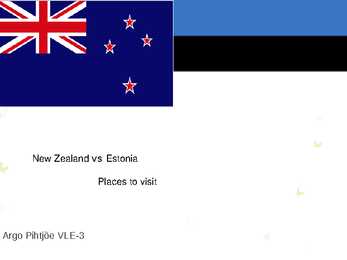
the east by Lake Peipus and Russia. Across the Baltic Sea lies Sweden in the west and Finland in the north. The territory of Estonia covers 45,227 km 2, and is influenced by a humid continental climate. The Estonians are a Finnic people, and the official language, Estonian, is a Finno-Ugric language closely related to Finnish, and distantly to Hungarian and to the Sami languages. The population of Estonia is 1.5 million. Of this number 62 per cent are Estonians. The geography of the land is surprisingly varied. Islands make up 9,2 per cent of Estonian’s total territory, the largest islands are Saaremaa, Hiiumaa and Vormsi. The highest point is Suur Munamägi, which is 317m high. Estonia has a surprisingly mild climate for an area so far north. Sea winds keep the weather from becoming very cold or hot. Estonia’s flag has three horizontal stripes. The blue stripe at the top of the flag represents the sky. The middle stripe of black stands for the land
On account of the country's proximity to the sea, the skies are often cloudy, and rain often falls in the spring and autumn, in the winter the rain turns to snow. The highest point in Estonia is Suur Munamäg It is in fact the highest point in the Baltic region Forest cover over one half of Estonia. The most common types of tree are pine, spruce and birch. Estonia, along with Finland and Sweden are the countries with the greatest percentage of forested land. Forest management and wood production are particularly important for the Estonian economy. One third of Estonian forests are protected areas. In these protected forests you can come across types of primeval forest cover, which have long ago disappeared from other parts of Europe. Examples of such primeval forests are the Järvselja forest in Tartumaa County and Poruni in Ida- Virumaa County. Meadows in Estonia are rich in different species much more so than in Western Europe.
You won't find large buildings or breathtaking architecture here, but an overwhelming sense of togetherness and plenty of cultural events, the majority of them geared towards younger people. Jõgeva town was born 130 years ago, thanks to the Tapa-Tartu railway: this is where the first train stopped and a village formed around the railway station. Just half a century later, Jõgeva earned its town rights. There are about 6500 people living in Jõgeva. Jõgeva events · The festival year in Jõgeva starts with a music festival dedicated to the tragic Estonian composer Alo Mattiisen · In June, around mid-summer's day, when Estonia enjoys its white nights, Jõgeva town organises its "Helisev Suveöö" ("Sound of a Midsummer Night") festival, when music can be enjoyed all over the town, including in private gardens. · In July, the annual bikers reunion Jõgevatreff takes place this motorcycle and
The capital of Estonia is Tallinn. The currency used in Estonia is Eesti kroon. The Estonian national flag is blue-black-white. It was originally the flag of the Estonian Students' Society. The flag was first consecrated in Otepää Church in 1884. For a while, during the Soviet occupation, the flag was banned but it was again seen in public in Tartu in May 1988. The national flower is cornflower, the national bird is barn swallow and the national stone is limestone. The Estonian national anthem called "My Native Land, My Pride and Joy" was composed in 1848 by Friedrich Pacius. The Estonian language words were written by J. V. Jannsen. It was officially adopted after the War of Independence in 1920.The same melody with different words is also Finland's national anthem. The current coat of arms of Estonia is a golden shield which includes three slim, blue leopards (or lions) in the middle, with oak branches along the side of the shield
The Nigula Nature Reserve preserves the peat-bog ecosystem within its territory of 2771 hectares. Häädemeeste is one of the most important yacht-building centers in Estonia and also famous for its mineral water. The Island of Kihnu is the biggest island in the Gulf of Riga. There are some peculiarities in local dialect, dressing, folk songs and wedding customs. Saaremaa is the largest island in Estonia and is characterized by rare plants, windmills, thatched roofs, stone fenches and the hospitality of the local people. The islanders hold on to old traditions and take pride in their folklore. A road spans the strait between Saaremaa and Muhumaa. The biggest city on Saaremaa, Kuressaare, is a quiet green town with friendly unpolluted environment and it has been the biggest port trade centre. The old part of the town has been well restored in Baroque architecture style. Its sights include the Town Hall, the Episcopal castle and a Town Park
The county of Saaremaa Siiri Tabri Kaia Vask Saaremaa - an exciting island Saaremaa - the biggest island of Estonia is known as a good recreation place with unique nature and a lot of sights. Saaremaa has retained its uniqueness due to its location and insulation. Junipers, dolomite, windmills and the famous local home- brewed beer are considered the symbols of Saaremaa. Rich nature. Because of its mild maritime climate and soil rich in lime, Saaremaa has very rich flora and fauna. In Saaremaa a great number of Roman snails, rare butterflies and beautiful orchids can be found.
The small pillory (for smaller criminals) was fixed to the wall of the Town Hall. Both pillories were used when people were birched. The punishment was carried out by the hangman and his assistants and was considered a great shame and dishonour. The pillories were still in use in the 19th century. 72 peasants who had taken part in the disturbances of Kose-Uuemõisa in 1806, were birched in the small pillory (a number of them were later sent to Siberia). A round stone slab in the square signifies the place of the pillory. Town Hall Square was not a place of execution, but there was one exception. At the end of the 17th century a priest, being drunk in a pub, had killed the maid in anger. After that he went to the Town Hall and confessed to the crime. Usually murderers were hanged on the Gallows Hill, but he was sentenced to honourable death by the hangman's sword, as he " had been affected ", when he committed the crime. The priest was beheaded in the square
Lough Neagh which lies in the centre of Northern Ireland is thr UK's largest freshwater lake. The climate in the UK is variable. The weather changes so frequently that it is difficult to forecast. It is not unusual for people to complain that the weathermen were wrong. Fortunately there is no extreme weather conditions, it is never very cold or very hot. The first inhabitants were Iberians and Celts who settled on the land and were often at war with each other. In AD 43 the Roman Emperor Claudius invaded, and made Britain a Roman province. They stayed for three hundred years, and built villas, roads and towns. Many Roman remains can be visited in Britain today. The Romans finally abandoned Britain in AD 410 and a long period of invasion by Nordic peoples (from northern Germany and Scandinavia) started. The Angles, Saxons and Jutes
Sweden, German and Russia. The clock of liberty, 2004. Kiek in de Kök ● The cannon tower, founded in 1475-1483. Kiika kööki, peek into the kitchen, from up there it was possible to peek into the enemy’s kitchen. The walls are 4 m thick, can see the cannons stuck in there. Tallinn City Museum. ● Town Wall (Unesco) - one of the greatest towers of Tallinn’s Town Wall, Old Town declared the UNESCO World Heritage Site in 1997 Toompea ● Toompea is a limestone hill in the central of Tallinn. It towers about 30-40 metres above the surrounding areas. According to the legend, its the tumulus moundn over the grave of the national hero Kalev, erected stone by stone by his grieving wife Linda. While we don’t want to question this wonderful theory, there is an alternative version which says that Toompea is just a naturally formed limestone hill.
Introduction Tallinn, the capital city of the Republic of Estonia and of the Harju county, is a town in North Estonia on the coast of the Gulf of Finland. It has nearly half a million inhabitants and covers an area of almost 160 sqkm. It is also an important economic and cultural centre and one of the main ports in the Baltic States. Tallinn is one of the oldest cities on the Baltic Sea. It is unique for its well-preserved architecture from the 13-15 centuries. In contrast to the ancient town-walls and towers, Tallinn of today offers modern hotels, restaurants, sport and cultural centres. Every five years national song and folk dance festivals take place in Tallinn. The yachting regatta of the 1980 Moscow Olympic Games was held at Pirita. History Tallinn means in English "Danish town". The place is believed to have been settled by Finno-Ugric people about 2500 BC
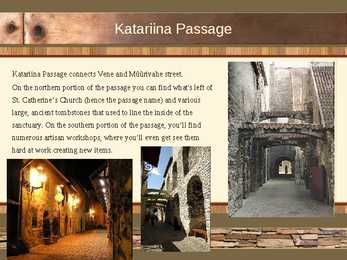
hard at work creating new items. City wall Tallinn's medieval city wall is a sub-facility that was built to protect the lower Tallinn and upper Tallinn (Toompea). The building of the city wall began in 1310th years, and by improving over time it formed the city wall with defensive buildings (towers). It was finished by the end of the 1561. Then it was 2.35-kilometer-long circular wall, which had 27 wall gate, 8 tower gate and 21 other stone fortifications. Many parts of the town wall have survived until today Great Coastal Gate (Suur Rannavärav) and Fat Margaret's Tower (Paks Margareeta) Great Coastal Gate (Suur Rannavärav) and Fat Margaret's Tower (Paks Margareeta) are located on the north end of Pikk Street. The Great Coastal Gate and Fat Margaret's Tower are two of Tallinn's most remarkable and outstanding defensive constructions. The gate and tower were built to protect the
Estonia. Estonia, officially the Republic of Estonia is a country in Northern Europe. It is the smallest of the three Baltic countries. Estonia has land borders with Latvia (339 km) to the south and Russia (229 km) to the east. It is separated from Finland in the north by the narrow Gulf of Finland and from Sweden in the west by the Baltic Sea. Estonia has been a member of the European Union since May 1, 2004 and of the NATO since March 29, 2004. The area of Estonia is about 45000 square kilometres and the population is about 1.4 million people. The capital of Estonia is Tallinn and the official language is Estonian
might have taken place in the year 1892, but actually, the two men never did meet. A copy of the sculpture was given as a gift from the town of Tartu to the Irish city of Galway in 2004. Father and Son The bronze sculpture, "Father and Son", created by sculptor Ülo Õuna (1944-1988), was placed on Küüni Street, on Children's Day ('childrens protection day'), 1 June 2004. Bridges Tartu Stone Bridge In the 18th century the first stone bridge in the Baltics was built at the end of the Town Hall Square, with two triumph arches and a lifting centre, which was dedicated to Catherine II and was opened for traffic in 1784. The bridge was destroyed in World War II, now it can only be admired by way of the model bridge, which was created in 2004. Tartu was hit by a great fire in 1775, during the course of which a large part of the city center burned down. Catherine II
professional, classic yet innovative With eclectic neighborhoods and - San Francisco takes its numerous landmarks, London paradoxical qualities in stride, requires several days (if not years) boasting diverse cultural enclaves. to get to know. That said, your Neighborhoods like Nob Hill, inaugural visit (as you will certainly the Castro and the Mission be coming back for more) should District offer unique experiences include trips to the Tower of for every traveler. Yet, there are London, the National Gallery, and several monuments that you can't the British Museum. But if you miss, such as the cable have more time, hit up Portobello cars, Fisherman's Road and Borough Market to Wharf andAlcatraz. And, of appreciate the local culture. course, the city's crowning
Tallinn, later on renamed Kadriorg after Empress Catherine I. The jubilee season is launched by the exhibition "The Palace and Its Story", spotlighting authentic objects, documents, works of art, blueprints and pictures, thus illustrating the historic layers of the palace and entertaining the visitors with the air of the past centuries. Collection The collection contains over more than 900 Western European and Russian paintings from 16th to 20th centuries, about 3,500 prints, over 3,000 sculptures and gems, and about 1,600 decorative arts objects (historic furniture, porcelain, glass etc.). The foreign art collection of the Art Museum of Estonia was founded already in the first years of the museum. In subsequent years, new works have come to the museum mostly as purchases or donations. The works in the exhibition of the museum are arranged according to the various schools of different countries. About 100 paintings attributed to the 16th-18th century masters from the Netherlands school
Celtic and Glasgow Rangers. Scotland has a very picturesque landscape. It may be divided into two parts: the Lowlands (an are of gentle hills, fields and woodlands, more densely populated than other parts, they also include plenty of wild upland country) and the Northern Highland (which are considered by many people, especially mountain-lovers, to be the most beautiful part of Scotland and a real tourist Mecca; they say that there may even be small patches of land on which nobody has ever set foot). Britain's highest peak, Ben Nevis (1343 m) lies not far from Fort Williams. The Scottish flag has a white cross on a blue background. It is also on the Union Jack. Northern Ireland is the smallest part of the UK as it only covers about 5500 square kilometres. About half of the 1.7 million inhabitants live in or around Belfast, the capital, in the eastern coastal region.
My Town I live in Tallinn. It's the capital and main seaport of Estonia. Tallinn is a very beautiful city that lies on the Baltic Sea. It covers 158 square kilometres. The Mayor of Tallinn is Jüri Ratas. The population of our capital is about 400000 people. About 55% of them are Estonian, 37% Russians and the other 8% are from different nations. The people here are mostly engaged in industry- mainly the food industry (23%), trade (16%) and transport and communication (14%). History. Tallinn has a great history. It was first marked on a map of the world by the Arab geographer al-Idrisi in 1154, its name then being Kolyvan. In the 13 th- century chronicle of Henricus de Lettis the town was called Lyndanise. Then it was called Reval for some time and finally Estonians started to call the town Tallinn from Taanilinn (Danish town) after the Danish conquest in the 13th century. The Knights of the Sword took Tallinn from the Dane
is an outdoor stage for summer plays. Lai 23 is a typical merchant`s house in the Late Gothic style. It is a two-room building, the so- called diele-dornse house, in which a vestibule diele is a bigger room at the street side and a smaller living-room dornse stands behind it in the depth of the yard. 6 The central room in the house's street side part was a large, high-ceilinged entrance hall with a small kitchen under a mantle chimney. This type of chimney was unique to medieval homes, with a bottom section that widened to create a square space that would define the outlines of the small kitchen beneath it. The house also had one heated living room and several unheated rooms, basement rooms, and rooms upstairs for the storage of goods. The entrance hall typically had a higher ceiling than the adjacent rooms, as well as a staircase leading to the upstairs rooms. Goods were usually hoisted to the upper floors directly from the street with the
TOOMPEA Toompea (from German Domberg – Cathedral Hill ) is a limestone hill with an area of about 7 hectares in the central part of Tallinn. It towers about 30-40 m above the surrounding areas. According to the legend it´s the tumulus mound over the grave of the national hero Kalev, erected stone by stone in his memory by his grieving wife Linda. It is the birthplace of Tallinn - a place where in 1229 the Knights of the Sword built a fortress instead of the wooden Estonian stronghold. Toompea Castle is also one of the most potent symbols of the reigning power. Today Toompea is the seat of the Government of Estonia as well as the Riigikogu, both of which are often simply colloquially referred to as Toompea. For centuries there was only one access to Toompea - Pikk Jalg - but there is also
defeated in the same year at the Battle of Lipany. Following Sigismund's death, George of Podbrady (Jií z Podbrad) ruled as Bohemia's one and only Hussite king, from 1452 to 1471, with the backing of Utraquist forces. He was centuries ahead of his time in suggesting a European council to solve international problems by diplomacy rather than war, but he couldn't convince the major European rulers or the pope. After George's death two weak kings from the Polish Jagiellonian dynasty ruled Bohemia, though real power lay with the Utraquist nobles, the so-called Bohemian Estates. INDEPENDENCE Czechs had no interest in fighting for their Austrian masters in WWI, and neighbouring Slovaks felt the same about their Hungarian rulers. Many defected to renegade legions fighting against the Germans and Austrians. Meanwhile Tomás Garrigue Masaryk, Edvard Benes and the Slovak Milan Stefánik began to
Topic Australia Tallinn English College 2006 Australia 1 . Introduction The name Australia is derived from the Latin Australis, meaning of the south. In land area, Australia is the sixth largest nation, its territory is 7,686,850 sq km and its population reaches today over 20,5 million people. It is the only nation to govern an entire continent and its outlying islands. Australia's capital is Canberra, the only city with its own territory. It was built in the early 1900s just to be the capital. The official language is English and the official name of Australia is the Commonwealth of Australia.
Japanese festivals Japanese festivals are traditional festive occasions. Some festivals have their roots in Chinese festivals but have undergone dramatic changes as they mixed with local customs. Some are so different that they do not even remotely resemble the original festival despite sharing the same name and date. There are also various local festivals (e.g. Tobata Gion) that are mostly unknown outside a given prefecture. It is commonly said that you will always find a festival somewhere in Japan. Matsuri is the Japanese word for a festival or holiday. In Japan, festivals are usually sponsored by a local shrine or temple, though they can be secular. There is no specific matsuri days for all of Japan; dates vary from area to area, and even
 annaabi.ee