Leidsid 33 sarnast õppematerjali, mis on seotud failiga "Inglismaa pühad". Need materjalid aitavad sul teemat sügavamalt mõista.
course, irish, british, tradition, since, english, trick, king, dance, other, include, heart, figure, patrick, holiday, 17th, activities, such, april, jokes, commonwealth, royal, hill, carnival, street, observed, fawkes, parliament, february, 14th, lovers, express, cards, valentine, symbols, outline, cupid, march, alike, green, songs, drink, kids, craftsHadrian’s Wall is an ancient wall which was built in 2nd century by Hadrian, the emperor of Rome from AD 117 to 138, and it marked the northern border of the Roman Empire in Britain. The wall was 80 Roman miles (117 kilometres) long and it is situated in northern Great Britain and stretched from Solway Firth in the west to the Tyne River near Newcastle in the east. It was built to keep the Caledonians of Scotland out of England. Windsor Castle, which is one of the official residents of British monarch, is located in the English country of Berkshire. It is the largest in habited castle in the world and the oldest in continuous occupation, since it dates back to the time of William the Conqueror. The castle’s area is approximately 484,000 square feet (44, 955 square metres). The castle has been garrison fortress, home, official palace and sometimes prison for most of the Kings and Queens of England/Great Britain. During the war, the castle has been heavily fortified but
1. The Queen’s official title. Elizabeth the Second, by the Grace of God, of the United Kingdom of Great Britain and Northern Ireland and of Her other Realms and Territories Queen, Head of the Commonwealth, Defender of the Faith. 2. The Queen’s working day. Starts after breakfast. Reads the newspapers which are prepared by the Press Secretary, and a report on the previous day’s proceedings in the Parliament and the letters she receives. Also phone calls. Once a month she attends the Privy Council in order to give Royal Assent to various items of government legislation.
order to sneak into the castle. But, alas, the lord of the manor's son discovers the deception. He is overcome by jealous rage and orders his men to seal the girl inside the thick stone walls while still alive. Turned into an incarnation of undying love, the White Lady now appears every August, on the night of the full moon, in the Dome Church chapel window. Haapsalu is seven-and-a- quarter centuries old this year, and the townsfolk intend to make it a celebration to remember. The annual dance and light show dedicated to the Lady alone involves over 100 performers - and you'll have several chances to catch it over the four days of the event. Musical shows, dances and contests of strength and skill will be held all over town. This festival is held in August and it is said that Haapsalu, Estonia's most famous ghost, appears during this festival Black nights film festival http://www.tourism.tallinn.ee/fpage/events/newwinprint/ Beerfestival ( Õllesummer)
Officials were appointed (governors, procurators to collect taxes, look after the estates and mines and se that the gold, silver, iron and lead were exported back to Rome). Introduced schools,a new language Latin, large farms (villas), baths. In AD 410 they had to leave . roman occupation lasted nearly 400 years. They left behind very little. Roman province of Britannia covered most of present-day England and Wales. 4. Latin influence on English *The influence of Latin is noticeable also in the names of European cities: the Latin noun colonia (settlement, colony) may be found in numerous place-names: Lincoln, Colchester, Cologne ; from Latin word castrum (military camp) were derived English affixes -chester and -castle: Manchester, Lancaster, Newcastle; Latin word portus (seaport) in Portsmouth *-tor - person, doer, masculine form. The suffix is attached to the stem: victor (`winner', from the
And the paintings and carvings are increaslibly falling victim to vandalism: they have been painted over, spoilt with knives, even used for target practice. The American Rock Art Research Association protects rock-art sites. 2) THE FAVOURITE SPORT IN BRITAIN The most popular sport is probably football. Two kinds of football is played in Great Britain. One of them, which is called association football, is played all over Europe. The other kind: rugby football is also very popular in New Zealand, France, and some other European countries. English boys play it at school, and in public parks. When they grow up, they play as members of important amateur teams or as a professional in teams competing in football ,,leagues". Professional football is as much a business as a sport. Rugby football was first played in 1823. In rugby every player is allowed to carry the ball. The ball is oval, not round. Each team contains 15 players
The Romans gave us a language based on Latin, the calendar, law and legal system, the census and also straight roads, central heating and concrete. Anglo- Saxons around AD 400 Anglo- Saxons were warrior farmers from Germany, Denmark and the Netherlands. Later in the 5th century, Anglo-Saxons settled just west of Londinium, around the Strand, and formed the town of Lundenwic. The area of the old Roman city became a landing-place for ships and a centre for trade.The first English King to convert to Christianity, King Ethelbert, founded St Paul's Cathedral in 604. The Vikings 8th and 9th century By the 9th century, London was a very prosperous trading centre, and its wealth attracted the attention of Danish Vikings. The Danes periodically sailed up the Thames and attacked London. In 851 some 350 longboats full of Danes attacked and burned London to the ground. King Alfred the Great totally defeated the Danes in 878 and they split the country between them
Alberta is rich in natural resources such as oil and natural gas. In Quebec and Ontario are many manufactories and industries. In the west there is maritime climate and so they fish and ship there. Toronto is the biggest city in Canada, with a population of 5,1 million people. It is followed by Montreal with 3,9, Vancouver, Ottawa (which is the capital of Canada) 800 000 and Quebec with 700 000. Government Canada is a federation of ten provinces (Alberta, British Columbia, Manitoba, New Brunswick, Newfoundland and Labrador, Nova Scotia, Ontario, Prince Edward Island, Quebec, and Saskatchewan) and three territories (Northwest Territories, Yukon, and Nunavut). Formally considered a constitutional monarchy, Canada is governed by its own House of Commons. While the governor-general is officially the representative of Queen Elizabeth II, in reality the governor-general acts only on the advice of the Canadian prime minister.
Halloween also known by Halloween or All Hallow's Eve is an annual holiday observed around the world on October 31, the night preceding All Saints Day. Typical Halloween activities include trick-or-treating, attending costume parties, carving jack-o'-lanterns, lighting bonfires, apple bobbing, visiting haunted attractions, playing pranks, telling scary stories, watching horror films, as well as praying and attending vigils or church services.Trick-or- treating is a customary celebration for children on Halloween. Children go in costume from house to house, asking for treats such as candy or sometimes money, with the question, "Trick or treat?" The word "trick" refers to a "threat" to perform mischief on the homeowners or their property if no treat is given .Halloween costumes are traditionally modeled after supernatural figures such as monsters, ghosts, skeletons, witches, and devils.Because the holiday comes in the wake of the annual apple harvest, candy apples, caramel or taffy apple
road signs All speed limit signs in the Republic changed to the metric system in 2005. Some direction signs still show distance in miles so tourists often mix them up. There are usually about 10 signs or more on one post , and its really hard to see them when driving, so tourists disturb traffic quite often when slowing down to read the signs All the signs are multilingual ,due to high percentage of English speakers Forests Ireland has only about 8 % of his whole land covered with forests. Centuries ago people cut the forests and didn't think about the future so nowadays there is mostly peat ( turvas) which Ireland uses to produce energy. Economy Ireland had a big economic boom in the late 20'th century, but now the Republic of Ireland is ranked the second wealthiest per capita country in the European Union. Education in Ireland is free at all levels, including college.
island situated to the northwest of Continental Europe. It is the ninth largest island in the world, the largest European island, and the largest of the British Isles. With a population of about 60.0 million people in mid-2009, it is the third most populous island in the world, after Java and Honsh. Great Britain is surrounded by over 1,000 smaller islands and islets. The island of Ireland lies to its west. Politically, Great Britain may also refer to the island itself together with a number of
SOCIETY AND CULTURE OF ENGLISH-SPEAKING COUNTRIES Introduction 1. Nowadays, English is so widely spoken that it can hardly be considered "a one nation's" language. The main countries where English is spoken are: the U.K, the U.S, Canada, Australia, the Republic of Ireland, New Zealand, West Indies 2. There are approx. 300-400 million speakers of English in the world. English occupies the 3rd place by its number of speakers; it is right behind Mandarin and Spanish. 3. ESL (English as a Second Language) used in your own country (e.g. India) EFL (English as a Foreign Language) used in a foreign country ESP (English for Specific Purposes) used in business, airlines, hotels etc. 4. Settlement colonies people migrated into them from Britain and started their own
Valentine's Day Saint Valentine's Day is an annual holiday held on February 14 celebrating love and affection between intimate companions.The holiday is named after one or more early Christian martyrs named Valentine and was established by Pope Gelasius I in 496 AD. It is traditionally a day on which lovers express their love for each other by presenting flowers, offering confectionery, and sending greeting cards .. The holiday first became associated with romantic love in the circle of Geoffrey Chaucer in the High Middle Ages, when the tradition of courtly love flourished.hModern Valentine's Day symbols include the heart-shaped outline, doves, and the figure of the winged Cupid. Since the 19th century, handwritten valentines have largely given way to mass-produced greeting cards
Changing the Guard · Perhaps the epitome of London's surviving pageantry can be found in the ceremonial Changing of the Guard. · A hugely popular spectacle, the Changing of the Guard takes place at a range of royal locations in and around · London daily during the summer and on alternate days for the rest of the year. · There is no ticketing, so make sure you get there early. · Ever since 1660 Household Troops have guarded the Sovereign Palaces. · The Palace of Whitehall was the main residence until 1689 and was guarded by the Household Cavalry. · The court moved to St James's Palace in 1689 and when Queen Victoria moved into Buckingham Palace the Queen's Guard remained at St James's Palace and a detachment guarded Buckingham Place, as it does today. Trooping the Colour
Valentine's Day is a holiday, which is celebrated on the 14 th February. This holiday is named after a priest Valentine. The holiday is celebrated almost everywhere around the world. It is the traditional day on which lovers express their love for each other, sending cards. On this day people show how much they care about their friends. Usually on this day people gift hand-made cards and roses. Nowadays people can also send e-cards. Modern Valentine symbols include the heart-shaped outline and the figure of the winged Cupid. The traditional Valentine's colours are pink and red. On that day people should were pink and red clothes. In different countries there are different traditions on Valentine's Day. History
London is the capital of both England and the United Kingdom, and the largest metropolitan area in the European Union. An important settlement for two millennia, London's history goes back to its founding by the Romans. Since its foundation, London has been part of many movements and phenomena throughout history, including the English Renaissance, the Industrial Revolution, and the Gothic Revival.The city's core, the ancient City of London, still retains its limited medieval boundaries; but since at least the 19th century, the name "London" has also referred to the whole metropolis that has developed around it. Today the bulk of this conurbation forms the London region of England and the Greater London administrative area, with its own elected mayor and assembly. London is one of the world's most important business, financial and cultural centres and its influence in politics, education, entertainment, media, fashion and the arts contributes to its status as a major global city
Decide which word best fits into each gap. Write a correct letter (A-L) into the appropriate gap. There is one extra word that you do not need. An example (0) has been done for you. The Notting Hill Carnival Dancing policemen, steel drums, street stalls, sound systems and Rastas. This can only mean one thing: The Notting Hill Carnival. The biggest street festival in Europe takes place every year on the August (0) __I__ as two million people gather in west London to eat, drink and dance to music. What was once started by a small group of dedicated Trinidadian steel drummers in the 1960s is now one of the biggest (31) ____ festivals in the World. The festival has something for everyone. There are over 45 licensed stages each (32) ____ with hundreds of speakers that compete with each other for your attention. They play every kind of music under the sun (33) ____ Drum & Bass, Hip Hop, Garage, Reggae, Funk, Jazz and Soul.International stars have also (34) ____ on Notting Hill's
They called what they had found New Holland, but made no attempt at settlement. In 1770, James Cook sailed there, mapping the east coast of Australia, which he named New South Wales and claimed for Britain. Britain started sending its convicts to the place now called Sydney, and they established the colony of New South Wales. This day is celebrated as Australia's national day, Australia day. Most of the people there are of British origin, with a culture and outlook similar to the UK and USA. In 1901, five colonies became states linked by one federal government the Commonwealth of Australia. English is the official language, and is spoken and written in a distinct variety known as Australian English. It is believed that there used to be around 200-300 Australian Aboriginal languages, when Europeans first came to the country. Now there are about 70, with all but 20 being endangered.
LANDMARCS HYDE PARK: Hyde Park is one of the largest parks in central London, England and one of the Royal Parks of London, famous for its Speakers' Corner. The park is divided in two by the Serpentine. The park is contiguous with Kensington Gardens; although often still assumed to be part of Hyde Park, Kensington Gardens has been technically separate since 1728, when Queen Caroline made a division between the two. THE TOWER OF LONDON: Her Majesty's Royal Palace and Fortress, more commonly known as the Tower of London (and historically as The Tower), is a historic fortress and scheduled monument in central London, England, on the north bank of the River Thames. It is located within the London Borough of Tower Hamlets and is separated from the eastern edge of the City of London by the open space known as Tower Hill
Society and culture of english-sspeaking countries Introduction 1. The countries of the world where the English language is spoken. 2. Approximate number of mother tongue speakers of English approximately 350-400 million native speakers. Which place does English occupy in the world by its number of speakers?After which language? English occupies second place by its number of speakers after Mandarin Chinese. 3. What is the difference between English as a Second Language, English as a Foreign Language and English for Specific Purposes? Give examples of situations where they are used. English as a Second Language (ESL or TESL) is a traditional term for the use or study of the English language by non-native speakers in an English-speaking environment. That environment may be a country in which English is the mother tongue (e.g., Australia, the U.S.) or one in which English has an established role (e.g., India, Nigeria)
usually related to the rice harvest. Notable matsuri often feature processions which may include elaborate floats. Preparation for these processions is usually organized at the level of neighborhoods, or machi. Prior to these, the local kami may be ritually installed in mikoshi and paraded through the streets. One can always find in the vicinity of a matsuri booths selling souvenirs and food such as takoyaki, and games, such as Goldfish scooping. Karaoke contests, sumo matches, and other forms of entertainment are often organized in conjunction with matsuri. If the festival is next to a lake, renting a boat is also an attraction. Favorite elements of the most popular matsuri, such as the Nada Kenka Matsuri of Himeji or the Neputa Matsuri of Hirosaki, are often broadcast on television for the entire nation to enjoy. Some examples of famous matsuri are the Jidai, Hadaka Matsuri, Aoi and Gion Matsuri held
It is about the men (and women) who lost their lives fighting in the World Wars. It's celebrated then, because that's the day WWI was ended with a treaty. 4. Which powers does the Queen of the UK have? The Queen has to sign all the bills for them to pass. She is the one who opens the Parliament every fall for the next session. She is however more of a representative than an actual decision maker these days. 5. What is the British Parliament made up of? What are their roles? It's made of 3 parts: the monarch, the House of Commons and the House of Lords. The House of Lords can ask the House of Commons to rewrite parts of the bill. The bill needs the Queen's signature to pass. The House of Commons writes the bills. 6. What do you know about the Wars of the Roses? It was a war between two families, one had a red rose as their symbol and the other had a white rose as their symbol
The Dreaming is the Aboriginal creation story. Aborigines believe that at the beginning of time the world was a shapless mass of nothing, waitng to be transformed into what we see today. Every major geographical feature in australia has an aboriginal story to explain it. The Dreaming gets very abstract, it turns almost into another dimension. Aborigines beleive that they are constantly living in the Dreaming and that every time they do something they leave an impression on the other reality that is the Dreaming . Present Day Today the Aborigines are in trouble. Many have left the their traditional lifestyle, and have moved to suburbs. There is a 40% unemployment rate in many Aborigines populations, in part because Aborigines are widely discriminated against which causes some people not to hire them. Even the police and government discriminate against aborigines. In many places bars are segregated into different parts for Aborigines or
But it not seems so easy for everybody, Piggott Bros, the Society's tent contractors, were clearly horrified by the timetable. It would be impossible to put up the tents in 14 days; they needed 28. Considering that Chelsea Flower Show now takes at least 18 months to organize, the RHS was running a tight schedule if it was to be ready in time. At the end of April, a Press luncheon was arranged for Monday, 19 May (a tradition that continues to this day). With only a fortnight to go until the Show opened, the committee agreed that bath chairs should be allowed in, from 9am to 12 noon on the second day, for five shilling extra. Finally Chelsea successfully opened on Tuesday 20 May 1913, for three days. Curiously there is no Council report on how this Show actually went. The Gardner's Chronicle, which provided the best written records of the early Shows, was more forthcoming
BRITISH NATIONAL SYMBOLS Research work CONTENTS CONTENTS.....................................................................................................................................2 INTRODUCTION............................................................................................................................3 1. BRITISH NATIONAL SYMBOLS..............................................................................................5 1.1 Great Britain and British story................................................................................................5 1.2 National Symbols and Nation Building..................................................................................5 1.3 The Use of Flags throughout History.....................................................................................6 1.4 The Early Modern Flags. United Kindom: Union Jack..........................................................8 1
1. What are the capitals of the 4 constituent countries? England- London; Northen Ireland- Belfast; Scotland- Edinburgh; Wales- Cardiff 2. Order the invaders in correct chronological order: Anglo-Saxons, Normans, Romans, Celts. Romans Anglusaxons , Norman 3. How did the Celts influence Britain? Language. Wars. Engand and Scotland eventually became 1 contry 4. How many people approximately speak English? Approximately 600 million 5. Who (which tribes) gave the base of the English language?Germanic tribes- Anglo-Saxons. 6. Describe Wales.- Wales is a mountainous country on the western side of Great Britain. The national game of Wales is Rugby. Flag- Red dragon on a green and white field. They have their own language Cymraeg ( Welsh) . Anthem- Land Of My Fathers. Official animal- Dragon. There used to be a lot of coalmines. 7
A.D. Romans occupied Britain for four centuries. The Roman way of life all vanished after the invasions from Northern Europe by the Angles, Saxons and Jutes from the 5th century onwards. They ruined Londinium, but they were easily turned into Christianity and religion became more and more important. The Vikings, who came in the 9th century, first raided England to plunder it, but then they decided to stay. In the 10th century England fell under Danish Rule, with King Canute finally managing to unite the Anglo-Saxons and Danes at the beginning of 11th century. Medieval England After defeating the Anglo-Saxon King Harold at the Battle of Hastings in 1066, William of Normandy (who became William I, also called William the Conqueror) introduced the Norman feudal system, rewarding his French-speaking followers with land in return for their continued support. French remained the language of the upper classes and administration until the 14th century.
Introduction The name Australia is derived from the Latin Australis, meaning of the south. In land area, Australia is the sixth largest nation, its territory is 7,686,850 sq km and its population reaches today over 20,5 million people. It is the only nation to govern an entire continent and its outlying islands. Australia's capital is Canberra, the only city with its own territory. It was built in the early 1900s just to be the capital. The official language is English and the official name of Australia is the Commonwealth of Australia. Australia is located on the Southern Hemisphere (because of that Australia is also called "A land down under"). 2 . Geographical position Australia is an island continent and it is located between the Indian and South Pacific oceans south east of Asia. From the north it is bordered by the Timor Sea and the Torres Strait. From the east by the Coral Sea
The United Kingdom and London United Kingdom is a political name of the United Kingdom of Great Britain and Northern Ireland. These political names include the countries of England, Scotland and Wales. Every country has its own capital and language. The capital of England is London, the people there are english and the language spoken is English. In scotland live the scots, capital is Edingburg and the languages spoken are English and Scottish. The capital of Wales is Cardiff, the people tehre are welsh and the languages spoken are welsh and English. N. Ireland is the home for the Irish, the capital is Belfast and the language is Irish. The first inhabitants were Iberians and Celts who settled on the land and were often at war with each other. In AD 43 Britain was made a Roman province. The romans stayed there for three hundred years. After the romans left came the Angles, Saxons and Jutes. Angles
priesthood, given responsibility by Christ to govern, teach and sanctify the Body of Christ, members of the Faithful. Priests, deacons and lay ministers cooperate and assist their bishop(s) in shepherding a flock. Vicar/ priest is a representative, deputy or substitute; anyone acting "in the person of" or agent for a superior (compare "vicarious" in the sense of "at second hand"). Linguistically, vicar is cognate with the English prefix "vice", similarly meaning "deputy". Minister In Christianity, a minister is someone who is authorized by a church, or other religious organization, to perform functions such as teaching of beliefs; leading services such as weddings, baptisms or funerals; or otherwise providing spiritual guidance to the community. The term is taken from Latin minister ("servant", "attendant"), which itself was derived from minus ("less").[1] In Catholic churches, the concept of a priesthood is emphasised
Halloween Halloween is a holiday in many English speaking countries that is celebrated on the night of October 31st. Children wear costumes and they go to peoples' homes saying "Trick or treat!" to ask for candy, sweets. This practice originally involved a threat. A threat is when someone says that they will do something bad if they do not get what they want. In this case the threat could be explained as: "Give me a treat or I will play a trick on you." Children today usually do not play tricks if they do not get treats. However, some children still get up to mischief (pranks or things to make fun of people; like putting toilet paper in trees; writing on windows with soap or throwing eggs at peoples' houses). People sometimes dress up as ghosts, witches, goblins and other scary things for Halloween. A jack-o-lantern is typically a carved pumpkin. It is associated chiefly with the holiday of Halloween
Mardi Gras in the USA Mardi Gras, from the French words meaning "Fat Tuesday," combines religious tradition with a carnival or festival to welcome spring. It is also called Shove Tuesday or Pancake Day (in UK pancakes have an important role in celebrating Mardi Gras). Mardi Gras is the final day of Carnival- a festival season. Carnival begins 12 days after Christmas on January 6 and ends on Mardi Gras, which always falls exactly 47 days before Easter. The date of Mardi Gras changes every year. In the year 2008 it is on the 5th of February.
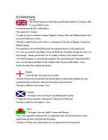
1) General facts The UK: * the United Kingdom of Great Britain and Northern Ireland was formed in 1801 * it covers 243,610 sq km * everybody from the UK is called British * the capital city is London * is made up of four constituent countries: England, Scotland, Wales and Northern Ireland which in turn are divided into counties * the flag is called the Union Jack which is a combination of the flags of England, Scotland and Northern Ireland * the population is about 60,000,000 people, the population density is 242 people/sq km * its coasts are washed by the Atlantic Ocean, the North Sea, the English Channel, the Celtic Sea,
1. Society- people who interact in such a way as to share a common culture. The cultural bond may be ethnic or racial or geographical, based on gender, or due to shared beliefs, values, and activities. 2. Culture- beliefs, behaviors, objects, and other characteristics common to the members of a particular group or society. 3. A unitary state- a state governed as one single power in which the central government is ultimately supreme and any administrative divisions (subnational units) exercise only powers that their central government chooses to delegate. The majority of states in the world have a unitary system of government. 4. A federal state-- a political entity characterized by a union of partially self-
 annaabi.ee