History of Estonia Elina, Rasmus, Joosep Pre-history The Mesolithic Period The Neolithic Period The Bronze Age The Iron Age Early Middle Ages Click to edit Master text styles Second level Third level Fourth level Fifth level Counties of Ancient Estonia The Middle Ages Danish Estonia Swedish Coastal Settlements Terra Mariana The Reformation Period Division of Estonia in the Livonian War PolishLithuanian Commonwealth Estonia in the Swedish Empire Estonia in the Russian Empire Age of Enlightenment National Awakening Road to Republic Occupation of Estonia by German Empire. United Baltic Duchy Declaration of Independance As a result of the availability of education Age of awakening Red Army's retreat and arrival of German troops in Pärnu on 23 February in Tallinn on 24 February 1918 Independence (1918-1939) Tartu peace treaty in 1920 First recognized by Finl...
The History of Estonia 8000 BC traces of first settlement at Pulli 3000 BC Finno-Ugric tribes arrive 1st cent AD Estonians mentioned in written records by Tacitus 1030 first written mention of Tartu 1154 first written mention of Tallinn, map of Estonia 1219 Danish invasion by the Teutonic Order 13th century German invasion by the Livonian Order 1343 St George's Night uprising 15th century serfdom begins to develop 16th century Reformation 1558.1583 The Livonian War between Sweden, Poland, Denmark, Russia 1629.1710 Swedish era 1700.1721 The Northern War, Russian invasion 1860.1885 era of national awakening 1918.1920 the War of Independence 1918.1940 the Republic of Estonia 1940.1941 first Soviet occupation 1941.1944 German occupation, World War II 1945.1991 second Soviet occupation 1991 the Decla...
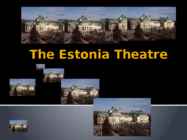
The Estonia Theatre The location Estoniatheatre is situated in the centre of Tallinn. Theatre Estonia winter garden The history The Estonia Theatre is an opera house and concert hall in Tallinn, Estonia. The Jugendstil building was designed by Finnish architects Armas Lindgren and Wivi Lönn. It was built as a national effort with the leadership of Estonia society in 1913 and was opened to the public on 24 August. At the time, it was the largest building in Tallinn. The opera house was heavily damaged in the Soviet air raid on Tallinn on 9 March 1944. It was reconstructed in a classical and Stalinist style, and reopened in 1947. Thebuilding has two large auditoriums in two separate wings. It now houses the Estonian National Opera and the Estonian National Symphony Orchestra. A chamber hall was opened in 2006. Speciality In2003 a new multipurpose chamber hal...
Pirita Convent Anete Samelselg 10th grade About the convent It was founded by St. Birgitta in 1412 and consercrated in 1436. The area is 1360 square meters. It was the biggest church building in the Middle aged Estonia. Name Pirita is orginated from St. Birgitta. The idea and construction The history of the the Pirita Convent dates back to the 15 century. The idea to found a convent in Tallinn, the capital of Estonia, was initiated by some Tallinn merchants already in 1400. Building plot was donated from Livonian Order. The building were built in two different parts. One for nuns and one for monks. Church in the middle and it was used by both. St. Birgitta rules In the convent have to live both - nuns and also monks. Nuns and monks were seperated and did not see each other at all. The Convent could not have more than 85 members 60 sisters and 25 brothers. The leader of the co...
The most important key dates in Estonian history Every country has its history and some moments are more important than the others. Here are some of the most notable dates from Estonian history. 3rd millennium BC the Finno-Ugric tribes arrive in Estonia 1154 First written mention of Tallinn (by al-Idrisi) 13th century German and Danish invade Estonia. Estonians' numerous attempts to restore independence fail 1343 St. George's Night uprising 1558-1583 the Livonian War after which Northern Estonia is occupied by Sweden and Southern Estonia occupied by Poland 1632 Tartu University was founded 1860-1885 the era of national awakening, the foundation for Estonian journalism was laid, collection of folklore 1869 First all-Estonian Song Festival in Tartu 1884 The blue-black-and-white flag of Estonian Students' Society was consecrated ...
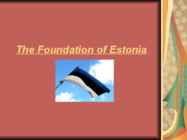
The Foundation of Estonia Estonia The history of Estonia The history of Estonia is a part of the history of Europe. Estonia was settled near the end of the last glacial era, beginning from around 8500 BC. Before the Germans invaded in the 13th century proto-Estonians of the Ancient Estonia worshipped the spirits of nature. Since the Northern Crusades Estonia became a battleground for centuries where Denmark, Germany, Russia, Sweden and Poland fought their many wars over controlling the important geographical position of the country as a gateway between East and West. Being conquered by Danes and Germans in 1227, Estonia was ruled initially by Denmark in the north, by the Livonian Order, an autonomous part of the Monastic state of the Teutonic Knights and Baltic German ecclesiastical states of the Holy Roman Empire. From 1418–1562 the whole of Estonia was part of the Livonian Confederation. A...
Report about Estonia Introduction The purpose of this report is to describe Estonia's. I'm going to write little about the geography, culture, Geography of Estonia Estonia has 4 neighbours Latvia, Sweden, Finland and Russia. Estonian land border with Latvia is 267 km, with Russia its 290 km. Estonia lies on the east of the Baltic Sea. Estonian highest point is the Suur Munamägi winces height is 318 m. Estonia has 3794 km of coastline. The number of islands is estimated around 1500 and two of the largest are called Saaremaa and Hiiumaa. Estonia is situated in the northern part of the temperate climate zone and in the transition zone between maritime and continental climate. Estonia has four seasons of near-equal length. Estonia has over 1,400 lakes. Most are very small, with the largest, Lake Peipus being 3,555 km2. Culture of Estonia The culture of Estonia incorporates indigenous heritage, as represented by the Estonian language and the...
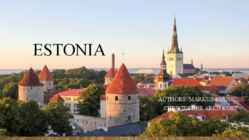
ESTONIA AUTHORS: MARKUS KUUSE, CHRISTOFHER ARKO KÖST FACTS ABOUT ESTONIA • Estonia is about 50% forest • Estonia has over 2000 islands • Estonia was the first country in the world to use online political voting. HISTORY • Humans settled in the region of Estonia near the end of the last glacial era • In the Middle Ages, Estonia became a battleground for centuries where Denmark, Germany, Russia, Sweden and Poland fought their many wars • Estonians declared their independence in February 1918 RECENT HISTORY • In 1940, the Soviet Union occupied Estonia • Nazi Germany occupied Estonia in 1941; later in World War II the Soviet Union reoccupied it (1944). GEOGRAPHY • The two largest islands are Saaremaa and Hiiumaa • The highest point in Estonia is Suur Munamägi ESTONIA CITIES • Capital: Tallinn • Tartu • Pärnu TALLINN • The capital of Estonia • Reval, Lindanise • Old town TARTU • Second larg...
Report Theatres of Tallinn Student: Supervisor: Tallinn 2008 Table of Contents Table of Contents........................................................................................................................2 Introduction.................................................................................................................................3 The Estonia National Opera........................................................................................................4 Russian Drama Theatre...............................................................................................................5 Tallinn City Theatre.................................................................................................................... 6 Estonian Drama Theatre....................................
Estonia Tjorn Treu KP-31 Information · Area- 45,227 km2 · Population- 1,282,963(2011 july) · Location- Baltic Region of Northern Europe · Capital- Tallinn · Main cities- Tallinn,Pärnu,Tartu,Narva · Official Language- Estonia · Political structure- democraic republic National symbols Flag- Coat of arms- Anthem-"My Fatherland, My Happiness and Joy,, Plant-cornflower Bird-chimney swallow Stone-slate Tree- Oak History DATES Independence Day (Iseseisvuspäev) - February 24 May Day (kevadpüha) - May 1 National Flag Day (Eesti lipu päev) - June 4 Victory Day (võidupüha) - June 23 St. John's Day (Jaanipaev) - June 24 Day of Restoration of Independence (taasiseseisvumispäev) - August 20 history EVENTS Viljandi Folk Music Festival - July Ollesummer (Beer Summer) July The All-Estonian Song Festival (Laulupidu) takes place every five years in Tallin...
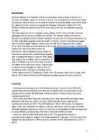
Estonia and what you know about it By Anšiel and Liza National symbols • The flag is blue, black and white horisontal lines, It represents the blue sky, the dirt, purity or snow. • The national bird is a swallow. • The national flower is a cornflower. History • The first settelments in Estonia came by supposedly about 11 000 years ago. • In the past most Estonians worshipped spirits of nature and their beliefs were seen as unholy by christian crusaders. Taara is believed to have been the name of the old Estonian god. • Starting with the Northern Crusades in the Middle Ages, Estonia became a battleground for centuries where many countries fought their wars over controlling the important geographical position of the country as a gateway between East and West, despite this the country has survived. • Estonia first got it’s independence in 1918 wich lasted 22 years. • The first president of Estonia during this period was Kon...
Estonia officially the Republic of Estonia, is a country in the Baltic region of Northern Europe. It is bordered to the north by the Gulf of Finland, to the west by the Baltic Sea, to the south by Latvia and to the east by Russia. Across the Baltic Sea lies Sweden in the west and Finland in the north. The territory of Estonia covers 45,227 km2, and is influenced by a humid continental climate. Estonia is a democratic parliamentary republic divided into fifteen counties, with its capital and largest city beingTallinn. With a population of 1.3 million, it is one of the least-populous member states of the European Union. The Estonians are a Finnic people, and the official language, Estonian, is a Finno-Ugric language closely related to Finnish The history of Estonia is a part of the history of Europe. Estonia was settled near the end of the last glacial era, beginning from around 8500 BC. Before the Germans invaded in the 13th century pro...
The Great Guild Liisbeth Kallakmaa The Great Guild Medieval Tallinn's social institutions were guilds and brotherhoods, whose main function was to provide members with social interactions and ensure their rights, but also played an important political and economic role. Tallinn had three important guilds - The Great Guild, St. Canute's Guild and St. Olaf's guild. The Great Guild was the youngest among them, founded in the 14th century, but soon became the biggest and most important. It was founded as an organization of the wealthiest merchants and shipowners. The name of the Great Guild was introduced in the late 15th century. There were close ties between the guild and the town rules: only members of the Great Guild had the right to belong to the town council and could be elected for mayor. Tallinn's small coat of arms is also the Great Guild's coat of arms. Guild was led by Alderman, with the assistance of t...
01.12.14 The Priorities of Estonian Historical Research As a result of multiple nations having ruled over Estonian lands, Estonian history has been written from multiple perspectives. Often, religion, politics, and personal motives have fashioned history into what its authors wanted it to be. People have written from a multiplicity of perspectives. It should be one Estonian historical research's greatest priorities to distance itself from this, to seek after holistic, balanced accounts of the past. Early chronicles of Estonian history illustrate this diversity of perspective. Johann Renner, a Baltic German, held his own people in high esteem, deeming them the people of God. He implied this when he wrote that God would save His people from the hand of Gog. He seems to indicate that Gog was the Muscovite people. Perhaps the ...
Finland history biggest narco gang direction Estonia. Monday began Finland Espo court of justice north neighbours history biggest narco process, where other amidst is guiltcouch also Estona electorate. Estonia When recently second progresive in court conculusion Finland hockey star Jere Karalaht and connate 2006.year act narco gang above in that case they couple hundred kg amfetamiini record is already over beaten. Accusal according to cart 25-member gang, where noted also eight Estonia electorate. In the court fore accompanied gang belongs too two Spaniard rest are Finn. Finn over in spite of were also Estonian. Explorotory group assay gang set to pull Estonia. Estonia move also assemblage gang money by Estonia.
HISTORY The history of rail transport in Estonia starts in 1870 when a line was opened connecting Paldiski, Tallinn, Tapa and Narva; the line extending all the way to St. Petersburg in Russia. The first railway line to be built in Estonia was the Paldiski Tallinn Narva Gatchina line constructed in 1870; Baltic German nobility provided the impetus for the construction of the line, though because of the Russian influence the line was built to 1524mm gauge to connect with the line from St. Petersburg to Warsaw . The construction project was controlled by the Russian Ministry of Roads. The port of Paldiski was chosen because its southerly position made it ice free all the year round. Soon after both Paldiski and Tallinn experienced an upswing in trade, notably exports of grain.In 1877 another line was complete, connecting Tapa and Tartu; later extended to Valga in 1887, which brought ...
Estonia is divided into 15 counties which are divided in turn into 207 rural municipalities and 47 towns. The Republic of Estonia, the northernmost and smallest of the three Baltic countries, is located on the eastern shores of the Baltic Sea in the north-east of Europe. Lying between East and West, it has served as junction of international trade routes for centuries. Moreover, Estonian neighbours are Russia and Latvia. Estonia is accessible, both from a logistical and social point of view - Tallinn is within 3 hours flight from major European capitals and the power distance is very low. In the west, the coast of Estonia is washed by the Baltic Sea. It is a land of great natural beauty with a long and varied history and rich culture. That's their nature especially concerning national symbols such as their music or their language. Even if Estonia is tiny, it still offers a breathtaking amount of nature. It is safe or safer than most pl...
Talking points What is Deloitte? History Deloitte in Estonia What is Deloitte? Deloitte is the brand under which tens of thousands of dedicated professionals in independent firms throughout the world collaborate to provide audit, consulting, financial advisory, risk management, and tax services to selected clients. These firms are members of Deloitte Touche Tohmatsu Limited, each member firm provides services in a particular geographic area and is subject to the laws and professional regulations of the particular country in which it operates. Deloitte with approximately 193,000 people worldwide with , is one of the Big Four professional services firms along with PricewaterhouseCoopers, Ernst & Young, and KPMG. , and KPMG Deloitte history In 1845 William Welch Deloitte opened his own ...
Estonia Topic Tallinn 2007 2 List of Contents page Facts and figures 3 Geography 3 Climate 3 Nature 4 History 5 Economy 6 Culture 6 Biggest towns 7 Language 8 3 Facts and figures The Republic of Estonia is a small country. Covering only 45, 228 sq km it is slightly bigger than Denmark, Belgium or Switzerland. Estonia's population is under 1.4 million. The official language is Estonian but since very many Russians live here Russian is also wide spread. The capital of Estonia is Tallinn. The currency used in Estonia is Eesti kroon. The Estonian national flag is blue-black-white. It was originally the flag of the Estonian Students' Society. The flag was first consecrated in Otepää Church in 1884. For a while, during the Soviet occupation, the flag was banned but it was again seen in p...
Theaters of Estonia Jõhvi Theater Jõhvi Concert H all, situated in a small town Jõhvi near N arva, is the youngest, yet the most modern theater in Estonia. With it's large multi-functional transforming scene and stunning unusual architecture it became an important art and cultural center not only of Ida Virumaa, but of the whole Estonia in a very short time. The colourful history of Jõhvi Concert H all dates back to the year 1491, when Jõhvi M anor with its historicist features stood on the spot of the modern Jõhvi Concert H ouse. The manor buildings were surrounded by a spacious park, which can be found next to the concert house even today, reminding us of the former glory of the manor. In cooperation with the Estonian M inistry of Culture and Jõhvi Government the Jõhvi Theater was built in 2004 and first opened its doors on the 8th of October 2005 under the management of Aivar M äethe Director of Estonian Concert. The ...
This is Toompea Castle. The history of Toompea is actually the story of rulers and power in Estonia. The times and rulers changed and so did power and mentalities – each new ruler built and fortified this place according to his needs and taste. Today, visitors to Toompea can find here buildings mostly dating from three periods: the medieval order’s stronghold with its impressive western wall and towers, the most well-known of which is the tower of Tall Herman; the Russian-era government administration building with a facade representing classical styles and opening onto Castle Square; and the building of the Riigikogu, which originates from the time of the First Republic of Estonia and is hidden behind the walls of the castle Time has been generous to Toompea castle. The well-protected fortress has been almost impregnable. It has been spared big fires and, even more importantly, the palace has always had its masters. Being a centre of...
Old Tallinn The history of Tallinn has been long and dignified and up to the end of the medieval times connected with the area forming the foundation of current Old Town.The frist settlements on the coast of Northern Estonia appeared at the end of the 10th century,when the Estonians established a stronghold in the neighborhood of a favorable port- on the hill of Toompea. The dominants of that time are preserved in their medieval from : churches, public buildings,the Town Hall with the square in of it and the order castle on the hill of Toompea. The O ld Town is the spiritual centre of Estonia with the most important shrines,museums and its historical heritage. The Old Town has surprise for the one-day tourist as well as for its own citizens who have walked the streets of the medieval city for decates. Ten face of the Old Town Vibrant old town The Old Town Has Never become a museum exhibit of frozen time or ...
A single nation. A million voices. The fall of and empire. Main events in Estonian history NIMI Ancient Estonia · Begins from around 8500 BC. · Worshipped the spirits of nature. · Own gods. · 5 periods: mesolithic, neolithic, bronze age, iron age, early middle ages. Click icon to add picture Click icon to add picture Estonian crusade · One of the last corners of medieval Europe to be christianized. · Against pagans in Estonia. ...
Estonia Estonia, officially called the Republic of Estonia is a small country in Northern Europe. It has land borders with Latvia in the south and Russia in the east. It is separated from Finland in the north by the Gulf of Finland and from Sweden in the west by the Baltic Sea. The capital of Estonia is Tallinn, it's also the biggest city we have. The national flag of Estonia is a tricolour: horizontally blue, black and white, called "sinimustvalge". The President of Estonia is Toomas Hendrik Ilves and the Prime Minister is Andrus Ansip. Estonia has been occupied several times during its history. The last occupiesation happened 16 June 1940 and it was declared 20 August 1991. Republic of Estonia has only one offical language - the Estonian language. Estonia is a constitutional democracy, with a president elected by its parliament. The elections are held every four years. Estonia became a member of the European Union 1 May 2004 and NATO...
Kiili Gümnaasium Referaat Hiiumaa Kairo parts 8b klass Kiili 2011 Contents 1. Hiiumaa 2. Name 3. History 4. Transport 5. Kõpu lighthouse Hiiumaa Hiiumaa (Finnish, Hiidenmaa, German Dagö, Swedish Dagö, Danish Dagø) is the second largest island (989 km²) belonging to Estonia. It is located in the Baltic Sea .north of the island of Saaremaa ,a part of the West Estonian archipelago. Its largest town is Kärdla. Name Hiiumaa is the main island of Hiiu County, called Hiiumaa or Hiiu maakond in Estonian. The Swedish and German name of the island is Dagö (day isl...
Tallina Lillekyla Gymnasium Tallinn Port and Airport Student: Margit Reinsalu Supervisor: Meeri Sild Tallinn 2010 1 Table of Contents Table of Contents.................................................................................................................... 2 Introduction............................................................................................................................. 2 Lennart Meri Tallinn Airport..................................................................................................... 4 Port of Tallinn.......................................................................................................................... 5 Statistics.................................................................................................................................. 6 Introduction The top...
HAAPSALU By Marika Form 7 HAAPSALU Seaside resort town located on the west coast of Estonia Administrative centre of Lääne County Population - 11,618 Tallinn 100 km away White Lady Western Region Administrative Centre Area - 10,59 km2 HISTORY The German Knights of the Sword conquered this region in 1224, and Haapsalu became the bishop's residence, with a fortress and cathedral built soon afterwards. The Danes took control during the Livonian War then the Swedish had their turn in the 17th century, but they lost it to the Russians during SYMBOLS Flag-blue and white, the flag is confirmed on 27 September 1994 Coat of arms- of the 27th confirmed September 1994 NATURE A few rivers and lakes A lot of deciduous trees and coniferous trees Lakes- Vaikeviik lake Rivers- Asuküla Main Ditch Haapsalu Bay FAMOUS PEOPLE Kaia Kanepi - tennis player Eda-Ines Etti - singer Eia Uus - writer ...
Lennart Meri Lennart Meri was a writer, film director and statesman who served as the second President of Estonia. Meri was a leader of the Estonian independence movement. His lifestory: Lennart Georg Meri was born in Tallinn, 29 March 1929, a son of the Estonian diplomat and later translator Georg Meri, and Estonian Swedish Alice-Brigitta Engmann. Because his father was a diplomat, Lennart left Estonia at an early age and studied abroad, in nine different schools and in four different languages. In addition to his native Estonian, Lennart Meri fluently spoke five other languages: Finnish, French, German, English and Russian. The family was in Tallinn when Estonia was occupied by the armed forces of the Soviet Union in June 1940 and in 1941, the Meri family was deported to Siberia. They came back to Estonia 1945. In 1953, Lennart Meri graduated cum laude from t...
Tallinn's Old Town Tallinn is the largest and the capital city of Estonia. Tallinn occupies an area of 159 km2. It's situated on the northern coast of the country. Tallinn's Old Town has been listed among the top 10 digital cities in the world.It is not easy to determine the beginning of Tallinn history. The location probably attracted attention as a suitable port area. Many countries have ruled Estonia, for example Denmark, Sweden, Russia, Germany. Upper Town has always been the seat of whatever power that has ruled Estonia. The Lower Town has been demaged.
Lennart Meri Lennart Meri was a writer, a film director and a statesman who served as the second President of Estonia. Meri was a leader of the Estonian independence movement. His lifestory: Lennart Georg Meri was born in Tallinn, 29 March 1929, a son of the Estonian diplomat and later translator Georg Meri, and Estonian Swedish Alice-Brigitta Engmann. Because his father was a diplomat, Lennart left Estonia at an early age and studied abroad, in nine different schools and in four different languages. In addition to his native Estonian, Lennart Meri fluently spoke five other languages: Finnish, French, German, English and Russian. The family was in Tallinn when Estonia was occupied by the armed forces of the Soviet Union in June 1940 and in 1941, the Meri family was deported to Siberia. They came back to Estonia 1945. In 1953, Lennart Meri graduated cum laude fr...
Cities and towns of Estonia Facts 47 cities/towns Almost 50% forest In 2011 Tallinn was the European Capital of Culture Has over 1,500 islands Tallinn Capital of Estonia Old town Businesses Park Kadriorg TV tower Open-air museum Zoo Estonia Theatre Tartu University Old town AHHAA science centre Aura water park & SPA Art and history museums Vanemuine Theatre Pärnu Captial of summer Beach SPA hotels Tallinn gate Endla Theatre Viljandi Sild Viljandi Lake Ruins of the Viljandi Order Castle Ugala Theatre Rakvere Rakvere Castle Modern central square Aqua SPA hotel Rakvere Theatre Haapsalu Episcopal Castle Legend of the White Lady Estonian Railway Museum Beaches Thanks for watching!
Official name: Republic of Estonia Territory: 45 227 km Population: 1 342 000 Official languafe: Estonian Largest ethnic groups: Estonians 68%, Russians 26%, Ukrainians 25, Belarussians 1%, Finns 1% Capital of Estonia: Tallinn Number of islands: 1 521 Highest point: Suur-Munamagi (Great Egg Hill) 318 m Religion: Lutheran Currency: Estonian Kroon (EEK),1 EUR = 15,65 EEK Estonia has two Independence Days - Estonia first achieved independence from the Soviet Union on the 24th February 1918 and again on the 20th August 1991 after 51 years of occupation. The second date is known as the Restoration of Independence Day The Estonian language belongs to the Finno-Ugric group and is most similar to Finnish Estonia was the first country in the world to introduce online political voting Estonia won the Eurovision Song Contest in 2001 with the song Everybody There are over 1500 Islands, 1000 lakes and 7000 rivers in Estonia Chess Grandmaster Paul ...
President of Estonia Kadi Hõim Form 10 The President of the Republic (in Estonian: Eesti Vabariigi President) is the head of state of the Republic of Estonia. Estonia is a parliamentary republic, therefore President is mainly a symbolic figure and holds no executive power. Presidential Flag of Estonia The President is elected by the Parliament or a special electoral body for a five-year term. The electoral body is convened in case no candidate secures a two-third-majority in Parliament after three rounds of balloting. The President can not be elected for more than two consecutive terms. History Estonia didn't have a president from 1918 to 1938. This institution was intentionally left out of the first Estonian constitution, for its authors tried to avoid the concentration of power in one person's hands by all means possible. Esto...
How far can we go being tolerant? One of our most valuable and rare qualities is tolerance. It is the ability to see things from the other side, capability to take our companions as equal and bravery to show out all those things. Just like all valuable things are uncommon, tolerance is rare too. It is caused by the fact that comparing to the previous centuries people have changed more self-centered and envious, forgetting others around. Tolerance as a characteristic feature is an acknowledged ideal in today`s modern society. The democratic state is based on tolerance. Over the last few years the attitude against ethnic monorities has been a frequently discussed topic in Estonia. Russians, who settled in Estonia during the USSR occupation are causing economical, racial and religious conflicts between them and Estonians. Although Estonians don't have any particular reason why we don't accept Russians as equals, we are used to just...
Symbols of Estonia Estonian coat of arms The Estonian coat-of-arms has ancient roots and resembles both that of Denmark and of England. The three blue leopard-like creatures on a gold background were first used in 1219 as part of the coat-of-arms of the city of Tallinn and, later in history, of the Estonian province. In 1925, what is called the three lion coat-of-arms finally became the national coat-of-arms. National flower The campaign to choose a national flower for Estonia was organized by The Estonian Wildlife Protection Society in 1967-1968 where the ornamental Blue Cornflower was the favourite because of its popularity and decorative appearance, because of this Blue Cornflower was selected as the National Flower of Estonia. National bird The barn swallow, the national bird, is a characteristic guest of Estonian homes. Its call can be heard from practically every eave or barn rafter in t...
Kuressaare Marita-Mary Taaler Saku Gümnaasium, 7b Kuressaare • Kuressaare is a town and a municipality on Saaremaa island in Estonia. It is te capital of Saare County and the westernmost town in Estonia. • The city, located at the Livonia Bay, has territory of about 15 sq.km and a population of about 15 000. • The city is situated on the coast of the Gulf of Riga. Kuressaare Kuressaare castle • Saaremaa Museum is one of the oldest (founded in 1865) and biggest museums in Estonia and is visited by 70-80 thousand people every year. • At the heart of the museum is an episcopal castle built during the 14th and 15th. Kuressaare castle History • Kuressaare first received its town charter in 1563 under the Danish rule. • Kuressaare first appeared on maps around 1154. Used literature • Wikipedia.org • Google.com • Estlandia.de •...
Valgamaa,Estonia Merilin Kõrnas, Johanna Pärn Location It´s in the south of Estonia and Valga´s city is next to the Latvian border. It´s next to Tartu , Viljandi , Põlvamaa , Võrumaa county . History of Valgamaa Back in 1783 counties 9 parishes from 11 were on Latvian area , only small pieces of Valgamaa`s 11 parishes Luke and Härgmäe were on Estonian area. were: Valgamaa´s people spoke Latvian. Koivaliina Härgmäe Luke Aluliina Apekalns Palsmane-Aumeisteri Gulbene Smilt...
Singing Revolution To the end of 80s, the Soviet Union folks didn't want to live under socialistic- communistic order anymore. The Soviet Union was protected with the Iron Curtain, which symbol was the Berlin wall. At the same time, not only Estonia, but also other countries that were under the authority of the Soviet Union, increased the independence efforts. People didn't want to live like this anymore, it was based on fear and commands. The start of the Estonian public announcement of the reindependence is probably the Singing Revolution. To begin with, the Singing Revolution was a non-violent wish expressing and embarked on the Soviet Union to fall apart. The Singing Revolution is a commonly used name for events between 1987 and 1990 that led to the restoration of the independence of Estonia and also Latvia and Lithuania. Afterwards, there was a spontaneous mass night-...
Milestones in Estonian History The Estonians are a Finno-Ugric people who came from the area near the Urals and the Volga and Oka rivers. They migrated westward to the Baltic shores some 5, 000 years ago. In the ninth century A.D. Viking ships invaded Estonia and the country became a vital link in the sea-trade between East and West. By the 12th century, the Arabian geographer al-Idrisi had placed the city on his maps. In the 13th century, Tallinn joined the Hanseatic League, the union of European commercial towns that stretched from London to Novgorod. Pärnu, Viljandi and Tartu were also members. Estonia became a vital link in the sea-trade between East and West. The oldest preserved book written in Estonian, a catechism, dates from 1535. Tartu University was established in 1632, on orders from Sweden's King Gustav II Adolf. Literacy spread. The Bible was translated into Estonian in 1739(pole vaja teada). A period of wars began in...
Introduction Estonia, officially the Republic of Estonia (Estonian: Eesti or Eesti Vabariik) is a country in the Baltic region of Northern Europe. It is bordered to the north by Finland across the Gulf of Finland, to the west by Sweden across the Baltic Sea, to the south by Latvia (343 km), and to the east by the Russian Federation (338,6 km). The territory of Estonia covers 45,227 km² and is influenced by a temperate seasonal climate. The Estonians are a Finnic people closely related to the Finns, with the Estonian language sharing many similarities to Finnish. The modern name of Estonia is thought to originate from the Roman historian Tacitus, who in his book Germania (ca. AD 98) described a people called the Aestii. Similarly, ancient Scandinavian sagas refer to a land called Eistland, close to the German term Estland for the country. Early Latin and other ancient versions of the name are Estia and Hestia. Until the late 1930s, the ...
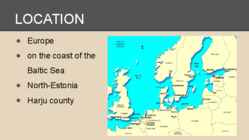
LOCATION ● Europe ● on the coast of the Baltic Sea ● North-Estonia ● Harju county FACTS ● capital city of Estonia ● largest city in Estonia ● population 435,000 ● area 156 km² ● previous name - Reval HISTORY ● first marked on the map in 1154 ● Danish rule started in 1219 ● 1285 - member of the Hanseatic League ● 1345 - Danes sold Tallinn to the Teutonic Order ATTRACTIONS ● Toompea Castle ● Old Town ● Town Hall ● Kadriorg - beautiful park ● City Centre - medieval churches, modern towers OLD TOWN ● listed in the UNESCO world heritage list ● built up from the 13th to 16th centuries ● old Hanseatic town ● surrounded by huge walls ● many towers, narrow streets TOWN HALL ● on the Town Hall Square ● built in 1402-1404 ● oldest in the Baltic region and Scandinavia ● tower height is 64 m ATTRACTIONS Old Town Town Hall ATTRACTIONS Park Kadriorg City Centre Thank you for listening! ...
Estonian history between 1710-1850 and 1850-1918 Contents Contents.................................................................................................................................. 2 17101850.............................................................................................................................. 3 Population and social structure........................................................................................ 4 Serfdom and the intensifying manorial economy ............................................................. 4 Influences of Pietism and the Moravian Brethren............................................................. 5 Enlightenment and enlightened absolutism...................................................................... 6 18501918.......................................................................................................................
Saarepeedi school Türi Autor:Tauno Toomsalu 03.03.2013 Türi history 1347 Türi first mentioned in historical records by the name of Turgel 1687 The establishment of the first school 1900 Railway traffic (ViljandiTallinn, Türi Paide) opened Türi city 1917 Türi gains the rights of a market town 1924 The first secondary education institution in Türi opened Türi Horticultural Gymnasium 1926 The rights of a town given to Türi Türi administrative 1950 - 1959 Türi - the centre of Türi County.1997 Türi College of the University of Tartu for environmental science studies opened. 2000 Türi declared the Spring Capital of Estonia by Mart Laar, the prime minister of Estonia 2005 Türi became the administrative centre of newly formed Türi Parish. Türi museum 1995 Türi ...
BALMORAL CASTLE Mikk Kull 9.B Nõo Põhikool 2012 Castle Muutke teksti laade Teine tase Kolmas tase Neljas tase Viies tase Location Balmoral Castle /bælmrl/ is a large estate house in Royal Deeside, Aberdeenshire, Scotland. It is located near the village of Crathie, 10 kilometres (6.2 mi) west of Ballater and 11 kilometres (6.8 mi) east of Braemar. Location Muutke teksti laade Teine tase Kolmas tase Neljas tase Viies tase History King Robert II of Scotland (13161390) had a hunting lodge in the area. A house at Balm...
HISTORY OF ESTONIA Estonians are one of the longest-settled European peoples, whose forebears, known as the "comb pottery" people, lived on the southeastern shores of the Baltic Sea over 5,000 years ago. Like other early agricultural societies, Estonians were organized into economically self-sufficient, male-dominated clans with few differences in wealth or social power. By the early Middle Ages most Estonians were small landholders, with farmsteads primarily organized by village. With the collapse of the Russian empire in World War I, Russia's provisional government granted national autonomy to Estonia. A popularly elected assembly (Maapaev) was formed but was quickly forced underground by opposing extremist political forces. The Committee of Elders of the underground Maapaev announced the Republic of Estonia on February 24, 1918, 1 day before German troops invaded. After the withdrawal of Ger...
estonian culture The culture of Estonia incorporates indigenous heritage, as represented by the country's rare Finno-Ugric national language Estonian, with mainstream Nordic and European cultural aspects. Due to its history and geography, Estonia's culture has been influenced by the traditions of the adjacent area's various Finnic, Baltic, Slavic and Germanic peoples as well as the cultural developments in the former dominant powers Sweden and Russia. Traditionally, Estonia has been seen as an area of rivalry between western and eastern Europe on many levels. An example of this geopolitical legacy is an exceptional combination of nationally recognized Christian traditions: a western Protestant and an eastern Orthodox Church. Like the mainstream culture in the other Nordic countries, Estonian culture can be seen to build upon the ascetic environmental realities and traditional livelihoods, a heritage of ...
TARTU Tartu is the second largest city of Estonia. In contrast to Estonia's political and financial capital Tallinn. Tartu is often considered the intellectual and cultural hub, especially since it is home to Estonia's oldest and most renowned university.Situated 186 km southeast of Tallinn, the city is the centre of southern Estonia. The Emajõgi river, which connects the two largest lakes of Estonia, crosses Tartu. The city is served by Tartu Airport. Tartu was the place where the northsouth road going above the major waterwaysriver.Thought to be the sixth8.Here is the hill fortress built centuries. In Tartu live 82268 Estonians, 15998 Russians, 1214 Finns, 491 Belorussians, 141 Jews, 140 Poles, 124 Germans, 109 Latvians, 91 Lithuanians, 81 Tatars and 673 other nationality people. Mostly known as a university town, Tartu is also a site of heavy industry. In the beginning of the 21st cen...
Education in Estonia { The beginning The history of formal education dates back to 1314th century crusades The first schools were built near churches The first primer was published in 1575 It was possible to learn reading & writing in various guilds during the 16th century 1617th century Education in the Estonian language started after the reformation by Martin Luther During Swedish era, on Gustav Adolf II's orders, the first school and university were built in 1631 GAG in Tallinn and in 1632 the University of Tartu After The Great Northern War, as Estonia was occupied by Russia, many admiralty schools were built 18th century During the reign of Russian empress Katarina II, many great improvements were made in peasant school system and girls started going to school Estonians were quite highly educated for that time, since at least half of the folk in a parish could read and a third write In 1739, the first bible w...
Estonian language Seliin-Doris Tsinjakov 11. Klass Kehra Gümnaasium · Estonian is the official language of Estonia. · Spoken natively by about 1.1 million people. · It belongs to the Finnic branch of the Uralic language family. Classification · Belongs to the Finnic branch of the Uralic languages, along with Finnish, Karelian, and other nearby languages. · Estonian has been influenced by Swedish, German and Russian, though it is not related to them genetically. History · The two different historical Estonian languages, the North and South Estonian languages, are based on the ancestors of modern Estonians migration into the territory of Estonia in at least two different waves, both groups speaking considerably different Finnic vernaculars. · Modern standard Estonian has evolved on the basis of the dialects of Northern Estonia. · The domination of Estonia a...
My home town of Valga Guide to Valga town ancient and modern Valga is the southern-most town in Estonia and despite its small size, the town straddles two countries. So it has two languages, two currencies and two cultures. Valga also has a rich history and a versatile cultural scene. Valga town is a pearl waiting to be discovered. In the south, Estonia shares a border with Latvia and here Valga town is split in half, the northern side, "Valga", belongs to Estonia and "Valka", on the southern side, belongs to Latvia. For years, this created a complicated situation where members of one family, even living on the same street, may have had different citizenships and had to go through customs and border guards in order to visit each other. Fortunately, after both countries joined the Schengen zone, border points were removed and Valga-Valka is fast overcoming the separation issues. Two different c...
 annaabi.ee