Leidsid 33 sarnast õppematerjali, mis on seotud failiga "Estonian flag and what are the symbols of Estonia". Need materjalid aitavad sul teemat sügavamalt mõista.
symbols, width, band, dear, tell, republic, coat, anthem, bird, flower, meaning, although, nowadays, often, forget, piece, cloth, consists, equal, bands, colour, upper, blue, medium, black, correlation, lengthEstonian National Emblems and Symbols There are several important emblems and symbols of Estonia of which many are also known for the rest of the world. Estonian national emblems are the blue- black-and-white national flag, the national anthem and the coat of arms. The symbols are national flower (the cornflower), national bird (the barn swallow) and national stone (limestone). Estonian flag was originally the flag of the Estonian Students' Society which was consecrated in 1884. During Soviet rule, the flag was prohibited and it was first used again in Tartu in 1988. The national anthem is entitled as "My Native Land, My Pride and Joy". The melody was composed in the centre of the 19 th century by Friedrich Pacius and the
Tallinn English College Topic Estonia Tallinn 2008 1. Introduction Estonia is a small country about the size of Switzerland, or New Hampshire and Massachussetts combined. Estonia is named after the people called "Ests" who lived in the region in the 1 st century AD. The Republic of Estonia is one of the three countries commonly known as the "Baltic States". The other Baltic States are Latvia and Lithuania. 2. Geographical position Estonia is situated in northeastern Europe. Estonia is bounded on the north by the Gulf of Finland, on the east by Russia, on the south by Latvia and on the west by the Baltic Sea. In the north it borders on Finland. The coastline of the Baltic Sea in Estonia is characterized by numerous gulfs and bays, the biggest of them
BRITISH NATIONAL SYMBOLS Research work CONTENTS CONTENTS.....................................................................................................................................2 INTRODUCTION............................................................................................................................3 1. BRITISH NATIONAL SYMBOLS..............................................................................................5 1.1 Great Britain and British story................................................................................................5 1.2 National Symbols and Nation Building..................................................................................5 1.3 The Use of Flags throughout History.....................................................................................6 1
Estonia Topic Tallinn 2007 2 List of Contents page Facts and figures 3 Geography 3 Climate 3 Nature 4 History 5 Economy 6 Culture 6 Biggest towns 7 Language 8 3 Facts and figures The Republic of Estonia is a small country. Covering only 45, 228 sq km it is slightly bigger than Denmark, Belgium or Switzerland. Estonia's population is under 1.4 million. The official language is Estonian but since very many Russians live here Russian is also wide spread. The capital of Estonia is Tallinn. The currency used in Estonia is Eesti kroon. The Estonian national flag is blue-black-white. It was originally the flag of the Estonian Students' Society
Introduction of Estonia The Republic of Estonia is beautiful country which is located in northeastern Europe, bordering the Baltic Sea on the west, the Gulf of Finland on the north, Latvia on the south, and Russia on the east. Estonia is the smallest of the Baltic countries. Administrative division: Estonia has an area of 45,226 square kilometers and Estonia is administratively divided into counties. There are 15 counties in Estonia. The capital is Tallinn which is located in Harjumaa
Estonia. Estonia, officially the Republic of Estonia is a country in Northern Europe. It is the smallest of the three Baltic countries. Estonia has land borders with Latvia (339 km) to the south and Russia (229 km) to the east. It is separated from Finland in the north by the narrow Gulf of Finland and from Sweden in the west by the Baltic Sea. Estonia has been a member of the European Union since May 1, 2004 and of the NATO since March 29, 2004. The area of Estonia is about 45000 square kilometres and the population is
During Swedish rule, the first university in Estonia was founded at Tartu in 1632. Tartu University is still widely considered the most important university in Estonia. The period is still often remembered by Estonians as "the Good old Swedish time". In the early 18th century, the Great Northern War left Estonia under Russian rule. A high point of the Estonian national movement was the first nation-wide Song Festival in Tartu in June 1869. In 1918 on the 24th of February, the Estonian Republic was proclaimed. It is a highly important holiday in Estonia. At first it was merely a decision on paper. True independence was fought for in the following years, in the War of Liberation. Independence lasted until 1939 when a pact between Nazi Germany and the Soviet Union was signed. Following the Soviet occupation in 1940, Estonia was occupied by Nazi Germany from 1942 to 1944. The Soviet Union incorporated Estonia in the autumn of 1944. A large proportion of the population fled abroad
Tallinna Inglise Kolledz Estonia Topic Alice Tärk, 9b Tallinn 2007 FACTFILE Area: 45 228 sq km Poplulation: under 1.4 million Capital: Tallinn Language: Estonian Currency: Eesti kroon (EEK) Main religion: Lutheran National holiday: 24 February (anniversary of the republic) National flower: Cornflower National bird: Barn Swallow National stone: Limestone LOCATION The Republic of Estonia is the northernmost and smallest of the three Baltic States. It is located on the eastern shores of the Baltic Sea in the north east of Europe. To the east the country borders Russia. Latvia is the countries neighbour to the south. From the west the coast of Estonia is washed by the Baltic Sea and from the north by the Gulf of Finland. The length of the coastline is approximately 3 800 km. The longest distance from east to west is
Latvia and in the east there lies Russian Federation. The territory of Estonia is 45,227 km 2 and it is divided into 15 counties. The capital and also the largest city in Estonia is Tallinn. The population is not large only 1.3 million people. The official language is Estonian. Although we have only few speakers in word terms, we are proud of our language which is considered to be one of the world's most beautiful ones. Estonia is an independent country, the government is parliamentary republic and the president of Estonia is Toomas-Hendrik Ilves. In Estonia, there are many places worth visiting. For example, the ruins of the Order Castle in Viljandi, national parks in Soomaa and definitely Old Tallinn and the University of Tartu. There is a spectacular landscape in Estonia, which offers outstanding natural beauty and tranquillity for forigners. There are many pastures and forests but there isn't much untouched and wild landscape
Arti Hunt IT-14E The Republic of Estonia is a country in Northern Europe. Estonia is located on the eastern coast of the Baltic Sea. The capital of Estonia is Tallinn Estonia has an area of 45 227 km2 In Estonia, there are about 1 340 021 people The colours of Estonian flag are blue, black and white National flower is cornflower National bird is swallow National stone is limestone National anthem is ,,Mu isamaa , mu õnn ja rõõm’’ National Coat of Arms is a golden shield which includes three lions in the middle, with oak branches along the side of the shield. Estonia has 1521 islands and the biggest of them are Saaremaa and Hiiumaa. Estonia is divided in to 15 different counties. The biggest cities in Estonia are Tallinn,
2 Towns (Upper & Lower Town) Tallinn used to be divided into 2 parts - Upper Town where lived the aristocracy, gentry and the clergy; and Lower Town with traders, craftsmen and merchants. Legend says the Toompea Hill is actually the tumulus mound of the great Kalev. Linda carried rocks to his grave. It is a naturally- formed limestone hill. Lower Town was a merchantile centre, Tallinn also belonged to the Hansaetic League (1285). It is often referred to as the town of citizens. Any grown-up, married and economically independent
part of the country has shorter, cooler summers and longer, colder and snowier winters. Famous for Pipi Longstocking by Astrid Lindgren Interesting facts - When you travel to Sweden you will see traditional red wooden farmhouses in the countryside. The famous colour, also known and loved in Estonia, is called Swedish red. Kingdom of Norway Capital Oslo Language Norwegian The flag of Norway is red with an indigo blue Scandinavian cross outlined in white that extends to the edges of the flag. Symbols - With elk as the National Animal, purple heather being its National Flower and dipper as its national bird. Size 323,802 square kilometres Population - 4,999,800 Biggest rivers Glomma and Otra Landscape Scandinavia mountains, The rugged coastline, broken by huge fjords and thousands of islands Climate - The southern and western parts of Norway experience more precipitation and have
Fact file: Australia comprises a land area of 7 686 850 square kilometres. Its population is about 21,3 million people. Australia's capital is Canberra. The national language is English. The official name of it is the Commonwealth of Australia. It's divided into six states and two territories: New South Wales, Queensland, South Australia, Western Australia, Tasmania, Victoria, Australian Capital Territory (ACT) and Northern Territory. Symbols: Australia had the British flag as their official flag until 1901, when the Commonwealth of Australia was formed. Over 30 000 entries attracted the official competition. Five of them, which contained almost identical designs, were placed equally first. The Australian flag symbolises Australia's historical links with Britain, because it has British flag on it, and Australia's location in the southern hemisphere, because it has stars of the Southern Cross on it
Võnnu Keskkool ESTONIA Referaat Autor: Klass : 9 Juhendaja: Võnnu 2013 Estonia officially the Republic of Estonia, is a state in the Baltic region of Northern Europe It is bordered to the north by the Gulf of Finland, to the west by the Baltic Sea, to the south by Latvia and to the east by Lake Peipus and Russia.Across the Baltic Sealies Sweden in the west and Finland in the north. The territory of Estonia covers 45,227km2 The Estonian climate resembles that of other countries on the Baltic littoral. On account of the
It is a major exporter of agricultural products, such as wheat, wool sugar cane, and minerals, including various metals (copper, lead, gold, silver, tin and zinc), coal and natural gas. Nearly all the world's high-quality opals are mined in Australia. The service sector of the economy makes up 69% of the gross domestic product. Although both agriculture and natural resources give up only 5%, they make up most of Australia's exports. The best-known national symbols of Australia are the national flag, the coat of arms of Australia, the golden wattle, the opal, the colours green and gold and the National Anthem. The national flag of Australia has the union Jack in the top left corner, which represents the history of Australia as a former British colony. The stars on the flag represent each of the states, the territories and the country's location on the Southern Hemisphere. Each state and territory also has its own flag.
festival. Starting with the fourth festival, mixed choirs were also participating. Starting with the sixth festival in 1896, the festival tradition moved to Tallinn. It began in 1947, during the first song festival (Laulupidu) held after the Soviet occupation, when a centuryold national poem, forbidden by the Soviets, was set to music. "Mu Isamaa on minu arm" ("Lands of My Fathers, Land That I Love") was set to music and the song became the unofficial Estonian national anthem that miraculously slipped by the Soviet censors. In 1969, more than a hundred thousand participants gathered for the century anniversary of a national song festival and, in a spontaneous act of nonviolent resistance, sang this song. For fifty years, it was a musical statement of every Estonian's desire for freedom. http://www.blogto.com/events/3626 Pärnu Hanseatic Days 2008 June 27th 28th
country into the Civil War during the reign of Charles I. The king believed that the monarch had been appointed by God to rule and to have absolute power, but the elected English Parliament disagreed. The two sides in the war were those of Charles I and the Parliamentarians, led by Oliver Cromwell. The Civil War resulted in the following: Charles I was defeated and executed; Cromwell took up rule of the country, which became a republic – the Commonwealth. Cromwell was its Lord Protector until his death. After Cromwell’s death the Stuarts returned to the throne. Charles I’s son was called back from exile and crowned Charles II. However, the Parliament was firmly established by this time and no future monarch would ever seriously challenge its power. 17. Oliver Cromwell. A civil war broke out in 1642 between royalists and parliamentarians (led by Cromwell)
Southern Ocean. Four seas are surrounding Australia, which are the Timor Sea and Arafura Sea in the north of Australia, the Coral Sea in the north-east of Australia and the Tasman Sea, near the island of Tasmania, in the south-east of Australia. Government The full name of the county is the Commonwealth of Australia. Its territory is 7.7 million square kilometres and population is about 19.7 million. The state symbols are the coat of arms, flag anthem and aboriginal symbols. Australia's flag has a British Union flag. . It is blue with the flag of the UK in the upper left corner. Five stars represent the Constallation Southern Cross and a large star is for the country's states and territories. The coat of arms features a kangaroo and an emu. The kangaroo and emu are chosen for the coat of arms of Australia because they can only move forward just like Australia.
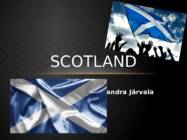
(although not the Olympic Games). Law Scotland retains Scots Law, its own unique legal system, based on Roman law, which combines features of both civil law and common law. The terms of union with England specified the retention of separate systems. The barristers being called advocates, and the judges of the high court for civil cases are also the judges for the high court for criminal cases. Scots Law differs from England's common law system. National symbols The Flag of Scotland, known as the Saltire or St. Andrew's Cross, dates (at least in legend) from the 9th century, and is thus the oldest national flag still in use. The Saltire now also forms part of the design of the Union Flag. There are numerous other symbols and symbolic artefacts, both official and unofficial, including the thistle, the nation's floral emblem, the 1320 statement of political independence the Declaration of Arbroath, the textile pattern tartan that often
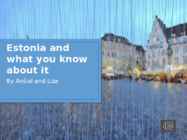
Estonia and what you know about it By Anšiel and Liza National symbols • The flag is blue, black and white horisontal lines, It represents the blue sky, the dirt, purity or snow. • The national bird is a swallow. • The national flower is a cornflower. History • The first settelments in Estonia came by supposedly about 11 000 years ago. • In the past most Estonians worshipped spirits of nature and their beliefs were seen as unholy by christian crusaders. Taara is believed to have been the name of the old Estonian god. • Starting with the Northern Crusades in the Middle Ages, Estonia became
Estonia Tjorn Treu KP-31 Information · Area- 45,227 km2 · Population- 1,282,963(2011 july) · Location- Baltic Region of Northern Europe · Capital- Tallinn · Main cities- Tallinn,Pärnu,Tartu,Narva · Official Language- Estonia · Political structure- democraic republic National symbols Flag- Coat of arms- Anthem-"My Fatherland, My Happiness and Joy,, Plant-cornflower Bird-chimney swallow Stone-slate Tree- Oak History DATES Independence Day (Iseseisvuspäev) - February 24 May Day (kevadpüha) - May 1 National Flag Day (Eesti lipu päev) - June 4 Victory Day (võidupüha) - June 23 St. John's Day (Jaanipaev) - June 24 Day of Restoration of Independence (taasiseseisvumispäev) - August 20 history EVENTS Viljandi Folk Music Festival - July
Canberra is the capital of Australia and it is situated between Sydney and Melbourne because both of these cities wanted to be the capital. The population is about 19 million people and growing. New South Wales is the most populated state and Victoria is the most densely populated state. The national language is English. It is English because British settlers came to live in Australia in the past and they brought convicts with them who were also British. Symbols. The Australian Flag came into being after the federation of the Australian States into the Commonwealth of Australian on the first January, 1901. The Commonwealth Blue Ensign was selected as a result of a public competition (over 30 000 designs were submitted). In the upper left corner there is the Union Jack that is the national flag of England. It denotes Australia's historical links with Great Britain. Under the flag there is the Commonwealth star which has seven tips. Six of
customs (toll) The Australians called for signing a legislation to remove any obstacles to New Zealand's increasing trade with the ports in Australia. While a temporary licence was granted in August 1831 allowing the Sir George Murray to return to Sydney for trading, the need for an official flag to mark New Zealand-built ships was clear. Description The New Zealand flag is the symbol of the realm government and people of New Zealand. Its royal blue background is reminiscent of the blue sea and clear sky surrounding NZ. The stars of the Southern Cross emphasise the country's location in the South Pacific Ocean. The New Zealand Flag features, on a royal blue background, a Union Jack in the first quarter and four five-pointed red stars of the Southern Cross on the other part of the flag. The New Zealand Flag is the national symbol of this country and accordingly it should be honoured and treated with respect. The New Zealand Flag may be flown on any day of the year, usually
association were signed. These were sundry organisations. But they had one name- European Community. As the authorisations broaden, it become European Union in 1993. The European Union was formally established when the Maastricht Treaty came into force. In 1985, the Schengen Agreement led the way toward the creation of open borders without passport controls between most member states and some non-member states. 1957 Belgium , Netherlands, Luksembourg, Italy, Federal Republic of Germany and France 1973 Great Britain, Ireland and Denmark 1981 Greece 1986 Spain and Portugal 1990 Rest of Germany 1995 Austria, Finland and Sweden 2004 Estonia, Latvia, Lithuania, Poland, Hungary, Czech, Slovakia, Slovenia, Maltese and Cyprus
Jannsen, it was officially adopted after War of Inependence in 1920; THE COAT OF ARMS: lions were first used as Estonia's heraldic emblem in the 13th century, a similar motif was later used on the coat of arms of the Province of Estonia under Swedish rule. Estonia changed hands but the three lions remained, in 1925 they were adopted officially. The present coat of arms is a golden shield charged with three blue lions with golden oak branch on each side. Ministers: * Andrus Ansip Peaminister represents the government to approve the state budget, represents Estonia in the European Council, directs the activity of the government *Tõnis Lukas - Haridus- ja teadusminister sets aims for the development of vocational education and training in Estonia, guarantees the expedient and effective development and education
arrive to admire the Incaic architecture, the altiplano lakes, and the Valley of the Moon. The central port city of Valparaíso, with its unique architecture, is also popular. Finally, Easter Island in the Pacific Ocean is probably the main Chilean tourist destination.And also Viña del Mar the most important musical event in Latin America The flag of Chile consists of two equal horizontal bands of white (top) and red; there is a blue square the same height as the white band at the hoist-side end of the white band; the square bears a white five-pointed star in the center representing a guide to progress and honor; blue symbolizes the sky, white is for the snow-covered Andes, and red stands for the blood spilled to achieve independence
MAJOR CITIES · The largest city is Glasgow. Glasgow has a population of 598,830. The city has an area of 175.5 km ². · Aberdeen, Dundee, Paisley, East Kilbride and Livingston are are also large cities. · There is a Glasgow bus tours for tourists SCOTLAND FLAG · The Flag of Scotland, also known as Saint Andrew's Cross or the Saltire, is the national flag of Scotland. · Scottish flag is blue · On the flag is a white X-shaped cross. NATIONAL SYMBOLS · The national flower of Scotland is the thistle. · Scotland's national animal is the unicorn. · The Scots Pine is the national tree of Scotland. · Scotland's national bird is the golden eagle. HERALDRY · The Royal Arms of Scotland is a coat of arms symbolising Scotland and the Scottish monarchs. · The thistle, the floral emblem of Scotland, also features in Scottish & British heraldry through symbols, logos, coat of arms and on British currency.
Topic Estonia, Tallinn The Republic of Estonia is the northernmost of the three Baltic States on the eastern shore of the Baltic Sea. To the east Estonia borders on Russia and Lake Peipsi and on the south on Latvia. The area of Estonia is 45 100km2, its coastline is 774km long. The geography of the land is surprisingly varied. Islands make up 9,2 per cent of Estonian's total territory, the largest islands are Saaremaa, Hiiumaa and Vormsi. The highest point is Suur Munamägi, which is 317m high.
National language in Australia is english and the monetary unit is Australian dollar. Australia is divided into 6 states and 2 territories. Symbols Australia has a British Union flag. It is red, white and blue. Five small stars represent the constellation Southern cross. The big star represents country's states and territories. In 1901 the flag was chosen from about 30000 entries in a public contest. It was officially adopted as Australian flag in 1953. The coat of arms features a kangaroo and an emu (the national animals of Australia), golden wattle (the national floral emblem), a shield with the coats of arms of the six states of Australia and a star for all states and territories. Australia's national anthem is "Advance Australia Fair", which replaced "God Save The Queen" in 1984. the unofficial anthem is "Waltzing Matilda". As said before Australias national animals are kangaroos and emus.
of about 7 hectares in the central part of Tallinn. It towers about 30-40 m above the surrounding areas. According to the legend it´s the tumulus mound over the grave of the national hero Kalev, erected stone by stone in his memory by his grieving wife Linda. It is the birthplace of Tallinn - a place where in 1229 the Knights of the Sword built a fortress instead of the wooden Estonian stronghold. Toompea Castle is also one of the most potent symbols of the reigning power. Today Toompea is the seat of the Government of Estonia as well as the Riigikogu, both of which are often simply colloquially referred to as Toompea. For centuries there was only one access to Toompea - Pikk Jalg - but there is also another way leading up to Toompea - Lühike Jalg, which was made in the 14th century. At present Pikk Jalg and Lühike Jalg are used only by pedestrians. Until the 20th century there was no way down from the western side of Toompea
Symbols of Estonia Estonian coat of arms The Estonian coat-of-arms has ancient roots and resembles both that of Denmark and of England. The three blue leopard-like creatures on a gold background were first used in 1219 as part of the coat-of-arms of the city of Tallinn and, later in history, of the Estonian province. In 1925, what is called the three lion coat-of-arms finally became the national coat-of-arms. National flower The campaign to choose a national flower for Estonia was organized by The Estonian Wildlife Protection Society in 1967-1968 where the ornamental Blue Cornflower was the favourite because of its
Estonia Estonia, officially the Republic of Estonia, is a state in the Baltic region of Northern Europe. It is bordered to the north by the Gulf of Finland, to the west by the Baltic Sea, to the south by Latvia, and to the east by Lake Peipus and Russia. Across the Baltic Sea lies Sweden in the west and Finland in the north. The territory of Estonia covers 45,227 km 2, and is influenced by a humid continental climate. The Estonians are a Finnic people, and the official language, Estonian, is a Finno-Ugric language closely
Approximately 600 million 5. Who (which tribes) gave the base of the English language?Germanic tribes- Anglo-Saxons. 6. Describe Wales.- Wales is a mountainous country on the western side of Great Britain. The national game of Wales is Rugby. Flag- Red dragon on a green and white field. They have their own language Cymraeg ( Welsh) . Anthem- Land Of My Fathers. Official animal- Dragon. There used to be a lot of coalmines. 7. What are the symbols of the 4 constituent countries? England- The three national symbols of England are St.George's cross; The red Rose and the Three Lions Crest; The oak is national tree; Northen Ireland- Shamrock; St.Patrick ;Scotland-thistle, St.Andrew 's cross . ; Wales-daffodil, leek, Prince of Wales's feathers; St.David, red dragon 8. How did the Romans influence Britain? The Romans built the first bridge(in London), the capital(London) is a
 annaabi.ee