Estonian and British Education System Estonian and British education system is not quite different. In Estonia, the education system is based on six levels which include the: kindergarten, primary school, basic school, secondary school and university or vocational school. In Britain, the education system is also based on six levels which include the: nursery school, infant school, junior school, secondary school, 6th form and university or college. What is similar for both systems is that the first level of education starts at age of three. While in Estonia this level is called Kindergarten, then in Britain it is called Nursery school. Kindergarten is for children´s from age three to six, but Nursery school is for children´s three to four. Differently from Estonian system, at age of five to seven, British children ´s go to Infant school. This is called year one, year two and year three and all these three...
The Estonian Education System The current Estonian education system consists of pre-school education, basic education, general secondary education, vocational education and higher education. Basic education is the compulsory education minimum, whics is provided by basic schools. Estonian law requires all children to be in full-time education from age of seven. In Estonia the National Curriculum is compulsory for all schools. The academic year begin on the first of September and is divided into four terms. So pupils have four holidays: a week in October, two weeks at Christmas, a week in March and three months in summer. Most Estonian children receive free education in state schools. School uniform is not compulsory. At the end of basic school pupils take three exams and at the end of twelfth form pupil take five exams. On completion of basic education, studies may be continue in a general secondary school...
Education in Russia Table of contents Compulsory school years School stages Grading system PISA results GDP investment Literacy rate in the country Interesting facts about rules and regulations Compulsory school years Eleven-year secondary education in Russia is compulsory A student of 15 to 18 years of age may drop out of school with approval of his/her parent and local authorities Students with multiple violations may be kicked out of school at starting age of 15 School stages kindergarten (age 3 to 7) elementary (years 1-4) middle (years 5-9) senior (years 10-11) Grading system In Russia, most educational institutions use a five-point grading scale, where 5 is the highest and 1 is the lowest 5 "Excellent" 4 "Good" 3 "Satisfactory" 2 "Unsatisfactory" 1 "Very Poor" In higher education, most subjects are graded `Pass/No pass' PISA resul...
If I were the Minister of Education in Estonia During my years being a student, I have noticed that there have been some changes in the Estonian educational system. Some of them are useful, some are not. Yet I think there are still many things that could use a change. I think, that one good change has been made related to the national exams, they have been improved a lot. This has assured an ongoing high level of education in Estonia. Our colleges' curriculums have also certified our college students' competitivity worldwide. I would like to bring out the education getting more and more creative as a positive change. I have noticed the use of active teaching methods and personal approach to the students. If I would be the Minister of Education, I would make the first change in turning the educational system to be more student-centered. I find, that not only those students need perso...
USA school system Most children enter the public education system around ages five or six. They may begin in preschoolpreschool, kindergartenkindergarten or first gradefirst grade. They normally attend 12 grades of study over 12 calendar years of primary and secondary education before graduating, earning a diploma that makes them eligible for admission to higher educationhigher education. Education is only mandatory until age 16, however. There are generally five years of primary (elementary) school, during which students customarily advance together from one grade to the next as a single cohort or "class", three years of middle school, which may have cohorts, and four years of high school. There is some variability in the arrangement of grades. In the U.S., ordinal numbersordinal numbers (e.g., first gradefirst grade) are used for identifying grades. Typical ages and grade groupings in contemporary, public and private schools may be...
What is wrong with current school education? School education right now, like democracy, is not perfect. It has to be perfected all the time, according to the ways of life, which are always changing. There definately is not a certain perfect solution. Firts problem in current education system coul be that students are put into a „box“. Everyone gets graded by a certain standard, if you can not reach that line, then yo have failed. This is the fairest way, at least in concept. But not all the people have same abilities and strengths. Education should be more personal, focusin on a certain students talents and strengths and trying to develope those, so that the children could reach their full- potential and would always be encouraged to follow their heart in life. Secondly, there should be more practical learning. Practical learning is much more sufficient and also more fun. Learning can be fun, but children do not know...
If I were the minister of education, I would do changes in education system. We have a lot of problems in education. Firstly, I would change the exam system. I will lose the national tests to make the schools themselves and instead of school examinations. It increases the benefit of the examinations passed. What is very positive. Also, it would make life easier for students. Secondly, we should pay more attention to rural schools. There are a lot of schools which would be needed to renovate. It should be a lot of money to invest. We should not focus only on the city schools. Finally, as far as I know from year to year decrease in the number of high school graduates. And this is a great loss for our education. Because we need more and more people to teach at the University of engineers and IT professionals. In conclusion, educational needs of our increasingly well-educated people. This is our future. High School education shoul...
The French education system is split into three stages: primary school (école), secondary school (collège) and high school (lycée). Primary and secondary education is free, neutral, secular and compulsory between the ages of 6 and 16. However, there are some private schools that are not subject to these obligations and particularities of the French education system. Nursery school classes accept toddlers at 2 or 3 years of age, starting in September. The children develop their basic faculties, improve their speaking skills and are introduced to the world of reading and writing, numbers and other key areas of learning. From age 6 to 11, the children attend elementary school which is mixed and freein the case of public (state) schools. The 'collège' accepts all pupils after elementary school without the need to pass an entrance exam. The teaching is structured by subject: French, mathematics, history-geography, 'civics' or civil education...
If I were the minister of education in Estonia. Many people think that our school system is out of date and we should make it more modern. Even teachers and students say that some changes need to be made. Maybe our government should consultate more with poeple who know the real situtation when they create new laws. If I were minister of education I would deffenetly prefere American educational system to Russian. Because our new generation of children use English a lot more than Russian. In addition I would give more money to renovate our schools and raise also teatchers salary and students scholarship. This would boost up their motivation to give quality education to our children. Also i would invite more exchange students into our schools and send our children more often to learn in foreign countrys. Finally, as far as I know from year to year decrease in the number of high school graduates. And ...
What would i change if i were minister of education. Many people think that our school system is out of date and we should make it more modern. Even teachers and students say that some changes need to be made. Maybe our government should consultate more with poeple who know the real situtation, when they create new laws. If I were minister of education I would deffenetly prefere American educational system to Russian. Our children should do more practical exercises in school and develop creative thinking. In addition to that I would give more money to our schools and raise also teatchers salary. This would boost up their motivation to give quality education to our children. Also i would invite more exchange students into our schools and send our children more often to learn in foreign countrys. The last thing I would change is the amount of the final exams. I would change all school exams into national exams. I hope that...
Essay United States and Estonian education systems USA and Estonian school systems are very similar. But still there are some differences. How children attend school and when? How chlidren are divided by age in USA and Estonia? The American school year traditionally begins in August or September, after the traditional summer recess, which is three months long. As well in Estonia. School year usually ends in may or june. First difference between Estonian school system and USA's is that children attend school at the age of 5-6, but in Estonia children go to school at the age of 7-8. Before going to school american children attend preschool (selectively). Years 5-6 american children attend kindergarden, which is a preparation for the first grade. Most children enter the public education system around ages five or six. Children are assigned into year groups known as grades, beg...
The Integration of subjects The present-day school system revolves around traditional education, in which students learn each subject individually. This structure means that pupils don’t have the capability or know-how to connect math, biology or even art into their daily life. Even though the tutors of this conventional education have faith in the arrangement of subjects it is still entirely about high test scores, grades and graduation.The essence of progressive, alternative education like the integration of subjects is learning and the accumulation of valuable knowledge & skill. First of all, the courses that should be combined need to be challenging to the students. It would be wise to assimilate math, physics and chemistry because these classes are very similar. For instance, in order to complete a physics equation you need to know math, the same applies to chemistry. If...
REPORT PURPOSE The purpose of this report is to compare the opinions of Estonian and British students about education. The report is based on 2 surveys carried out in Estonia and the United Kingdom. THE AIM OF CHILDREN’S EDUCATION As predicted all the Estonian children questioned, think that the main aim of children’s education is to prepare them for everyday life. Surprisingly 73% of the questioned British children think that the aim of children’s education is to prepare them for a career. Only 23% of the questioned British think that school prepares them for everyday life. The result surprised me because it showed that British kids and Estonian kids think very differently. THE SCHOOL UNIFORM Surprisingly, 17% of the questioned Estonian students approved the school uniform, for me it was surprising that so many approved the school uniform. Predictably, 74% of the questioned British students approved school uniform, which was expec...
TALLINN COLLEGE OF ENGINEERING INGLISE KEEL Essee Differences between Estonian and USA school and education systems. Juhendaja: Koostanud: 2009 Differences between Estonian and USA school and education systems. Question is, how different are our own and this big country they call United States of America's education. Or maybe there is no difference at all, and our systems about school and education are more similar than they appear at first sight. After reading all the materials and all sorts of notes about USA's education systems and their school household. All at once I realized, that they are not so different at all. Like for example USA's kids have to go to school exactly the same amount of time as our Estonian children. And basically learn same amount of same things. Like everywhere there are always ...
Estonia Do you know that ? Estonia in general · Capital : Tallinn · Population : 1,332,893 · Literacy : total population 99,8% male 99,8 % female 99,8 % · Government type : Parliamentary republic · Currency : Estonian kroon (EEK) Flag and coat of arms Languages · Estonian 67,3 %; 80 · Russian 29,7%; 70 · Other 2,3%. 60 50 40 30 20 10 0 Estonian Russian Other National food · Potato salad · Sauerkaut · Sült · Boiled potato · Black pudding Sport · Plays an important role in our culture · First competed as a nation at the 1920 Summer Olympics · Has won most of her Olympic medals in weightlifting, wrestling and...
1) Eduactional charities - Hariduslikud heategevusasutused 2) Universal education - Üldkättesaadav haridus 3) Compulsory education - Kohustuslik haridus 4) Full-time education - Päevane õpe 5) Home schooling - Koduõpe 6) Maintained schools - Riigikoolid 7) National Curriculum - Rahvuslik õppekava 8) Independent schools - Erakoolid 9) Foundation subjects - Alusained 10) School hours - Koolitunnid 11) Terms - Semestrid 12) State schools - Riigikool 13) Primary (education) - Algharidus/algkool 14) Infant - Väikelastele 15) Junior - Algaste 16) Secondary - Põhikool 17) Single-sex - Ühesoolised 18) Co-educational - Segakoolid 19) Comprehensive schools - Üldhariduskool 20) Selective - Valiv 21) General certificate of secondary education - Põhikooli lõpueksam 22) Independent examination boards - Sõltumatud eksamikomisjonid 23) Vocational college - Kutsekool 24) Technical college - Tehnikumid 25) A-Level - Riigieksamid 26) Further eduaction col...
Education in Croatia Educational system in Croatia divided into: 1.Early childhood education 2.Primary education 3.Secondary education 4.Higher education Early childhood education There are three stages of early childhood education: · from when the child is 6 months old to when they're one · from the ages of one to three · from the age of three until the child stars attending primary school Even though these three stages are not compulsory, every child must attend kindergarten for a year prior to primary school. Primary education (Children begin school at the age of 6 or 7.) There are two stages: · 1st through 4th grade, being taught by one teacher per class that teaches every subject with the exception of foreign languages and Religion. The students stay in one classroom for the 4 years. · 5th through 8th grades, where different teachers teach different subj...
School system in the USA Education in the United States is provided by government. Each of the 50 states has its own laws regulating education. Children start school at the age of 5 or 6 and continue until the age of 18. Primary or grade school starts from the first grade up to the sixth grade. Then students attend middle school also called junior high school for three years. After middle school, students attend secondary schools, which are called "high schools" from ninth to twelfth grades. The idea of secondary school is to get a high school diploma. Students should take on average 17 or over 20 units during their studies. Public schools are free of charge and available for everybody. To which school a child attends is determined by where they live. Primary school American children start school at the age of five. The first year at school is called kindergarten. It is obligatory for all American ch...
Education in Estonia { The beginning The history of formal education dates back to 1314th century crusades The first schools were built near churches The first primer was published in 1575 It was possible to learn reading & writing in various guilds during the 16th century 1617th century Education in the Estonian language started after the reformation by Martin Luther During Swedish era, on Gustav Adolf II's orders, the first school and university were built in 1631 GAG in Tallinn and in 1632 the University of Tartu After The Great Northern War, as Estonia was occupied by Russia, many admiralty schools were built 18th century During the reign of Russian empress Katarina II, many great improvements were made in peasant school system and girls started going to school Estonians were quite highly educated for that time, since at least half of the folk in a parish could read and a third write In 1739, the first bible w...
Report The aim of this report is to compare Estonian and British students opinion on educational system. We wrote down our opinion on the 6th of september 2012 in our english class. We had 12 students who gave an opinion about the Estonian educational system. Corporal punishment is illegal in British and Estonian schools. 62% of British childrens think that it would be needful but only 31% Estonian childrens have the same opinion. Actually it could be not banned, because if they used controlled corporal punishment it is not likely to be harmful. I would argue that there were actually fewer discipline problems back in the old days when corporal punishment was more common. Most school in England require children to wear school uniform. Estonian children no longer wear uniforms but few decades ago they wore uniforms. 74% British students and 39% Estonian students believes that school uniforms ...
2 Educational system in Croatia divided into: 1. Early childhood education 2. Primary education 3. Secondary education 4. Higher education 3 Early childhood education There are three stages of early childhood education: • from when the child is 6 months old to when they're one • from the ages of one to three • from the age of three until the child stars attending primary school Even though these three stages are not compulsory, every child must attend kindergarten for a year prior to primary school. 4 Primary education (Children begin school at the age of 6 or 7.) There are two stages: • 1st through 4th grade, being taught by one teacher per class t...
State or public education In Estonia the most of children attend state schools. However, in the last ten years the number of private schools has increased. What are the main differences between private and state secondary schools? Firstly, private schools are not free and parents ought to pay for their children is learning in a public school. But state schools are free and parents do not have to pay for education. Secondly, private schools are more strict than state schools. Another vital aspect is that public schools have a more strict evaluation system and there is a lot of homework. However when we compare state and public schools then it is seen that the results of examinations for students of private schools are higher than in state schools. On the one hand i know that well-off families prefer public education because it will give their children more opportunities. ...
If I Were a Minister of Education In the last five years we have witnessed several changes in the education system. Although some people find it useful and needed, others find it tragic. What has changed and what would I do to make school a better place? Firstly, there are several things that has been changed in the last few years, such as financing vocational schools. Students of vocational schools get paid for good grades and in some schools even for attending school. Even dorms are paid for students. That is true, we have a chance of getting a little scholarship in high schools, if we graduate with a medal, but it is times and times harder to achieve. In fact government has started to close high schools because they think that there are too many of them. It looks like our country wants only graduates with vocational education, which I find really sad. If I were a minister of education I would do every...
VOCABULARY EXERCISES UNIT 5 II Exercise Learning to operate a computer is not as difficult as many people think. Computers can be expensive to buy, but you can often get comprehensive packages containing all the equipment you need at a discount from big companies. Some companies will even install the system for you. Your system will also include various kinds of software such as word- processing and game programmes, all stored on disks. When you put the disk into the computer, the programme or information can be displayed on the screen. Many computer users go on the Internet. This is a system that links computers, making it possible to transmit information from one system to another in a different place via the telephone. This can cause problems, because addicts who use their computers all the time can overload the phone circuits meaning that other people cannot make ordinary phone calls. III Exercise 1. Joh...
Education The education system is a little bit different in the UK than ours. For example they have go to school 2 years earlier than us. Primary school is for pupils aged 5-11. Though schooling is only compulsory from age 5 in the UK, children most commonly enter Reception Class aged 4 in the academic year in which they will reach their 5th birthday. When pupils are aged 7 they sit Key Stage 1 [SATs]. Key Stage 2 SATs are taken when pupils are aged 11. Secondary school is for pupils aged 11-16. 11-13 years old pupils study a broad range of 10–15 subjects. No public examinations are taken during this time. Traditionally, at the age of 14 students start a programme that lasts for 2 years and during which time they study up to 11 subjects of their choice. After this students take GCSE state examinations After 16 attending at school isn't compulsory but pupils can stay at school, go to coll...
An Essay There are many different education systems in the world. Basics are pretty much the same, but ofcourse depending of the culture, the differences and interests of educating people, are big. Children go to school at age five in Great Britain, which is too early in my opinion. Most children in Estonia start school at age seven, only some of them at age six. I think starting with school and competition, rivalry, witch always associates with schooling, too young, shortens the childhood and may affect negatively self-esteem, success and coping in the future. Children´s job is to play, it develops child the best, so I think anyone shouldn't forbit humans inherent needs. Children don´t have to become too fast to an adult. The high school in Great Britain starts at age eleven, but in Estonia at about age fifteen. Biggest difference is that in Great Britain they prepare young people to get a job ...
THE BRONTE SISTERS CHARLOTTE EMILY ANNE BIOGRAPHY FATHER AN IRISH PROTESTANT, A CLERGYMAN IN YORKSHIRE MOTHER DIED IN THEIR CHILDHOOD VIVID IMAGINATION DRAWING, WRITING AND TELLING STORIES EDUCATED AT A CHARITY SCHOOL GOVERNESSES "POEMS BY CURRER, ELLIS AND ACTON BELL" CAHRLOTTE 1816-1855 THE PROFESSOR (1857) JANE EYRE (1847) SHIRLEY (1849) VILLETTE (1853) JANE EYRE GREATLY AUTOBIOGRAPHICAL REALISTIC PICTURES + ROMANTICISM WOMAN'S PROBLEMS AND SOUL LONELINESS, POVERTY, SOCIAL INSIGNIFICANCE ATTACKS THE GREED AND LACK OF CULTURE OF THE BOURGEOISIE JANE EYRE SOCIETY CAN BE REFORMED BY MEANS OF EDUCATION INHUMAN EDUCATION SYSTEM OF CHARITY SCHOOLS FIGHT FOR WOMEN'S EMANCIPATION EMILY 1818 - 1848 WUTHERING HEIGHTS (1847) PLOT FULL OF ...
Introduction of Estonia The Republic of Estonia is beautiful country which is located in northeastern Europe, bordering the Baltic Sea on the west, the Gulf of Finland on the north, Latvia on the south, and Russia on the east. Estonia is the smallest of the Baltic countries. Administrative division: Estonia has an area of 45,226 square kilometers and Estonia is administratively divided into counties. There are 15 counties in Estonia. The capital is Tallinn which is located in Harjumaa. Counties are divided into 194 rural municipalities. Population: The population of Estonia was estimated at 1.34 million in January 2011, with a density of 30 persons per square kilometer. According to the last census the number of inhabitants has decreased. In 2010 the birth rate was 11,82 per 1,000 population, while the death rate was exactly the same, so population growth rate is 0%. The proportion of urban p...
Electro-fishing equipment is used for collecting different fish species and recording their relative abundances, and making cursory determinations of their health based on external observations. Collecting and recording fish data reveals what species are surviving and inhabiting a particular stream system and to what extent the aquatic ecosystem is maintaining that population. Depending on the type of stream visited and the field chemistry and habitat measurements taken, biologists have certain expectations of what type of species they should expect to find. When this ends up not being the case, as where warm water pollutant tolerant species are found in what would be considered cold water species habitat, then the biologists look closer into possible causes for the ecological imbalance. When combined with water chemistry, habitat, and stream invertebrate information, a clear picture of the ecological system is brought in to focus fr...
Established church The Church of England is the established church, which means that: 1.)the Monarch is the Supreme Governor of the church, 2.)the Church performs a number of official functions, 3.)Church and State are linked. To disestablish Disestablishmentarianism refers to campaigns to sever links between church and state, particularly in relation to the Church of England as an established church. It was initially a movement in the United Kingdom in the 18th century. The established churches in Wales and Ireland could not count on even nominal adherence by a majority of the population of those countries. In Ireland, the predominantly Roman Catholic population campaigned against the position of the established Anglican Church of Ireland - eventually disestablished in Ireland from 1 January 1871. A broad church The Church of England is a broad church, representing a wide spectrum of theological thought and practice ...
REPORT (FORMAL) This report is intended to describe the access and facilities for disabled ppl in my school. More and more high school students with disabilities are planning to continue their education in high-school. As a student with a disability, you need to be well informed about your rights and responsibilities as well as the responsibilities high-school have toward you. As a disabled student, being well informed will help ensure that student has a full opportunity to enjoy the benefits of the high-schools education experience without confusion or delay. One way to ensure that our school can help the disabled students is to make elevators and lifts, but it costs a lot, so many schools, including ours, does not have such kind of a system. If school does not have elevators and lifts then the other way is to hire people who can help the disabled students out. There is always another way. Township can make sch...
STEP Analysis Switzerland Liisi Nigul Turundus II Sociological factors: Religions: Main religion is Roman Catholic 41,8%, then comes Protestants with 35,3% and on the third place are so called non-believers (people with no religion) 11,1%. (Other: muslin, orthodox, other Christian and so on). Birth rates: Switzerland has a birthrate of 9, 51 births to 1000 people, it's in the 199 place in the world's birth rate comparison. Leisure activities: Leisure activities range from taking part in grueling sports to relaxing with family and friends. Many people also devote part of their leisure time to the public service. Life expectancy at birth: total average is 81 years but if you look ...
Life in Estonia through the eyes of an economics student With a population of 1 313 271 people, Estonia is one of the least populous member states of the European Union. However, according to the IMF, it is a developed country with an advanced and high-income economy. Estonia follows market economy system which ensures the little government intervention and the determination of prices of goods and services in a free price system. Therefore, economic decisions are guided solely by the aggregate interactions of a country's citizens and businesses. In addition to mentioned afore, Estonia tends to perform favourably in measurements of civil liberties, education, and press freedom. Living in Estonia has many of its good sides, for instance it is a secure place from nature disasters and it has a beautiful nature. Although, when not to look only through rose-tinted glasses, there are still some minuses in country’s organiz...
POPULATION Influences: demographic transition birth, death economy education urbanization employment migration ethnic-cultural background Demographic transition is a theory according to which all societies start with traditional alternation of generations and they finish with modern alternation of generations (demographic explosion, ageing) TRADITIONAL ALTERNATION OF GENERATIONS -agrarian society -BR is high (10-12 children/3-4 survive) traditions, moral parents hope that their children will suport them in the future no healthcare -DR is high no healthcare epidemics -average age 35-40 THE BEGINNING OF INDUSTRIALIZATION -healthcare -development of economy -education Increase in the living standards. BR remained the same (still high) DR decreased Big amount of children in the society. 18th c. demographic explosion in Europe Factors that lead to the end of dem. explosion: -prohibitions of children's work -women were offered work (wa...
Finland judicial system Roadmap Finnish judicial system General courts Administrative courts Special courts Lay judges in Finland The Finnish judicial system consist of: ● Courts ● Prosecution service ● Enforcement authorities ● Prison and probation service ● Bar Association General courts 1.District Courts 2.Courts of Appeal 3.Supreme Court District court ( Finnish: käräjäoikeus) 27 district courts Criminal cases, civil cases and petitionary matters Chief Judge and District Judges Courts of Appeal 5 courts Chief Justice and Senior Justices Appointed by the president The Supreme Court Helsinki President and 18 justices Function is to rule on important points of law Gives advice to President and Ministry of Justice Administrative courts Regional Administrative Court 8 courts The judicial oversight of administrative acts is the task of the administrative courts. Cases like land use, buildi...
Dear Mr President , I am writing in order to invite you to our class during the ,,Back to school" week. I think that your coming to my class would be really instructive and interesting for students. It would give everyone an opportunity to ask about your school times, life as a president and your position. I am sure that find out about your professional knowledge, perks and official duties helps us to understand your profession better. However, the lesson would be in English, so students can express them thoughts and ask questions in English. It would help us to evolve our communication in the formal way and it makes us richer by the experience. Visiting our school would be useful for you too. We could discuss about the problems in the education system and offer our solutions to improve an education. You could communicate with the younger generation who respect you and will be indescribably happy about you visiting. It would...
Comparison of Education in Britain and Estonia When looking into the educational systems of Britain and Estonia, several differences appear. In this essay I am going to point out some of the most distinguish features in the education of both countries. Firstly, there are dissimilarities in the age at which children go to school. In Estonia the age is 7 whereas in Britain children start their educational journey already as young as 5 years old. Primary school lasts 6 years just like in Estonia but the pupils in Britain are 2 years younger when they finish primary school than the pupils in Estonia. However, students in Britain and Estonia finish secondary school at the same age because secondary school lasts 5 years in Britain instead of 3 like it is in Estonia. Altogether, compulsory school in Britain lasts 11 years which is 2 years more than in Estonia. Moreover, there are slight differences as for the compulsory ...
Washington Washington is a state in the Pacific Northwest region of the United States located north of Oregon, west of Idaho, and south of the Canadian province of British Columbia on the coast of the Pacific Ocean. It was named after George Washington, the first President of the United States, the state was made out of the western part of the Washington Territory, which had been ceded by Britain in 1846 in accordance with the Oregon Treaty in the settlement of the Oregon Boundary Dispute. It was admitted to the Union as the 42nd state in 1889. Olympia is the state capital of Washington. Washington is sometimes referred to as Washington State or the State of Washington to distinguish it from Washington, D.C., the capital of the U.S., which is often shortened to Washington. Washington is the 18th largest with an area of 184,827 sq/km and the 13th most populous state with over 7 million pe...
AUSTRALIA CONTENT · Australia · Symbols · Location · States · Language · Religion · Education · Health · Culture · Humour · Video AUSTRALIA · Is a country, and a continent · Is the sixth largest country in the world · The world's smallest continent SYMBOLS · Green and gold were confirmed as Australia's national colours in 1984 · The Golden Wattle was officially proclaimed as the national floral emblem in 1988 · National anthem is Advance Australia Fair · National Gemstone is Opal Coat of arms of Australia LOCATION · Located in oceania, continent between the Indian Ocean and the South Pacific Ocean STATES · Western Australia · Northern Territory · South Au...
Esimene rühm 1. Name the processes of population that have an economic importance. 2. What is demographic transition and what influences it? 3. Speak about demographic explosion. 4. What is demographic crisis? 5. Speak about the course of demographic transition up to 1950s. 6. Speak about full employment in the NORTH. 7. What is natural increase? 8. Why is the rapid increase of population so acute problem? 9. Name the factors that influence death rate. 10. What are the main reasons for death in the developing world? 11. Analyse a population pyramid (what stage was in 2000?). Vastused 1. 1. Demographic transition, 2. Changes that take place in education and full employment, 3. Migration, 4. Urbanization, 5. Etno-cultural process. 2. This is a theory according to which all societies start with traditional alternation (vaheldus) of generations. It is influenced by indust...
Canada Geography The geography of Canada is vast and diverse. Occupying most of the northern portion of North America, Canada is the world's second largest country in total area. The highest point in Canada is Mount Logan 6,050 m, which is in the Yukon. The two principal river systems are the Mackenzie and the St. Lawrence. The St. Lawrence, with its tributaries, is navigable for over 3,058 km. The largest lake situated entirely in Canada is Great Bear Lake at 31,328 km2 in the Northwest Territories. The largest lake which is at least partly in Canadian territory is Lake Superior Climate Canada's climate is as diverse as its landscape. Generally, Canadians enjoy four very distinct seasons, particularly in the more populated regions along the US border. Daytime summer temperatures can rise to 35°C and higher, while lows of -25°C are not uncommon in winter. More moderat...
Estonian state system The Resolution of the National Independence of Estonia was adopted on August 20, 1991. The Constitution of Estonia is the fundamental law of the Republic of Estonia and it was adopted in June 1992. Estonia is a Democratic Parliamentary Republic where the supreme power is vested in the people. The head of State of Estonia is the President of the Republic who can be elected for two five-year terms. The Legislature. The Parliament of Estonia is called Riigikogu and it is elected by people for a four year term. The election is universal, uniform and direct. Voting is secret. The Riigikogu is comprised of one hundred and one members. The Riigikogu has three main functions: legislation, reviewing the activities of the executive power, representation. The members of the Riigikogu have the rights to form factions. The Executive. The Executive of Estonia consists of the body of the Prime Minister and cabinet of ministers. ...
Mathematica Margus Martsepp Estonia named first computer- based math education country (11.2.2013) In our first Estonia project we will work with them to rewrite key years of school probability and statistics from scratch. -- Conrad Wolfram Predictive interface Linguistic input suggestions Unit discovery, conversion and problem solving Visualisation and graphics composition is really simple Fundamental limitation of all numerical systems Blind numerical sampling - black box Too complex for others 14th order linear differential system automatically solved Example problem Process diffusion-related experimental data to find the Matano interface and create an ascending diffusion on a ternary plot Example problem Example problem Example problem Example problem Example problem Final result: Line count ratio The end
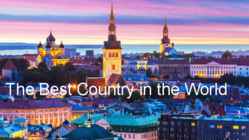
The Best Country in the World The Best Country in the World Estonia ● Area: 45,227 km² ● Population: 1,36 million ● Capital city: Tallinn (405 000 inhabitants) Sport ● Kiiking ● Kelly Sildaru ● Wife carrying Fun facts ● Tallinn is the city of the first Christmas tree ● Free public transport ● The first country to introduce online political voting ● Skype was invited in Estonia ● Estonian education system is the best in Europe ● 75.7% are irreligious ● 16% say that they believe in God Estonian nature History ● Human settlement was around 11 000 years ago ● Has been under Danish, Swedish, German and Russian ruling ● Achieved independence 24th of February 1918 ● Re-independence 20. August 1991 ● Regained its independence without a war ● Baltic Way Baltic Way The Estonian Song and Dance Festival https://youtu.be/ieKfoxVWUSo
Film review · Background information · Story (Who, Where to, Why, How) · Characters (1&2), developments (values), important moments (entering, essays?......) the most interesting moment for me. · Personal opinion, recomnedations (Who for) 1. introductions 2. social system 3. when? (30 years ago) when filmed 4. mates` opinion Film review ,,Educating Rita" Some English lessons ago I saw a comedy about a teacher and a very memorable student. It was filmed abot 30 years ago by A young wife decides to complete her education and take her exams. She meets a professor who teaches her to value her own insights while still being able to beat the exams. Bored with teaching undergraduates English literature, Frank Bryant morosely reflects through a whisky glass on his failed marriage and his attempt at becoming a poet. His world is ...
Education Education is so multifaceted that it is difficult for me to know where to begin discussing it, or how to prioritize the many factors. Relaying my own experience is easy: I had a standard classroom approach, supplemented by inordinate reading. In only the briefest and least memorable instances did I receive any individual tutoring. Education is commonly thought of as the job of schools. Adults cry "educate our children!" Everyone has opinions about the best way to do the job. It is of urgent importance, and all the numerous factors are much studied, debated, and new (or old) ideas continually tested or retested. Some people say "it's as simple as . . . " and then name their pet peeve or passion. My view is not of an education specialist, but of one who loves sharing what I learn, and owes much to educators. Since I don't have an educational theory neatly worked-out, nor an outline of my perceptions, my intent is to addr...
San Francisco San Francisco, officially the City and County of San Francisco, is the leading financial and cultural of stateof California and it's located in the far-west of USA. The earliest archaeological evidence of human habitation of the territory of the city of San Francisco dates to 3000 BC. The Yelamu group of the Ohlone people resided in several small villages when a Spanish exploration party, led by Don Gaspar de Portolà arrived on November 2, 1769, the first documented European visit to San Francisco Bay. Upon independence from Spain in 1821, the area became part of Mexico. Under Mexican rule, the mission system gradually ended and its lands began to be privatized. In 1835, Englishman William Richardson erected the first independent homestead, near a boat anchorage around what is today Portsmouth Square. Together with Alcalde Francisco de Haro, he laid out a street plan for the expanded s...
Diana Parker, International Recruitment Office, Box 202, 10001 Tallinn Estonia Dear Ms. Parker The office manager position, advertised in The Baltic Times, is a perfect match for my career goals. I am interested in working in the UNICEF because of its mission. The job offer fits well with my education and experience. My language skills, spoken and written, are very good in Estonian (native language) and in English. I have basic knowledge in Russian. As your position requires experience in computer system, I have attended several computer courses and my practical experience has given me valuable skills. I am hardworking, loyal, honest and I am willing to learn and gain new experiences. With my friendly and open character I find it easy to communicate. Thank you for your consideration. I look forward to speaking with you. Sincerely, Evelin Rubin Abja vald, Umbsoo küla 69309 Viljandimaa Estonia
Homework William Jefferson "Bill" Clinton was born on August 19, 1946. He is an American politician who served as 42nd President of the United States from 1993 to 2001. Inagurated at age 46, Bill was the third-youngstes president. Born and raised in Arkansas, Bill became both a student leader and a skilled musician. He met and later married Hillary Rodham Clinton, who has served as the United States Secretary of State since 2009 and was a Senetor of New York from 2001 to 2009. They both recived a law degree from Yale Law School. As a Governor of Arkansas, Bill overhauled the state's education system. Clinton was elected president in 1992, defeating president George H. W. Bush. In 2004, he released his autobiography ,,My Life". Clinton left office with the highest end-of-office approval rating of any U.S. president since World War II.
Definition People are treated as property and are forced to work Slaves can be held against their will Different forms Child labor Bonded labor Serfdom Servile marriage Trafficking in persons (especially women and children) The exploitation of domestic and migrant labor Human trafficking One method of obtaining slaves Victims are typically recruited through deceit or trickery "Debt slavery" Majority of victims are women, and sometimes children Regions where is it common In parts of Africa In the Middle East Sudan - 570 enslaved people (69 children) In 2008 the abolishement of the Haliya system of forced labour (freeing 20 000) India - 40 million bonded ...
 annaabi.ee