Leidsid 33 sarnast õppematerjali, mis on seotud failiga "Tallinn's Old Town". Need materjalid aitavad sul teemat sügavamalt mõista.
ruled, situated, northern, country, listed, among, digital, easy, beginning, location, attention, suitable, denmark, sweden, russia, germany, upper, seat, powerKunda Gymnasium Rait Türkel Old Tallinn Report Instructor:Teacher Kristi Aron Kunda 2012 Introduction Like most cities with an eight-hundred-year-old past, Tallinn is a patchwork of historic areas. The city's pride and joy is without a doubt its Medieval Old Town, but equally enchanting is the Kadriorg district, a throwback to the time when Estonia was ruled by the Russian Tsars. Tallinn is the capital and largest city of Estonia. It occupies an area of 159.2 km2 with a population of 416,470. It is situated on the northern coast of the country, on the shore of the Gulf of Finland, 80 km south of Helsinki, east of Stockholm and west of Saint Petersburg. Tallinn's Old Town is in the list of UNESCO World Heritage Sites. It is ranked as a global city and has been listed among the top 10 digital cities in the world
Estonian cities Tallinn is the capital and largest city of Estonia. It occupies an area of 159.2 square kilometers with a population of 413,000. It is situated on the northern coast of the country, on the banks of the Gulf of Finland, 80 km south of Helsinki, east of Stockholm and west of Saint Petersburg. Tallinn was founded in the 12th century and has been under the rule of Denmark, Sweden, and Germany as well as Russia, and all left their mark on the city's architecture. It is one of the best preserved medieval towns in northern Europe, and makes a beautiful impression from the sea, with its ancient city walls, church spires, and red-tile roofed homes. Tallinn has
Tallinn, general overview Prepared: Hanna Bergmann 16.04.2011 Tallinn's Old Town is in the list of UNESCO World Heritage Sites. Tallinn is ranked as a global city and has been listed among the top 10 digital cities in the world. Tallinn is a European Capital of Culture for 2011, along with Turku, Finland. Location Tallinn is situated on the northern coast of the country, on the banks of the Gulf of Finland, 80 km south of Helsinki, east of Stockholm and west of Saint Petersburg. Tallinn is situated on the southern coast of the Gulf of Finland, in north-western Estonia. Tallinn Population The registered population of Tallinn is 412,341 (as of 1 Dec 2010). According to Eurostat, in 2004 Tallinn had the largest number of non-EU nationals of all EU member states' capital cities.As of 2009 around
Tallinn developed along three lines: fortress, port and market town. The Lower Town, a free town of merchants and craftsmen, gradually evolved at the foot of Toompea. From the 13th century onwards these became separate towns with different communities, both with their own interests and laws. Tallinn grew rapidly and had developed into a well-known trading centre by the 15th, century. A century later its population of 7,000-8,000 made it one of the biggest cities in northern Europe. Unfortunately, prosperity did not last long due to the weakening of the Hanseatic League, epidemics, hunger and wars. Sweden finally managed to take control of the whole of Estonia in 1629. Though hard times continued, the period that followed is known as the good old Swedish era': foundations were laid for the Estonian school system, the privileges of the nobility were curtailed, local peasants were granted the right to own property, and so on.
Tallinn English College Topic Estonia Tallinn 2008 1. Introduction Estonia is a small country about the size of Switzerland, or New Hampshire and Massachussetts combined. Estonia is named after the people called "Ests" who lived in the region in the 1 st century AD. The Republic of Estonia is one of the three countries commonly known as the "Baltic States". The other Baltic States are Latvia and Lithuania. 2. Geographical position Estonia is situated in northeastern Europe. Estonia is bounded on the north by the Gulf of Finland, on the east by Russia, on the south by Latvia and on the west by the Baltic Sea. In the north it borders on Finland. The coastline of the Baltic Sea in Estonia is characterized by numerous gulfs and bays, the biggest of them being the Gulf of Finland, the Gulf of Riga and the Gulf of Pärnu. Bays include the Narva Bay, Matsalu Bay, Kolga Bay, Kunda Bay, Tallinn Bay etc. Estonia has over
It is on almost the same latitude east St. Petersburg in Russia, Stockholm in Sweden and Stavanger in Norway, and covers 158 sq km. Tallinn was first marked on a map of the world by the Arab geographer al-Idrisi in 1154, its name then being Kolyvan (probably derived from the name Kalev). In the 13th-century Chronicle of Henricus de Lettis the town was called Lyndanise. Later came Reval (presumably after the old county of Rävala), the name used by the Germans who ruled the country for seven centuries. Russians then modified Reval to Revel. For Estonians, the town came to be called Tallinn from Taanilinn (Danish town) after Danish conquest in the 13th century. Over the course of time, Taanilinn was shortened to Tallinn The place is believed to have been settled by Finno-Ugric peoples about 2500 BC. The Danes, led by King Valdemar II, conquered northern Estonia in 1219. Legend has it that one
Kunda Ühisgümnaasium Tallin Old Town Report Student: Kristin Karu Teacher: Kristi Aron Kunda 2012 The Alexander Nevsky Cathedral The Alexander Nevsky Cathedral is an orthodox cathedral in the Tallinn Old Town,Estonia. It was built to a design by Mikhail Preobrazhensky in a typical Russian Revivalstyle between 1894 and 1900, during the period when the country was part of theRussian Empire. The Alexander Nevsky Cathedral is Tallinn's largest and grandest orthodox cupola cathedral. It is dedicated to Saint Alexander Nevsky who in 1242 won the Battle of the Ice on Lake Peipus, in the territorial waters of present-day Estonia. The late Russian patriarch, Alexis II, started his priestly ministry in the church. Interior of the Cathedral. The Alexander Nevsky Cathedral crowns the hill of Toompea where the Estonian folk hero
Tallinn Tallinn is situated on the southern coast of the Gulf of Finland, in north-western Estonia. A limestone cliff runs through the city. It is exposed, for instance, at Toompea and Lasnamäe. However, Toompea is not a part of the cliff, but a separate hill. Coastline is 46 kilometres long.The highest point of Tallinn, at 64 meters above the sea level, is situated in the district of Nõmme, in the south-west of the city. The first human steps, that archeologists found, are about 5000 years old. Tallinn`s first fortress was built in Toompea, in 1050. As an important port for trade between Russia and Scandinavia, it became a target for the expansion of the Teutonic Knights and the Kingdom of Denmark during the period of Northern Crusades in the beginning of the 13th century when Christianity was forcibly imposed on the local population
its wide bay protected by the two outlying islands of Aegna and Naissaar for a large port. Tallinn developed along three lines: fortress, port and market town. Tallinn grew rapidly and had developed into a well-known trading centre by the 15th century. Unfortunately, prosperity did not last long due to the weakening of the Hanseatic League, epidemics, hunger and wars. Sweden finally managed to take control of the whole of Estonia in 1629. Their rule ended after the Northern War in 1710 when Estonia was joined to the Russian Empire. Life changed for the better thanks to the opening of a railway line from St. Petersburg to Tallinn in 1870. Tallinn grew into a major port and an industrial centre, with huge shipyards. Interest in culture grew and Estonians became conscious of their national identity, dreams of independence gained ground. On 24 February 1918 Estonia was declared an independent country and Tallinn became the capital of the Republic of Estonia.
INTRODUCTION Tallinn is the capital and largest city of Estonia. It occupies a surface of 159.2 km2 in which 404,000 inhabitants live. It is situated on the northern coast of the country, on the banks of the Gulf of Finland, in north-western Estonia. Tallinn is the location of many institutions of higher education and science. As an important port for trade between Russia and Scandinavia, it became a target for the expansion of the Teutonic Knights and the Kingdom of Denmark. Historically, the city has been attacked, sacked, razed and pillaged on numerous occasions. Although extensively bombed by Soviet airforces during the latter stages of World War II, much of the medieval Old Town still retains its charm.
Topic Estonia, Tallinn The Republic of Estonia is the northernmost of the three Baltic States on the eastern shore of the Baltic Sea. To the east Estonia borders on Russia and Lake Peipsi and on the south on Latvia. The area of Estonia is 45 100km2, its coastline is 774km long. The geography of the land is surprisingly varied. Islands make up 9,2 per cent of Estonian's total territory, the largest islands are Saaremaa, Hiiumaa and Vormsi. The highest point is Suur Munamägi, which is 317m high. Estonia has a surprisingly mild climate for an area so far north. Sea winds keep the weather from becoming very cold or hot. The population of Estonia is 1.5 million. Of this number 62 per cent are Estonians. Estonians speak the Estonian language, which is closely related to Finnish. Estonia's flag has three horizontal stripes. The blue stripe at the top of the flag represents the sky. The middle stripe of black
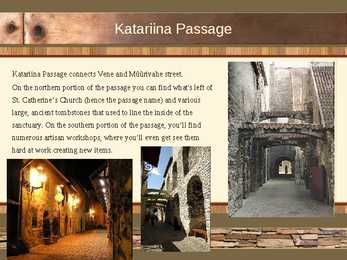
Katariina Passage Katariina Passage connects Vene and Müürivahe street. On the northern portion of the passage you can find what's left of St. Catherine's Church (hence the passage name) and various large, ancient tombstones that used to line the inside of the sanctuary. On the southern portion of the passage, you'll find numerous artisan workshops, where you'll even get see them hard at work creating new items. City wall Tallinn's medieval city wall is a sub-facility that was built
FACTFILE Area: 45 228 sq km Poplulation: under 1.4 million Capital: Tallinn Language: Estonian Currency: Eesti kroon (EEK) Main religion: Lutheran National holiday: 24 February (anniversary of the republic) National flower: Cornflower National bird: Barn Swallow National stone: Limestone LOCATION The Republic of Estonia is the northernmost and smallest of the three Baltic States. It is located on the eastern shores of the Baltic Sea in the north east of Europe. To the east the country borders Russia. Latvia is the countries neighbour to the south. From the west the coast of Estonia is washed by the Baltic Sea and from the north by the Gulf of Finland. The length of the coastline is approximately 3 800 km. The longest distance from east to west is 350 km, while north to south Estonia stretches 240 km. THE NAME The name EESTI was apparently derived from the word AISTI, the name given by ancient Germans to the peoples living northeast of the Vistula River
Having acquired North Estonia again in 1238, King Valdemar of Denmark appointed the Toompea church the cathedral of the Tallinn bishopric, which was formed in 1240, and subordinated to the archdiocese of Lund. The cathedral chapter was established at the cathedral consecrated to St. Mary the Virgin and a school was formed at the church in 1319 at the latest. The reconstruction of the initally one-nave and relatively modest church into a three- nave one started at the beginning of the 14 th century and lasted approximately a hundred years. This period includes another change of power, resulting in Tallinn's subordination to the order one more time. Although the main building of the church dates back to those times, the medieval cathedral was quite different from the present appearance. For example, the tower on the western side of the church was built only in the 18 th century, the annexes of the southern side date back to the 16 th -18th centuries and those on the
disliked by many Estonians as a symbol of oppression and the russian power, but it has never been actually taken down. The legend says it’s the very grave of Kalev, estonian’s national hero. Stenbock House ● It’s the official seat of Government and the Government office of Estonia since 2000. One of the most remarkable government buildings in the wholw of Europe with it’s architecture and location. Bears the name of its builder, Jakob Stenbock. He agreed to undertake the building of the court house, but the state failed to pay him. But hoping to maintain further interest in house, he decided to finish it. St. Mary’s Cathedral ● Oldest church in Tallinn and mainland Estonia. It is assumed that the building started in 1219. Largest collection of epitaphs. Organ built in 1878, probably the most powerful in Estonia. The interior is filled with coats of arms from the
Pikk Street as the longest and also the main street from medieval times is well-known, but Lai Street that runs parallel to it is not. The aim of the report is to be helpful for the students of Tallinna Mustamäe College who study the history of Tallinn and would like to get additional information about Lai Street, as they need to pass the guide practice exam in form eleven. The report is divided into chapters so that each chapter deals with one of the important houses in Lai Street. In the beginning there are also two introductory chapters about Lai Street in general and the origin of the name "Lai". 3 Lai Street in general Lai Street is 520 m long and begins at a small green patch below the Toompea slope, where a graceful bronze statue of a Roe Deer by Jaan Koort (1883-1935), one of the best-known Estonian sculptors, has been standing for several decades. Lai Street stretches from Nunne Street to Pikk Street. Parallel with Pikk Street, Lai Street, too, ends at the Great Coast Gate
Estonia Where it is? Republic of Estonia is a state in the Baltic region of Northern Europe .It is bordered to the north by the Finland, to the west by the Baltic Sea, to the south by Latvia (343 km), and to the east by lake Peipus and Russia (338.6 km). Across the Baltic Sea lies Sweden in the west and Finland in the north. Towns Tallinn is the capital and the largest city of Estonia. It lies on the northern coast of Estonia, along the Gulf of Finland. There are 33 cities and several town-parish towns in the country. In total, there are 47 linna, with "linn" in English meaning both "cities" and "towns". More than 70% of the population lives in towns. History • Estonia was settled near the end of the last glacial era, beginning from around 8500 BC. Before the
Estonia lies on the eastern shores of the Baltic Sea on the level northwestern part of the rising east European platform. Estonia is a flat country covering 46 226 square kilometers.Estonian's neighbours are Finland, Sweden, Latvia and Russia. Estonia is rich in islands. The two largest are Saaremaa and Hiiumaa . Saaremaa is famous for its big meteorite crater called Kaali and Hiiumaa is famous for its nature and plants. The countries highest point Big Egg hill ( Suur- Munamägi) reaches 318 meters above sea level. Estonia has many uplands too. The uplands are: Pandivere upland, Otepää upland, Vooremaa upland, Karula
The southern part of Viljandi county catches the eye with its sublime scenery. The area today lies in the very heart of the historical Mulgimaa the home of hills, deep valleys and lakes brought together by a beauty spot Halliste primeval valley. According to several folk tales, it is also in these valleys, woods and bogs that Old Nick found refuge.The great variety displayed in the nature is also reflected in the local cultural heritage. At the beginning of the 19th century growing linen spread and became the basis of the legendary wealth of Mulgi farms. The ancient barn-dwellings and decaying manor houses are the mute witnesses of those times. The riches and cultural heritage of Mulgimaa owe to the diligence and tenacity of the local people. Village handicraftsmen and masters have always been honoured. Mulgikapsad (stewed sauerkraut with barley groats), Estonian cheesecakes and kama (a roasted meal-mixture) have not lost their popularity.
Estonia Topic Tallinn 2007 2 List of Contents page Facts and figures 3 Geography 3 Climate 3 Nature 4 History 5 Economy 6 Culture 6 Biggest towns 7 Language 8 3 Facts and figures The Republic of Estonia is a small country. Covering only 45, 228 sq km it is slightly bigger than Denmark, Belgium or Switzerland. Estonia's population is under 1.4 million. The official language is Estonian but since very many Russians live here Russian is also wide spread. The capital of Estonia is Tallinn. The currency used in Estonia is Eesti kroon. The Estonian national flag is blue-black-white. It was originally the flag of the Estonian Students' Society. The flag was first consecrated in Otepää Church in 1884. For a while,
Estonia Estonia, officially the Republic of Estonia, is a state in the Baltic region of Northern Europe. It is bordered to the north by the Gulf of Finland, to the west by the Baltic Sea, to the south by Latvia, and to the east by Lake Peipus and Russia. Across the Baltic Sea lies Sweden in the west and Finland in the north. The territory of Estonia covers 45,227 km 2, and is influenced by a humid continental climate. The Estonians are a Finnic people, and the official language, Estonian, is a Finno-Ugric language closely
Above the door is the founder of the union, king Knut 7. Suurgildi hoone - gothics. Belonged to Tallinn's Suurgildile, where were the town's most powerful and richest merchants. Hoone Ehitus kestis 14071410, siseviimistlus lõpetati 1417. 8. Holy ghost church - 14. Century. One of Tallinn's oldest churches, and the only sacred building that preserved its original form.and still retains its original exterior, except for the Baroque spire. The clock in northern side is one of the oldest in Tallinn and though it has been blanched with rain and window, the clock strick the time exactly. It has a Baroque wooden carvings, made by Christian Ackermann. 9. Saiakäik (White Bread passage) suubub raekoja platsile Raekoda mainitakse esimest korda 1322, säilinud hoone valmis 1404. Raeapteek- mainitakse 1. korda 1422. Raekoja platsile suubuvad tänavad: Vanaturu kael, Kullassepa, Dunkri, Voorimehe, Kinga, Mündi, Saiakäik, Apteegi.
.............................. 9 References.................................................................................................................................10 2 Introduction I choose this topic because I want to get know more about local Theatres I hoped to get more information about their location, for whom each theatre is designed and a little overview about their history. The history of Estonian theatre does not differ much from that of the neighbor countries. The first play was performed in the 16th century at the Tallinn Town Hall. The town school children, who were Germans, staged Terence's The Andria in Latin. The first theatre house in Tallinn was mentioned in written materials which date from the late 17th century; the house was used by travelling theatre groups
The Historic Centre (Old Town) of Tallinn is an exceptionally complete and well-preserved medieval northern European trading city on the coast of the Baltic Sea. The city developed as a significant centre of the Hanseatic League during the major period of activity of this great trading organization in the 13th-16th centuries. The combination of the upper town on the high limestone hill and the lower town at its foot with many church spires forms an expressive skyline that is visible from a great distance both from land and sea.
viewing platform. Estonian flag is raised there every morning at sunrise but not before 7am and lowered at sunset but not later than 10pm; except at midsummer June 23, when it’s not lowered at all. It’s commonly recognised that whoever’s flag flies on top of this tower is the ruler of Estonia. Toompea as a tourist attraction Alexander Nevsky Cathedral - largest and grandest orthodox cathedral crowning the hill of Toompea. It was finished in 1900, when the country was a part of the Russian empire. Time of russification, many estonians against it. Dedicated to the prince of novgorod, alexander nevsky who won the battle of ice. Due to the lack of funds and the building’s massive construction, it was never demolished. Kohtuotsa viewing platform - gives great view to the both parts of the city. blabla Estonian Knighthood House - The German nobles in Estonia were united in the Estonian Knighthood
For centuries there was only one access to Toompea - Pikk Jalg - but there is also another way leading up to Toompea - Lühike Jalg, which was made in the 14th century. At present Pikk Jalg and Lühike Jalg are used only by pedestrians. Until the 20th century there was no way down from the western side of Toompea except for a foot-path. The stairs were built in 1903 and called Patkul Stairs after Dietrich Friedrich von Patkuli who had been the deputy Governor in Tallinn during the Great Northern War. Pikk Jalg (Long Leg) - the original road leading to the ancient Estonian stronghold (therefore the oldest street in Tallinn) and the only public road connecting the upper and lower town. It was paved with cobblestones already in the 14th century and was considered quite a dangerous place in the old times. It was certainly not recommended to walk along it after dark and it was not an easy road to be taken on a carriage, as the steep rise often proved too difficult for the
festivals, and criminals were executed. In summer on Raekoja Square many open air conserts and fairs of handicraftsmen were arranged, at the same time old traditions are remembered, took place many different party parades, knight tournaments and shooting competitions. In winter Christmas tree is placed and christmas fair is spent -Defensive Towers Tallinns Town Wall, reinforced with defensive towers, is one of the strongest defensive structures in Northern Europe by the XVI sentury. It is 3m wide, 16m high and its lenght is about 4km -Modern Tallinn Tallinns business center, with the hotel skyscrapers, banks and business centers, is already a habitual part of the harisont,which people see when the come from over the sea to Tallinn -Old Town Harbour & The Old Town Old City Harbour is one of the biggest and busiest passenger harbour in the Baltic region -The Russalka Monument
The city has seven "Chapter Divisions" or districts. 3 I read one girl blog and she described Prague so beautifuly. She talked about her adventures. When i was reading that it seemed so real, that i was there to. The city's charms can occasionally be obscured by too many tourists, congested traffic and tacky commercialism. Packed in among thousands of other visitors, trying like crazy to see the city in three days and worrying about getting ripped off, it's not surprising, may think the city is overrated. Just relax, take a deep breath. While the city centre is a mélange of stunning architecture, from Gothic, Renaissance and baroque to neoclassical, art nouveau and cubist, beyond the medieval lanes of the Old Town and the Castle District, there's an entire other cosmopolitan city to explore
Holidays, Festivals, Cultural events TALLINN - If you're looking for entertainment in Estonia this summer, you are really spoiled for choice. Festivals and events dedicated to the consumption of beer are a lot of fun, but if you want to get the true feel of the country, you need something a little more ethnic. Like a town fair. Just as July becomes August, the seaside town of Haapsalu will host a grand spectacle of rural Estonian entertainment. The White Lady Days is a summer celebration filled with amusement for all the family. Held in and around the remains of the Teutonic-knights-era castles, the fair combines enchanting medieval legends with modern countryside charm to create a comprehensive experience of Estonia beyond the big cities.
region, because there is enough food. The savannas which are grasslands with some trees are mostly in the west. Farther west are the bushlands. The real deserts occupy the centre of the Western Plateau. In the very south west there are thin forests of evergreens trees. Australia is the driest inhabited continent, the flattest, and has the oldest and least fertile soils. Only the south-east and south-west corners of the continent have a temperate climate. The northern part of the country, with a tropical climate, has vegetation consisting of rainforest, woodland, grassland, mangrove swamps and desert. Climate is highly influenced by ocean currents, including the El Niño southern oscillation. 4. Land regions Mountains The Great Dividing Range runs along the Pacific ocean. These mountains are very old and much of worn down but the Australian Alps are the highest of them. The highest top Mount Kosciusko is 2228 metres above sea level
Introduction, Location Australia is a country between the Indian Ocean and the Pacific Ocean. It is the only country in the world that occupies an entire continent. The mainland covers an area of 7.7 million km² and it is about 3700 km from the most northern point to its most southern point and about 4000 km from east to west. There are also many different seas around Australia, like the Coral and the Tasman Seas in the west or the Timor and the Arafura Seas in the north, where the Indian and the Pacific Oceans meet. Because all seas and oceans near Australia are warm, surfing is a very popular hobby. Political subdivision Australia is divided into six states, which are: · New South Wales · Victoria · Queensland · South Australia
................................ ................................. Aborigines and first settlers.......................................................................................... Sports............................................................................................. .................................... Culture............................................................................................. .................................. Factfile Australia is the only country in the worlf that fills the whole continent. The continent is also called Australia, if you want to make clear that you are speaking about the country you may call it by its official name: Commonwealth of Australia. Australia is the smallest continent, but one of the largest countries in the world. Its area is about 7,6 million sq kilometers. Its population is about 20,0 million and most of the people live in bigger cities: Sydney (4.2 million), Melbourne (3
TALLINN History Tallinn is one of the oldest cities in the Baltic Sea region. Tallinn was first mentioned in written sources of the 1154th, when the Arabian geographer Al Idris took a world map the city 'Kaleveny "/ Kolõvan. Through the years, the city of Tallinn had several names: Lindanisa, Kolõvan, Reval and eventually Tallinn. Tallinn was granted the Lübeck law in 1248 and became the member of the Hanseatic League in 1285. General Data l Country - Estonia l County - Harju County l First appeared on map - 1154 l Town rights - 1248 l Mayor - Edgar Savisaar l Aera - Total 159.2 km2 (61.5 sq mi) l Population - (1 Mar 2012) Total - 416,470 Denisty - 2,614.0/km2(6,766.6/sq mi) Tallinn Coat of arms Flag Top 5 Attractions 1. Kiek in de Kök Visitors to the museum will see examples of Medieval firepower, displays detailing how the city's system of walls and towers developed
 annaabi.ee