Leidsid 33 sarnast õppematerjali, mis on seotud failiga "Sights of Estonia". Need materjalid aitavad sul teemat sügavamalt mõista.
north, light, land, fall, ship, song, northern, building, built, late, kiek, highest, waterfall, here, lahemaa, catherine, original, first, festival, present, other, century, hill, mountain, meters, part, concert, jägala, palace, island, crater, sights, icebreaker, through, rooms, festivals, during, there, fire, cannon, compared, guns, baltic, locatedLater came Reval (presumably after the old county of Rävala), the name used by the Germans who ruled the country for seven centuries. Russians then modified Reval to Revel. For Estonians, the town came to be called Tallinn from Taanilinn (Danish town) after Danish conquest in the 13th century. Over the course of time, Taanilinn was shortened to Tallinn The place is believed to have been settled by Finno-Ugric peoples about 2500 BC. The Danes, led by King Valdemar II, conquered northern Estonia in 1219. Legend has it that one day, when the Danes were about to lose a bloody battle, the sky suddenly opened and a red flag with a white cross on it dropped down upon them from the heavens. This is allegedly how the Danes obtained their national flag, the Dannebrog in a battle against the Estonians. In the middle of the 14th century Denmark sold its possessions in Estonia to the German Teutonic Order. Toompea became the seat of the German-born gentry
Estonia has many national parks. A national park is a protected area. They are good to protect animals, birds, insects and other natural resources. The most famous national parks are: Lahemaa, Karula, Soomaa, Vilsandi, Matsalu. On the 8th millenium BC first people began to settle here in Estonia. On the 13th century Germans and Danish tried to conquer our country. On the 16th century the first book in Estonian language was publicated. Then the Livonian War began. Northern part of Estonia was occupied by Sweden and the southern part of Estonia was occupied by Poland. On the 17th century Estonia was under Sweden occupation. In 1632 Tartu University was founded. On the 18th century there was a Norhern War and Estonia was occupied by Russia. On the 19th century poeple started to collect Estonian folklore. In 1869 was the first Estonian song festival in Tartu. 1884 blue-black-white flag of Estonia was consecrated in Otepää Church. In 1885-1890
It has nearly half a million inhabitants and covers an area of almost 160 sqkm. It is also an important economic and cultural centre and one of the main ports in the Baltic States. Tallinn is one of the oldest cities on the Baltic Sea. It is unique for its well-preserved architecture from the 13-15 centuries. In contrast to the ancient town-walls and towers, Tallinn of today offers modern hotels, restaurants, sport and cultural centres. Every five years national song and folk dance festivals take place in Tallinn. The yachting regatta of the 1980 Moscow Olympic Games was held at Pirita. History Tallinn means in English "Danish town". The place is believed to have been settled by Finno-Ugric people about 2500 BC. It was first marked on a map of the world by the Arab geographer al-Idrisi in 1154. The Estonians were the first to build a stronghold on the spot of the Toompea Hill, but the real Tallinn was built by the Danes who conquered
Instructor:Teacher Kristi Aron Kunda 2012 Introduction Like most cities with an eight-hundred-year-old past, Tallinn is a patchwork of historic areas. The city's pride and joy is without a doubt its Medieval Old Town, but equally enchanting is the Kadriorg district, a throwback to the time when Estonia was ruled by the Russian Tsars. Tallinn is the capital and largest city of Estonia. It occupies an area of 159.2 km2 with a population of 416,470. It is situated on the northern coast of the country, on the shore of the Gulf of Finland, 80 km south of Helsinki, east of Stockholm and west of Saint Petersburg. Tallinn's Old Town is in the list of UNESCO World Heritage Sites. It is ranked as a global city and has been listed among the top 10 digital cities in the world.The city was a European Capital of Culture for 2011, along with urku, Finland.Tallinn is the oldest capital inNorthern Europe. The city was known as Reval from the 13th century until the 1920s. http://en
The wings are erected in 1772. There are 64 rooms in the Castle. 6 ponds were dug in the grounds of the Castle and a park and a garden established. In 1796 the Castle was sold to Baron UngernSternberg. The attic of the Castle has doubleceiling, where the Baron used to hide the treasures stolen from ships that had sunk in the Näkimadalad. On 19 October 1802 the Baron killed Karl Johannes Malm, the Captain (of Swedish origin) of his ship "Brig Morian", in this Castle. For this the baron was deported to Siberia. There are currently two schools in the Castle: Suuremõisa Gymnasium and Suuremõisa Technical School. In the latter one can also study how to become a ship's captain. · The Estonian Railway Museum is located in the socalled Emperor's Pavilion. Haapsalu Railway Station (built in 19051907) is one of the most peculiar
Kunda Ühisgümnaasium Tallin Old Town Report Student: Kristin Karu Teacher: Kristi Aron Kunda 2012 The Alexander Nevsky Cathedral The Alexander Nevsky Cathedral is an orthodox cathedral in the Tallinn Old Town,Estonia. It was built to a design by Mikhail Preobrazhensky in a typical Russian Revivalstyle between 1894 and 1900, during the period when the country was part of theRussian Empire. The Alexander Nevsky Cathedral is Tallinn's largest and grandest orthodox cupola cathedral. It is dedicated to Saint Alexander Nevsky who in 1242 won the Battle of the Ice on Lake Peipus, in the territorial waters of present-day Estonia. The late Russian patriarch, Alexis II, started his priestly ministry in the church.
Old Thomas - quardian of Tallinn, put on top of the spire of Tallinn Town Hall in 1530; boy that excelled springtime contests thrown by Baltic German elite, because of his low-born status was unable to receive a prize, therefore was granted the position of town guard. Right now there’s third Old Thomas, first one can be seen at Tallinn City Museum. Toompea as a symbol of power Toompea palace - wooden fortification was originally built in the 9th century, Danes made the castle the centre of secular power; Toompea palace hosts the parliament of the Republic of Estonia, designed by Eugen Habermann and Herbert Johanson. The parliament has 101 members and is chosen for 4 years. Stenbock House - the official seat of the Estonian Government since 2000; the building started in 1787, originally meant to be a courthouse. After russians ran out of fund, house went into Jakob Pontus Stenbock’s possession
Total - 416,470 Denisty - 2,614.0/km2(6,766.6/sq mi) Tallinn Coat of arms Flag Top 5 Attractions 1. Kiek in de Kök Visitors to the museum will see examples of Medieval firepower, displays detailing how the city's system of walls and towers developed through the centuries and an exhibit on crime and punishment in Old Tallinn. 2. Kadriorg Palace - Kadriorg Art Museum A trip to Tallinn isn't a trip to Tallinn without a visit to this magnificent northern baroque palace, built by Peter the Great for his wife, Catherine I, in 1718. The grandiose palace with its surrounding manicured gardens is home to the foreign art collection of the Art Museum of Estonia. The Kadriorg Art Museum displays hundreds of 16th- to 20th-century paintings by Western and Russian artists, as well as prints, sculptures and other works. 3. Estonian Open Air Museum This museum lets you travel back in time to the rural Estonia of old
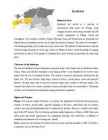
FACTFILE Area: 45 228 sq km Poplulation: under 1.4 million Capital: Tallinn Language: Estonian Currency: Eesti kroon (EEK) Main religion: Lutheran National holiday: 24 February (anniversary of the republic) National flower: Cornflower National bird: Barn Swallow National stone: Limestone LOCATION The Republic of Estonia is the northernmost and smallest of the three Baltic States. It is located on the eastern shores of the Baltic Sea in the north east of Europe. To the east the country borders Russia. Latvia is the countries neighbour to the south. From the west the coast of Estonia is washed by the Baltic Sea and from the north by the Gulf of Finland. The length of the coastline is approximately 3 800 km. The longest distance from east to west is 350 km, while north to south Estonia stretches 240 km. THE NAME The name EESTI was apparently derived from the word AISTI, the
has been created. The oldest written information about a water mill (the beginning of the 13th century) derives from this place. The best impression of the mightiness of the waterfall can be obtained in the period of high waters in spring and autumn. · Narva Stronghold is the oldest and biggest stronghold in Estonia (built in 13- 17th century) creating with the Ivangorod Stronghold on the opposite shore of the River Narva a unique architectural ensemble in Northern Europe. Three wings of the stronghold and the Tower of Tall Hermann are open to visitors. The historical interiors in the West and North wings have been restored. In the five halls of the stronghold the history of the town of Narva of the period from the 18th century until the beginning of the 20th century is on display: products of local craftsmen, flags of the guilds, arms, commodities, architectural details.
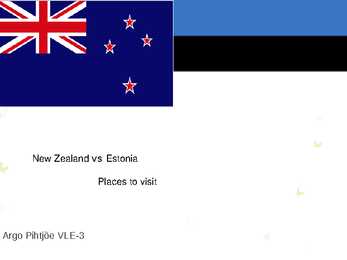
spa pool by simply digging a small hole in the sand and waiting for it to fill up with warm sea water. Kaikoura seaside town of Kaikoura overlooks majestic mountains which are snow capped for many months of the year. Kaikoura is one of the few places in the world where whales can be seen all year round. In addition, dolphin swimming, seal swimming, fishing, diving, shark diving, and a large number of both land and water based activities is available. Top ten places to visit in Estonia Tallinn Tallinn is the capital of Estonia. Toompea is the historical heart of the city. Tallinn was inscribed in the UNESCO World Heritage List in 1997. The Kadriorg Palace It was built by Italian architect Niccolo Michetti. For Peter the Great of Russia in 1718. the Office of the President. Top ten places to visit in
Names of town ● Lindanise - it was first used in 1219, derived from mythical Linda, the wife of Kalev and the mother of Kalevipoeg, national hero. ● Koluvan - found in old Russian chronicles, the name possibly deriving from the Estonian mythical hero Kalev ● Reval - used after 1219; comes from two german words ‘reh’ and ‘fall’, meaning the falling of the deer - as they fall down the Toompea hill, probably when escaping from the Danish occupation or just the hunters. ● Tallinn - used after Estonia gained its independence in 1918, origin is definitely estonian; meaning Taani-linn, tali- linn. Liberty Square ● The central square of Tallinn, it was renovated in 2008. There used to be Harju gate, which can now be seen through glass.
Estonia Where it is? Republic of Estonia is a state in the Baltic region of Northern Europe .It is bordered to the north by the Finland, to the west by the Baltic Sea, to the south by Latvia (343 km), and to the east by lake Peipus and Russia (338.6 km). Across the Baltic Sea lies Sweden in the west and Finland in the north. Towns Tallinn is the capital and the largest city of Estonia. It lies on the northern coast of Estonia, along the Gulf of Finland. There are 33 cities and several town-parish towns in the country. In total, there are 47 linna, with "linn" in English meaning both "cities" and "towns". More than 70% of the population lives in towns. History • Estonia was settled near the end of the last glacial era, beginning from around 8500 BC. Before the
Art Museum of Estonia Art Museum of Estonia was founded on November 17th, 1919, but it was not until 1921 that it got its first permanent building the Kadriorg Palace, built in the 18th century. In 1929 the palace was expropriated from the Art Museum in order to rebuild it as the residence of the President of Estonia. The Art Museum of Estonia was housed in several different temporary spaces, until it moved back to the palace in 1946. In September, 1991 the Kadriorg Palace was closed, because it had totally deteriorated by then. At the end of the year the Supreme Council of the Republic of Estonia decided to guarantee the construction of a new building for the Art
Then it was called Reval for some time and finally Estonians started to call the town Tallinn from Taanilinn (Danish town) after the Danish conquest in the 13th century. The Knights of the Sword took Tallinn from the Danes in 1227 and made Toompea their fortress. In the middle of the 14th century Denmark sold its possessions in Estonia to the German Teutonic Order; Toompea became the seat of German-born gentry. A fortified wall was built between the Toompea (the Upper Town) and the Lower Town (inhabited by people of a lower social standing), as there were conflicts between the two. The doors and the gates of the wall were locked at night, a procedure which carried on until the end of the 19th century. Tallinn joined the German-dominated Hanseatic League in 1285 and became a junction of trade between East and West: furs, honey, leather and seal fat moved west,
Its largest town is Kärdla. Name Hiiumaa is the main island of Hiiu County, called Hiiumaa or Hiiu maakond in Estonian. The Swedish and German name of the island is Dagö (day island),Dagø in Danish -- a calque of its old Finnish name Päivänsalo (day island); compare Ösel (Yösalo night island) for Saaremaa. In modern Finnish it is called Hiidenmaa, literally hiisi's land. In Old Gutnish it was Dagai (day isthmus), from which the local North Germanic name "Daë" is derived. History Archaeological evidence of the first human settlement in Hiiumaa dates to as early as the 4th century BC. The first documented record of the island of Dageida was made by contemporary chroniclers in 1228, at the time
Estonia. Estonia, officially the Republic of Estonia is a country in Northern Europe. It is the smallest of the three Baltic countries. Estonia has land borders with Latvia (339 km) to the south and Russia (229 km) to the east. It is separated from Finland in the north by the narrow Gulf of Finland and from Sweden in the west by the Baltic Sea. Estonia has been a member of the European Union since May 1, 2004 and of the NATO since March 29, 2004. The area of Estonia is about 45000 square kilometres and the population is about 1.4 million people. The capital of Estonia is Tallinn and the official language is Estonian. The currency is Eesti kroon. The main religion is Lutheran. Anniversary of the republic is celebrated on February 20
Tallinn 2008 1. Introduction Estonia is a small country about the size of Switzerland, or New Hampshire and Massachussetts combined. Estonia is named after the people called "Ests" who lived in the region in the 1 st century AD. The Republic of Estonia is one of the three countries commonly known as the "Baltic States". The other Baltic States are Latvia and Lithuania. 2. Geographical position Estonia is situated in northeastern Europe. Estonia is bounded on the north by the Gulf of Finland, on the east by Russia, on the south by Latvia and on the west by the Baltic Sea. In the north it borders on Finland. The coastline of the Baltic Sea in Estonia is characterized by numerous gulfs and bays, the biggest of them being the Gulf of Finland, the Gulf of Riga and the Gulf of Pärnu. Bays include the Narva Bay, Matsalu Bay, Kolga Bay, Kunda Bay, Tallinn Bay etc. Estonia has over 1500 islands, the largest being Saaremaa and Hiiumaa, Muhu and Vormsi.
Tallinn is a small port town in which the population is 371 000 people, and the area is only 159,2 km².( square kilometers). Tallinn, the capital of Estonia, is named after taani linnus, which means Danish castle. The Castle in question was built by King Waldemar of Denmark in the 13th century. The settlement quickly developed itself into a busy port. -The Old Town In medieval age Tallinn was called Reval and it was as big as the Tallinns Old Town is now. Uniqueness of Tallinn is that it is one of very few European cities, where the historical lay-out is kept in it's original form , and has a lot of monuments of that time. Thanks to that in 1997 Old Tallinn has been included in the list of a world heritage of UNESCO.
All the main sightseeings can be easily reached by buses, electric trains and ferries. Culture Life The identity of every city is created by its symbols, which are made up of historical buildings, monuments, holy places, people and traditions. And so it is with Pärnu. The Hansa Days, which have become a tradition and will be crowned by the International Hansa Days to be organized by Pärnu in 2010, brings artists onto the streets. The main centers for cultural activities are Enda Theatre, built in the 1960s, which greets visitors riding in from Tallinn and the Pärnu Concert Hall, located on the riverbank next to the bridge, which has a grand hall with an organ and extraordinary acoustics. Of the Pärnu festivals, many are related to music. The largest of these is the festival commemorating David Oistrakh, the world-famous violinist, also Neeme Järvi organizes festivals in Pärnu. Along with classical music, which culminates in the Glass Pearl Festival in July and
It was not until the 18th century that the name Lai also started to appear. In 1872, when the street names were being fixed, Lai remained the sole name of the street. 4 1 Lai Street / 4 Nunne Street A good example of Neo-Renaissance and early Art Nouveau styles combined is Lai Street 1, the present Youth and Puppet Theatre, erected at the beginning of the 20th century as the Nobility Club. The three-storey building replaces two medieval properties. In 1784 an amateur theatre began playing in a house situated in the same place and soon became a professional German City Theatre. The famous German writer August von Kotzebue (1761-1819), the life and soul of the theatre, lived in Tallinn for several long periods. (Otto von Kotzebue, the son of August von Kotzebue, accompanied explorer Adam Johann von Krusenstern on his Journey around the World of 18031806.) Estonian was heard
houses are the mute witnesses of those times. The riches and cultural heritage of Mulgimaa owe to the diligence and tenacity of the local people. Village handicraftsmen and masters have always been honoured. Mulgikapsad (stewed sauerkraut with barley groats), Estonian cheesecakes and kama (a roasted meal-mixture) have not lost their popularity. However, linen growers have now been replaced by cereal grains growers and many farms have specialised on raising sheep or horses. And as the song goes: "Mulgimaa it's a place where life is good. It's a land of vast woods, fertile fields and nature's charms, the home of prosperous Estonian farms..." Tourism and handicraft in Lõuna-Viljandimaa Lõuna- Viljandimaa captivates senses with its beautiful landscapes. Lõuna- Viljandimaa as we know it today stays in the heart of the historic Mulgimaa. Mulgimaa is the home of mountains, deep valleys and lakes, its natural axis is the beautiful old valley of Halliste.
Estonia Estonia, officially the Republic of Estonia, is a state in the Baltic region of Northern Europe. It is bordered to the north by the Gulf of Finland, to the west by the Baltic Sea, to the south by Latvia, and to the east by Lake Peipus and Russia. Across the Baltic Sea lies Sweden in the west and Finland in the north. The territory of Estonia covers 45,227 km 2, and is influenced by a humid continental climate. The Estonians are a Finnic people, and the official language, Estonian, is a Finno-Ugric language closely related to Finnish, and distantly to Hungarian and to the Sami languages. The population of Estonia is 1
Topic Estonia, Tallinn The Republic of Estonia is the northernmost of the three Baltic States on the eastern shore of the Baltic Sea. To the east Estonia borders on Russia and Lake Peipsi and on the south on Latvia. The area of Estonia is 45 100km2, its coastline is 774km long. The geography of the land is surprisingly varied. Islands make up 9,2 per cent of Estonian's total territory, the largest islands are Saaremaa, Hiiumaa and Vormsi. The highest point is Suur Munamägi, which is 317m high. Estonia has a surprisingly mild climate for an area so far north. Sea winds keep the weather from becoming very cold or hot. The population of Estonia is 1.5 million. Of this number 62 per cent are Estonians. Estonians speak the Estonian language, which is closely related to Finnish.
TOOMPEA Toompea (from German Domberg – Cathedral Hill ) is a limestone hill with an area of about 7 hectares in the central part of Tallinn. It towers about 30-40 m above the surrounding areas. According to the legend it´s the tumulus mound over the grave of the national hero Kalev, erected stone by stone in his memory by his grieving wife Linda. It is the birthplace of Tallinn - a place where in 1229 the Knights of the Sword built a fortress instead of the wooden Estonian stronghold. Toompea Castle is also one of the most potent symbols of the reigning power. Today Toompea is the seat of the Government of Estonia as well as the Riigikogu, both of which are often simply colloquially referred to as Toompea. For centuries there was only one access to Toompea - Pikk Jalg - but there is also another way leading up to Toompea - Lühike Jalg, which was made in the 14th century
Besides Viidumae and Vilsandi Nature Reserves, there are over two hundred single nature objects under protection - parks, high cliffs, large trees, erratic boulders and unique marshy lowlands. The meteorite crater at Kaali is the biggest in Europe and easily approachable for visitors A lot of sights. Among the numerous sights of Saaremaa, several are worth calling special attention to, e.g. Angla windmill hill, Mustjala cliff, bell tower built in the 17Ih century at Kihelkonna, manor house at Loona, ruins of Maasi castle of order, and Mihkli Farm Museum at Viki. The medieval churches of Saaremaa have remarkable archaic architecture, e.g. churches of Poide and Karja. The oldest of them - the church of Valjala - was built in the 13th century. The most important tourist sight in the only town of the county, Kuressaare (up to 1917 Arensburg) is the bishopric castle dating from the 13lh century.
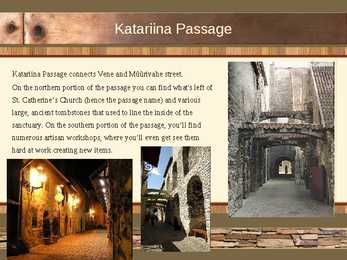
Katariina Passage Katariina Passage connects Vene and Müürivahe street. On the northern portion of the passage you can find what's left of St. Catherine's Church (hence the passage name) and various large, ancient tombstones that used to line the inside of the sanctuary. On the southern portion of the passage, you'll find numerous artisan workshops, where you'll even get see them hard at work creating new items. City wall Tallinn's medieval city wall is a sub-facility that was built
Tallinna Lillekyla Gymnaasium Report Song Festival Ground Student:Laura Kivistu Supervisor:Meeri Sild Tallinn 2008 Table of Contents 2 Introduction The topic of my report is ,,Song Festival Ground". I chose this topic, because everything what is related with music and singing is very interesting to me. Music is part of our lives. We all know that Estonians made singsong revolution.
Tallinn Mustamäe College G2K Jaana-Kristiina Jõgevest The Four oldest churches of Tallinn Report Supervisor: Ingrid Teigar Tallinn 2009 The Dome Church The Danes began fortification of Toompea after the conquest of Tallinn in 1219 and probably also built the first church there. It was presumably a wooden building located at the site of the present cathedral. However, a serious conflict with the Order of the Brothers of the Sword broke out soon as the latter wanted to gain control of the entire Estonia. The order succeeded in subordinating Tallinn and the whole of North Estonia to its rule in 1227. The monks of the Dominican Order began the construction of a stone church in Toompea in 1229. The first written data on the cathedral date back to 1233, the date of a
Sightseeing in Estonia Tallinn TV Tower The Tallinn TV Tower (Tallinna teletorn) is a free-standing structure with an observation deck, built to provide better telecommunication services for the 1980 Moscow Summer Olympics regatta event (see Sailing at the 1980 Summer Olympics). It is located near Pirita, six km north-east of the Tallinn city center. The tower has a specified height of 314 m (1030.2 ft), though some sources put it at 312.6 m (1026.6 ft). The building is administered by the public company Levira (formerly Estonian Broadcasting Transmission Center Ltd) and is a member of the World Federation of Great Towers. The tower was designed by architects David Baziladze and Juri Sinis. The cornerstone was laid on September 30, 1975, and the building was inaugurated July 11, 1980 (although the first transmission took place in 1979). The tower body was constructed of reinforced concrete
Turu Kael sidestreet. The market location perfectly suited for trade: five trade routes started there. The square is connected to Town Hall Square by a short sidestreet. Town Hall Square Was used as marketing place, for festivities as well as for executions. In summer it is filled with outdoors cafes In winter it becames a magical christmas market The L-shaped sigh There has been a town hall in Tallinn since at least 1322. Town Hall Built in 13th century The management of the city worked in the Town Hall until the year 1970 The only gothic town hall on Northern Europe Weathervane Old Thomas The height of the towe is 64 metres Town Hall pharmacy Is one of the oldest working pharmacies in Europe and the oldest company in Tallinn Was first mentioned in 1422 There were also sold other goods like: ground bats, dried frog feet etc
Sculptures and monuments St. John's Lutheran Church St John's Church was probably built in the first third of the 14th century. There is no other brick church decorated with so much terracotta plastic in Europe Eduard Tubin Monument The Eduard Tubin monument, marking the 100th birthday of the composer, was dedicated in 2005. The authors of the statue are sculptor Aili Vahtrapuu, architect Veronika Valk, with sound installations by Louis Dandrel.Eduard Tubin (1905-1982) was a versatile composer and conductor, one of the most recognized symphonists throughout history
recorded in the description of the second siege of Tallinn in 1577 as Kyck in de Kaeken, later on several forms of the same name were used, such as Kik (Kyk) in de Kok, Kiek in die Küche, Pulffer-Thurm Giecken Köck. In 1696 the present name Kiek in de Kök was also mentioned, meaning "peek into the kitchen" in Low German. And true enough, it was possible to watch what the enemy was doing in their "kitchen" i.e. on position lower down from the about 38m-high tower. Already in the late 15th century the tower was somewhat reconstructed. The outer walls were made thicker and the tower got a diameter of 17.3 m. The walls are 4 m thick but the tower was then lower than today. The waterproof upper floor made of cobblestones was open and had 22 embrasures in its parapet. The parapet must have been covered by some kind of a roof but the middle part of the floor was uncovered to get the mortars and catapults in place better.
 annaabi.ee