✔ Many opine that organic food can be afforded only by the elite strata of the society. Apart from that, large farming spaces are required to cultivate organic crops using natural manure. However, with the introduction of intensive farming, the space, equipment, and other requirements for farming are less and more economical. ✔ The EPA (Environment Protection Agency) has set certain rules and regulations on how livestock, pesticides, and animal manure are to be maintained. The farmers, who follow these set rules help to provide an affordable, safe, and healthy produce to all alike. ✔ Another advantage is that large productivity of food is possible with less amount of land. This leads to economies of scale and directly contributes towards meeting the ever-growing demand for food supplies. Disadvantages ✘ Intensive farming involves the use of various kinds of chemical fertilizers, pesticides, and insecticides
Manure, garbage, and crops such as corn, soy, and sugar cane can also be used as biomass feedstocks. We get energy from biomass by burning it. Wood chips, manure, and garbage are dried out and compressed into squares called "briquettes." Biomass can also be converted into biofuel. A major advantage of biomass is that it can be stored and used when it is needed. Negative aspects of biomass energy Growing crops for biofuels requires large amounts of land and pesticides. Some pesticides could pollute the air and water. Biomass energy can also be a non renewable energy source. If people do not replant biomass feedstocks as fast as they use them, biomass energy becomes a nonrenewable energy source. Conclusion Renewable energy is generated from natural resources. Renewable energy sources are sunlight, wind, geothermal heat, water and various forms of biomass. These renewable sources cannot be exhausted and they are constantly renewed. They do not harm the environment
grow faster and bigger. The chickens can’t carry their own weight and fall down. Employees hit and toture them. I find horrifying how the chikens are treated as plain food not living creatures. Cows and pigs are treated in the same way. Most of the food in America is controlled and manufactured by few main companies. The major food companies make huge profits of which are based on supplying cheap but contaminated food, the heavy use of petroleum-based chemicals (largely pesticides and fertilizers), and the promotion of unhealthy food consumption habits by the American public. I think that it’s absolutely wrong how the food indrustries and farms work. Nowadays, it’s all about the money. No compassion. My solution is to fight against the system. If many countries would cooperate, than there would be a chance that we could end this tragedy.
harmful after long term exposure. Such as the water pollution is global ecological problem we have to know what can we do to prevent this contamination and how to keep waters clean. There are many things we can do to help. We have to be careful about what we throw down our sink or toilet. We can't throw paints, oils or other forms of litter down the drain. By having more plants in our garden we are preventing fertiliser, pesticides and contaminated water from running off into nearby water sources. We must not throw litter into rivers, lakes or oceans. We should clean up any litter we see on beaches or in rivers and lakes, make sure it is safe to collect the litter and put it in a nearest bin. Water is a very important resource for people and the environment. We have to start saving the clean water for next generations and stop thinking only about ourselves.
Summary The present summary is based on the book "Northern Europe’s seas. Norther Europe’s environment" by Britt Aniansson. Oceans and seas are polluted every day by different substances that reach the waters from different sources on land and at the sea. The author points out four main problems in the marine environment. One of the main problems is the chemical pollution which is caused by natural or man- made halogenated compounds, pesticides, dioxins, chlorinated organic materieals and so on. These compounds are causing deformage in marine animals and are storaged in their fatty tissues. They have also been found in organisms throughout the world oceans because they are dispersed quickly by winds and currents. Another problem that affects the marine life is excess phosphorus and nitrogen flow into the sea from towns, factories and other man-made sources which cause intense algae growth.
........... in this family, so that the father found himself looking after the house and the children. (umber pöörama, vastupidiseks muutma) 15. Once the area was known for ............. in spring, now we come across ................ rivers there. (üleujutused, kuivanud) III Make up dialogues/discussions using the following words and expressions a) campaigners for green living appalling problems, reverse, consumption, contamination, depletion of ozone layer, artificial fertilizers, pesticides, recycle, local/regional/global problems, destruction, prediction, depletion, remorseless b) farmers in the Amazon region acid rain, organic farming, poverty, famine, floods, fertile land, fell trees, dry up, clog up, growth of population, disaster, beyond our control, protection, eruption, reduction c) owners of a paper factory in Estonia waste chemicals, dump industrial waste, fuel/electricity consumption, energy-efficient, beyond our control,
These obstacles have disrupted some animal's movements to traditional feeding and denning grounds. When they try to pass through a town they are often scared away or shot. With their feeding patterns disrupted, many polar bears have starved. The Alaskan oil pipeline was built across a caribou migration route. In some places the pipeline has been raised above the ground so the caribou can pass under it. Pesticides have been used to control the hordes of insects. Thousands of migrating birds come to the tundra because of the abundant insects. Through the food chain the pesticides reach many of the animals that live on the tundra. Pollution from mining and drilling for oil has polluted the air, lakes and rivers. The land around some nickel mines in Russia has become so polluted that the plants in the surrounding area have died. Footprints and tire tracks can be visible for many years after they were made
Arable farming is concentrated mainly in eastern and south-central England and in eastern Scotland. The main crops grown are wheat, barley, oilseed rape, sugar beet, potatoes and oats. There is also a significant horticultural industry producing a variety of vegetables, orchard and soft fruits, and bulbs and flowers. The high productivity of the arable sector has been achieved by the removal of hedgerows to create larger fields, by mechanization, and by the intensive use of fertilizers, pesticides, and fungicides. As with the issue of animal treatment, these trends in arable agriculture have provoked public concern. Combined, these concerns have helped encourage the rapid growth of vegetarianism in Britain since the early 1980s and the expansion of organic farming, although this is still on a very small scale. However, partly in reaction to these concerns, and partly because of costs, the trend is now towards lower chemical use in farming.
• The reservoir of viable seeds found in the soil or at its surface • Depends on the intensivity, soil type, previous cropping, cultivation and herbicide use • 1000 seeds/m2 in pastures or intensively managed arable fields • 80000 seeds/m2 in less intensively managed fields Different ways to deal with weeds • Herbicide • Non-chemical • Integrated weed management • Biological control of weeds Herbicides • ‘’Weedkiller’’ • Pesticides used to kill unwanted plants • Selective herbicides kill specific targets while leaving the desired crop unharmed • Non-selective herbicides kill all plant material with whichthey come in contact (used to clean waste ground, industrial sites, railways) • In the US, herbicides account for about 70% of all agricultural pesticide use Herbicide-resistant weeds • The inferited ability of a weed to survive a rate of herbicide, which would normally result in effective control
09.2008) 6. Mereste, U. ,,Majandusleksikon II" Tallinn 2003, 643 lk 7. Mõisted ja metoodika. Statistikaamet. Regionaalarengu andmebaas: majandus. Põllumajandus. Põllumajanduslike majapidamiste struktuur. Tööjõud. [http://pub.stat.ee/px- web.2001/Database/Majandus_regionaalne/13Pellumajandus/04Pellumajanduslike_maj apidamiste_struktuur/08Toojoud/PMS201.htm] (24.09.2008) 8. Pestitsiidide tarbimine (Pestitcides consumption). FAOSTAT. ResourceSTAT- Pesticides Trade. Pestitcides Consumption [http://faostat.fao.org/site/424/DesktopDefault.aspx?PageID=424#ancor] (20.09.2008) 9. Põllumajanduslik maa (Argicultural area). FAOSTAT. ResourceSTAT-Pesticides Trade. Land. [http://faostat.fao.org/site/377/DesktopDefault.aspx?PageID=377#ancor] (20.09.2008) 11
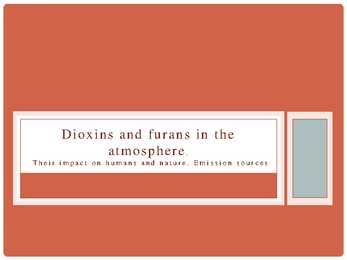
production was stopped in 1977. . Emission sources Dioxins are mainly produced as unwanted byproducts of industrial processes and there is no intentional production or use. They can also to a small extent be formed naturally in forest fires or volcanic activity. Examples of activities resulting in dioxin emissions are waste incineration, burning fuels (wood, coal or oil), chlorine bleaching of pulp and paper and chlorinated pesticides manufacturing. Burning of many materials containing chlorine, such as plastics and wood treated with pentachlorophenol also produce dioxins. According to a study in the context of the Stockholm Convention, the main sources for emissions of dioxins to air in EU25 are Residential combustion (~ 30%) Open burning of waste (backyard burning) (~15%) Wood preservation (~15%) Iron and steel industry (~ 8%) Power production, nonferrous metals, chemical industry (~ 5% each)
these processes generally involve removing carbon from or adding hydrogen to the molecules, and using fluid catalytic cracking to convert the longer, more complex molecules in the oil to the shorter, simpler ones in the fuels. Due to its high energy density, easy transportability and relative abundance, oil has become the world's most important source of energy since the mid-1950s. Petroleum is also the raw material for many chemical products, including pharmaceuticals, solvents, fertilizers, pesticides, and plastics; the 16 per cent not used for energy production is converted into these other materials. Petroleum is found in porous rock formations in the upper strata of some areas of the Earth's crust. There is also petroleum in oil sands (tar sands). Known oil reserves are typically estimated at around 190 km3 (1.2 trillion (short scale) barrels) without oil sands, or 595 km3 (3.74 trillion barrels) with oil sands. Consumption is currently around 84 million barrels (13
One of two classes of natural acidic organic polymer that can be extracted from humus found in soil, sediment, or aquatic environments. The process by which humic acid forms in humus is not well understood, but the consensus is that it accumulates gradually as a residue from the metabolism of microorganisms. Transition and heavy metals--for example, Fe3+ or Pb2+--as well as other compounds having aromatic or hydrophobic (water-insoluble) chemical structures (i.e., organic pesticides or anthropogenic hydrocarbons), react strongly with humic acid. This property makes it an effective agent in sequestering many of the pollutants in terrestrial and aquatic environments. Fulvohape Väiksema molekulmassiga kui humiinhape. This organic matter is soluble in strong acid (pH = 1) and has the average chemical formula C135H182O95N5S2. One of two classes of natural acidic organic polymer that can be extracted
C., Brown, G. G. (2007). Soil biodiversity for agricultural sustainability. – Agriculture, Ecosystems & Environment. Vol 121, No. 3, pp. 233–244. 4. David W. Crowder Randa Jabbour. Biological Control. Relationships between biodiversity and biological control in agroecosystems: Current status and future challenges 75 köide, august 2014, lk 8-17. 5. Geiger, F. Bengtsson, J. Berendse, F., Weisser, W.W., Emmerson, M., Morales, M.B., jt. 2010. Persistent negative effects of pesticides on biodiversity and biological control potential on European farmland. Basic and Applied Ecology 11: 97-105. 6. Gurr, G. M., Wratten, S. D., Luna, J. M. (2003). Multi-function agricultural biodiversity: pest management and ohter benefits. – Basic and Applied Ecology. Vol. 4, No. 2, pp. 107–116. 12 7. Parker, J. E., Crowder, D. W., Eigenbrode, S. D., Snyder, W. E. (2016). Trap crop diversity enhances crop yield
microbial population balance, particularly of N2 fixing bacteria and thereby improve soil fertility. Liming of acid soils increases activity of bacteria and actinomycetes and lowers the fungal population. Fertilizers and manures applied to the soil for increased crop production, supply food and nutrition not only to the crops but also to microorganisms in soil and thereby proliferate the activity of microbes. Foliar or soil application of different chemicals (pesticides, fungicides, nematicides etc.) in agriculture are either degraded by the soil organisms or are liable to leave toxic residues in soil which are hazardous to cause profound reduction in the normal microbial activity in the soil. 2. Soil fertility: Fertility level of the soil has a great influence on the microbial population and their activity in soil. The availability of N, P and K required for plants as well as microbes in soil determines the fertility level of soil
desertification. FIND OUT 5 WAYS HOW TO STOP GLOBAL WARMING. 3. Overpopulation: The population of the planet is reaching unsustainable levels as it faces shortage of resources like water, fuel and food. Population explosion in less developed and developing countries is straining the already scarce resources. Intensive agriculture practiced to produce food, damages the environment through use of chemical fertilizers and pesticides. FIND OUT 5 WAYS HOW TO STOP OVERPOPULATION. 4. Waste Disposal: The over consumption of resources and creation of plastics are creating a global crisis of waste disposal. Developed countries are notorious for producing an excessive amount of waste or garbage and dumping their waste in the oceans and, less developed countries. Nuclear waste disposal has tremendous health hazards associated with it. Plastic, fast food, packaging and cheap electronic wastes threaten the well being of humans.
carcinogen International Agency of Research for Cancer (1995): "Taken together, the epidemiological studies suggest a causal relationship between exposure to formaldehyde and nasopharyngeal cancer, although the conclusion is tempered by the small numbers of observed and expected cases in the cohort studies". IARC's overall evaluation is that formaldehyde is probably carcinogenic to humans (Group 2A). Later IARC classified formaldehyde as human carcinogen. Evaluating Pesticides for Carcinogenic Agency classified formaldehyde in Group B1 - probable human carcinogen, under conditions of unusually high or prolonged exposure. The National Toxicology Program, an interagency program of the Department of Health and Human Services, named formaldehyde as a known human carcinogen in its 12th Report on Carcinogens (2011). Toxicity for Reproduction Studies in Humans No increased risk of spontaneous abortion was seen after maternal or paternal exposure to
One of the advantages for adopting biofuels is the offsetting of carbon in the production process. Biofuels are carbon neutral when their combustion doesn't release any more carbon dioxide into the atmosphere, than was sequestered by the plant through photosynthesis (Rajagopal, Zilberman, 2007). Nevertheless, there are many uncertainties around the biofuels' carbon neutrality. In the production process, biofuel require significant amounts of energy for tillage, fertilizers, pesticides, irrigation and for harvesting. Nitrogen oxide from fertilisers are known to be particularly potent greenhouse gases with 300 times more potential than CO 2 and it has a harmful effect on the stratospheric ozone (Schaerlmann, Laurence, 2008). Also, as in any other agricultural production, biofuels can cause erosion and eutrophication due to fertilizer runoffs (Rajagopal, Zilberman, 2007). According to the International Energy
[2] 42. pollination; maintain biodiversity; benefits to food chain/food for other organisms; max 2 [2] 43. increased profit for farmers/shops; no residues on food; no pesticides; less use of inorganic fertilizers; less risk of pollution; benefits to soils structure and quality; benefits to biodiversity; benefits to human health; max 3 [3] 44. (i) A scapula B humerus C ulna
r --;- . =I - · Poor air qu ality' Jr - co ntm ent. Land and water po llution (fro m ferri lizers, pesticides, and ~ O· Jan Apr lu i Oct industrial wast e) lS also widespread . Since the 1960 's, th e am ounr o f "Cutes exceed ing at leasl one of the Wo rld Healt h
residue test samples (Croubels et al. 2004). the United Nations Environment Programme The FDA Center for Veterinary Medicine as those persistent chemical substances that issues the analytical criteria. The control of can accumulate in foods and cause adverse residues of these substances in meats exported effects to consumers. Most of the organo- to the European Union was further assured chlorine pesticides were banned during the by an Additional Testing Program designed 1970s and 1980s, but they are persistent and by the USDA (Croubels et al. 2004). stable and may remain in the environment The detection of these substances is quite for many years, constituting a risk of long- complex due to the large number of samples term exposure (Moats 1994). These sub- and the low levels of the substances to be stances tend to be accumulated in the fatty detected
License for the production and Ministry of Agriculture 200 GEL packaging of children's food products of Georgia Ministry of Environment License for the production 280 GEL Protection and Natural of biological pesticides Resources of Georgia General license for trading military 2,000 GEL Ministry of Defense of Georgia arms License for trading a specific 100 GEL Ministry of Defense of Georgia type of weaponry License fee for production
5 costumes,bright decorations and a lotsof a to showpeoplehow they feel. T danc ing. 3 'Act Now' is for children. F (5 marks) 4 Danwantsto teachpeoplehow to use and pesticides. fertilizers F Communication 5 'Act Now'arranges publicprotestsand ' demonstrations. T Fnd the questionwhichmatches
5 costumes,bright decorations and a lotsof a to showpeoplehow they feel. T danc ing. 3 'Act Now' is for children. F (5 marks) 4 Danwantsto teachpeoplehow to use and pesticides. fertilizers F Communication 5 'Act Now'arranges publicprotestsand ' demonstrations. T Fnd the questionwhichmatches
5 costumes,bright decorations and a lotsof a to showpeoplehow they feel. T danc ing. 3 'Act Now' is for children. F (5 marks) 4 Danwantsto teachpeoplehow to use and pesticides. fertilizers F Communication 5 'Act Now'arranges publicprotestsand ' demonstrations. T Fnd the questionwhichmatches
5 costumes,bright decorations and a lotsof a to showpeoplehow they feel. T danc ing. 3 'Act Now' is for children. F (5 marks) 4 Danwantsto teachpeoplehow to use and pesticides. fertilizers F Communication 5 'Act Now'arranges publicprotestsand ' demonstrations. T Fnd the questionwhichmatches
High iron stores have been correlated to an increased number of heart attacks in otherwise symptom-free males, and blood donation has conversely been correlated to a decrease in "cardiovascular incidents." Drs. Michael and Mary Dan Eades suggest aiming for blood ferritin levels of 50 mg/dl, which, if your levels aren't over 400, can usually be achieved with 14 whole blood donations spread two months apart.6 No leeches required. If you'd like to increase the removal of pesticides and other environmental toxins normally stored in fat, you can do two things: schedule to donate a double portion of plasma, and drink a cup of ca einated co ee about 60 minutes before going to the center. Donated blood will always contain such toxins, so you are not being a bad citizen by temporarily increasing their excretion. Though some scientists argue that iron depletion is necessary for full cardiac bene ts, I see no
 annaabi.ee