 10 punkti
Autor soovib selle materjali allalaadimise eest saada 10 punkti.
10 punkti
Autor soovib selle materjali allalaadimise eest saada 10 punkti.
 ~ 2 lehte
Lehekülgede arv dokumendis
~ 2 lehte
Lehekülgede arv dokumendis
 2011-09-20
Kuupäev, millal dokument üles laeti
2011-09-20
Kuupäev, millal dokument üles laeti
 10 laadimist
Kokku alla laetud
10 laadimist
Kokku alla laetud
 0 arvamust
Teiste kasutajate poolt lisatud kommentaarid
0 arvamust
Teiste kasutajate poolt lisatud kommentaarid
 pkg11
Õppematerjali autor
pkg11
Õppematerjali autor
Medieval England 1066-1485 Eva Asper Anna Pohlak 11.c The Norman Dynasty The Norman Conquest In the 11th century, Normans conquered England - The Battle of Hastings 14.10.1066 The Anglo-Saxon forces had more soldiers but the Normans had better military tactics and won in the end thanks to a clever strategy William I, also known as William the Conqueror, replaced King Harold on the throne The invasion was completed by 1071 - The Norman invasion is depicted on the Bayeux Tapestry a long embroidered cloth The death of King Harold embroidered on the Bayeux Tapestry The Norman England William I ensured his power by dividing the land into parts and making 1/7 of it a royal domain He made his nobles swear an oath of allegiance and become his vassals Died in 1087 while fighting in France, was succeeded by his third son, William II Rufus William II was very unpopular:
British kings and queens Kings King Henry VIII King Henry VIII is arguably the most well-known king of England. Famous for beheading his wives, of which he had six, King Henry VIII also had several children. King James I King James I was already King of Scotland when he got the English crown. King James I was the first ruler to call himself King of Great Britain, as he ruled England, Scotland and Wales. King James was the first King of Great Britain. King William I, the Conqueror King William I, otherwise known as William the Conqueror was born in France on 1028. He became friendly with the current English King, Edward the Confessor. He invaded and attacked England on Edward's death, as he was promised the English crown, but then denied it by the Saxon Harold. King George VI King George VI did not expect to become king, he was the shy brother of Edward VIII who only took the thrown when Edward abdicated. King George VI ruled during World War
The Middle Ages The Middle Ages are one of the most turbulent periods in English history. The Middle Ages are so called as the middle period between the decline of the Roman Empire and the Renaissance. The Middle Ages started in 1066. with the Battle of Hastings and the Norman Conquest. William the Conqueror took all the lands from the Saxon English and gave these to French nobles. Normans were known as great builders. This is assured by the fact that many great castles and other buildings, including the Tower of London, were built during the Norman Conquest. In 1086. Domesday Book was compiled. It is a detailed survey of England ordered by William the Conqueror. The reign of King William Rufus who was the son of William started in 1087 and lasted until 1100. Next king was Henry I who was the brother of William Rufus. His reign was from 1100-1135. In 1135 Henry I nephew Stephen got to the throne of England and reigned the country for 19 years. He was th
LONDON HISTORY PERIOD EVENTS PEOPLE The Celtic period (400 BC Name: Celtic words (Llyn (a lake) + AD 43) Dun (a fort or strong place) ) Not important The Roman occupation (AD 43 Londinium not important Boadicea a revolt against - AD 410) politically. An important trading the Roman conquest centre. Devastation AD 61. Rebuilt. Roman walls built in AD 200. Anglo Saxons (AD 400 Destroyed the Roman towns. Many 1066) kingdoms. London in ruins. King Egbert one Flourishing. Attacks by Vikings. kingdom England (the 9th century)
Avinurme Gümnaasium Referaat Suurbritannia Andres Oja Juhendaja: Ene Lüüs Avinurme 2010 Lipp ja vapp Suurbritannia lipp ehk Union Jack on Suurbritannia riigilipp ja endise Briti impeeriumi lipp. Lipu praegune kujundus pärineb 1801. aastast. Lipp on saadud Inglismaa, Sotimaa ja Põhja-Iirimaa lippude kombineerimisel. Suurbritannia vapil on esindatud Ühendkuningriigi erinevad osad. Vapikilbi esimesel ja neljandal väljal asuvad Inglismaa kolm leopardi. Teisel väljal on Soti lõvi ja kolmandal väljal Iirimaa harf. Vasakult toetab vapikilpi krooniga inglise lõvi ja paremalt soti ükssarvik.
2. saj Roomlased ehitasid Britannia provintsi kaitseks Hadrianuse ja Antoniuse vallid. 5. saj 410 lahkusid viimased Lääne-Rooma leegionid Britanniast. Algas germaani hõimude (anglosakside) sissetung seni keltidega asustatud Inglismaale. Püha Patrick ristiusustas suurema osa iirlastest; kloostrikultuuri algus Briti saartel. 7. saj Suurem osa Inglismaa anglosaksidest elanikke oli sajandi lõpuks vastu võtnud ristiusu. 8. saj 793 viikingid rüüstasid Lindisfarne kloostrit; viikingiaja algus. 11. saj 1016-1035 Inglismaa kuulus Taani kuningas Knut Suure suurriigi koosseisu. 1066 Normandia hertson Guillaume II lõi Hastingsi lahingus anglosakside väge ja krooniti William I Vallutaja nime all Inglise kuningaks. 13
2.saj · Roomlased ehitasid Britannia provintsi kaitseks Hadrianuse ja Antoniuse vallid. 5.saj · 410 lahkusid viimased Lääne-Rooma leegionid Britanniast. · Algas germaani hõimude (anglosakside) sissetung seni keltidega asustatud Inglismaale. · Püha Patrick ristiusustas suurema osa iirlastest; kloostrikultuuri algus Briti saartel. 7.saj · Suurem osa Inglismaa anglosaksidest elanikke oli sajandi lõpuks vastu võtnud ristiusu. 8.saj · 793 viikingid rüüstasid Lindisfarne kloostrit; viikingiaja algus. 11.saj · 1016-1035 Inglismaa kuulus Taani kuningas Knut Suure suurriigi koosseisu. · 1066 Normandia hertson Guillaume II lõi Hastingsi lahingus anglosakside väge ja krooniti William I Vallutaja nime all Inglise kuningaks. 13
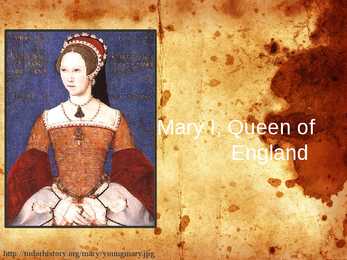
Mary I, Queen of England http://tudorhistory.org/mary/youngmary.jpg Queen Mary I of England Born: 18 February 1516 Proclaimed Queen: 19 July 1553 at St. Paul's Cathedral Coronation: 1 October 1553 Died: 17 November 1558 Buried: 14 Decenber 1558 http://tudorhistory.org/mary/marywhitehall.jpg Mary Tudor The Tudor Britain (1485-1603) Daughter of Henry VIII and Catherine of Aragon Henry divorced Catherine and married Anne Boleyn From "princess" to "The Lady Mary" http://tudorhistory.org/mary/marytudorsig.gif http://tudorhistory.org/elizabeth/signature.gif Catherine of Aragon 16 Dec 1485- 7 Jan 1536 Born in Toledo's Palace, Spain Youngest child Ferdinand and Isabella Married to Prince Arthur: 14 Nov 1501 Married to King Henry VIII: 11 June 1
 annaabi.ee








Kõik kommentaarid