Independence Day On 24 February, Independence Day is celebrated in the Rebublic of Estonia. This is the day that the Manifesto was declared in Tallinn 91 years ago. In responce to a period of Russification initiated by the Russian empire in the 1890's, Estonian nationalism took on more political tones, with intellectuals first calling for greater autonomy, and later, complete independence from the Russian empire. Following the Bolshevik takeover of power in Russia after the October Revolution of 1917 and German victories against the Russian army, between the Russian Red Army's retreat and the arrival of advancing German troops, the Committee of Elders of the Maapäev issued the Estonian Declaration of Independence in Pärnu on February 24, 1918. after winning the Estonian Liberation War against Soviet Russia and at the same time German Freekorps volunteers (the Tartu Peace Treaty was signed on 2 February 1920), Estonia maintai...
February 24: Independence Day The Republic of Estonia was founded on February 24, 1918 when the Salvation Committee, Päästekomitee, declared the independence of the Republic of Estonia. This date was celebrated as the Day of Independence until the Soviet occupation of Estonia in 1940. During the Soviet occupation, the Independence Day was festively celebrated in Estonian communities around the world. Every year, the US Secretary of State sent greetings on the occasion to the Ambassador of the Republic of Estonia to the United States, Ernst Jaakson. On February 24, 1989, the red flag of Soviet Estonia was replaced by the blue-black-white Estonian national flag on Toompea and since that time the Independence Day has been celebrated as a public holiday again. This year Estonia will celebrate the 83rd anniversary of the declaration of the state independence. A Quest for Independence For centur...
Estonian national holidays Christmas Christmas , also referred to as Christmas Day, is an annual holiday celebrated on December 25 or January 7 that commemorates the birth of Jesus of Nazareth. Modern customs of the holiday include gift-giving, Church celebrations, and the display of various decorations--including the Christmas tree, lights, mistletoe, nativity scenes, and holly. In many countries there are many different types of decorations used depending on the traditions and available resources. However , in Estonia people bring Christmas tree in and decorate it with straw ,glass balls and candles. Estonians eat sauerkraut and black pudding. On the 24th December people leave work early, families gather, Santa Clouse comes , everybody gives gifts. People are very calm at Christmas time and they support each other. New Year's Eve New Year's Eve is on December 3...
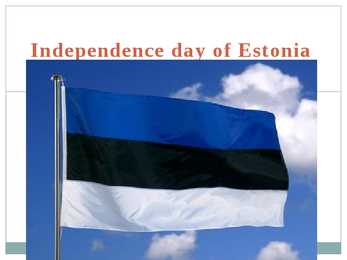
Independence day of Estonia Independence Day, officially known as Eesti Vabariigi aastapäev is a federal holiday in Estonia when it declared independence in 1918 February 24: Independence Day The Republic of Estonia was founded on 24 February 1918, when the Salvation Committee (Päästekomitee) declared the independence of the Republic of Estonia. A Quest for Independence The 1917 revolution and the generally unstable situation in Russia created the opportunity for Estonia to gain its independence. Celebration of the 95th Anniversary of the Proclamation of the State Independence of the Republic of Estonia Saturday, 23 February 11.00 Placing of wreaths on the graves of Estonian state figures 13.00 Handing out of state decorations by President of the Republic Toomas Hendrik Ilves Sunday, 24 February 07.33 Formal flag-raising ceremony on Pikk Hermann tower in Tallinn ...
1) INDIAN ROCK ART: A NATIONAL TREASURE IN DANGER Unrecognized, unprotected, this priceless legacy of primitive art has endured the ravages of nature only to fall victim to wanton destruction by ,,civilized" man. Like the huge stone statues of Easter Island and prehistoric cave paintings of Altamira and Lascaux, North American Indian rock art is surrounded by an atmosphere of mystery. Although examples of rock art exist at some 15000 sites in canyons, deserts, caves and river gorges. Nowadays, however, primitive rock art in the United States has become a new field of scientific study. Klaus F Wellmann wrote two books about rock art. He is a professor of medicine. Rock art represents the history of aboriginal Americans. In the most cases the art is an expression of ideas and way of life, ritual ceremonies, hunting, fighting. The pictures of people and animals are often strikingly lifelike and artistic. Many of these ancient relics have ...
Estonian holidays Robert Rootsi Allan Marran LE10 Christmas Christmas , also referred to as Christmas Day, is an annual holiday celebrated on December 25 or January 7 that commemorates the birth of Jesus of Nazareth. Modern customs of the holiday include gift-giving, Church celebrations, and the display of various. Estonian people bring Christmas tree indoors and decorate it with straw ,glass balls and candles. On the 24th December people leave work early, families gather, Santa Clouse comes , everybody gives gifts. People are very calm at Christmas time and they support each other. New Year's Eve New Year's Eve is on December 31, the final day of the Gregorian year, and the day before New Year's Day. New Year' s Eve is celebrated all around world because it's final day of the Gregorian year. New Year's Eve is usually celebrated with families or with...
Estonian Public holidays New Year's Day January 1 New Year is the time at which a new calendar year begins and the calendar's year count is incremented. In many cultures, the event is celebrated in some manner. The New Year of the Gregorian calendar, today in worldwide use, falls on 1 January, as was the case with theRoman calendar. There are numerous calendars that remain in regional use that calculate the New Year differently Independence Day Independence from the Russian Empire in 1918. Independence re-declared from the Soviet Union in 1991 An Independence Day is an annual event commemorating the anniversary of a nation's assumption of independent statehood, usually after ceasing to be a group or part of another nation or state; more rarely after the end of a military occupation. Most countries observe their respective independence days as a national holiday, and in some cases the observance date is controversial or contested. Goo...
The Most Interesting Historical Events in Estonia Liana Põldver · The nationwide Song Festival tradition began with the first Song Festival in Tartu, June 18 20, 1869. · 1860 marks the beginning of the period of the National Awakening. A singing society led by Johann Voldemar Jannsen started and carried through the nationwide idea of Song Festival. · During 1879 1910 six Song Festivals were held that played an important part in the nation's cultural and economical awakening and growth. In the independent Estonian Republic the Song Festivals were held in every five years (1923 1938). After World War II, the Song Festival tradition began again in 1947. Since 1950 General Song Festivals were held in every five years again. 1969 was an exception though when 100th anniversary of the Song Festival was celebrated. · The foreign authorities have tried to use the ...
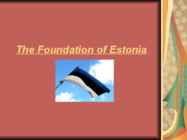
The Foundation of Estonia Estonia The history of Estonia The history of Estonia is a part of the history of Europe. Estonia was settled near the end of the last glacial era, beginning from around 8500 BC. Before the Germans invaded in the 13th century proto-Estonians of the Ancient Estonia worshipped the spirits of nature. Since the Northern Crusades Estonia became a battleground for centuries where Denmark, Germany, Russia, Sweden and Poland fought their many wars over controlling the important geographical position of the country as a gateway between East and West. Being conquered by Danes and Germans in 1227, Estonia was ruled initially by Denmark in the north, by the Livonian Order, an autonomous part of the Monastic state of the Teutonic Knights and Baltic German ecclesiastical states of the Holy Roman Empire. From 1418–1562 the whole of Estonia was part of the Livonian Confederation. A...
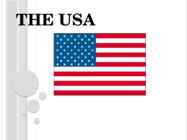
THE USA INTRODUCTION • USA located almost entirely in North America, comprising also a state in Oceania. • The United States of America have 50 states and 14 islands. • The United States of America, the third largest country by size in the world. • The country bordered with Mexico on the South and Canada on the North PRESIDENT AND CURRENCY The president of the US is Barack Obama The currency is the dollar INTRESTING FACTS Population: 296, 483, 000 Capital: Washington D.C Language: English, Spanish Independence day: 4th July 1776 Over 312 million people live in the United States. The most populated state in USA is California, with over 37 million people. TRADITSIONS Thanksgiving Day Christmas Independence Day PLACES TO VISIT The largest mountain: Rocky Mountains The largest river: Mississippi River The ...
Estonia Tjorn Treu KP-31 Information · Area- 45,227 km2 · Population- 1,282,963(2011 july) · Location- Baltic Region of Northern Europe · Capital- Tallinn · Main cities- Tallinn,Pärnu,Tartu,Narva · Official Language- Estonia · Political structure- democraic republic National symbols Flag- Coat of arms- Anthem-"My Fatherland, My Happiness and Joy,, Plant-cornflower Bird-chimney swallow Stone-slate Tree- Oak History DATES Independence Day (Iseseisvuspäev) - February 24 May Day (kevadpüha) - May 1 National Flag Day (Eesti lipu päev) - June 4 Victory Day (võidupüha) - June 23 St. John's Day (Jaanipaev) - June 24 Day of Restoration of Independence (taasiseseisvumispäev) - August 20 history EVENTS Viljandi Folk Music Festival - July Ollesummer (Beer Summer) July The All-Estonian Song Festival (Laulupidu) takes place every five years in Tallin...
Independence day 24 February. Estonian people often have a day-off from school and work, to celebrate this day. People often make big dinners and sit around in the circle of family. They often light a few candles on the window and all houses have an Estonian flag out. This is by law the most important holiday, commemorating the declaration of independence in 1918. New Year's Eve 31December The New Year's Eve is an event that happens when Estonians celebrates the end of one year and the beginning of the next year. Estonians launch a big amount of fireworks up to the sky at midnight. It's a celebration with family and friends. After launcing the fireworks people watch and toast and wich a happy new year to each other. Christmas Eve 24 December Most of the traditions, such as Christmas dinner and gift giving are observed in Estonia on this day. Santa Claus visits homes in person, played by an older family member or a rent-a-Santa. In Est...
Estonian War of Independence During World War I the greatest colonial power in Europe the Russian Empire seized to exist. On its ruins the formerly enchained nations founded their own states. Among them was the Estonian Republic, officially declared on February 24, 1918. When Germany surrendered to the Western Allies on November 11, 1918 a strategic vacuum arose in Eastern Europe. The new rulers of Russia the Bolsheviks decided to use it as a proper moment to re-conquer their lost territories. The ultimate goal was international communist revolution and Germany was the first standing on their way. Thus on November 13, 1918 the Government of Soviet Russia denounced peace with Germany. On November 16 the Commander-in-Chief of the Red Army, Jukums Vacietis, gave orders to start a massive attack on a long front from the Gulf of Finland to the Ukraine. On November 28, two divisions of the Red Army (altogether 12,000 troops) crossed...
HISTORY OF ESTONIA Estonians are one of the longest-settled European peoples, whose forebears, known as the "comb pottery" people, lived on the southeastern shores of the Baltic Sea over 5,000 years ago. Like other early agricultural societies, Estonians were organized into economically self-sufficient, male-dominated clans with few differences in wealth or social power. By the early Middle Ages most Estonians were small landholders, with farmsteads primarily organized by village. With the collapse of the Russian empire in World War I, Russia's provisional government granted national autonomy to Estonia. A popularly elected assembly (Maapaev) was formed but was quickly forced underground by opposing extremist political forces. The Committee of Elders of the underground Maapaev announced the Republic of Estonia on February 24, 1918, 1 day before German troops invaded. After the withdrawal of Ger...
*Estonians conquered by the crusaders 1208 *Reformation 16th century establishments of new school, Estonians first book appeared in 1525 *Tartu University 1632 founded by King Gustavus II Adolphus, classical university, member of the Coimbra group *Abolition of serfdom 1816 *Song festival 1869 in Tartu, an organiser was J.V.Jannsen, 822 singers, men only *Declaration of independence 24th February 1918 *War of independence 1918-1920 during the Russian Civil War, resulted in a victory for Estonia *Deportation 1949 *Estonia becomes independent 20th August 1991 *Joining EU 1st May 2004 Language: Estonian language, belongs to the Balti-Finnic group of the Finno-Ugric languages, closely realted to Finnish and rather remotely to Hungarian; Latin alphabet with 32 letters , 5 of which occur only in foreign words, the phenomes include 9 vowels and 18 consonants; words are borrowed from Latin, Greek, English etc.; sinc...
Holidays, Festivals, Cultural events TALLINN - If you're looking for entertainment in Estonia this summer, you are really spoiled for choice. Festivals and events dedicated to the consumption of beer are a lot of fun, but if you want to get the true feel of the country, you need something a little more ethnic. Like a town fair. Just as July becomes August, the seaside town of Haapsalu will host a grand spectacle of rural Estonian entertainment. The White Lady Days is a summer celebration filled with amusement for all the family. Held in and around the remains of the Teutonic-knights-era castles, the fair combines enchanting medieval legends with modern countryside charm to create a comprehensive experience of Estonia beyond the big cities. But the legend of the White Lady of Haapsalu, which is at the heart of the festival, is perhaps the most famous tall tale of the many that are so abundant in Estonia's folklore. It is the story of...
Culture of the United States About · The United States is a multicultural nation, home to a wide variety of ethnic groups, traditions, and values. · A side from the now small Native American and Native Hawaiian populations, nearly all Americans or their ancestors immigrated within the past five centuries. · Mainstream American culture is a Western culture largely derived from the traditions of European immigrants with influences from many other sources, such as traditions brought by slaves from Africa. Food · Slow-cooked pork and beef barbecue, crab cakes, potato chips, and chocolat chip cookies are distinctively American styles. · Characteristic dishes (apple pie, fried chicken, pizza, hamburgers, and hot dogs or french fries) · Highly sweetened soft drinks Music · American contemporary music can be heard all over the world, through MTV, Chann...
Mari-Liisa Reigo Jaanipäev Jaaniõhtu, also called Jaanilaupäev and Jaanipäev are the most important days in the Estonian calendar, apart from Christmas. The short summer seasons with long days and brief nights hold special significance for the people of Estonia. Jaanipäev is celebrated in the night between 23rd and 24th of June, a few days after the summer solstice, when night seems to be non-existent. For Estonians, Jaanipäev celebrations were merged with the celebration of Võidupüha during the War of Independence when Estonian forces defeated the German troops on 23 June 1919. After this battle against Estonia's traditional oppressors, Jaaniõhtu and the lighting of the traditional bonfires became linked with the ideals of independence and freedom. Jaanipäev marks a change in the farming year, specif...
Singing Revolution To the end of 80s, the Soviet Union folks didn't want to live under socialistic- communistic order anymore. The Soviet Union was protected with the Iron Curtain, which symbol was the Berlin wall. At the same time, not only Estonia, but also other countries that were under the authority of the Soviet Union, increased the independence efforts. People didn't want to live like this anymore, it was based on fear and commands. The start of the Estonian public announcement of the reindependence is probably the Singing Revolution. To begin with, the Singing Revolution was a non-violent wish expressing and embarked on the Soviet Union to fall apart. The Singing Revolution is a commonly used name for events between 1987 and 1990 that led to the restoration of the independence of Estonia and also Latvia and Lithuania. Afterwards, there was a spontaneous mass night-...
Estonia Estonia is a small country in Northern Europe with an area of about 45 000 sq km. As a part of the East-European Plain, the country has a rather flat surface. The highest and most diverse region in Estonia is in the south-eastern part of the country. At 318 metres, Suur Munamägi is not only the highest point in Estonia, but of all the Baltic countries. There are about 1500 islands in Estonia, the biggest of which being Saaremaa and Hiiumaa. Sixty-four species of mammals have been recorded in Estonia, three of them have been introduced: the racoon dog, the American mink and the muskrat. A couple of species have been re-introduced The European beaver, who was hunted to extinction by the end of the 19th century. A vital population of them now exists in Estonia once again. Another re- introduced species is the red deer. An attempt has been made in Estonia in recent years to disperse the p...
The United States of America. History. For thousands of years America was unknown to Europe. There lived only the native people, who had come from Siberia many thousand years ago by a land bridge. They had spread over the country, varying enormously from nomadic food gatherers to fishing societies. Then the Vikings visited Canada around AD 1000, but they did not stay. In 1492 Christopher Columbus discovered America while trying to reach India. He named the native people Indians, because he though he had reached India. He didn't stay either and in the sixteenth century the first Europeans to settle in America were the Spanish, the English and the French. The first village founded by the English settlers was in Virginia in 1607. It was called Jamestown. They didn't have good relations with the Indians and many of them died. But Pocahontas, the daughter of an Indian chief, became their friend and helped them....
The Estonian War of Independence The Estonian War of Independence began with the attack of the Red Army of the Soviet Russia on Narva on the 28 November 1918 and lasted until a ceasefire on the 3 January 1920 (juridically until the 2 February 1920). In the War of Independence, Estonia received support from the UK, Finland, Latvia and the White Russian Northwestern Army. In the defence of the independent statehood of Estonia in the battlefield participated at least 130 students and 11 teachers of the Gymnasium for Boys, which was the name for Gustav Adolf Grammar School at that time. Johan Laidoner has said that it was the schoolboys who brought "the belief, that we would win and that is the greatest gift they have given to the Republic during its birth." (point to the list of students on the slide.) The youngest students of our school in the War of Independence were 15 and the oldest, Martin Hendrikson, cele...
The Day After Tomorrow The Day After Tomorrow is a disaster film dealing with global warming starring with Dennis Quaid in the role of government climatologist Jack Hall, Jake Gyllenhaal in the role of Jack's son, Ian Holm in the role of Jack's colleague and Sela Ward in the role of Sam's best friend . Film is directed by Roland Emmerich who has also directed the film Independence Day. This film talks about global catastrophe, where second ice age is coming with a huge storm before it. A climatologist Jack Hall's researches show that his fears are coming true. He must go to the White House to warn everybody, but in addition he must reach to New York to save his son who is draped in a library by storm. On the plus side the movie is visually stunning. Special effects are great and there is plenty of action to keep you in front of the screen. On the other hand some people may not like how far all this climate changing has taken and f...
Trindidad and Tobago 14Meh Kaur Ülejõe Official name of the country • Official name of the country is Republic of Trinidad and Tobago Motto • "Together we aspire, Together we achieve" National anthem • "Forged from the Love of Liberty" https://www.youtube.com/watch?v=7au6DJfG7zY Independence day • 1 August 1976 Polity/ Government/Head of state • Trinidad and Tobago is a republic with a two-party system and a bicameral parliamentary system based on the Westminster System. The head of state of Trinidad and Tobago is the President, currently Anthony Carmona. The head of government is the Prime Minister, currently Keith Rowley. The President is elected by an Electoral college consisting of the full membership of both houses of Parliament. Capital city • Port of Spain Largest city • Chaguanas Official language • Official language is English Top10 non-English languages spoken • Trinidadian Creole 1m...
Official name: Republic of Estonia Territory: 45 227 km Population: 1 342 000 Official languafe: Estonian Largest ethnic groups: Estonians 68%, Russians 26%, Ukrainians 25, Belarussians 1%, Finns 1% Capital of Estonia: Tallinn Number of islands: 1 521 Highest point: Suur-Munamagi (Great Egg Hill) 318 m Religion: Lutheran Currency: Estonian Kroon (EEK),1 EUR = 15,65 EEK Estonia has two Independence Days - Estonia first achieved independence from the Soviet Union on the 24th February 1918 and again on the 20th August 1991 after 51 years of occupation. The second date is known as the Restoration of Independence Day The Estonian language belongs to the Finno-Ugric group and is most similar to Finnish Estonia was the first country in the world to introduce online political voting Estonia won the Eurovision Song Contest in 2001 with the song Everybody There are over 1500 Islands, 1000 lakes and 7000 rivers in Estonia Chess Grandmaster Paul ...
The History Of Flag Day The Fourth of July was traditionally celebrated as America's birthday, but the idea of an annual day specifically celebrating the Flag is believed to have first originated in 1885. BJ Cigrand, a schoolteacher, arranged for the pupils in the Fredonia, Wisconsin Public School, District 6, to observe June 14 (the 108th anniversary of the official adoption of The Stars and Stripes) as 'Flag Birthday'. In numerous magazines and newspaper articles and public addresses over the following years, Cigrand continued to enthusiastically advocate the observance of June 14 as 'Flag Birthday', or 'Flag Day'. On June 14, 1889, George Balch, a kindergarten teacher in New York City, planned appropriate ceremonies for the children of his school, and his idea of observing Flag Day was later adopted by the State Board of Education of New York. On June 14, 1891, the Betsy Ross House in Philadelphia held a Fla...
Estonia and what you know about it By Anšiel and Liza National symbols • The flag is blue, black and white horisontal lines, It represents the blue sky, the dirt, purity or snow. • The national bird is a swallow. • The national flower is a cornflower. History • The first settelments in Estonia came by supposedly about 11 000 years ago. • In the past most Estonians worshipped spirits of nature and their beliefs were seen as unholy by christian crusaders. Taara is believed to have been the name of the old Estonian god. • Starting with the Northern Crusades in the Middle Ages, Estonia became a battleground for centuries where many countries fought their wars over controlling the important geographical position of the country as a gateway between East and West, despite this the country has survived. • Estonia first got it’s independence in 1918 wich lasted 22 years. • The first president of Estonia during this period was Kon...
Tallinn English College Topic Estonia Tallinn 2008 1. Introduction Estonia is a small country about the size of Switzerland, or New Hampshire and Massachussetts combined. Estonia is named after the people called "Ests" who lived in the region in the 1 st century AD. The Republic of Estonia is one of the three countries commonly known as the "Baltic States". The other Baltic States are Latvia and Lithuania. 2. Geographical position Estonia is situated in northeastern Europe. Estonia is bounded on the north by the Gulf of Finland, on the east by Russia, on the south by Latvia and on the west by the Baltic Sea. In the north it borders on Finland. The coastline of the Baltic Sea in Estonia is characterized by numerous gulfs and bays, the biggest of them being the Gulf of Finland, the Gulf of Riga and the Gulf of Pärnu. Bays include the Narva Bay, Matsalu Bay, Kolga Bay, Kunda Bay, Tallinn Bay etc....
Canada Mary-Liis Kull KiNG 10.klass Basic information Area is about 10 million sq km Popluation is estimately 35 million people The country is bilingual (English and French) The National Holiday is Independence Day on July 1'st The capital is Ottawa and the largest city is Toronto Basic information Consists of 10 provinces and 3 territories Extends from the Atlantic to the Pacific and northward into the Arctic Ocean Shares land borders with the U.S Is a federal state, governed as a parliamentary democracy and a constitutional monarchy Canada comes from the word kanata, meaning village or settlement History The first inhabitants were the Inuits (Eskimo) First white man in the country John Cabot The French and British colonies settled the Atlantic coast in the late 15th century Later on, thousands of British colonists emigrated to Canada from the American colonies and the...
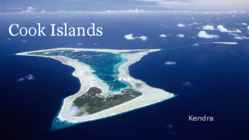
Cook Islands Kendra Location Capital: Avarua South Pacific Ocean 15 islands, 9 main islands Rarotonga Area: 240 square km Time zone: 12h behind Associated: New Zealand Geography Capital: Avarua Divided into two Coastline: 120km Natural resources: coconuts Climate: Tropical Mountainous, volcanoes, palms, soils, caves, People European, Chineese, African settlers Polynesian roots 2 polynesian languages: Pukapuka and other islands Official language Cook Islands Maori, English Population: 14,974 Villages, farms Politics Left: Henry Puna, right: John Key Self-governing state In international treaties Head of state: British monarch Parliamentary elections: 4 years Independence: 4th August 1965 Political parties: Cook islands party, the Democratic Economy Few natural resources: cobalt, phosphate Inadequate infrastructure Main industries: Tourism, fishing, banking, mining Export: citrus & tropical fruits, handicraft...
The USA- culture & traditions Carmely Reiska 12.2 Religion and beliefs ★ 70-80% Christian ★ Judaism faith ★ Mormons and Shakers ★ Religion in politics Taboos in public ★ Do not spit. ★ Do not discuss race, religion or politics. ★ Do not swear. ★ Do not discuss the wrong/rights about abortion. ★ Do not assume you can smoke anywhere, even outside. Traditional American dishes Reuben Sandwich Bagel and Lox American Hamburger Apple Pie Drop Biscuits and Sausage Gravy Clam Chowder Hominy Grits Barbecue Ribs Tacos American fashion ★ Mostly informal ★ Blue jeans ★ Cowboy hat ★ Cowboy boots ★ Motorcycle jacket Sports ★ American football ★ Baseball ★ Basketball ★ Ice-hock...
United States Armed Forces Timothy Tamm 2011 Consists of Army Navy Marine Corps Air Force Coast Guard Hierarchy President Secretary of Defense Joint Chiefs of Staff Department of Defense Headquarters Click to edit Master text styles Second level Third level Fourth level Fifth level http://upload.wikimedia.org/wikipedia/commons/thumb/0/0c/The_Pentagon_January_2008.jpg/800px-The_Pentagon_January_2008.jpg The Pentagon Budget $549,1 billion 43% of th...
Anni Sandra Varblane Text Analysis 1 Pille Põiklik October 8, 2013 She Set a Path for a Modern-Day Woman Jordan Baker did not play a primary character in The Great Gatsby and she definitely did not start out as the most likeable one, yet oddly enough, she ended up being my favourite. The reason for that is simple: she portrayed a present-day woman who might have been vain, and at times, careless but she was also fairly independent and knew how to take care of herself in a world where women were thought of as nothing more than merely housewives. I truly respect the qualities she possessed, even tho...
HISTORY PRECOLONIAL AMERICA Before the first Europen settlers came, various groups of interrelated cultures lived there. Such as the Tingits, the Nootka, the Yurok and many more. Indigenous people mostly fished, because there vas a vast stock of fish. But they also relied upon agriculture, hunting and trapping. They built stable villages, and lived either in birchcovered wigwams or in rectangular longhouses. Later the indigenous people were called indians, by Christopher Columbus who thought that he had reached to India. COLONIAL AMERICA As far as people know were the Vikings first European settlers to visit America. but in 1492, an Italian sailor called Christopher Columbus reached southern America when he was looking for a sea route from Europe to India. He is called to be the man who discovered America. In 1607 two very different groups of English people came to America. a group of farmers began a...
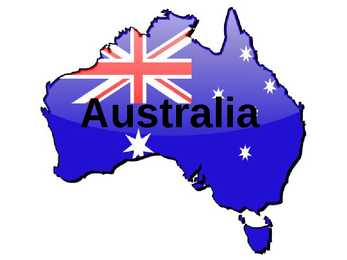
Australia Geography Location: between the Pacific and Indian Ocean Total area: 7,7 million sq km Coastline: 25,760 km Climate: varies widely Nature: extremely diverse Political system Capital: Canberra Government type: federal parliamentary democracy Independence: 1 January 1901 National holiday: Australia Day Monarch Queen Elizabeth II Prime Minister Julia Gillard Governor-General Quentin Bryce Economy Currency: Australian Dollar The main industry: agriculture Low rate of poverty Natural resources Coal Tin Gold Silver Nickel Zinc Diamonds People Population: 21,5 million National language: English National symbols National animal: Red Kangaroo National bird National bird: Emu ...
Scotland *Scotland is a country in northwest Europe. Capital Edingburgh Population 5.144.200 Patron Saint St.Andrew Monarch Elizabeth 2 Language - English Clans of Scotland · "Clann" means family or children in Gaelic. Each clan was a large group of geographicallyrelated people, theoretically a wideranging family, supposedly descended from one ancestor, and all owing loyalty to the head clan chief. It also included a large group of looselyrelated divisions related families or outside groups, all of whom looked to the clan chief as their head and for their protection . Famous Scottish People William Wallace Rod Stewart King MacBeth Sean Connery Alexander Graham Bell Sir Alexander Fleming James Watt Tartans in Scotland The word 'tartan' is derived from the French 'tiretaine' whic...
SOCIETY AND CULTURE OF ENGLISH-SPEAKING COUNTRIES Introduction 1. Nowadays, English is so widely spoken that it can hardly be considered "a one nation's" language. The main countries where English is spoken are: the U.K, the U.S, Canada, Australia, the Republic of Ireland, New Zealand, West Indies 2. There are approx. 300-400 million speakers of English in the world. English occupies the 3rd place by its number of speakers; it is right behind Mandarin and Spanish. 3. ESL (English as a Second Language) used in your own country (e.g. India) EFL (English as a Foreign Language) used in a foreign country ESP (English for Specific Purposes) used in business, airlines, hotels etc. 4. Settlement colonies people migrated into them from Britain and started their own communities, they are the present English-speaking countries (USA, Australia, Canada, New...
Society and culture of english-sspeaking countries Introduction 1. The countries of the world where the English language is spoken. 2. Approximate number of mother tongue speakers of English approximately 350-400 million native speakers. Which place does English occupy in the world by its number of speakers?After which language? English occupies second place by its number of speakers after Mandarin Chinese. 3. What is the difference between English as a Second Language, English as a Foreign Language and English for Specific Purposes? Give examples of situations where they are used. English as a Second Language (ESL or TESL) is a traditional term for the use or study of the English language by non-native speakers in an English-speaking environment. That environment may be a country in which English is the mother tongue (e.g., Australia, the U.S.) or one in which English has an established role (e.g., India, Nigeria) English as a...
The United States of America General information Location: North-America, bordering both the North- Atlantic Ocean and the North-Pacific Ocean, between Canada and Mexico Area: 9.5 million square km Population: 302 million (most from European immigrants; 30 million African Americas; 2 million American Indians) Language: English 81,1 %, Spanish 10,7 %, other Indo- Euroean 3,8 %, Asian and Pacific island 2,7%, other 0,7% (the official language in Hawaii is Hawaiin) Head of State: the President (Barack Obama) Head of Government: the President Independence Day: 4th July 1776 Capital: Washington Largest City: New York (7.3 m) National Emblem: the bald-headed eagle National Currency: US dollar Government The U.S. Federal Government was formed in the eighteenth century, and the United States is considered to be the first modern national federation in the world. Th...
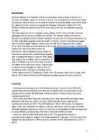
Estonia Topic Tallinn 2007 2 List of Contents page Facts and figures 3 Geography 3 Climate 3 Nature 4 History 5 Economy 6 Culture 6 Biggest towns 7 Language 8 3 Facts and figures The Republic of Estonia is a small country. Covering only 45, 228 sq km it is slightly bigger than Denmark, Belgium or Switzerland. Estonia's population is under 1.4 million. The official language is Estonian but since very many Russians live here Russian is also wide spread. The capital of Estonia is Tallinn. The currency used in Estonia is Eesti kroon. The Estonian national flag is blue-black-white. It was originally the flag of the Estonian Students' Society. The flag was first consecrated in Otepää Church in 1884. For a while, during the Soviet occupation, the flag was banned but it was again seen in p...
United States of America Alejandro Perez Toribios Tarvo Mäesepp SiimKristjan Lange USA · USA consist of: · 50 states · 16 territories · and a federal district USA flag USA flag · The USA flag have 50 stars and 13 stripes · 50 stars represent the states of the United States of America and the 13 stripes represent the thirteen British colonies. The location President · USA president is Barack Obama, he is also head of state and head of government of the United States. · He was born in 4th august in1961 in Hawaii · He is 44th president of the USA · He is graduated Columbia University and Harvard Law School Barack Obama is president since 2009 Facts · English 82.1%, Spanish 10.7%, other Indo European 3.8%, Asian and Pacific island 2.7%, other 0.7% . · USA Independence Day is at July 4, 1776. · The National flower is the rose. Celebrities · Bill Gates,...
World Trade Center By Topics • Design • Construction • Buildings • Owners • Exploitation • Film and media • Accidents • Rebuilding the WTC • Pictures Design • Architects - Minoru Yamasaki, Emery Roth & Sons • Closely-spaced towers • The worlds tallest building • Height 417m, with antenna 526m • 110 floors Construction • Construction started in August 5, 1966 • Had to create 23 acers park next to center • Complited in 1970 • Opened for tenants in January 1972 • The ribbon cutting ceremony was on April 4, 1973 • Total cost reached to $900 million Buildings • "North Tower," a 110-story tower • "South Tower," a 110-story tower • 22-story Marriott World Trade Center Hotel • 2 office buildings • United States Customs House and a Federal office building • New York City government emergency response center and WTC office rooms Owners • Port ...
Tax policy After regaining independence in 1990, Lithuania is a fully functional parliamentary democracy. The chief of state is the president, and the head of the government is the premier. The president is directly elected by the people and serves a 5-year term. The parliament, known as the Seimas, has 141 members who are elected for 4-year terms. Of these, 71 are directly elected by the people and 70 are elected by proportional vote. The tax burden, at some one-third of the GDP is moderate by international standards and will further be reduced as the liberalization progresses. These are mainly income and value-added taxes . Tax revenues come from a variety of sources. Goods that are imported into Lithuania face import duties that range from 10 to 100 percent (but average 15 percent on most goods). The highest tariffs are on tobacco, automobiles, jewelry, and gasoline. The personal income tax level is 33 percent with rates of betwee...
Was the British Empire a good thing that enlarged the world creating possibilities for everyone or was it just a way for some to gain power and wealth? How is the modern-day Commonwealth different? The British Empire used to be one of the largest and wealthiest empires in the world. Its prosperity started at the early 1600s and reached its high peak at the end of the World War I. The Empire faded into the Commonwealth at the end of 1930s as one colony after another gained its independence. After studying the topic I would say that it cannot be said whether the British Empire was a very good or a very bad thing. Of course any kind of oppression should not be approved of and actually the Empire and native British forced on their way of life and culture to the colonies. On the other hand the Empire also helped its subjects to develop in a positive sense. In overall Britain ruled several parts of the world, like India, parts of Africa, ...
S C O T L A N D GENERAL OVERVIEW Territory: 31, 510 sq miles Highest peak: Ben Nevis 1343m Population: 5, 055, 000 National emblem: the thistle Capital: Edinburgh National flower: the bluebell Islands: About 790 National instrument: bagpipes Lakes: the best- known is Loch Ness, famous for National dish: haggis Nessie, its mythical monster Scotland is also famous for: whisky, kilts and sheep · One of the four constituent nations which form the UK · They have their own money, system of law, history, stamps, deep- rooted customs, traditions and ancient language- Gaelic · Most people speak the Scottish dialect becoming endangered language · Weather unpredictable · Breat...
REVISION QUESTIONS 1. What do you know about Margaret Thatcher? Winston Churchill? Margaret Thatcher was the first female Prime Minister in Europe. She was a member of the conservative party. She died recently. Winston Churchill was the Prime Minister during WW II. He was excellent in making speeches, but he was a heavy drinker and also smoker. 2. What are the main countries of the UK and their capitals? There are 4: England with London as the capital; Wales with Cardiff as the capital; Scotland with Edinburgh as the capital; and Northern Ireland with Belfast as the capital. 3. What is Remembrance Day all about and why is it celebrated at that time? It is about the men (and women) who lost their lives fighting in the World Wars. It's celebrated then, because that's the day WWI was ended with a treaty. 4. Which powers does the Queen of the UK have? The Queen has to sign all the bills for them to pass. She is the o...
Introduction Estonia, officially the Republic of Estonia (Estonian: Eesti or Eesti Vabariik) is a country in the Baltic region of Northern Europe. It is bordered to the north by Finland across the Gulf of Finland, to the west by Sweden across the Baltic Sea, to the south by Latvia (343 km), and to the east by the Russian Federation (338,6 km). The territory of Estonia covers 45,227 km² and is influenced by a temperate seasonal climate. The Estonians are a Finnic people closely related to the Finns, with the Estonian language sharing many similarities to Finnish. The modern name of Estonia is thought to originate from the Roman historian Tacitus, who in his book Germania (ca. AD 98) described a people called the Aestii. Similarly, ancient Scandinavian sagas refer to a land called Eistland, close to the German term Estland for the country. Early Latin and other ancient versions of the name are Estia and Hestia. Until the late 1930s, the ...
Usa 1. Gross Domestic Products Gross Domestic Products of USA United States of America has the highest Gross Domestic Products nominal about 14.624 trillion US dollars according to World Bank. 2. Rhode Island Rhode Island is actually named Rhode Island and Providence Plantations and it makes the smallest state in the United States has the longest name. 3. Califrnia never rains It is believed that California is the state with the lowest rainfall in the world. For two years, California never rains. For those amazing and unique facts, California has been attracting so many tourists. Many people also adore this fact and this facts is often included in a song lyric. 4. President Grover Cleveland Grover Cleveland is the only USA president who married in office. It becomes more unusual because he married 21 years old bride when he was 49. 5. National Holidays There are ten official nationa...
Born: February 23rd, 1874 (Tahkuranna Parish) Died: January 18th, 1956 (Kalninin, Russia) Lawyer (University of Tartu) First president of Republic of Estonia Päts was born in Tahkuranna Parish to a family of Jakob Päts and Olga Tumanova. He started learning in local school. Continued in Riga's seminar and then went to Pärnu's Gymnasium. He graduated in Tartu University In 1898, Päts graduated from the faculty of Law of Tartu University. From 1901 to 1905 he worked as an editor in newspaper "Teataja". Päts had to escape from Estonia, because he was found guilty for rebellious activity. Päts lived in Finland and Switzerland and returned to Estonia in 1909, when he had to serve nine months in St. Petersburg's prison. Päts was a member of the Salvation Committee that issued the Estonian Declaration of Independence on 24 February 1918. On the same ...
Kolga-Jaani Basic school European Union Roosmary Suigusaar Form 9 Kolga-Jaani 2010 Site map What does European Union?...........................................................3 The main aurthorities....................................................................4 Information...............................................................................5 What does European Union? European integratsion process began in 1951, when concluded European Coal and Steel Community founding agreement between Belgium, Netherland, Luxenbourg, Italy, France and West Germany. It was to prevent armed conflicts between the Member States. EU is economic and political partnership between 27 democratic European countries (Austria, Belgium, Bulgaria, Cyprus, the Czech Republic, Denmark, Estonia, Finland, France, Germany, Greece, Hungary, Ireland, I...
 annaabi.ee