 50 punkti
Autor soovib selle materjali allalaadimise eest saada 50 punkti.
50 punkti
Autor soovib selle materjali allalaadimise eest saada 50 punkti.
 ~ 7 lehte
Lehekülgede arv dokumendis
~ 7 lehte
Lehekülgede arv dokumendis
 2010-12-21
Kuupäev, millal dokument üles laeti
2010-12-21
Kuupäev, millal dokument üles laeti
 11 laadimist
Kokku alla laetud
11 laadimist
Kokku alla laetud
 0 arvamust
Teiste kasutajate poolt lisatud kommentaarid
0 arvamust
Teiste kasutajate poolt lisatud kommentaarid
 Andry2109
Õppematerjali autor
Andry2109
Õppematerjali autor
NKVD (People's Commissariat for Internal Affairs) headquarters In conclusion, he had been in many parliaments like Estonian Provincial Assembly, Estonian Constituent Assembly, I parliament, II parliament, III parliament, IV parliament and V parliament. In 1936 he supported Juhan Kukk, Ants Piip, Jaan Teemant and Jaan Tõnisson, who signed a memorandum addressed to Prime Minister in duties of the State Elder Konstantin Päts. In 1938 Otto became a judge at the Permanent Court of International Justice in the Hague. In 1939, Strandman went back to Estonia and returned to his home in Kadrina. He wasn’t active in politics anymore. Strandman achieved a formal notice to arrive in NKVD, but he knew his fate and decided to shoot himself. He shooted himself in his home in Kadrina on 5 February 1941 and he was buried to Tallinn Sisekalmistu cemetery. He was also active in cultural activities
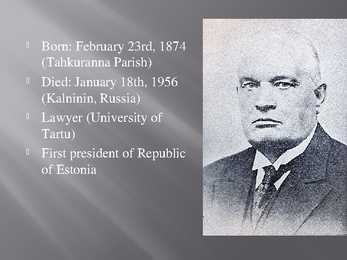
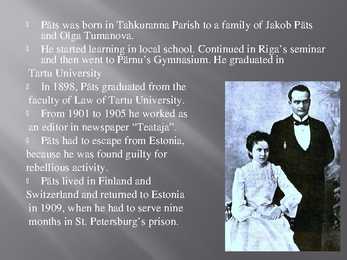
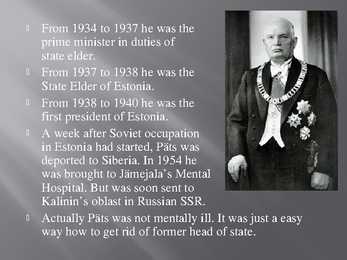
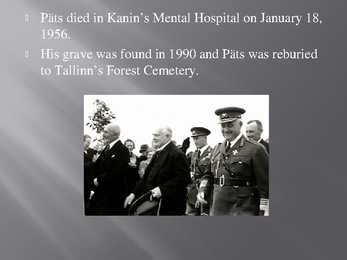
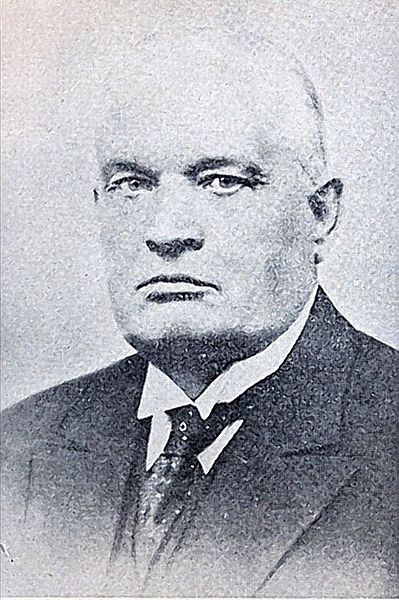
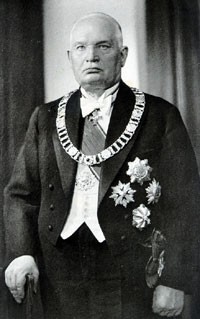
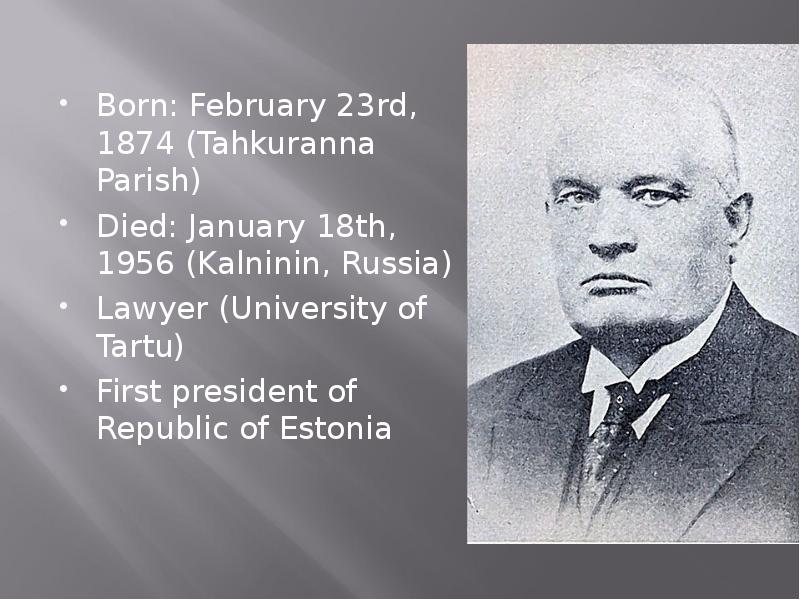
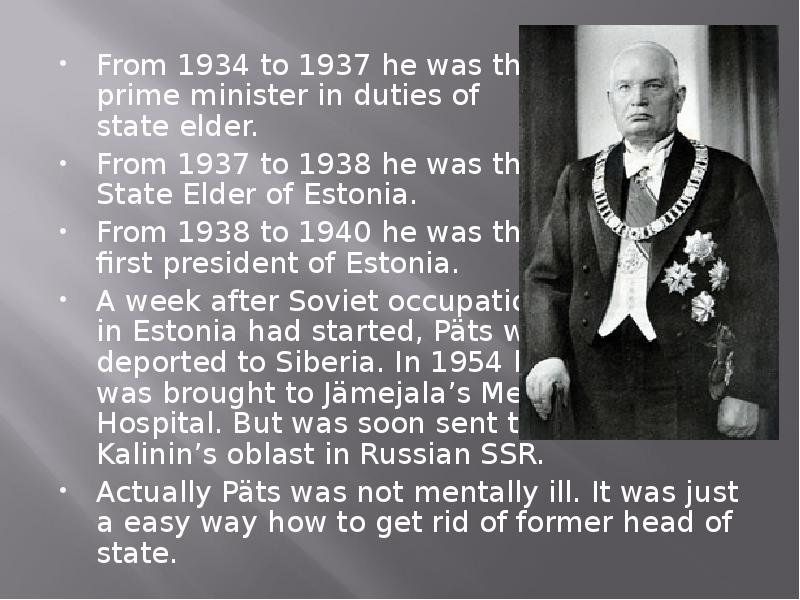
Estonian presidents Estonia has only had 4 presidents, since it's been a republic for little time. Konstantin Päts (1874-1956) was the first president of Estonia. His reign as a president started in 1938 and ended in 1940. Päts' political career started early. He served as a municipal advisor in 1904 and had many political positions after that. With his speech during the War of Independence he put a basis to Estonian economy. Päts' position as a president ended when Soviet Union occupied Estonia in 1940. Päts was forced to leave his office and was deported to Leningrad with his family
Lennart Meri Lennart Meri was a writer, film director and statesman who served as the second President of Estonia. Meri was a leader of the Estonian independence movement. His lifestory: Lennart Georg Meri was born in Tallinn, 29 March 1929, a son of the Estonian diplomat and later translator Georg Meri, and Estonian Swedish Alice-Brigitta Engmann. Because his father was a diplomat, Lennart left Estonia at an early age and studied abroad, in nine different schools and in four different languages. In addition to his native Estonian, Lennart Meri fluently spoke five other languages: Finnish, French, German, English and Russian. The family was in Tallinn when Estonia was occupied by the armed forces of the Soviet Union in June 1940 and in 1941, the Meri family was deported to Siberia. They came back to Estonia 1945. In 1953, Lennart Meri graduated cum laude from the Faculty of History and Languages of the Univers
Lennart Meri Lennart Meri was a writer, a film director and a statesman who served as the second President of Estonia. Meri was a leader of the Estonian independence movement. His lifestory: Lennart Georg Meri was born in Tallinn, 29 March 1929, a son of the Estonian diplomat and later translator Georg Meri, and Estonian Swedish Alice-Brigitta Engmann. Because his father was a diplomat, Lennart left Estonia at an early age and studied abroad, in nine different schools and in four different languages. In addition to his native Estonian, Lennart Meri fluently spoke five other languages: Finnish, French, German, English and Russian. The family was in Tallinn when Estonia was occupied by the armed forces of the Soviet Union in June 1940 and in 1941, the Meri family was deported to Siberia. They came back to Estonia 1945. In 1953, Lennart Meri graduated cum laude from the Faculty of History and Languages of the Uni
e. constitutional monarchy. They also demanded citizens' rights in Russia, modelled upon those in Western Europe. The moderate ideologists relied on liberal reforms and legal, non-violent means of political struggle. They were afraid to suggest direct resistance to Russian authorities that could result in mass repression and destroy the Estonian people. In opposition to the moderates, the Tallinn newspaper Teataja (19011905), its publisher Konstantin Päts and the lawyer Jaan Teemant, attracted a radical wing of people connected with socialists. The radicals were prepared to resort to revolutionary actions in order to achieve a democratic state; they also demanded an extensive reduction of the land possessed by the manor houses. Estonian socialists were divided into social-democratic-centralists and social-democratic- federalists. The first belonged to the local, strictly conspiratorial organisations of the illegal
Klein won and 'Russia' was given as his country of residence. Many Estonian sports heroes have been immortalised in art. For example Amandus Adamson's bronze sculpture of Georg Lurich. Before independence, Estonians were the best in the whole Russian empire in athletics (16 records out of 29), wrestling and weightlifting. Estonian sport was therefore born before the independent state. Several great figures of national politics, among them the first president Konstantin Päts, belonged to the sports association. It is no surprise that sportsmen have always been held in high regard in Estonia. The most popular fields of sport are light athletics such as basketball, chess, sailing and cycling. Basketball is the most popular ball game in Estonia, and it is this sport that the best results have been achieved. The Estonians are a Northern people and skiing is a part of their lifestyle. Thousands take part in marathons and for this reason, Estonians have always considered
3 Beginning of 20th century Estonian literates participated in the fight for local power mainly with the help of the newspaper "Teataja" created in 1901. The 1904 elections were won by an Estonian-Russian block of 5 Russians and 38 Estonians. The first Estonian mayor was Voldemar Lender and assistant major Konstantin Päts. In 1905 was bloody Sunday in St. Petersburg and this influenced estonian workers: mass meeting, had conflicts with police. 17.10.1905 was made first estonian party Eesti Rahvameelne Eduerankond created by newspaper ,,Postimees" supporters. In 1906 was created estonian proffesional theatre ,,Estonia". Theathre ,,Estonia" In 1912 was started to constructing seastronghold and war harbour ( Peter the Great seastronghold). In 1913 was created power station, theatre building ,,Estonia" and
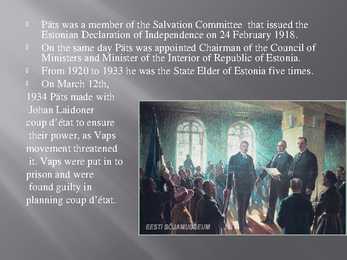
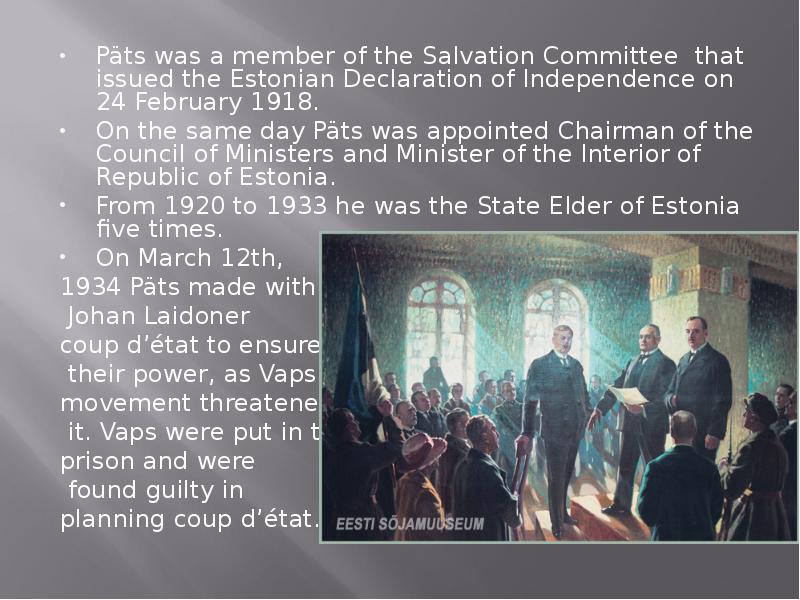
States and Canada. The Twentieth Century Estonian proclamation of independence in February 1918 was followed shortly by German occupation. After Germany surrendered to the Allies in November 1918, Estonia declared itself an independent democratic republic and repulsed the invading Red Army. In 1920, by the Peace of Tartu, Soviet Russia recognized Estonia's independence. Political parties were abolished in 1934, and President Konstantin Päts instituted an authoritarian regime(reziim). A more democratic constitution came into force in 1938; but the Nazi-Soviet Pact of August 1939, placed the Baltic countries under Soviet control.Complete Soviet military occupation came in June 1940. Following elections in July, Estonia was incorporated into the USSR as a constituent republic. Over 60,000 persons were killed or deported during the occupation's first year. Estonian irregulars
 annaabi.ee










Kõik kommentaarid