Leidsid 33 sarnast õppematerjali, mis on seotud failiga "Estonian War of Independence". Need materjalid aitavad sul teemat sügavamalt mõista.
army, russia, could, front, latvia, german, republic, first, soviet, attack, sent, january, took, again, russian, february, germany, place, forces, helped, command, during, greatest, power, europe, states, eastern, conquer, government, peace, chief, finland, begun, desperate, than, without, cannon, soldiers, forced, north, military, units, resistanceestablished the relationships between Estonia, Livonia and the Russian Empire. The Baltic Landesstaat reached its full development. The freedom of action in the new provinces was naturally granted to one of the most firm ideological pillars of the tsarist empire -- the Russian orthodox church; though as the Landeskirche in the Estonian and Livonian territories, the Lutheran church long maintained a de facto predominance. The most important organ of Baltic German local government was the Diet, consisting of all the noble families who had been `selected' in a list of the eligible. Although jealously guarding their privileges, the knighthoods still never became entirely closed. Between sessions of a Diet, the legislative power of the knighthoods belonged to the Council of the Diet. The towns were governed by the Town Councils, which supplemented their ranks from among the representatives of merchants and lawyers. The
The Most Interesting Historical Events in Estonia Liana Põldver · The nationwide Song Festival tradition began with the first Song Festival in Tartu, June 18 20, 1869. · 1860 marks the beginning of the period of the National Awakening. A singing society led by Johann Voldemar Jannsen started and carried through the nationwide idea of Song Festival. · During 1879 1910 six Song Festivals were held that played an important part in the nation's cultural and economical awakening and growth. In the independent Estonian Republic the Song Festivals were held in every
Independence Day On 24 February, Independence Day is celebrated in the Rebublic of Estonia. This is the day that the Manifesto was declared in Tallinn 91 years ago. In responce to a period of Russification initiated by the Russian empire in the 1890's, Estonian nationalism took on more political tones, with intellectuals first calling for greater autonomy, and later, complete independence from the Russian empire. Following the Bolshevik takeover of power in Russia after the October Revolution of 1917 and German victories against the Russian army, between the Russian Red Army's retreat and the arrival of advancing German troops, the Committee of Elders of the Maapäev issued the Estonian Declaration of Independence in Pärnu on February 24, 1918. after winning the Estonian Liberation War against Soviet Russia and at the same time German Freekorps volunteers (the Tartu Peace Treaty was signed on 2 February 1920), Estonia
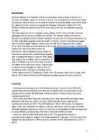
Estonia Topic Tallinn 2007 2 List of Contents page Facts and figures 3 Geography 3 Climate 3 Nature 4 History 5 Economy 6 Culture 6 Biggest towns 7 Language 8 3 Facts and figures The Republic of Estonia is a small country. Covering only 45, 228 sq km it is slightly bigger than Denmark, Belgium or Switzerland. Estonia's population is under 1.4 million. The official language is Estonian but since very many Russians live here Russian is also wide spread. The capital of Estonia is Tallinn. The currency used in Estonia is Eesti kroon. The Estonian national flag is blue-black-white. It was originally the flag of the Estonian Students' Society
The Estonian War of Independence The Estonian War of Independence began with the attack of the Red Army of the Soviet Russia on Narva on the 28 November 1918 and lasted until a ceasefire on the 3 January 1920 (juridically until the 2 February 1920). In the War of Independence, Estonia received support from the UK, Finland, Latvia and the White Russian Northwestern Army. In the defence of the independent statehood of Estonia in the battlefield participated at least 130 students and 11 teachers of the Gymnasium for Boys, which was the name for Gustav Adolf Grammar School at that time. Johan Laidoner has said that it was the schoolboys who brought "the belief, that we would win and that is the greatest gift they have given to the Republic during its birth." (point to the list of students on the slide.) The youngest students of
The selection of music varies from jazz to rock and disco. It is a great Estonian party which cannot be found anywhere else in the world. Estonian Song Festival (Laulupidu) The AllEstonian Song Festival (Laulupidu) happens in Tallinn every five years, and gives a privileged insight into Estonian music and culture. Its aim is to bring together all the traditional songs and singers from across the country, as well as guest singers from other countries. The first AllEstonian Song Festival was held in 1869 in the town of Tartu , near the centre of Estonia. Around 870 singers took part, along with 76 musicians. Things have changed a lot, and today, the average festival gathering involves 25,000 participants, including large, joint choirs from all over Estonia
February 24: Independence Day The Republic of Estonia was founded on February 24, 1918 when the Salvation Committee, Päästekomitee, declared the independence of the Republic of Estonia. This date was celebrated as the Day of Independence until the Soviet occupation of Estonia in 1940. During the Soviet occupation, the Independence Day was festively celebrated in Estonian communities around the world. Every year, the US Secretary of State sent greetings on the occasion to the Ambassador of the Republic of Estonia to the United States, Ernst Jaakson. On February 24, 1989, the red flag of Soviet Estonia was replaced by the blue-black-white Estonian national flag on Toompea and since that time the Independence Day has been celebrated as a public holiday again
social power. By the early Middle Ages most Estonians were small landholders, with farmsteads primarily organized by village. With the collapse of the Russian empire in World War I, Russia's provisional government granted national autonomy to Estonia. A popularly elected assembly (Maapaev) was formed but was quickly forced underground by opposing extremist political forces. The Committee of Elders of the underground Maapaev announced the Republic of Estonia on February 24, 1918, 1 day before German troops invaded. After the withdrawal of German troops in November 1918, fighting broke out between Bolshevik and Estonian troops. On February 2, 1920, the Treaty of Tartu was signed by the Republic of Estonia and Soviet Russia. The terms of the treaty stated that Soviet Russia renounced in perpetuity all rights to the territory of Estonia. Independence lasted 22 years. This period was one of great cultural advancement.Estonia underwent a number of
......................................................................................................... 8 References...................................................................................................................................9 2 Introduction I did this choice, because I thought, I could find a lot of materials for this subject. I hope, this is not hard subject for me and I can do this report finely. 3 Beginning of 20th century Estonian literates participated in the fight for local power mainly with the help of the newspaper "Teataja" created in 1901. The 1904 elections were won by an Estonian-Russian block of 5 Russians and 38 Estonians
Tallinn English College Topic Estonia Tallinn 2008 1. Introduction Estonia is a small country about the size of Switzerland, or New Hampshire and Massachussetts combined. Estonia is named after the people called "Ests" who lived in the region in the 1 st century AD. The Republic of Estonia is one of the three countries commonly known as the "Baltic States". The other Baltic States are Latvia and Lithuania. 2. Geographical position Estonia is situated in northeastern Europe. Estonia is bounded on the north by the Gulf of Finland, on the east by Russia, on the south by Latvia and on the west by the Baltic Sea. In the north it borders on Finland. The coastline of the Baltic Sea in Estonia is characterized by numerous gulfs and bays, the biggest of them being the Gulf of Finland, the Gulf of Riga and the Gulf of Pärnu. Bays include the
Introduction Estonia, officially the Republic of Estonia (Estonian: Eesti or Eesti Vabariik) is a country in the Baltic region of Northern Europe. It is bordered to the north by Finland across the Gulf of Finland, to the west by Sweden across the Baltic Sea, to the south by Latvia (343 km), and to the east by the Russian Federation (338,6 km). The territory of Estonia covers 45,227 km² and is influenced by a temperate seasonal climate. The Estonians are a Finnic people closely related to the Finns, with the Estonian language sharing many similarities to Finnish. The modern name of Estonia is thought to originate from the Roman historian Tacitus, who in his book Germania (ca. AD 98) described a people called the Aestii. Similarly, ancient Scandinavian sagas
buildings, roads Christianity in Roman Britain Until 4th C christians were persecuted 313 AD Emperor Constantine legalised christianity 380 AD Emperor Theodosius I made it the official religion of the empire Paganism had been eclipsed but continued to pose a political, religious challenge Boudicca Queen of Iceni people of Eastern England, led an uprising against Roman forces Prasutagus(ruler) was first allowed to rule when romans conquered England, after his death, romans decided to rule Iceni and flogged Boudicca and raped her daughters 60-62 AD Iceni rebelled, Boudicca´s warriors defeated Roman Ninth Legion, destroied capital-Colchester Finally Boudicca was defetated, she poisoned herself to avoid capture Hadrian´s wall A defensive barrier builtin 122 AD by Roman emperor Hadrian to guard the northern part of
Tartu University was established in 1632, on orders from Sweden's King Gustav II Adolf. Literacy spread. The Bible was translated into Estonian in 1739(pole vaja teada). A period of wars began in the 16th century, bringing parts of Estonia under the control of Russia, Denmark, Poland and Sweden. For most of the 17th century, Sweden ruled Estonia. In the 18th century Russian Tsar Peter the Great joined Estonia to his empire. The first true political parties emerged(Where established) at the turn of the century, demanding autonomy for Estonia. Following the Russian Revolution of 1917, Estonia declared independence from Russia on Feb. 24, 1918. Independent Estonia made large strides between wars. World War II ended Estonia's independence. The country was occupied by the Soviet Army in June 1940.Thousands of Estonians were killed or deported to Siberia. In 1944, Estonia became part of the Soviet Union
and academic conferences, science, technology, diplomacy and sport. Perhaps even more important contributor to the dominant role of the English language in the world is that over two-thirds of the world's scientists are able to read in English. Three quarters of the world's mail is written in English and eighty per cent of the world's electronic information is stored in English. The biggest countries where English is spoken as the first language are: Great Britain, Canada, United States of America and Australia. Estonian on in comparison to English is a language that is spoken only by approximately 1 million people. On the other hand English in comparison to Estonian is a very young language. According to Wikipeia online dictionary, English is an Anglo-Frisian language brought to south-eastern Great Britain in the 5th century AD by Germanic settlers from various parts of northwest Germany (Saxons, Angles)
Some of the things you will learn in THE CODEBREAKERS • How secret Japanese messages were decoded in Washington hours before Pearl Harbor. • How German codebreakers helped usher in the Russian Revolution. • How John F. Kennedy escaped capture in the Pacific because the Japanese failed to solve a simple cipher. • How codebreaking determined a presidential election, convicted an underworld syndicate head, won the battle of Midway, led to cruel Allied defeats in North Africa, and broke up a vast Nazi spy ring. • How one American became the world's most famous codebreaker, and another became the world's greatest.
They were not centrally governed. The Celts brought iron working, iron ploughs and metal swords, horses, wheels and chariots - all these things gave them an instant superiority over the native tribes. The Celts built a number of hill forts throughout the region. The society was divided into warrior aristocracy, agricultural commons and the priests, the druids. *Caesar in Britain - Britain was very rich in minerals but that wasn't the main reason Caesar wanted to defeat it. He could clearly see that Britain was a threat to his latest and greatest conquest - France. He invaded Britain twice, in 55 and 54 BC. The first invasion was unsuccessful - it gained a beachhead on the coast of Kent but achieved little else. The second was more successful, the Celts asked for truce. However it wasn't a victory he had imagined and Julius Caesar never returned to Britain after that. The island was left undisturbed for nearly a century.
Why did Russian civil war breake out in 1918? The Russian Civil War was to tear Russia apart for three years, between 1918 and 1921. The civil war occurred because after November 1917, many groups had formed that opposed Lenin's Bolsheviks. These groups included monarchists, militarists, and, for a short time, foreign nations. Collectively, they were known as the Whites while the Bolsheviks were known as the Reds. But why did it really breake out? There were three reasons why Civil War broke out in Russia in 1918.The first reason
*Estonians conquered by the crusaders 1208 *Reformation 16th century establishments of new school, Estonians first book appeared in 1525 *Tartu University 1632 founded by King Gustavus II Adolphus, classical university, member of the Coimbra group *Abolition of serfdom 1816 *Song festival 1869 in Tartu, an organiser was J.V.Jannsen, 822 singers, men only *Declaration of independence 24th February 1918 *War of independence 1918-1920 during the Russian Civil War, resulted in a victory for Estonia *Deportation 1949 *Estonia becomes independent 20th August 1991
Estonia. Estonia, officially the Republic of Estonia is a country in Northern Europe. It is the smallest of the three Baltic countries. Estonia has land borders with Latvia (339 km) to the south and Russia (229 km) to the east. It is separated from Finland in the north by the narrow Gulf of Finland and from Sweden in the west by the Baltic Sea. Estonia has been a member of the European Union since May 1, 2004 and of the NATO since March 29, 2004. The area of Estonia is about 45000 square kilometres and the population is about 1.4 million people. The capital of Estonia is Tallinn and the official language is Estonian. The currency is Eesti kroon. The main religion is Lutheran
Britain History Pre-Norman Britain The Iberians brought their metal-working skills and the first real civilization to Britain in the third millennium B.C and were overrun by various Celtic invasions that began in the 8th century. The Celts introduced their tribal organization and an early form of agriculture before they were forced westward by the Roman invasion. Forms of Celtic language are still spoken in Britain. Romans (with Julius Caesar in the head of them) first tried to occupy Britain in 55 B.C., but there was a rebellion in Gaul so they had to leave to fight against it
In tents, dark skin, hair is long, black and straight, women-agriculture, men- hunting. bands(chief. Travelled together) and tribes land was owned by the tribe that occupied it. 200 different tribes Apache- "enemy"- hunted buffalos, oil and natural gas from their land Cherokee- largest tribe Cheyenne- from Minnesota and S & N Dakota. High system of laws Northwest Ordinance of 1787 Signed in 1787 by Thomas Jefferson. The creation of the Northwest Territory as the first organized territory Ohio River was settled, 5 new states Advancement of education, maintenance of civil liberties, exclusion of slavery Promised not to invade or disturb Indians Northwest Indian War-> to stop white expropriation (sundkoormis) · Indian Removal Act of 1830 Destructive to tribes. Many died when travelled to the other side of Missisippi. Signed on May 28 by Andrew Jackson "Trade" land with the tribes Resolve the Georgia crisis (dispute with Cherokee)
numbers in other places where it is too high. About 350 bird species have been recorded in Estonia. More than 200 of them breed in Estonia. Due to the vast preserved natural landscapes, large raptorial birds, such as the golden eagle and eagle owl have made Estonia their home. It is the small islets, however, that can really be called bird paradise. Undisturbed by man and protected from most smaller predators by the sea, they are real nesting sanctuaries for a diversity of birds. The first inhabitants came to the area that now forms present-day Estonia some 11 000 years ago. Estonians were one of the last pagan people in Europe. Estonia was incorporated into Christendom at the beginning of the 13th century, under the pressure of crusaders from Denmark and Northern Germany. Estonians were reduced to the status of peasantry until the 19th century. From 1558 onwards, Estonia became the battleground for the Livonian War involving Denmark, Sweden, Russia and Poland
The local cultural heritage offers as much variety as the nature. Many rare work and mythological motives are retained in folk songs. The flax-growing that spread rapidly in the beginning of the 19th century was the basis of the prosperous Mulgi family farms in Southern Viljandimaa. 19. The second half of the 19th century and the beginning of the 20th century constituted the golden age for many local families. The mulgi inhabitants were actually the first farmers in Estonia who bought the farms for their families after being released from the servitude. The farming was developed rapidly thanks to flax-growing. The wealthiest farmers gained even so much money that for the first time in history Estonian farmers became owners of mansions. The wealthy mulk were the first of Estonian farmers to build manses, until then the farmers all over Estonia lived in farmhouses that included a barn so that people and animals lived under one roof
Tallinn English College English Sergo Vainumäe 9A TALLINN Report Supervisor: Inge Välja Tallinn 2006 Order of contents: 1.Introduction 2.Toompea 3.Lower Town 4.Kadriorg and Pirita 5.Museums 1. Introduction Tallinn, the capital of Estonia, lies on the Baltic Sea. It is on almost the same latitude east St. Petersburg in Russia, Stockholm in Sweden and Stavanger in Norway, and covers 158 sq km. Tallinn was first marked on a map of the world by the Arab geographer al-Idrisi in 1154, its name then being Kolyvan (probably derived from the name Kalev). In the 13th-century Chronicle of Henricus de Lettis the town was called Lyndanise. Later came Reval (presumably after the old county of Rävala), the name used by the Germans who ruled the country for seven centuries. Russians then modified Reval to Revel
Before new year people gives promises for coming year. Independence Day An Independence Day is an annual celebration commemorating the anniversary of a nation's assumption of independent statehood, usually after ceasing to be a colony or part of another state, more rarely after the end of a military occupation. In Estonia it's celebrated on February 24.Estonia got independence from the Bolshevist Russia in 1918.Estonia regain independence in 1991 from NSVL when it fall a part. People make some preparations before Independence Day, like they look up if they have a flag. Independence Day is celebrated with victory parade, flag raising and speeches , but some famililies have a lavish feast and parents talk to their children that how and when Estonia got independence.Many of people just watch victory parade from TV.
Estonia lies on the eastern shores of the Baltic Sea on the level northwestern part of the rising east European platform. Estonia is a flat country covering 46 226 square kilometers.Estonian's neighbours are Finland, Sweden, Latvia and Russia. Estonia is rich in islands. The two largest are Saaremaa and Hiiumaa . Saaremaa is famous for its big meteorite crater called Kaali and Hiiumaa is famous for its nature and plants. The countries highest point Big Egg hill ( Suur- Munamägi) reaches 318 meters above sea level. Estonia has many uplands too. The uplands are: Pandivere upland, Otepää upland, Vooremaa upland, Karula upland Haanja upland, Sakala upland. Estonia is covered by about 18 000 square kilometers of forest
New Year is the time at which a new calendar year begins and the calendar's year count is incremented. In many cultures, the event is celebrated in some manner. The New Year of the Gregorian calendar, today in worldwide use, falls on 1 January, as was the case with theRoman calendar. There are numerous calendars that remain in regional use that calculate the New Year differently Independence Day Independence from the Russian Empire in 1918. Independence re-declared from the Soviet Union in 1991 An Independence Day is an annual event commemorating the anniversary of a nation's assumption of independent statehood, usually after ceasing to be a group or part of another nation or state; more rarely after the end of a military occupation. Most countries observe their respective independence days as a national holiday, and in some cases the observance date is controversial or contested. Good Friday Moveable Friday
in another state, autonomy; a fully independent state is only allowed if the nation is very repressed in a state, e.g. in Kosowa?, others are not recognized, even de facto states are not recognized sometimes. Self-determination means that nation has the right to freely exercise their culture and language) 3. Sovereign equality and independence of all States (all countries are equal in front of law, since the collapse of the colonial system) 4. Non-interference in the domestic affairs of States (all countries can decide what to do on their territory, others cannot dictate this, but sometimes it can contradict with the 7 th principle) 5. The prohibition of the threat or use of force 6. Peaceful settlement of international disputes 7. Universal respect for, and observance of, human rights and fundamental freedoms for all
Tallinn Tallinn is situated on the southern coast of the Gulf of Finland, in north-western Estonia. A limestone cliff runs through the city. It is exposed, for instance, at Toompea and Lasnamäe. However, Toompea is not a part of the cliff, but a separate hill. Coastline is 46 kilometres long.The highest point of Tallinn, at 64 meters above the sea level, is situated in the district of Nõmme, in the south-west of the city. The first human steps, that archeologists found, are about 5000 years old. Tallinn`s first fortress was built in Toompea, in 1050. As an important port for trade between Russia and Scandinavia, it became a target for the expansion of the Teutonic Knights and the Kingdom of Denmark during the period of Northern Crusades in the beginning of the 13th century when Christianity was forcibly imposed on the local population. Danish rule of Tallinn and Northern Estonia started in 1219.
Tallinna Inglise Kolledz Estonia Topic Alice Tärk, 9b Tallinn 2007 FACTFILE Area: 45 228 sq km Poplulation: under 1.4 million Capital: Tallinn Language: Estonian Currency: Eesti kroon (EEK) Main religion: Lutheran National holiday: 24 February (anniversary of the republic) National flower: Cornflower National bird: Barn Swallow National stone: Limestone LOCATION The Republic of Estonia is the northernmost and smallest of the three Baltic States. It is located on the eastern shores of the Baltic Sea in the north east of Europe. To the east the country borders Russia. Latvia is the countries neighbour to the south. From the west the coast of Estonia is washed by the Baltic Sea and from the north by the Gulf of Finland. The length of the coastline is approximately 3 800 km. The longest distance from east to west is
...........10 Introduction I chose this theme because I'm interested in the world politics, especially in the dangerous hot spots in the world, and also in the contemporary history. Due to the facts that Iraq is closely related to terrorism and many Estonian soldiers took part in the Iraq war I think it is important to know how did those countries became enemies. In this report I'm going to write about relations between Iraq and the USA. First of all I am going to write about the common history between those countries. Because they do not share long history, I'm going to characterize every decade from 1980. Many people think that the U.S and Iraq have been enemies forever, but it is not so. The United States has supported Iraq in war and I am going to find out why and how. At some stage their relations got really bad and it led to the invasion of Iraq by the U.S
Tallinn is a very beautiful city that lies on the Baltic Sea. It covers 158 square kilometres. The Mayor of Tallinn is Jüri Ratas. The population of our capital is about 400000 people. About 55% of them are Estonian, 37% Russians and the other 8% are from different nations. The people here are mostly engaged in industry- mainly the food industry (23%), trade (16%) and transport and communication (14%). History. Tallinn has a great history. It was first marked on a map of the world by the Arab geographer al-Idrisi in 1154, its name then being Kolyvan. In the 13 th- century chronicle of Henricus de Lettis the town was called Lyndanise. Then it was called Reval for some time and finally Estonians started to call the town Tallinn from Taanilinn (Danish town) after the Danish conquest in the 13th century. The Knights of the Sword took Tallinn from the Danes in 1227 and made Toompea their fortress
Tallinn is the capital and the largest city of Estonia. It lies on the northern coast of Estonia, along the Gulf of Finland. There are 33 cities and several town-parish towns in the country. In total, there are 47 linna, with "linn" in English meaning both "cities" and "towns". More than 70% of the population lives in towns. History • Estonia was settled near the end of the last glacial era, beginning from around 8500 BC. Before the German invasions in the 13th century proto-Estonians of the Ancient Estonia worshipped the spirits of nature. Since the Northern Crusades Estonia became a battleground for centuries where Denmark, Germany, Russia, Sweden and Poland fought their many wars over controlling the important geographical position of the country as a gateway between East and West. Being conquered by Danes and Germans in 1227, Estonia was ruled initially by Denmark in the north, by the Livonian
 annaabi.ee