Leidsid 33 sarnast õppematerjali, mis on seotud failiga "Education Estonian Style". Need materjalid aitavad sul teemat sügavamalt mõista.
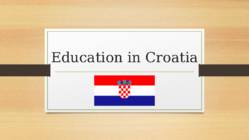
year, years, student, higher, basic, secondary, students, obtain, studies, university, grades, training, continue, upper, possible, schools, choices, universities, charge, paying, basis, part, often, them, such, whit, other, clubs, until, usually, means, addition, without, passed, within, skills, adults, least, academic, full, place, institutions, both2 Educational system in Croatia divided into: 1. Early childhood education 2. Primary education 3. Secondary education 4. Higher education 3 Early childhood education There are three stages of early childhood education: • from when the child is 6 months old to when they're one • from the ages of one to three • from the age of three until the child stars attending primary school Even though these three stages are not compulsory, every child must attend kindergarten for a year prior to primary school.
Educational system in Croatia divided into: 1.Early childhood education 2.Primary education 3.Secondary education 4.Higher education Early childhood education There are three stages of early childhood education: · from when the child is 6 months old to when they're one · from the ages of one to three · from the age of three until the child stars attending primary school Even though these three stages are not compulsory, every child must attend kindergarten for a year prior to primary school. Primary education (Children begin school at the age of 6 or 7.) There are two stages: · 1st through 4th grade, being taught by one teacher per class that teaches every subject with the exception of foreign languages and Religion. The students stay in one classroom for the 4 years. · 5th through 8th grades, where different teachers teach different subjects
applied in the late 17th century to those individuals who were opposed to the Puritan wing of the Church of England. It is first and foremost associated with the Anglo-Catholic movement of the later 19th century (from 1833 onwards). High Churchmen placed great emphasis on liturgy and the sacraments, especially the weekly or daily celebration of the Eucharist as well as on the three orders of ministry (deacon, priest and bishop). Archbishop In Christianity, an archbishop is a bishop of higher rank or office. Like popes, patriarchs, metropolitans, cardinal bishops, diocesan bishops, and suffragan bishops, archbishops are in the highest of the three traditional orders of bishops, priests, also called presbyters, and deacons. An archbishop may be granted the title, or ordained as chief pastor of a metropolitan see or another episcopal see to which the title of archbishop is attached. Bishop is an ordained or consecrated member of the Christian clergy who is generally entrusted
Estonian and British Education System Estonian and British education system is not quite different. In Estonia, the education system is based on six levels which include the: kindergarten, primary school, basic school, secondary school and university or vocational school. In Britain, the education system is also based on six levels which include the: nursery school, infant school, junior school, secondary school, 6th form and university or college. What is similar for both systems is that the first level of education starts at age of three. While in Estonia this level is called Kindergarten, then in Britain it is called Nursery school. Kindergarten is for children´s from age three to six, but Nursery school is for children´s three to four. Differently from Estonian system, at age of five to seven, British children ´s go to Infant school
The Estonian Education System The current Estonian education system consists of pre-school education, basic education, general secondary education, vocational education and higher education. Basic education is the compulsory education minimum, whics is provided by basic schools. Estonian law requires all children to be in full-time education from age of seven. In Estonia the National Curriculum is compulsory for all schools. The academic year begin on the first of September and is divided into four terms. So pupils have four holidays: a week in October, two weeks at Christmas, a week in March and three months in summer. Most Estonian children receive free education in state schools. School uniform is not compulsory. At the end of basic school pupils take three exams and at the end of twelfth form pupil take five exams. On completion of basic education, studies may be continue in a general secondary school or
School system in the USA Education in the United States is provided by government. Each of the 50 states has its own laws regulating education. Children start school at the age of 5 or 6 and continue until the age of 18. Primary or grade school starts from the first grade up to the sixth grade. Then students attend middle school also called junior high school for three years. After middle school, students attend secondary schools, which are called "high schools" from ninth to twelfth grades. The idea of secondary school is to get a high school diploma. Students should take on average 17 or over 20 units during their studies. Public schools are free of charge and available for everybody. To which school a child attends is determined by where they live. Primary school American children start school at the age of five. The first year at school is called kindergarten
III Exercise 1. John wondered what the doctor would charge him for the operation. 2. I received a fine for illegal parking yesterday. 3. As soon as the school as sufficient funds, they will build a new gym. 4. This jumper cost me a lot of money. 5. Embarrassingly, we nearly left the restaurant without paying the bill. 6. The instructor's fee for driving lessons is £10,00 per hour. 7. He wouldn't accept a cheque as payment. 8. I have had an account at that bank for years. IV Exercise In Britain, some children start their education by going to a kindergarten or nursery school when they are 2 or 3 years old. They must go to school from the age of 5, when they usually enter the state school system by attending primary school until they are 11 years old. Then they go on to a secondary school, which they can leave when they reach 16. Before leaving, students sit their GCSE examinations in 8 or 9 subjects. If they want to go on to study at
Work or University? After finishing secondary education students have to decide vhether to go to work or continue their education at a university. If a student decides to go to work after finishing secondary school, he does not have the best advantages for getting a good job. Today employers value high-quality vocational qualifications, so it might not be as good as choice as continuing your education. However, if a student chooses to continue his education, he has many possibilities, for example, university or vocational education. At a university he can choose what he wants to study and for how long, for instance, to get a bachelors degree he has to complete three years of study at a university. And after graduating from university he can, continue with post-garduate studies to complete a masters degree and then doctoral degree.
USA school system Most children enter the public education system around ages five or six. They may begin in preschoolpreschool, kindergartenkindergarten or first gradefirst grade. They normally attend 12 grades of study over 12 calendar years of primary and secondary education before graduating, earning a diploma that makes them eligible for admission to higher educationhigher education. Education is only mandatory until age 16, however. There are generally five years of primary (elementary) school, during which students customarily advance together from one grade to the next as a single cohort or "class", three years of middle school, which may have cohorts, and four years of high school. There is some variability in the arrangement of grades. In the U.S., ordinal numbersordinal numbers (e.g., first gradefirst grade) are used for identifying grades. Typical ages and grade groupings in contemporary, public and private schools may be found through the U.S
The high level of urbanisation on the island has contributed to a species extinction rate that is about 100 times greater than the background species extinction rate. 2 The History of the Great Britain The island was first inhabited by people who crossed over the land bridge from the European mainland. Traces of early humans have been found (at Boxgrove Quarry, Sussex) from some 500,000 years ago and modern humans from about 30,000 years ago. Until about 10,000 years ago, Great Britain was joined to Ireland, and as recently as 8,000 years ago it was joined to the continent by a strip of low marsh to what is now Denmark and the Netherlands. Britain in the reign of Elizabeth 3 Elizabeth II (Elizabeth Alexandra Mary; born 21 April 1926) is the
come to see them. Some of them are even like symbols of England. The most famous ones are: Stonehenge is one of the greatest national icons of Britain. That prehistoric monument is located in the plain of Salisbury, in the county of Wiltshire in the south-west of England. It is built of 150 enormous stones which are set in a purposive circular pattern. Stonehenge was probably built to mark the longest and shortest day of the year because it lies on the line of the midsummer sunrise and the midsummer sunset. That would have enabled people to keep a record of changing of seasons. Although it is still unclear who built it. Hadrian’s Wall is an ancient wall which was built in 2nd century by Hadrian, the emperor of Rome from AD 117 to 138, and it marked the northern border of the Roman Empire in Britain. The wall was 80 Roman miles (117 kilometres) long and it is situated in northern
The French education system is split into three stages: primary school (école), secondary school (collège) and high school (lycée). Primary and secondary education is free, neutral, secular and compulsory between the ages of 6 and 16. However, there are some private schools that are not subject to these obligations and particularities of the French education system. Nursery school classes accept toddlers at 2 or 3 years of age, starting in September. The children develop their basic faculties, improve their speaking skills and are introduced to the world of reading and writing, numbers and other key areas of learning. From age 6 to 11, the children attend elementary school which is mixed and freein the case of public (state) schools. The 'collège' accepts all pupils after elementary school without the need to pass an entrance exam. The teaching is structured by subject: French, mathematics, history-geography, 'civics' or
Why did I choose university education over vocational training? An essay Why more and more people nowadays tend to go to universities rather than to vocational schools? Will going to the university open all the doors in our lives? Is it necessary to have a higher education in order to survive in today’s economy? Those are just some of the questions that may arise when we start talking about the topic. Going to the university was once only for the children from wealthier families. Now as we have a lot of free higher education available, many people tend to use this wonderful opportunity. Although it might seem a great way to start building your way towards future career, it might not be the best way. Why? Because we have reached the stage where we have more people with higher education than we have jobs that require that kind of educational degree. To fix the issue, numerous studies have been
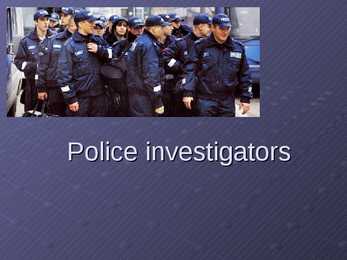
Police investigators Education You must be at least 19 years old and must have secondary education. A professional or vocational education/other vocational or higher education and completion of a professional development grant. Vocational training ( 2 years): Graduates will start work on patrol, some of them will be direct to training or to acquire higher education. It prepares police officers who are capable of bringing their skills and knowledge to perform various tasks. Higher education ( 2 years): It is a presumption to become a criminal police or post of the director. Master of Arts, which is required to take up senior management positions. Work description Performs services with in the competence of the pre-trial criminal procedure in the base of the Code of Criminal Procedure.
A basic education is provided free of charge for young people in nearly all developed and democratic countries. However, when it comes to university, or higher education, there are many different approaches taken. In some countries (such as Finland and Sweden) higher education is still free. In other countries, higher education is purchased like any other service. In many countries (such as the UK and the USA), fees are charged to students but how much of the cost of education these cover varies greatly. Often governments offer loans and financial support to help students pay these fees. However, more and more people want to go to university, putting student funding systems under pressure. So should Governments charge fees for higher education, or provide it for free? Government should charge fees because it is well known that the `education' is often only a small part of the university experience
reason. A person can be insensitive in one way, such as blind, and extraordinarily sensitive in another way, such as in hearing. It is also possible to be so ultra-sensitive that the result is disadvantageous. I expect no argument in asserting that a normal sensitivity is a healthy, indispensable ingredient for optimal education. Sensitivity can be heightened or blunted by education. It is intertwined with curiosity. An ideal education affords numerous and varied opportunities for students to touch, see, smell, listen, hear; to spark their curiosity. When I was a child the things that pleased me were largely other than the plants which have earned me a living as an adult. For example, I collected postage stamps, played basketball, was fond of listening to music, played all manner of games, but dealt only in a neutral, uninspired fashion with plants. The one thing that was constant and of supreme importance was my love of reading. I don't recall why, but by an early age, say age
Options after secondary school Im going to talk about different choices after secondary school. Firstly, a lot of students after graduating secondary school want to study more. There are two ways to continue your studies. The first choice is to continue the academic education in universities. It is the best way to educate yourself and later after graduation there will be some jobs with quite big salaries. The other way to continue your studies is to get vocational education. It includes different professions on technical field. It is a really great way to quarantee yourself a job, because after vocational school you have the necessary skills to work on certain job. In addition to that, there is one more option going to work. It is the best choice for some people who just do not want to study anymore or who do not know yet what to do with their lives. It gives them more time to figure out, who they wanna be in the future and with
sunday my birthday is on the 27th dec my address is i was born in 1996 country city town parish cummune municipal village flat avenue street road kindergarten(nursery) to decide vocational school profession education speciality construction of cars to establish restuarant to continue to mend to repair 1.In the future 2.i have to stay in my new school do practical work 3.i entered vocational school. 4.at the age of seven 5.i was born in 23.10.1984 6.during my session 7.for almost four years 8.i want to be weiter 1. i was born in 3 nev 1984 2.i went to school at the age of seven 3.i have to studie almost four years 4.in september i went to vocational school 5.im interested in cars 6.in school we do practical work too 7.in the future im going to keep the family resourant school final certifacate 1. vocational 2.certificate 3.restaurant 1.traveled to alot of countrys 2.got into rakvere vocational school 3.finished basic school to christen-ristima
arising from human interaction.5 However, the new knowledge of children as competent 1 Mark Drankeford and Jonathan Scourfield and Sally Holland, `Welsh Children`s Views on Government and Participation`, Childhood, 16 (2) (2009) 247-264 (p. 249). 2 Invernizzi, A. & Williams, J, Children and Citizenship, (London: Sage Publications, 2008). 3 Howe Brian and Covell Katherine, Empowering Children:Children`s Rights Education as Pathway to Citizenship, (London: University of Toronto Press, 2007), p.20. 4 Michael Freeman, ` The sociology of childhood and children's rights`, The International Journal of Children's Rights, 6 (1998) 433-444, p. 438. 5 Michael Freeman, 19898, p.438. 4 social actors has provoked a great controversy as it challenges the image of the incompetent child which is overwhelmingly prevalent in the Western society. It has generated a great
pursue them into bigger ones one day ahead. In these moments i like to remember what Napoleon Hill once said: ,,If you can´t do great things, do small things in a great way." The things is, that everyone has to start somewhere, to find their own way in this life-that is the reason why i am writing this letter at this very moment, to let you know, that i am ready to make a change. To introduce myself, i would use one word-determined. I am 19 years old girl from Estonia and i live in two cities at the same time. During my school time i live in Tartu and when i want to charge my batteries i take a trip to smaller city and my hometown called Rakvere. Itmight be little, but it has it´s own way to fancy people. For example our city is known for a running event-,,Night run" where for 2 years i have been a volunteer to encourage and help people who have come together to Rakvere for one goal-to run a distance and share good emotions.
If I Were a Minister of Education In the last five years we have witnessed several changes in the education system. Although some people find it useful and needed, others find it tragic. What has changed and what would I do to make school a better place? Firstly, there are several things that has been changed in the last few years, such as financing vocational schools. Students of vocational schools get paid for good grades and in some schools even for attending school. Even dorms are paid for students. That is true, we have a chance of getting a little scholarship in high schools, if we graduate with a medal, but it is times and times harder to achieve. In fact government has started to close high schools because they think that there are too many of them. It looks like our country wants only graduates with vocational education, which I find really sad.
Choices after secondary school Every abiturient is gacing with big decision what do to next. Should student go to university, vocational school or to the work after secondary scool. It is big step in their life and ther is no right answer for them. Choosing the university menas thaht you have to study atleast 3 more years and usually undergrad have to work at the same time for living. It is stressful time and some of the students can't carry it through. . But also there is good points choosing the university you will get many friends, exiting undergrad life and of course education. I think that university is for them who wants to study something more. Choosing the work doesn't sound good at all, because usually you have to work places where your salary is quite low at the beginning. But also there is exceptions, some of the students who choosed the work can have a very good job, because many
British Cuisine Some people criticize English food. They say it's unimaginable, boring, tasteless, it's chips with everything and totally overcooked vegetables. The basic ingredients, when fresh, are so full of flavour that British haven't had to invent sauces to disguise their natural taste. What can compare with fresh pees or new potatoes just boiled and served with butter? Why drown spring lamb in wine or cream and spices, when with just one or two herbs it is absolutely delicious? If you ask foreigners to name some typically English dishes, they will probably say "Fish and chips" then stop
Education The education system is a little bit different in the UK than ours. For example they have go to school 2 years earlier than us. Primary school is for pupils aged 5-11. Though schooling is only compulsory from age 5 in the UK, children most commonly enter Reception Class aged 4 in the academic year in which they will reach their 5th birthday. When pupils are aged 7 they sit Key Stage 1 [SATs]. Key Stage 2 SATs are taken when pupils are aged 11. Secondary school is for pupils aged 11-16. 11-13 years old pupils study a broad range of 10–15 subjects. No public examinations are taken during this time. Traditionally, at the age of 14 students start a programme that lasts for 2 years and during which time they study up to 11 subjects of their choice
Like for example USA's kids have to go to school exactly the same amount of time as our Estonian children. And basically learn same amount of same things. Like everywhere there are always differences. Education in the United States is mainly provided by the public sector, with control and funding coming from three levels: federal, state, and local. Child education is compulsory. A sub-type of compulsory education is public education. Public education is universal at the primary and secondary levels (known inside the United States as the elementary and high school levels). At these levels, school curricula, funding, teaching, and other policies are set through locally elected school boards with jurisdiction over school districts. School districts are usually separate from other local jurisdictions, with independent officials and budgets. Yet in Estonia our school system mainly stands on government. Public
learning through projects, teamwork, presentations. Estonian school system is obsolescent in my opinion. Children have to memorize a lot in Estonia, although Internet and libraries have all the answers. I think it´s a problem at this time that children in Estonia haven´t as developed ability to find the answers and think of their own as children in USA or Great Britain. Higher education system is pretty much the same in Estonia and Great Britain. Estonian and Great Britain student gets Bachelor's degree in three years, in America within four years. In Great Britain there are two different degrees such as BA- Bachelor in art and BS- Bachelor in science. We call it just a Bachelor's degree. The students can take full-time courses and study in the daytime, or they can enter the Open University and study by correspondence, attending distance learning courses. There are many different educational systems in different countries. They all have their plusses and minuses
At the moment photography has compensated itself fully. The best thing about it is that I am really good at something and people respect me because of that. I am proud that I had enough determination in the past that I did not give up my hobby. Another well-known statement that I have heard is that small town inhabitants haven’t seen the world. As we know, travelling broadens the mind. I agree that in a small town it is often harder to find the right resources for going abroad. Some years ago I felt this kind of situation very clearly. I really wanted to see the world! The only question was how, because my financial resources were limited. Nevertheless, I think, it is the perfect situation in life. If you are eager to get something you have to think how it is possible to fulfill your dreams. I knew I was interested in writing and photography . Then came the question, how could I combine them. I examined the theme
Work or university? After finishing secondary school you can take two choices. Whether you are going to work or study at the university. Now I would like to talk about their positive and negative sides. Firstly, I'd like to speak about going to work. Many people after finishing secondary school are going to work. One reason for this is that people have different abilities. Not everybody is suitable for university. The second reason is that perhaps they don't want to spend a lot of time on academic education. They are interested in particular profession which doesn't need an academic degree and want to move on with their life. Positive sides are that people can earn money and grow up faster. Negative sides are that it's not easy to get a job if doesn't have an education. Employees tend to prefer employers who have a good education and work experience.
MY SCHOOL & SPECIALITY Kuressaare Regional Training Centre is an educational institute that provides initial vocational training and in wide area of specialties. The school was established on the 6th of november 1922, named the Kuressaare Ehitusinstruktorite school. First accepted 19 students to the new school. This marks the beginning of the continuous training on Saaremaa. Nowdays, over 1000 of students enrolled in school. As tourism is an important industry in our region, training specialists in catering, cooking, tourism management and hotel service has a very important role. Construction and related fields like carpentry have also quite a number of students. My school is located on an island which has a strong seamanship traditions and small vessel building companies, Kuressaare Reginal Traingin Centre is the only vocational school in Estonia training boat builders.
In England and Wales most school were established by private benefactors and operated as educational carities. Compulsory education was introduced in 1888. Maintained schools follow National Curriculum. National Curriculum core subjects are English, matematics and science. Foundation subjects are design and technology, history, music, art. Children in Englan begin with primary education and it may be divided into Infant and Junior school. After primary school they move secondary school. Nearly 88 pre cent of secondary school pupils in England go to comperhensive schools. After five years of secondary education students take examination in a range of subjects at the level of GCSI (general certificate of secondary edcation) and that marked by independent examination board. Following two years of study, students may take A-level examinationa, which are required for university entrance in the UK.
tributaries, is navigable for over 3,058 km. The largest lake situated entirely in Canada is Great Bear Lake at 31,328 km2 in the Northwest Territories. The largest lake which is at least partly in Canadian territory is Lake Superior Climate Canada's climate is as diverse as its landscape. Generally, Canadians enjoy four very distinct seasons, particularly in the more populated regions along the US border. Daytime summer temperatures can rise to 35°C and higher, while lows of -25°C are not uncommon in winter. More moderate temperatures are the norm in spring and fall. Summers can be hot and dry on the prairies, humid in central Canada, and milder on the coasts. Spring is generally pleasant across the country. Autumns are often crisp and cool, but brightened by rich orange and red leaves on trees. Winters are generally cold with periods of snow, although southern Alberta enjoys the
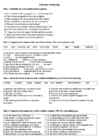
Task 2. Complete each sentence with a word from the box. Use each word once only. cheat copy memorise pay revise concentrate divide pass punish underline a) Our teachers used to punish us by making us stay behind after school. b) If you…….twenty-seven by nine, the answer is three. c) Try to……. the most important rules. d) It is difficult to …….attention in a noisy classroom. e) Pauline tried her best to …….the end of year examinations. f) Your work is the same as Harry's. Did you……. his work? g) Your mind is wandering! You must …….more! h) Helen decided to……. all her work at the end of every week. i) It's a good idea to……. important parts of the book in red. j) The teacher saw Jerry trying to …….in the exam. Task 3. Match the words in the box with a suitable definition (a-j). Use each word once only.
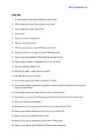
Poetry Luule Romance Armastusromaan Science fiction Ulmejutt Travel books Reisiraamatud Fairy tales muinasjutud Do you agree? Watching theatre performances on TV is just like eating canned food. Circus shows are exciting only for kids. The life of top sportsmen is only hard work and no fun at all. Nowadays sport is not so popular with young people as it was about ten years ago. WEATHER 1. What´s the weather like today? 2. What does the weather forecast say about tomorrow? 3. What kind of weather do you like best? Describe the weather you like best. 4. Is it good to have four seasons? Why? Why not? 5. Which season do you like best? What is your favourite season? Why? 6. Do you listen to weather forecasts? Do you read them in the newspaper? 7. What is the most terrible weather you have ever seen? 8. What will the weather be like if swallows fly very low
 annaabi.ee