Leidsid 33 sarnast õppematerjali, mis on seotud failiga "Canberra - PowerPoint presentation". Need materjalid aitavad sul teemat sügavamalt mõista.
australia, canberra, nation, metres, inland, located, australian, approximately, snow, gallery, northern, location, compromise, between, rivals, sydney, geography, covers, square, near, ranges, east, highest, mount, experiences, quite, summers, cold, heavy, frequent, rare, spot, light, falls, usually, widespread, institutions, such, memorial, portraitTopic Australia Tallinn English College 2006 Australia 1 . Introduction The name Australia is derived from the Latin Australis, meaning of the south. In land area, Australia is the sixth largest nation, its territory is 7,686,850 sq km and its population reaches today over 20,5 million people. It is the only nation to govern an entire continent and its outlying islands. Australia's capital is Canberra, the only city with its own territory. It was built in the early 1900s just to be the capital. The official language is English and the official name of Australia is the Commonwealth of Australia. Australia is located on the Southern Hemisphere (because of that Australia is also called "A land down under"). 2 . Geographical position
Australia Australia , officially the Commonwealth of Australia, is a country in the Southern Hemisphere comprising the mainland of the Australian continent, the island of Tasmania and numerous smaller islands in the Indian and Pacific Oceans. Australia flag Australia coat of arms. Australia is a cloudless dark blue sky, the bright sun, multikilometer beaches with snowwhite sand and ocean up to horizon. Australia's landmass of 7,617,930 square kilometers is on the IndoAustralian Plate. Surrounded by the Indian and Pacific oceans, it is separated from Asia by the Arafura and Timor seas. It the sixth largest country in area after Russia, Canada,
Australia Australia is the only country in the world that covers an entire continent, yet also the smallest and the driest of all the continents. It's almost the same size as continental USA, being the sixth largest country in the world. It's also the oldest some of the rocks are more than 3,000 million years old. Australia is often called `Down Under', because it lies in the Southern Hemisphere. As a result, its seasons are the opposite of ours. Australia, Tasmania and a number of smaller islands form the Commonwealth of Australia. Because of the country's great size, the climate in Australia ranges from tropical regions of the Northern Territory to the cool temperate conditions in the southeast and Tasmania, where it often snows in winter. In the north, half the year is `wet' and half is `dry'. From November to April heavy rain fills the rivers and makes enormous lakes where thousands of birds come for the summer. From
Australia Kaspar Rätsep G1A Australian nature · Australian nature is extremely diverse and interesting. It's the driest inhabited continent, only its south-east and south-west corners have a temperate climate. · The climate of Australia is significantly influenced by ocean currents, which is correlated with periodic drought, and produces cyclones in northern Australia. · Much of the northern part of the country has a tropical summer rainfall (monsoon) climate. The southwest corner of the country has a Mediterranean climate. Much of the southeast is temperate. · Climate change has become an increasing concern in Australia in recent years, with many Australians considering protection of the environment to be the most important issue facing the country. Australian nature · Eastern Australia is marked by the Great Dividing Range and
Australia Australia is the smallest continent in the world. It is 7.6 million square kilometres big. It is often called the island continent because it is rather small for a continent and very big for an island. There are only five countries bigger than Australia in the World. There are five states in the mainland. Tasmania is also considered as a state so there are six states. The Northern Territory and Canberra are also independent but they are not states. Canberra is the capital of Australia and it is situated between Sydney and Melbourne because both of these cities wanted to be the capital. The population is about 19 million people and growing. New South Wales is the most populated state and Victoria is the most densely populated state. The national language is English. It is English because British settlers came to live in Australia in
Topic Australia Introduction Many people know Australia as the land down under because it is the only continent except for Antarctica that is all on the southern hemisphere. Its name means ,,Southland". The official name of the country is the Commonwealth of Australia. It's capital is Canberra. Australia is the sixth largest country in the world but the smallest continent. Australia has 6 states and 2 territories (New South Wales, Victoria, Tasmania, Queensland, Western Australia , South Australia, The Australian Capital Territory and the Northern Territory). The Australian people are culturally the same as the Anglo Americans. There also live aborigines. Aborigines are the ancestors of the people. Like the US and Canada, Australia was an English speaking colony of Great Britain. Today Australia is a modern developed country with a diversified economy. Australia is an island continent of 7.7 million square kilometres, which makes it a little smaller than the USA.
..................................................................................................................10 Conclusion....................................................................................................................11 Materials........................................................................................................................11 2 Australia Introduction Australia is the one and only country in the world which fills the whole continent. The continent it fills is called Australia too. So, Australia is both a country and a continent. If you want to make clear that you are speaking about the country, you may call it the Commonwealth of Australia. It’s the official name of the country. Australia is the smallest continent, but one of the largest countries on Earth. It’s 6th largest country. Its area is about 7.6 million sq km
- What is the capital of Australia? a. Sydney b. Melbourne c. Canberra - Which city is the oldest and largest? a. Canberra b. Sydney c. Darwin - Which is a popular Australian animal? a. bear b. kangaroo c. fox - Who are the Australian natives a. Eskimos b. Aborigines c. Indians - Who discovered Australia? a. Columbus b. Captain Cook c. Lewis and Clark - What is the official Language in Australia? a. English b. German c. Spain Australia is situated south of Asia, between the Pacific and the Indian Oceans. Australia is a continent, a country and an island at the same time. Australia is located in the southern hemisphere. OFFITIAL NAME : Commonwealth of Australia CAPITAL: Canberra TOTAL AREA: 7,700,000 sq.km POPULATION: 20 million people HEAD OF STATE: Queen Elizabeth II represented by Governor- General
Australia Australia is a country and also a continent. If someone wants to make clear, that he is speaking of the country, he may call it by its full name of Commonwealth of Australia. Australia's name means "southland."It is south of the equator. Sometimes it is also called the island continent because it is an island. There are about twenty million people in Australia.It is 1,800 miles from the mainland of Asia and almost half way round the world from Europe. More than 600 miles of ocean separate it from Americas. Since Australia is south of the equator, its seasons are just the opposite of ours. It has summer while we have winter, and the other way round. States and Territories. Australia consists of six states, two territories and eight external territories. The six states are: Western Australia (capital Perth), South Australia (capital Adelaide),
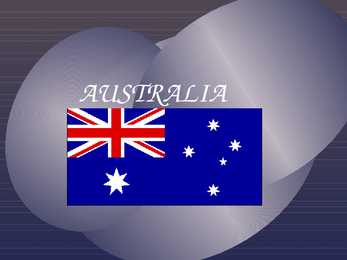
Australia Fact file: Australia comprises a land area of 7 686 850 square kilometres. Its population is about 21,3 million people. Australia's capital is Canberra. The national language is English. The official name of it is the Commonwealth of Australia. It's divided into six states and two territories: New South Wales, Queensland, South Australia, Western Australia, Tasmania, Victoria, Australian Capital Territory (ACT) and Northern Territory. Symbols: Australia had the British flag as their official flag until 1901, when the Commonwealth of Australia was formed. Over 30 000 entries attracted the official competition. Five of them, which contained almost identical designs, were placed equally first. The Australian flag symbolises Australia's historical links with Britain, because it has
Introduction, Location Australia is a country between the Indian Ocean and the Pacific Ocean. It is the only country in the world that occupies an entire continent. The mainland covers an area of 7.7 million km² and it is about 3700 km from the most northern point to its most southern point and about 4000 km from east to west. There are also many different seas around Australia, like the Coral and the Tasman Seas in the west or the Timor and the Arafura Seas in the north, where the Indian and the Pacific Oceans meet. Because all seas and oceans near Australia are warm, surfing is a very popular hobby. Political subdivision Australia is divided into six states, which are: · New South Wales · Victoria · Queensland · South Australia · Western Australia · Tasmania New South Wales is the most populous state in Australia. Its capital is Sydney.
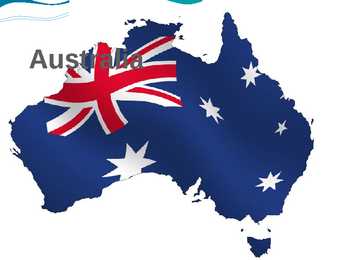
Australia Basic Knowledge Capital city: Canberra States: New South Wales, Queensland, South Australia, Tasmania, Victoria and Western Australia National Language: English Demonym: Australian, Aussie Goverment: Federal parliamentary constitutional monarchy Monarch: Elizabeth II Area: 7, 617, 930km2 Population: 22, 822, 641 Currency: Australian Dollar Flag and Coat of arms Flag Coat of arms Click to edit Master text styles Second level Click to edit Master text styles Third level Second level Fourth level Third level Fifth level Fourth level
...................................................... ................................. Aborigines and first settlers.......................................................................................... Sports............................................................................................. .................................... Culture............................................................................................. .................................. Factfile Australia is the only country in the worlf that fills the whole continent. The continent is also called Australia, if you want to make clear that you are speaking about the country you may call it by its official name: Commonwealth of Australia. Australia is the smallest continent, but one of the largest countries in the world. Its area is about 7,6 million sq kilometers. Its population is about 20,0 million and most of the people live in bigger cities: Sydney (4.2 million), Melbourne (3
Geography The name Australia means ,,southland". It is both a country and a continent, with an area of 7,617,930 square kilometres and it is also an island, separated from Asia by the Arafura and Timor seas. But Australia is also surrounded by the Indian and Pacific oceans. The Great Barrier Reef is the world's largest coral reef. It lies off the north-eastern coast and extends for over 2000 kilometres. The famous mountain range in the eastern part of Australia is the Great Diving Range and it's highest peak is Mount Kasciusco's 2230m. In the continental part, there are the Macdonnell ranges. Other smaller mountain ranges are the Musgrave Mountains, the Hammessley Mountains and the Darling Mountains. The continental part of Australia is mostly covered with deserts and these deserts are the Great Sandy Desert in the north-western part, the Great Victoria dessert in the southern part and Gibson desert and the Simpson desert
AUSTRALIA Valeria Jegorova 10A 2013 a. Australian flag Coat of Arms Coat of Arms Anthem: "Advance Australia Fair" Royal Anthem: "God Save The Queen" ABOUT Australia's population is roughly 22.7 million people . Australia is the world's sixth-largest country by total area. Australia's military expenditure is the world's 13th-largest. Australia is a constitutional monarchy with a federal division of powers. CULTURE Australian culture is as broad and varied as the country's landscape. Australia is multicultural and multiracial and this is reflected in the country's food, lifestyle and cultural practices and experience. ENVIRONMENT Australia has the greatest number of reptiles of any country, with 755 species. Australian forests are mostly made up of evergreen species, particularly eucalyptus trees . Well-known Australian animals:kangaroo ,koala and wombat .
Australia Australia is surrounded by the Indian and Pacific oceans, it is separated from Asia by the Arafura and Timor seas. Australia presents an enormous range of climatic conditions, since it covers thirty degrees of latitude. It is mostly temperate, but one third of the continent is tropical, and there are large desert areas. The two largest cities are Sydney and Melbourne. The capital of Australia is Canberra. It is a small city and was built in the early 1900s. History. Two hundred years ago there were no white people in Australia. The only inhabitants were dark-skinned people who were still living in a Stone Age. Their only weapons were stone knives and boomerangs. But their tribes had very well-worked- out customs. A few aborigines still live in the emptier part of the continent. In 1770, the British explorer Captain Cook raised the British flag. Cook found there a pleasant climate
AUSTRALIA Tallinn 2008 Only one country in the world fills a whole continent. That country is Australia. The continent it fills is Australia, too. Australia, then, is both a country and a continent. Australia is one only continent except Antartctica that is all south of the equator. Since it is south of the equator, its seasons are just the opposite of ours. It has summer while we have winter, and the other way round. Sometimes Australia is called the island continent. There is a good reason why. It is an island. It is 1800 miles from the mainland of Asia and almost half way round the world from Europe. More than 6000 miles of ocean separate it from the America. Australia is the world's smallest, flattest and driest continent. It is also the oldest some of the rocks are more than 3,000 million years old. It is the 6th largest country. Its territory is 7 700 000 km2.
Australia Australia is the world driest continent. More than two-thirds of country is desert or dry bushland. The climate is tensely hot. Australia is relatively flat country with mountainous only in the eastern regions. Most Australians live in the southern part of the country, where winters are wild and the summers are sunny and warm. The Great Barrier Reef is Chain of 500 island and coral reefs 2000 km long, near the coast of the north-east Queensland. It is one of the natural wonders of the world. There are some 150 million sheep in Australia. This is one-fifth of the total number of sheep in the world. Dingers are wild
Mustamäe College AUSTRALIA Report Compiled by Denis Doborovits 5A Tallinn 2009 Contents 1. Introduction 2. Australia 3. Animals 4. Cities 5. Economy 6. Summary Introduction I'll tell you a little about Australia. Australia is a continent In the southern hemisphere. The area is 7.7 million square km. The capital of Australia is Canberra. The population is 17 million. The official language is English. Australia The Outback is more than two-thirds of Australia, but its population is less than 100,000. Many people live on sheep or cattle stations which are enormous farms. There are a
The Commonwealth of Australia. The Commonwealth of Australia is a federal state within the Commonwealth of Nations. Its territories are the continent of Australia, the island of Tasmania and a number of smaller islands. It has an area of about eight million square kilometres. The continent of Australia is mostly a great plain with mountains in the east and south-east. The western part of the continent forms a plateau which occupies half of the continent. Australia's greatest rivers are the Murray and the Darling. Australia has several different climatic regions, from warm to subtropical and tropical. There are five big cities in Australia: Sydney, Melbourne, Adelaide, Perth and Brisbane. Each city is the capital of the state in which it is situated
Australia History & Geography Rakke Gymnasium X class Katre Pohlak, Alari Uudla April 2011 Key Facts Australia is the sixth largest country in the world. Australia is an island, surrounded by water. It is located on the smallest continent in the world. Key Facts Population: 17.5 million Geographic size: 2.97 million square miles Capital: Canberra Major cities and population: Brisbane, Sydney, Perth, Melbourne and Adelaide. Geographic Landmarks Australia has a very dramatic landscape. Australia is famous for its "outback," the remote lands of the interior. The desert outback covers most of the interior.
Australia Topic Koostas: Aineõpetaja: Tallinn 2011 Location Only one country in the world fills a whole continent. That country is Australia. The continent it fills is Australia, too. Australia, then, is both a country and a continent. If someone wants to make clear that he is speaking of the country, he may call it by its full name of Commonwealth of Australia. Sixty million years ago Australia and its nearby islands were separated from the rest of the world by a great upheaval. They were cut off from Asia by the ocean. Very few people and almost no animals visited Australia before English colonists began to settle there in 1788. During all those 60 million years the native Australian mammals developed by themselves, undisturbed by the animals developing elsewhere. Australia is the only continent except Antarctica that is all south of the equator. It's name means "southland"
English speaking countries English is world-wide language. Its spoken in very many countries. For example many countries in Europe, Asia, America and even in Africa. In many of them it's spoken as an official language. But it's also spoken as the dominant (domineeriv, valdav) language. Nowadays you can go almost everywhere and you can make through everything when you know some English. But still, no matter in which country you go, they're still very different. For example Australia, United Kindgom and its parts Endland and Scotland. Australia is located in the Pacific ocean and it's sixth country in the world for it's size. It's total area is 7741220 km². This country doesn't have an official language, but it's national language is English. Australia has much lakes and rivers in it. More exactly about 68 920 km² is made up by lakes and rivers. Climate in australia is dampish and warm. Australia's capital is Canberra, but the largest city is Sidney. The symbol of
AUSTRALIA Australia is a continent and a country. Australia is the sixth largest country in the world. It is below the equator. The first people to live in Australia were aborigines. Today there are still aborigines in Australia. Some live on reservations, some live on ranches or in cities. You can see some examples of their beautiful art if you visit Australia. Most people live in or near cities.The largest cities are Sydney, Melbourne, Brisbane, Perth, Adelaide. Monetary unit is australian dollar. Australians speak English. Australia is made up of six states and two territories. It is about the size of the United States (not including Alaska.) 21.3 million people live there, about as many people as in New York. Canberra is the capital of Australia. The weather in Australia is warm and pleasant. January and February are the warmest months, with average temperatures between 65° and 70° F. June and July are the coldest months,
Weather in Sidney Sydney's climate is pleasantly temperate all year round with more than 340 sunny days a year. In summer (December to February), average maximum temperatures in Sydney are around 26°C. It can also be humid at this time with an average humidity of 65 per cent. Average maximum temperatures in the winter (June-August) are around 16°C. Sydney's rainfall is highest between March and June. Appealling climate - Australian seasons are the opposite to the Northern Hemisphere, summer starts in December, autumn in March, winter in June and spring in September. Australian seasons Spring: September November Summer: December February Autumn: March May Winter: June August The best seasons to travel to Australia (nicest weather) are in either Spring or Autumn. Driving in Australia The most important thing to remember in Australia when driving is that Australian people drive on the left-hand side of the road
AUSTRALIA { · Capital city of Australia is Canberra. · The largest city is Sydney. · There is no official language, but the national language is english with an accent. · Australia area is 7,617,930 km2 · Australia is the smallest continent in the world but the sixth largest country in the world. · The kangaroo is a national symbol of Australia. The kangaroo is important to both Australian culture and the national image. · Population in Australia is 22,760,245. They have almost 10,700 beaches in all shapes, sizes and colours. I NTERESTI NG FACTS Ø There are 1500 species of Australian spiders. Ø The Sydney Opera House roof weighs more than 161,000 tons. Ø Australia is considered to have one of the highest degrees of urban concentration in the world. Ø Koalas are furry animals that live only in Australia they live only in certain
and severe climate. Canada extends across the continent of North America, from Newfoundland on the Atlantic coast to British Columbia on the Pacific coast and northward into the Arctic Ocean. Canada shares land borders with the United States to the south and north-west. Canada is a land of great variety. Towering mountains, crystal-clear lakes, and lush, green forests make Canada's far west a beautiful region. Farther inland, fields of wheat and other grains cover Canada's vast prairies. Thes fertile farmlands contrast vividly with the Arctic wastelands to the north. Most of the largest towns and industrial areas lie near the Great Lakes and the St Lawrence River in central Canada. In the east, fishing villages and sandy beaches dot the Atlantic coast. Across the country, Canadians experience many different landscapes from rolling plains and mountains to the cold tundra of the north.
11A West Coast · The "West Coast", "Western Seaboard", or "Pacific Coastline" are terms for the westernmost coastal states of the United States. · It most often comprises California, Oregon and Washington. Arizona and Nevada, while not coastal states, are often included due to their proximity to the Pacific Coast and their economic and cultural ties to California · As of 2007, the estimated population of the West Coast ranged from approximately 5060 million, depending on which states are included in the estimate. · Major coastal cities on the West Coast include San Diego, Los Angeles, San Francisco, Seattle, Las Vegas. ·West Coast includes: ·Washington ·Oregon ·Arizona ·Nevada ·California Washington · Named after George Washington, the first President of the United States · Capital: Olympia · Largest city: Seattle · There are three national parks and two National Monuments
In this region summers are very hot and humid and rainfall decreases to the west as a result of the rain shadow created by the West Pacific range and the Sierra Nevada. The Pacific coast is almost rainless in the summer. In winter there is commonly spray like rain. But the climate remains warm and dry especially in California. The climate on the Atlantic coast is continental with cool summers and rather warm winters with a permanent snow cover in mountainous regions. Further to the south the climate gets warmer, with warmer winters and hotter summers. The south western part of the country is the driest and the hottest. Death Valley is also located there. The second highest temperature on earth 55.5C was recorded in the valley. The place got its name because of gold seekers. Hoping to find a shorter way to gold fields, many of them died crossing the valley during the 1849 Gold Rush.
SOCIETY AND CULTURE OF ENGLISH-SPEAKING COUNTRIES Introduction 1. Nowadays, English is so widely spoken that it can hardly be considered "a one nation's" language. The main countries where English is spoken are: the U.K, the U.S, Canada, Australia, the Republic of Ireland, New Zealand, West Indies 2. There are approx. 300-400 million speakers of English in the world. English occupies the 3rd place by its number of speakers; it is right behind Mandarin and Spanish. 3. ESL (English as a Second Language) used in your own country (e.g. India) EFL (English as a Foreign Language) used in a foreign country ESP (English for Specific Purposes) used in business, airlines, hotels etc. 4
President: Tarja Halonen Prime Minister: Matti Vanhanen 1 Nature and geography Finland is a country of thousands of lakes and islands; 187,888 lakes (larger than 500 m²) and 179,584 islands to be precise. One of these lakes, Saimaa, is the fifth largest in Europe. The Finnish landscape is mostly flat with few hills and its highest point, the Halti at 1,324 metres, is found in the extreme north of Lapland at the border between Finland and Norway. The landscape is covered mostly (seventy-five percent of land area) by coniferous taiga forests and fens, with little arable land. The most common type of rock is granite. It is a ubiquitous part of the scenery, visible wherever there is no soil cover. Moraine or till is the most common type of soil, covered by a thin layer of humus of biological origin. The greater
very hot summers and mild winters. Northern Arizonafeatures forests of pine, Douglas fir, and spruce trees; the Colorado Plateau; some mountain ranges (such as the San Francisco Mountains); as well as large, deep canyons, with much more moderate summer temperatures and significant winter snowfalls. There are ski resorts in the areas of Flagstaff, Alpine, and Tucson. In addition to the Grand Canyon National Park, there are several national forest, national parks, and nation monuments. About midway through February, the temperatures start to rise again, with warm days, and cool, breezy nights. The summer months of June through September bring a dry heat ranging from 90120 °F (3249 °C), with occasional high temperatures exceeding 125 °F having been observed in the desert area.November through February are the coldest months, with temperatures typically ranging from 40 to 75 °F (4 to 24 °C), with occasional frosts Etymology
....................... ......8 6.Sport.................................................................. ......9 7.Language........................................................... ....10 8.Conclusion......................................................... ....11 9.New words............................................................12 10.References...................................................... .....13 Introduction Jamaica is an island nation of the Greater Antilles, 234 kilometres in length and as much as 80 kilometres in width, amounting to 11, 100 km 2. It is situated in the Caribbean Sea. With 2.8 million people, it is the third most populous anglophone country in North America, after the United States and Canada. Kingston is the largest city in Jamaica and the country's capital. I am interested in this country and it is my favourite country. History
 annaabi.ee