 10 punkti
Autor soovib selle materjali allalaadimise eest saada 10 punkti.
10 punkti
Autor soovib selle materjali allalaadimise eest saada 10 punkti.
 ~ 1 leht
Lehekülgede arv dokumendis
~ 1 leht
Lehekülgede arv dokumendis
 2009-03-06
Kuupäev, millal dokument üles laeti
2009-03-06
Kuupäev, millal dokument üles laeti
 96 laadimist
Kokku alla laetud
96 laadimist
Kokku alla laetud
 3 arvamust
Teiste kasutajate poolt lisatud kommentaarid
3 arvamust
Teiste kasutajate poolt lisatud kommentaarid
 Ege3
Õppematerjali autor
Ege3
Õppematerjali autor
Names with and without the Names fot the streets/roads/squares/parks etc are without the: Union street Fifth avenue Piccadilly Circus Hyde Park Blackrock road Broadway Times Square Waterloo Bridge Many names (especially names of important buildings and institutions) are two words: Kennedy Airport Cambridge University The first word is usually the name of a person (Kennedy) or a place (Cambridge). We do not usually use ,,the" with names like these. Some more examples: Victoria Station Edinburgh Castle London Zoo Westminister Abbey Buckhingham Palace Canterbury Cathedral But we say 'the White House' and 'the Royal Palace' because 'white' and 'royal' are not names like 'Kennedy' and 'Cambridge' Most other names (of laces, buildings etc) have names with the: The + adjective or + noun name etc Hilton Hotel National
London Zoo the post office Buckingham Palace the National Mall NB! the Royal Palace the Empire State Building the High Street the White House the Mall, the Strand (teed) the Eiffel Tower NB! Kui need hooned on saanud nime kellegi inimese järgi, siis artiklit ei kasuta: Victoria Station Westminster Abbey Lloyd´s Bank Järved: Jõed, kanalid, väinad, merehoovused: Lake Peipus (NB! the Peipus) the Thames, the Nile the Seine, the Rhine the English Channel, the Amaxon
The Article Table of Contents General Rules....................................................................... 2 The Definite Article ............................................................... 5 Names that take the Definite Article...................................... 6 No article.............................................................................. 7 Countable and uncountable nouns ....................................... 9 General Rules There are two articles in the English language – the Indefinite Article and the Definite Article. The Indefinite Article has two forms – a and an (a precedes words beginning with a consonant sound and an precedes words beginning with a vowel sound). It comes from the Old English word ãn, which meant one. The Definite Article is the. It comes from the Old English word ţis, which meant this. Thus, in most general terms, a and an cannot be used with countable no
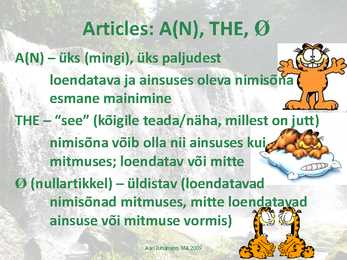
korrad jne.: They go to music school twice a week. He used to earn three dollars an hour. Määratleva taara või piiritleva/mõõtva/ loendatavaks muutva sõna ees: We need a loaf of bread and a bunch of bananas. This camera doesn't need a roll of film you can buy a nice bar of chocolate for that money. Aari Juhanson, MA 2009 NUMBERS to be continued · Kui number järgneb nimisõnale artiklit EI OLE: I could read Chapter Three before we were told to proceed to Gate Seven · Kindlates järgarvuga väljendites artiklit EI OLE: They said it had been love at first sight. At first glance I didn't notice anything suspicious. On second thought, however, we might even consider that possibility. Aari Juhanson, MA 2009
1. The Queen’s official title. Elizabeth the Second, by the Grace of God, of the United Kingdom of Great Britain and Northern Ireland and of Her other Realms and Territories Queen, Head of the Commonwealth, Defender of the Faith. 2. The Queen’s working day. Starts after breakfast. Reads the newspapers which are prepared by the Press Secretary, and a report on the previous day’s proceedings in the Parliament and the letters she receives. Also phone calls. Once a month she attends the Privy Council in order to give Royal Assent to various items of government legislation. Discusses domestic matters with the Master of the Household. Towards the end of the day, there is always another pile of official papers and reports waiting to be read or acted upon. The business on constitutional monarchy never ends. 3. Who is the present heir to the throne? Speak about his education. Who are the 2nd and 3rd in line? Pre
Stonehenge One of the best known ancient wonders of the world, 5000 years old Megalith monument, built by western mediterraneans during 3000-1600 BC Circular structure, large standing stones, aligned with rising sun at teh solstice Attlers and bones were sued to dig pits that hold the stones The Celts in Britain and their legacy 700-200 BC celts invade Britain Gaels or Goehls(Ireland and Scotland),Cymri(Wales) and Brythons(gave name to Brittany) Fierce fighters,superb horsemen.Most of them farmers, lived in thatched houses Good at art, craftmanship, used iron Divided into tribes, ruled by kings, only in face of danger would they choose a single leader Legacy- hill-forts, farms, churches, field system, woodland, pasture, weapons, iron objects, langugae, culture Caesar in Britain The great Roman Emperor Firts came 55 BC to gather information, celts were doing agriculturally well,so romans wanted
1. Ancient Britain: the Celtic tribes. 2000 years ago there was an Iron Age Celtic culture throughout the Br Isles. It seems that the Celts, who had been arriving from Europe from the 8th cent BC onward, intermingled with the peoples who were already there. The Celts were extremely talented people, creative and artistic. More than 1 Celtic tribe invaded Br. The descendants of ancient Celts live in Wales, Scotland, Cornwall and Ireland. They lived in primitive society. Druids priests, more powerful than chiefs. Acted like prophets. 2. Stonehenge From prehistoric period. Was built on Salisbury plain between 2500 and 1500 bc. One of the most famous and mysterious archaeological sites in the world. One of the mysteries is how it was built at all with the technology of the time. Another is its purpose. It appears to function as a kind on astronomical clock and we know it was used by the Druids for ceremonies marking the passing of the seasons. It appears in number of novels. T
History exam *Stonehenge - is a monument located in England. It is one of the most famous prehistoric sites in the world and is composed of earthworks surrounding a circular setting of large standing stones. The surrounding circular, earth bank and ditch, have been dated to about 3100 BC. Stonehenge was produced by a culture with no written language. Many aspects of Stonehenge remain subject to debate. There is little or no direct evidence for the construction techniques used by the Stonehenge builders. *The Celts in Britain and their legacy The Cets lived in Britain in The Iron Age. They were warring tribes who were battleful amongst themselves as well as inter-tribal war. They were not centrally governed. The Celts brought iron working, iron ploughs and metal swords, horses, wheels and chariots - all these things gave them an instant superiority over the native tribes. The Celts built a number of hill forts throughout the region. The society
 annaabi.ee







Kõik kommentaarid