Leidsid 33 sarnast õppematerjali, mis on seotud failiga "Art Museum of Estonia". Need materjalid aitavad sul teemat sügavamalt mõista.
museum, work, works, exhibit, build, building, palace, church, century, exhibition, kadriorg, collection, kumu, part, russia, here, other, open, altar, russian, year, there, europe, shop, 18th, present, 20th, centuries, workshop, serve, room, visitor, first, branch, display, temporary, halls, different, medieval, 16th, years, late, such, silver, thesethen being Kolyvan (probably derived from the name Kalev). In the 13th-century Chronicle of Henricus de Lettis the town was called Lyndanise. Later came Reval (presumably after the old county of Rävala), the name used by the Germans who ruled the country for seven centuries. Russians then modified Reval to Revel. For Estonians, the town came to be called Tallinn from Taanilinn (Danish town) after Danish conquest in the 13th century. Over the course of time, Taanilinn was shortened to Tallinn The place is believed to have been settled by Finno-Ugric peoples about 2500 BC. The Danes, led by King Valdemar II, conquered northern Estonia in 1219. Legend has it that one day, when the Danes were about to lose a bloody battle, the sky suddenly opened and a red flag with a white cross on it dropped down upon them from the heavens. This is allegedly how the Danes obtained
Lower Town was a merchantile centre, Tallinn also belonged to the Hansaetic League (1285). It is often referred to as the town of citizens. Any grown-up, married and economically independent person, born in a legal marriage between two free people and having lived in the town for at least 3 months, could apply to the Magistracy for citizenship. Serfs could escape from serdom after having successfully hidden in town for a year and a day. Two parts remained separated until the end of the 19th century. Four Names Lyndanise - mentioned by Henricus de Lettis in his Chronicle; derives from the name Linda - the wife of Kalev and mother of Kalevipoeg Koluvan - mentioned in Russian chronicles; derives from the hero Kalev from our national epic Reval - comes from the German words “REH” and “FALL”, meaning the falling of the deer; could be deers trying to escape from the Danes, running down the Toompea hill
Tallinn was granted the Lübeck law in 1248 and became the member of the Hanseatic League in 1285. General Data l Country - Estonia l County - Harju County l First appeared on map - 1154 l Town rights - 1248 l Mayor - Edgar Savisaar l Aera - Total 159.2 km2 (61.5 sq mi) l Population - (1 Mar 2012) Total - 416,470 Denisty - 2,614.0/km2(6,766.6/sq mi) Tallinn Coat of arms Flag Top 5 Attractions 1. Kiek in de Kök Visitors to the museum will see examples of Medieval firepower, displays detailing how the city's system of walls and towers developed through the centuries and an exhibit on crime and punishment in Old Tallinn. 2. Kadriorg Palace - Kadriorg Art Museum A trip to Tallinn isn't a trip to Tallinn without a visit to this magnificent northern baroque palace, built by Peter the Great for his wife, Catherine I, in 1718. The grandiose palace with its surrounding manicured gardens is
restaurants, sport and cultural centres. Every five years national song and folk dance festivals take place in Tallinn. The yachting regatta of the 1980 Moscow Olympic Games was held at Pirita. History Tallinn means in English "Danish town". The place is believed to have been settled by Finno-Ugric people about 2500 BC. It was first marked on a map of the world by the Arab geographer al-Idrisi in 1154. The Estonians were the first to build a stronghold on the spot of the Toompea Hill, but the real Tallinn was built by the Danes who conquered the north of Estonia in 1219. Legend has it that one day, when the Danes were about to lose a bloody battle, the sky suddenly opened and a red flag with a white cross on it dropped down upon them from the heaven. This is how the Danes obtained their national flag. In 1346 the Danish king sold his Estonian lands to the Teutonic Order, who a year later resold them to the Livonian Order
The shights of Estonia Brigita Maria Raave St. Olaf’s Church St. Olaf’s Church in Tallinn, in Estonia is believed to have been build in the 12th century. St. Olaf’s Church is located in Lai Street. St. Olaf’s Church is the city’s biggest medieval structure, took its name from the sainted Norwegian king Olaf Haraldsson. St Olaf Church was part of the united western tradition of Christianity, whose polity continues in the Roman Catholic church today. However, from the Reformation the church has been part of the Lutheran tradition. In 1950 St. Olaf’s Church became a Baptist church.The Baptist congregation continues to meet at St Olaf’s today. Pictures of St. Olaf’s Church cc St Olaf’s Church Tower According to some sources St Olaf’s Church was the tallest building in world from 1549 to 1625, till the Eiffel Tower was built. In 1590 the total height of the tower was 115 meters. After several rebuildings,
Estonian sculptors, has been standing for several decades. Lai Street stretches from Nunne Street to Pikk Street. Parallel with Pikk Street, Lai Street, too, ends at the Great Coast Gate (first mentioned 1359). Lai Street is very wide considering that it was laid out in the Middle Ages. This is because it sprang up on both sides of former city wall. Lai is quite a peaceful street with few shops. However, it has three museums and two theatres. The main entrance into St Olaf´s Church also faces the street. Several Lai Street houses have kept their Gothic appearance and even interiors, although we can also notice moderate Nordic Baroque, Neoclassicicm, Historicism and even Art Nouveau. The origin of the name "Lai" Lai Street belongs among the oldest streets of Tallinn. Despite its length and width its share in the city's inner traffic is fairly modest. The extraordinary width of the street is likely due to
Tallinn is a beautiful city in NorthEstonia. It is washed and influenced by the Gulf of Finland in the north. Tallinn has a lot on sights and I'm going to introduce some of them. Town Hall Square the square in front of Tallinn's Town Hall functioned as a marketplace for centuries, dating back to times even before the Town Hall itself was built. Through the years this served as a place of celebrations as well as executions. St. Olav's Church was the tallest church in Medieval Europe. The earliest data on St. Olav's Church come from 1267. Little is known about the building of this Gothic style church and its early years. Church of the Holy Ghost is the only sacred building from the 14th century in Tallinn that has preserved its original form. The simple, humble Church of Holy Ghost was completed in the 1360's, but for the exception of the baroque spire, it has retained its original medieval exterior.
What kind of city is Tallinn? What is it famous for? Old own The old City, city of Hanseatic sellers, was not an administrative part of a city (the Cathedral Hill) till the end of a XIX-th century. It was the centre of medieval marketing that has provided him well- being. Now it is the most popular place among tourists with shops and big variety of restaurants. It was opened 22 july 1718 year.Kadriorg it is the largest park in Tallinn.Kadriorg`s founder was the Peter I. He named the park in honour of his wife Ekaterine I. Y ou can walk around this beautiful park and enjoy delightful sights of nature. Tallinn Hall square is the area, popular in summer months and is
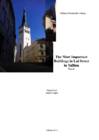
Tallinn Mustamäe College G2K Jaana-Kristiina Jõgevest The Four oldest churches of Tallinn Report Supervisor: Ingrid Teigar Tallinn 2009 The Dome Church The Danes began fortification of Toompea after the conquest of Tallinn in 1219 and probably also built the first church there. It was presumably a wooden building located at the site of the present cathedral. However, a serious conflict with the Order of the Brothers of the Sword broke out soon as the latter wanted to gain control of the entire Estonia. The order succeeded in subordinating Tallinn and the whole of North Estonia to its rule in 1227. The monks of the Dominican Order began the construction of a stone church in Toompea in 1229. The first written data on the cathedral date back to 1233, the date of a
A.D., it is more accepted by historians that the Romans were the first. The settlement was called Londinium. The first London lasted for just seventeen years, for around AD 61, a tribe of Celts led by Queen Boudica stormed London, burning it to the ground. The next heavily-planned London prospered and surpassed Colchester (another major city at the time) as the capital of the Roman province of Britannia. At its height in the 2nd century, Roman London had a population of about 60,000. However, by the 3 rd century, the city fell into a decline due to trouble in the Roman Empire and by the 5th century, it was largely abandoned. But, under the control of various English kings, London once again prospered as an international trading centre. However, Viking raids began in the late 10 th century and reached a head when they took the city under Danish king Canute and forced the then-English king to flee.
London important sights guide Roman period 20th century · Big Ben is the nickname for the great bell of the clock at the north end of the Palace of Westminster in London and is often extended to refer to the clock or the clock tower as well. It is the largest four-faced chiming clock and the third-tallest free-standing clock tower in the world. The clock first ticked on 31 May 1859. The pendulum is installed within an enclosed windproof box sunk beneath the clockroom. It is 3.9m long,
London History The Romans AD 43- AD 410 The Romans finally invaded Britain in AD 43 from Kent. The Romans lead by Julius Caesar attempted to invade Britain twice before that in 55 and 54 BC but the invasions were unsuccessful. They made their way to the river Thames and sailed up it. The Romans knew it was important to control a crossing point at the river Thames, so they decided to build a settlement on the north bank. Although small settlements had been built on the banks of the Thames, the Romans were the ones who built the first city. They called their city Londinium. The Roman engineers noticed that the point where the swampy river narrowed would make an ideal crossing point, they built London Bridge. Less than 20 years later the native Iceni tribe, led by Queen Boudicca, rose up against the Romans in revenge for mistreatment and burnt Londinium to the ground
London London is the capital of Great Britain. It is situated on the river Thames. The Thames is a river flowing through southern England and connecting London with the sea. The Thames has a length of 346 kilometres (215 miles). The first bridge was the tower bridge, built in the 12th century. The second bridge was built in the year 1750. .The river Thames divides London into the northern and the southern part. The port of London is one of the greatest trade centres in the world. The river Thames is certainly the most famous water body in London. London is also the seat of the government of Great Britain. It is one of the largest cities in the world with its population of about seven million. Before the great fire in 1666 there were many wooden houses and
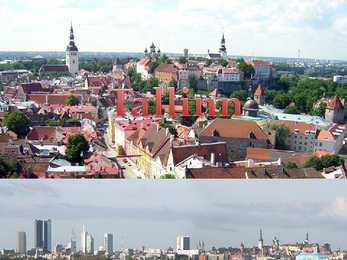
long.The highest point of Tallinn, at 64 meters above the sea level, is situated in the district of Nõmme, in the south-west of the city. The first human steps, that archeologists found, are about 5000 years old. Tallinn`s first fortress was built in Toompea, in 1050. As an important port for trade between Russia and Scandinavia, it became a target for the expansion of the Teutonic Knights and the Kingdom of Denmark during the period of Northern Crusades in the beginning of the 13th century when Christianity was forcibly imposed on the local population. Danish rule of Tallinn and Northern Estonia started in 1219. In 1285 the city became the northernmost member of the Hanseatic League - a military alliance of German-dominated cities inNorthern Europe. The Danes sold Tallinn along with their other land possessions in northern Estonia to the Teutonic Knights in 1346. Medieval Tallinn enjoyed a strategic position at the crossroads of trade between Western and Northern Europe and Russia
town of London, surrounded by the wall first built by Romans. The Romans also built a bridge over the Thames and there has been one in the same area ever since. The Roman Londinium grew up on the northern side of the bridge. In AD 61 the native Celtic tribe, led by Queen Boudicca, rose up against the Romans. They burnt down Londinium to the ground and killed most of its inhabitants. Roman armies eventually defeated Boudicca and Londinium was rebuilt. At the end of the fourth century AD the Roman Empire began to crumble and the Roman armies were recalled from Britain to defend Rome itself. Once they had left, tribes such as Angles, Saxons and Jutes invaded and settled in from Holland, Germany and Denmark. Together they are known as Anglo-Saxons. They were farming people who preferred living outside towns. For a while London probably lay in ruins, but it eventually developed again, partly because its position on the river was good for trading
It was built to a design by Mikhail Preobrazhensky in a typical Russian Revivalstyle between 1894 and 1900, during the period when the country was part of theRussian Empire. The Alexander Nevsky Cathedral is Tallinn's largest and grandest orthodox cupola cathedral. It is dedicated to Saint Alexander Nevsky who in 1242 won the Battle of the Ice on Lake Peipus, in the territorial waters of present-day Estonia. The late Russian patriarch, Alexis II, started his priestly ministry in the church. Interior of the Cathedral. The Alexander Nevsky Cathedral crowns the hill of Toompea where the Estonian folk hero Kalevipoeg is said to have been buried according to a legend. (There are many such legendary burial places of him in Estonia.) The cathedral was built during the period of late 19th century Russification and was so disliked by many Estonians as a symbol of oppression that the Estonian authorities scheduled the cathedral for demolition in 1924, but the decision was
its 27 embrasures for cannons and 30 for handguns. The floors of the embrasures were initially stepped to enable the men handle the guns better. Reconstructions in the 16th and 17th century changed the original looks of the tower considerably. 4. Suur Munamägi ("Big Egg Hill") Mountain Suur Munamägi, or Big Egg Hill, is the highest point in Estonia and other two Baltic countries. It is 318 meters high. The mountain is located in the middle part of Haanja uplands. It is in Haanja national park in Võrumaa. On the top of the mountain there is an observation tower the view from 346,7 meters is 50 km in radius. 5
Turu Kael sidestreet. The market location perfectly suited for trade: five trade routes started there. The square is connected to Town Hall Square by a short sidestreet. Town Hall Square Was used as marketing place, for festivities as well as for executions. In summer it is filled with outdoors cafes In winter it becames a magical christmas market The L-shaped sigh There has been a town hall in Tallinn since at least 1322. Town Hall Built in 13th century The management of the city worked in the Town Hall until the year 1970 The only gothic town hall on Northern Europe Weathervane Old Thomas The height of the towe is 64 metres Town Hall pharmacy Is one of the oldest working pharmacies in Europe and the oldest company in Tallinn Was first mentioned in 1422 There were also sold other goods like: ground bats, dried frog feet etc You can try spiced wine claret which was known and valued during the middle
Sculptures and monuments St. John's Lutheran Church St John's Church was probably built in the first third of the 14th century. There is no other brick church decorated with so much terracotta plastic in Europe Eduard Tubin Monument The Eduard Tubin monument, marking the 100th birthday of the composer, was dedicated in 2005. The authors of the statue are sculptor Aili Vahtrapuu, architect Veronika Valk, with sound installations by Louis Dandrel.Eduard Tubin (1905-1982) was a versatile composer and conductor, one of the most recognized symphonists throughout history. He served as concert master and conductor at the Vanemuise Theatre
Soon you will see The Devils Bridge. From what stone do you think it is made of? To go to the next object, you need to turn around and walk back along the Lossi street. Then you should see the famous Angels Bridge. What is written on the bridge? When do you think it was built? After that, go along the Lossi street, until you reach Jaani street. Then turn left on Jaani street, walk approximately 100 meters along the Jaani street. On your left you should see the Main Building of Tartu University. How many pillars has The University Building? What has been written on the under them? Whose statue is behind this building? If you are done with the tasks, walk again approximately 100 meters forwards along the Jaani street. You should soon notice a church, this is Tartu Jaani (St. John's) Church. About how high is this churches tower? Now walk back to the Munga street, on the corner turn left to the Munga street and walk to the Rüütle street.
kool Research work Styles in interior design nimi TALLINN2010 Interior design is a multifaceted profession in which creative and technical solutions are applied within a structure to achieve a built interior environment. The interior design process follows a systematic and coordinated methodology, including
LANDMARCS HYDE PARK: Hyde Park is one of the largest parks in central London, England and one of the Royal Parks of London, famous for its Speakers' Corner. The park is divided in two by the Serpentine. The park is contiguous with Kensington Gardens; although often still assumed to be part of Hyde Park, Kensington Gardens has been technically separate since 1728, when Queen Caroline made a division between the two. THE TOWER OF LONDON: Her Majesty's Royal Palace and Fortress, more commonly known as the Tower of London (and historically as The Tower), is a historic fortress and scheduled monument in central London, England, on the north bank of the River Thames. It is located within the London Borough of Tower Hamlets and is separated from the eastern edge of the City of London by the open space known as Tower Hill. It is the oldest building used by the British government. [1]
The Great Guild Liisbeth Kallakmaa The Great Guild Medieval Tallinn's social institutions were guilds and brotherhoods, whose main function was to provide members with social interactions and ensure their rights, but also played an important political and economic role. Tallinn had three important guilds - The Great Guild, St. Canute's Guild and St. Olaf's guild. The Great Guild was the youngest among them, founded in the 14th century, but soon became the biggest and most important. It was founded as an organization of the wealthiest merchants and shipowners. The name of the Great Guild was introduced in the late 15th century. There were close ties between the guild and the town rules: only members of the Great Guild had the right to belong to the town council and could be elected for mayor. Tallinn's small coat of arms is also the Great Guild's coat of arms. Guild was led by
in 1346. The Swedes came next in 1561. Tallinn weathered plague and the Great Northern War and became part of Russia in 1710. In 1918, Estonia declared independence from Russia and fought a bitter war against Bolshevik Russia. Independence didn’t last long, however, and the fledgling nation fell first to the Nazis and then the Soviets during World War II. Despite all this conquering, Tallinn’s historic core has survived remarkably intact. Much of the 14th century city wall still stands, including a couple of stretches where you can climb the narrow spiral staircases of the towers and end up on the medieval catwalk. The Viru Gates, flanked by thin pointed towers from the 14th century, makes a nice entrance into Old Town. Dominating the town atop Toompea Hill is Toompea Castle and Pikk Hermann Tower. It was used as the center of government since 1229 and is now the site of Estonia’s parliament. Nearby stands the inappropriately named Maiden’s Tower
There used to be Harju gate, which can now be seen through glass. ● The statue of Liberty, 2009; represents freedom, Estonia has been under many foreign powers, starting with Danes, Sweden, German and Russia. The clock of liberty, 2004. Kiek in de Kök ● The cannon tower, founded in 1475-1483. Kiika kööki, peek into the kitchen, from up there it was possible to peek into the enemy’s kitchen. The walls are 4 m thick, can see the cannons stuck in there. Tallinn City Museum. ● Town Wall (Unesco) - one of the greatest towers of Tallinn’s Town Wall, Old Town declared the UNESCO World Heritage Site in 1997 Toompea ● Toompea is a limestone hill in the central of Tallinn. It towers about 30-40 metres above the surrounding areas. According to the legend, its the tumulus moundn over the grave of the national hero Kalev, erected stone by stone by his grieving wife Linda
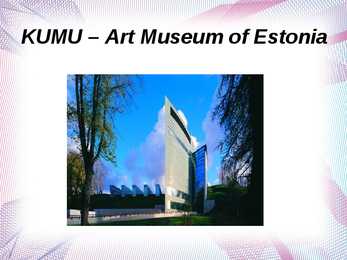
World War II, much of the medieval Old Town still retains its charm. Since independence, improving air and sea transport links with Western Europe and Estonia's accession to the European Union have made Tallinn easily accessible to tourists. SIGHTSEEING The main attractions are in the two old towns, Lower Town and Toompea, which are both easily explored on foot. Eastern districts around Pirita and Kadriorg are also worth visiting and the Estonian Open Air Museum near Rocca al Mare, west of the city, preserves aspects of Estonian rural culture and architecture. KADRIORG This is 2 kilometres east of the centre and is served by buses and trams. The former palace of Peter the Great, built just after the Great Northern War, now houses (part of) the Art Museum of Estonia, presidential residence and the surrounding grounds include formal gardens and woodland. The new residence of the Art Museum of Estonia: KUMU was built several years ago. PIRITA
The Franklin Delano Roosevelt Memorial, Jefferson Memorial, and the District of Columbia War Memorial are located around the Tidal Basin. 2. The Smithsonian Institution is an educational foundation chartered by Congress in 1846 that maintains most of the nation's official museums and galleries in Washington, D.C. The U.S. government partially funds the Smithsonian, thus making its collections open to the public free of charge. The most visited of the Smithsonian museums in 2007 was the National Museum of Natural History located on the National Mall. 3. The National Gallery of Art is located on the National Mall near the Capitol, but is not a part of the Smithsonian Institution. It is instead wholly owned by the U.S. government; thus admission to the gallery is free. The gallery's west wing features the nation's collection of American and European art through the 19th century. The east wing, designed by architect I. M. Pei, features works of modern art. The
A weekend in London Made by .... 6.d klass We will stay at the fabulous 5 Star Athenaeum Hotel in Mayfair which is close to Green Park and Buckingham Palace. It's creative and friendly. There are the colossal Living Wall and the beautifully refurbished spa and gym downstairs. There are also floor to ceiling windows, flat screen TV and complimentary mini bar soft drinks and snacks. Saturday At first we will go visit Buckingham Palace which is the official London residence and principal workplace of the British monarch. We would also like to see the nearby park where are a lot of birds and squirrels. Then we would like to see the river Thames and the Big Ben. Just a short walk from the Thames is situated Westminster Abbey which is a significant building in British history. This beautiful gothic church is a UNESCO World Heritage. Kings, Queens, statesmen,
KUMU Art Museum of Estonia Kumu Art Lives here! Kum u is th e h e a d q ua rte rs o f th e Art Mus e um o f Es to nia , a s we ll a s th e la rg e s t a nd m o s t im p re s s ive e xh ib itio n ve nue in Es to nia . T h e m us e um o p e ne d o n 1 7 Fe b rua ry 2 0 0 6 . The construction of Kumu stretched on for a long period and, during this time, the concept of the museum also changed: the building that had initially been planned as a national gallery became a museum that functions on two levels: collections of Estonian art starting from the early 18th century are displayed on the third and fourth floors, and a modern art gallery is on the fifth floor. Art predating World War II is exhibited on the third floor; the fourth floor houses an exhibition of works from the period of Soviet occupation. On Kumu's fifth floor, there are exhibitions of
The Romans. They burnt Londinium to the ground but Roman armies eventually defeated Boudicca. The city was rebuilt and was gradually surrounded with a wall of stone and brick which lasted for many centuries. During the archeological excavations in 1954 the Roman Temple of Mithras was revealed. It was a pagan temple dedicated to the Persian Sun-god. The Temple was later reconstructed only a short way from its original site and the relics are displayed in the Museum of London in the Barbican. At the end of the fourth century AD the Roman Empire began to crumble and the Roman armies were recalled from Britain to defend Rome itself. Once they had left Anglo-Saxons invaded and settled in Britain. They were farming people who preffered to live outside towns. For a while London probably lay in ruins, but it eventually developed again, partly because of its position on the river was good for trading. The Tower of London
The Presentations Triinu: "The Notorious Prisoners of the Tower" Built in 1078, has been used as a fortress, Royal Palace, a prison, the home for Crown Jewels. The first prisoner was Ranulf Flambard in 1100. The only woman tortured in the Tower was Anne Askew. Guy Fawkes was prisoned 5 th November 1605, hung in 1607. Walter Raleigh was knighted, married without queen´s permission. Last prisoners were in the Tower in 1952. Rita: "Alexander Fleming" Was a pharmacologist, has graduated 6 schools, studied anti-bacterial agents, found
The University of Oxford The University of Oxford, located in Oxford, England, is the second oldest and still remaining university in the world. The first one is the University of Bologna in Italy. But as for English speaking countries Oxford is a firm leader. There are evidence of teaching going far back to the 11th century, but a clear date is not known. In 1167, Henry II banned English students from studying in France which made Oxford's popularity grow rapidly. From then on, Oxford was named a real university and got it's first chancellor in 1201. For years, Oxford only accepted male students until four womens' colleges were opened thanks to the Association for Promoting the Higher Education of Women. First of them was Lady Margaret Hall, which was opened in 1878
trade (16%) and transport and communication (14%). History. Tallinn has a great history. It was first marked on a map of the world by the Arab geographer al-Idrisi in 1154, its name then being Kolyvan. In the 13 th- century chronicle of Henricus de Lettis the town was called Lyndanise. Then it was called Reval for some time and finally Estonians started to call the town Tallinn from Taanilinn (Danish town) after the Danish conquest in the 13th century. The Knights of the Sword took Tallinn from the Danes in 1227 and made Toompea their fortress. In the middle of the 14th century Denmark sold its possessions in Estonia to the German Teutonic Order; Toompea became the seat of German-born gentry. A fortified wall was built between the Toompea (the Upper Town) and the Lower Town (inhabited by people of a lower social standing), as there were conflicts between the two. The doors and the gates of the wall were locked at night, a
 annaabi.ee