 50 punkti
Autor soovib selle materjali allalaadimise eest saada 50 punkti.
50 punkti
Autor soovib selle materjali allalaadimise eest saada 50 punkti.
 ~ 1 leht
Lehekülgede arv dokumendis
~ 1 leht
Lehekülgede arv dokumendis
 2014-04-03
Kuupäev, millal dokument üles laeti
2014-04-03
Kuupäev, millal dokument üles laeti
 1 laadimist
Kokku alla laetud
1 laadimist
Kokku alla laetud
 0 arvamust
Teiste kasutajate poolt lisatud kommentaarid
0 arvamust
Teiste kasutajate poolt lisatud kommentaarid
 CDL
Õppematerjali autor
CDL
Õppematerjali autor
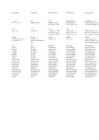
Unit 1/ Present Simple be /lihtolevik + - ? I am your teacher I'm not am I German? Yes- I am, you are, she/she/it is, we are, You are in room 13 you aren't am you German? you are, they are. He is jane he/she/it isn't Is he/she/it German? No I'm not, you aren't, he/she/it isn't, we aren't, She is marta we aren't are we German? you aren't, they aren't. It is a school. you aren't are you German? We are students they aren't are they German? You are in class 12 They are teachers Unit 2 / present simple + - ? yes- I do, you do, he/she/it does. I work I don't work Do I work no
Book 1 BASIC ENGLISH BASIC ENGLISH GRAMMAR GRAMMAR BASIC ENGLISH GRAMMAR Book 1 Book 1 Younger students at beginning to intermediate levels will greatly benefit from this step-by-step approach to English grammar basics. This is the ideal supplement to your language arts program whether your students are native English speakers or beginning English language learners. Skill-specific lessons make it easy to locate and prescribe instant reinforcement or intervention. · Illustrated lessons a
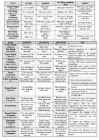
Get/ Have something TENSE ACTIVE PASSIVE WHEN? done Present Simple Am/is/are + Every day, year, often, I pv + do/does Have/ get + sth+ III pv Lihtolevik III pv usually, always Past Simple Yesterday, last year, II pv(-ed)+ did Was/ were + III pv Had/got + sth + III pv Lihtminevik last week Present
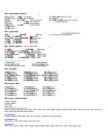
1. Active/Passive Active - the professor teaches the students. Passive - The students are taught by the professor 2. Present Simple [VERB] + s/es in third person. Tegevus on korduv või tavapärane. You speak English. I play tennis. Cats like milk. The train leaves tonight at 6 PM. I am here now. Active= Once a week, Tom cleans the car. Passive= Once a week, the car is cleaned by Tom. 3. Present Continuous [am/is/are + present participle]. Tegevus toimub/ei toimu praegusel hetkel. You are watching TV. You are learning English now. I am studying to become a doctor. I am meeting some friends after work. Active= Right now, Tom is writing the letter. Passive= Right now, the letter is being written by Tom. 4. Past Simple [VERB+ed] or irregular verbs. Tegevus algas/lõppes minevikus täpsel ajal. . You called Debbie. I saw a movie yesterday. I finished work, walked to the beach, and found a nice place to swim. I lived in Brazil for two years. I studied French when I was a child. Active
Windows are not made of wood. Simple Present · · New York is a small city. It is not important that this fact is untrue. [VERB] + s/es in third person USE 3 Scheduled Events in the Near Examples: Future · You speak English. · Do you speak English? · You do not speak English. USE 1 Repeated Actions Examples: · The train leaves tonight at 6 PM. · The bus does not arrive at 11 AM, it arrives at 11 PM. ·
Present tenses : 1) Present simple regular actions and routines especially with frequency(kordumine ) adverbs(määrsõna) N: Do you go to school by car every day ? I don't often watch TV. 2)Present continuousbe + verb + ing. Actions happening now N; Look! It's snowing. I'm meeting Jane tonight. You're always losing things. 3)keep + ingto describe habitual actions which may be irritating. N: my uncle keeps making silly jokes. Present perfect: 1) Present perfect simple: have/has + past participle. N: I've been here for ten minutes .The phone has rung ten times today. Look at this cheque,'I've won first prize. They have made a new star wars film. I've just got home. How long have you been here ? Have you ever been to Paris? It's the best book I've ever read. It's the first time I have ever been abroad. 2)Present perfect continious : have/has + been + ing. N:I've been living in this flat since 2000. I've be
Hardly= väga vähe, peaaegu üldse mitte · They were talking all the time. They were hardly listening. Can you imagine that Sam and Susy are getting married. They hardly know each other. Määrsõnade asend Viisimäärsõnad Viisimäärsõnad seisavad verbi järel. Sihitise korral asetseb sihitise järel. She sings perfectly. She sings the song perfectly. Kohamäärsõnad Kohamäärsõnad seisavad lause lõpus, rõhutamise korral lause alguses. Kui esineb ka ajamäärus, siis kohamäärus jääb enne ajamäärust. Here we like to get together. We will eat and talk here every Friday. Kindla aja määrsõnad Kindlat aega väljendavad määrsõnad seisavad kas lause lõpus või alguses. Tomorrow I will go to Latvia. I will sail by boat tomorrow. Umbmäärased ajamäärused Umbmäärased ajamäärused asetsevad 1. verbi ees; I always go to school by bus. He usually writes me letters. 2. liitaja korral põhiverbi ees;
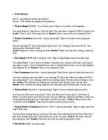
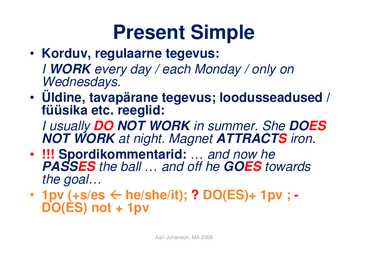
Present Simple · Korduv, regulaarne tegevus: I WORK every day / each Monday / only on Wednesdays. · Üldine, tavapärane tegevus; loodusseadused / füüsika etc. reeglid: I usually DO NOT WORK in summer. She DOES NOT WORK at night. Magnet ATTRACTS iron. · !!! Spordikommentarid: ... and now he PASSES the ball ... and off he GOES towards the goal... · 1pv (+s/es Å he/she/it); ? DO(ES)+ 1pv ; - DO(ES) not + 1pv Aari Juhanson, MA 2008 Present Progressive · Hetkel toimuv, pooleliolev tegevus: S/he IS TALKing on the phone now. I AM READing an interesting book. · Ajutine, regulaarsele ja tavapärasele vastanduv tegevus (tulevikku viitav): This summer they ARE not GROWing cucumbers as usual. They'RE GROWing tomatoes instead. · !!! Halvakspanu väljendus harjumuspärase tegevuse kohta: He IS always COMPLAINing! · BE (am/is/are) + 1pv-ing Aari Juhanson, MA 2008 Present Perfect ON -NUD ·
 annaabi.ee







Kõik kommentaarid