· The plays moved at a rapid speed · Elizabethan actors spoke their lines quicklier than modern performers · No woman appeared at the stage; women's and children's roled were played by boys who were skilful and highly trained · In a soliloquy the actor's alone on the stage, speaking to himself and revealing to the audience his inner thoughts and feelings · In an aside the actor speaks words that the other characters on stage are not supposed to hear Sonnet · A sonnet (from the Italian fot ,,little song") is a fourteen-line lyric poem with a fixed rhyme pattern and a regular rhythm, or predictable pattern of stressed and unstressed syllables called metre · The basic unit of metre is foot which usually contains one stressed syllable and one or two unstressed syllables · The usual metre of a sonnet is iambic pentameter · The English sonnet (Shakespearean sonnet) differs from the Italian one on its structure
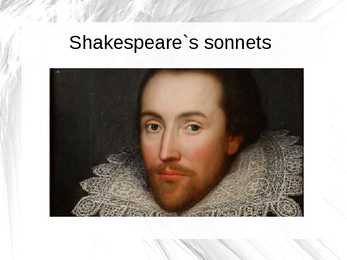
Shakespeare`s sonnets Sonnets in the world In Italy in the 14 century by Petrarch In England in the 15 century Fourteen lines Iambic pentameter 2 four-line and 2 three-line stanzas The structure of the Shakespearen sonnet It differs from Italian sonnet Three quatrians and a rhymed couplet In iambic pentameter The rhyme scheme is abab cdcd efef gg Shakespeare`s creation 154 sonnets Main themes : time, love and beauty First published in 1609 Dedication to Mr. W.H. Characters
almost a century and a half (1337-1485) The Renaissance in England may be divided into 3 parts: the rise of the R. under early Tudor monarchs, the height of R. under Elizabeth I, the decline of the R. under the Stuart monarchs. 6. The first manifestations of the Renaissance in English literature. The first major impact of the Renaissance on English literature is observable in the poetry of Wyatt and Surrey, who introduced and Anglicized the sonnet, a verse form that has proved to be both popular and durable. Surrey is credited also with inventing English blank verse. Other verse forms, borrowed from the Italian and French, had a lesser impact. Elaborate Renaissance conventions of love poetry were also transplanted, finding their outlet chiefly in sonnets and sonnet sequences. 7. Which events diminished the power of the Catholic Church in England? Two events occurred that were inimical to the influence of the Catholic Church
2. The ballad stanza 4 lines of iambic tetrametres (4 feet) & trimetres (3 feet): a b c b. 3. The Spenserian stanza 9 lines: 8 iambic pentametres followed by 1 iambic hexametre (6 feet): a b a b b c b c c. 4. Ottava rima 8 iambic pentametres (5 feet): a b a b a b c c. 5. Rhyme Royal 7 iambic pentametres (5 feet): a b a b b c c. 6. Terza rima written in triplets iambic pentametres: aba bcb cdc. 7. Sonnet 14 iambic pentametres (5 feet), difference (Italian Shakespearean) is a matter of rhyme. 8. Limerick funny poem of 5 anapaestic lines (x x /): a a b b a. 5 kinds of feet in English verse: 1. iambic iambus (1 unstressed and 1 stressed syllable) x / 2. trochaic trochee (the stressed syllable is followed by the unstressed one) /x 3. dactylic dactyl (1 stressed syllable is followed by 2 unstressed) /xx 4
Life in London: 1599 built Globe, 1623 first compilation Forms: classical & history plays, comedies+tragedies, poetry Style: metaphors, rhetorical phrases, free flow of words, unrhymed iambic pentameter; deviations Renaissance (end of 14th century) Italy, reaches rest of Europe Elizabethan era (16th II h - 17th I h) Theatre: combined medieval theatre, morality plays & Roman drama to create Elizabethan tragedy Poetry: Italian influences, sonnet (English: cddc ee) Rulers of England: Henry VII (brings prosperity, repairs economic situation; made alliances); Henry VIII (beginning of English reformation; killed "traitors"; 6 marriages); Mary I (Catholic); Elizabeth I (The Virgin Queen restores order; Religious Settlement; cautious measures in foreign affairs) Authors: Thomas Kyd's "The Spanish Tradegy" (revenge); Christopher Marlowe (moral dramas;
aastat hiljem suri, tema kaasajast ei ole säilinud tõendeid surma põhjuste kohta. Ta maeti Stratfordi Püha Kolmainu kirikusse. Epitaaf tema haua kohal hoiatab tema luude liigutamise eest. Tema eraelust on vähe andmeid, mis on põhjustanud palju oletusi tema väljanägemise, seksuaalsuse ja usuliste veendumuste kohta. Võib arvata, et kirjanik ise lootis kuulsaks saada pigem sonettide kaudu. Oma kogumikus avaldas ta 154 sonetti- Sonnet I From fairest creatures we desire increase, esimesed 126 on pühendatud kenale noorele That thereby beauty's rose might never die, But as the riper should by time decease, meessoost sõbrale, järgmised naisele, keda ta His tender heir might bear his memory: But thou contracted to thine own bright eyes,
vanilla, cargo, sombrero, siesta, anchovie, bonito, castanet, bonanza, salsa, cafeteria, canyon, cigar, cocoa, chocolate, tomato, cannibal, canoe, maize, potato, avocado, female, tobacco, hurricane, barbeque, tortilla, tango, chicle, gringo, tequila, afficienado, patio, cigarillo. ITALIA- opera, biano, solo, soprano, barritone, trio, concert, violin, allgero, andante, adagio, acapella, studio, fresco, miniature, attitude, corridore, balcony, cupola, sonnet, motto, umbrella, parasal, castume, squadran, squad, alarm, brigade, battalion, cartridge, cavalry, infintry, colonel, fiasco, bimbo, influence, mafia, graffito, papparazzo, pizza, pasta, macarony, vernicelli, spagetti, broccoli, ruconini, tutti-frutti, tiramisu, asti, DUTCH- boom, buoy, cabose, sloop, skipper, smack, yacht, dock, cruise, freight, scow, spool, kink, easel, etch, landscape, isinglass, dollar, brandy, geneves, tattoo, newizer,
embargo, mosquito, vanilla, cargo, sombrero, siesta, anchovy, bonito, castanet, bonanza, salsa, cafeteria, canyon, cigar, cocoa, chocolate, tomato, cannibal, canoe, maize, potato, avocado, female, tobacco, hurricane, barbeque, tortilla, tango, chicle, gringo, tequila, aficionado, patio, cigarillo. Italian borrowings opera, piano, solo, soprano, baritone, trio, concert, violin, allegro, andante, adagio, a cappella, studio, fresco, miniature, attitude, corridor, balcony, cupola, sonnet, motto, umbrella, parasol, costume, squadron, squad, alarm, brigade, battalion, cartridge, cavalry, infantry, colonel, fiasco, bimbo, influence, mafia, graffito, paparazzo, pizza, pasta, macaroni, vermicelli, spaghetti, broccoli, tutti-frutti, tiramisu, asti, Dutch borrowings boom, buoy, caboose, sloop, skipper, smack, yacht, dock, cruise, freight, scow, spool, kink, easel, etch, landscape, isinglass, dollar, brandy, geneves, tattoo,
· Ottava rima is a stanza of 8 iambic pentameters rhyming a b a b a b c c. It is borrowed from Italian poetry in the 16th century. · Rhyme Royal is a stanza of seven iambic pentameters rhyming a b a b b c c. James U of Scotland used it in his "King's Quair" · Terza rima is a verse written in triplets, lines being iambic pentameters with the rhyme scheme a b a b c b c d c and so on ending with a couplet to avoid one word unrhymed (Shelley's "Ode to the West Wind" · Sonnet is a poem that originated in Italy and was adopted in England in the 16 th century. There are 2 types of English sonnets--Petrarchan (Italian) and Shakespearean (English). Both contain fourteen iambic pentameters. The difference is in the rhyme. 1. Italian sonnet falls into the octave (a b b a a b b a) and the sestette (2 or 3 rhymes, their order is various- c d e d e c, c d c d c d, c c d e e d, etc. 2
Was 52 when died. Buried in the local church in Stratford. Before death designed his own epitaph( text on tombstone). If anybody touched is bones and ashes, he would be cursed. That stopped reburying Three periods in his literary period I Optimistic period II Pessimistic period III Romantic The Optimistic period He wrote poems and sonnets (154), world famous comedies, bright comedies, two tragedies "Romeo and Juliet" and some historical plays. 4 different items. Sonnet A poem of 14 lines, perfected in Italy by Petrarch. Each line has 10 syllables an d the stress is on everu other syllable. Adressed on two people. One was so called The Dark Lady. Other was The Writers Young Friend. Started to wrote them because sonnets abled him to criticise various human vices to express his feelings of love and friendship and his admiration of beauty. The above mentioned themes were very important in the Renaissance period. The ideal woman of those days looked like
cigar, tabacco, cafeteria, cocoa, chocolate, chilli, tomato, potato, avocado, tortilla, anchovy, canoe, maze, gringo, tequila, stampede, burrito, bongo, taco, sangria, cha-cha, rumba, ambo, macho, fajita, margarita, cojones 10. Italian borrowings music opera, piano, solo, soprano, baritone, trio, libretto, concert, violin art and architecture, studio, miniature, balcony, dome, sonnet literature fashion and garments umbrella mlitary battalion, squad, colonel, cavalry, infantry, misc bimbo, fiasco, influenza, volcano, lava, manifesto, Food macaroni, vermicelli, pizza, pasta, spaghetti, broccoli, zucchini, tutti-frutti, tiramisu 11. German borrowings metals and minerals zinc, nickel, quartz military mauser, rucksack, blitzkrieg
mosquito, mulatto, negro, peccadillo, pinto, pronto, sarsaparilla, silo, sombrero, vigilante 10. Italian borrowings Music o Opera, piano, solo, soprano, baritone, concert, libretto, violin, allegro, andante, adagio, a capella Art and architecture o Studio, fresco, miniature, attitude, corridor, balcony, cupola, dome Literature o Sonnet, motto Fashion o Umbrella, parasol, costume, Military o Squadron, squad, alarm, brigade, battalion, cartridge, cavalry, infantry, colonel Random o Fiasco, bankrupt, bimbo, volcano, influenza, lava, bandit, mafia, fascism, graffito, paparazzo Food o Pizza, pasta, macaroni, vermicelli, spaghetti, broccoli, zucchini, tutti-frutti, tiramisu Drinks o Asti, grappa, espresso, cappuccino, latte, 11
John Donne (1572–1631) – a puritan poet who rebelled against established traditions in poetry. Uses a lot of colloquial (characteristic of or appropriate to ordinary or familiar conversation rather than formal speech or writing; informal) words and original metaphors. He only has one sonnet that conforms to traditional rules; his songs are not lyrical at all. He introduces sex, death and erotic love into poetry. John Milton (1608–74) – poet; introduced the blank verse into English poetry. Best
Full Framing Heroic couplet Incomplete Anadiplosis Ballad stanza Vowel Tautology Spenserian stanza Consonant Polysyndeton Ottava rima Compound Inversion Sonnet: Eye-rhyme Detachment Italian Internal Antithesis Shakespearean Head r. Chiasmus Blank verse Couplet r. Anaphora Limerick Cross r. Epiphora Accented verse Frame r
It is borrowed from the Italian poetry in the 16th century. 5. Rhyme Royal is a stanza of 7 iambic pentametres (5 feet), rhyming: a b a b b c c. The name comes from the use of this stanza by the king James I of Scotland. 6. Terza rima a verse written in triplets, lines being iambic pentametres (5 feet), rhyming: aba bcb cdc, etc. ending with a couplet to avoid 1 word unrhymed. 7. Sonnet is a poem that originated in Italy and was adopted in England in the 16 th century. There are 2 types of English sonnets Petrarchan (Italian) and Shakespearean (English). Both contain 14 iambic pentameters. The difference between the 2 is mainly a matter of rhyme. 8. Limerick is a funny poem of nonsense comprising 5 anapaestic lines, rhyming: a a b b a; with the 3rd and 4th lines shorter than the other 3. 16. RHYTHM IN POETRY AND IN PROSE
" "And so ended his affection," said Elizabeth impatiently. "There has been many a one, I fancy, overcome in the same way. I wonder who first discovered the efficacy of poetry in driving away love!" "I have been used to consider poetry as the food of love," said Darcy. "Of a fine, stout, healthy love it may. Everything nourishes what is strong already. But if it be only a slight, thin sort of inclination, I am convinced that one good sonnet will starve it entirely away." Darcy only smiled; and the general pause which ensued made Elizabeth tremble lest her mother should be exposing herself again. She longed to speak, but could think of nothing to say; and after a short silence Mrs. Bennet began repeating her thanks to Mr. Bingley for his kindness to Jane, with an apology for troubling him also with Lizzy. Mr. Bingley was unaffectedly civil in his answer, and forced his younger sister to be civil also, and say what
 annaabi.ee