Leidsid 33 sarnast õppematerjali, mis on seotud failiga "USA school system". Need materjalid aitavad sul teemat sügavamalt mõista.
grade, internet, schools, year, first, years, there, freedom, grades, primary, penetration, ages, five, secondary, higher, until, however, elementary, advance, middle, numbers, different, country, almost, seven, basic, ranks, access, marks, government, children, around, begin, attend, study, calendar, before, earning, makes, them, eligible, admissionSchool system in the USA Education in the United States is provided by government. Each of the 50 states has its own laws regulating education. Children start school at the age of 5 or 6 and continue until the age of 18. Primary or grade school starts from the first grade up to the sixth grade. Then students attend middle school also called junior high school for three years. After middle school, students attend secondary schools, which are called "high schools" from ninth to twelfth grades. The idea of secondary school is to get a high school diploma. Students should take on average 17 or over 20 units during their studies. Public schools are free of charge and available for everybody. To which school a child attends is determined by where they live. Primary school American children start school at the age of five. The first year at school is called kindergarten
TALLINN COLLEGE OF ENGINEERING INGLISE KEEL Essee Differences between Estonian and USA school and education systems. Juhendaja: Koostanud: 2009 Differences between Estonian and USA school and education systems. Question is, how different are our own and this big country they call United States of America's education. Or maybe there is no difference at all, and our systems about school and education are more similar than they appear at first sight. After reading all the materials and all sorts of notes about USA's education systems and their school household. All at once I realized, that they are not so different at all. Like for example USA's kids have to go to school exactly the same amount of time as our Estonian children. And basically learn same amount of same things. Like everywhere there are always differences
Essay United States and Estonian education systems USA and Estonian school systems are very similar. But still there are some differences. How children attend school and when? How chlidren are divided by age in USA and Estonia? The American school year traditionally begins in August or September, after the traditional summer recess, which is three months long. As well in Estonia. School year usually ends in may or june. First difference between Estonian school system and USA's is that children attend school at the age of 5-6, but in Estonia children go to school at the age of 7-8. Before going to school american children attend preschool (selectively). Years 5-6 american children attend kindergarden, which is a preparation for the first grade. Most children enter the public education system around ages five or six.
church) and ministers. Evangelical = low church The Low Church movement can trace its roots back to the early 18th century but is primarily associated with the opposition to the Anglo-Catholic movement of the later 19th century. Low Church placed great emphasis on preaching, personal piety and the authority of scripture and gave much less importance to the orders of priesthood and episcopacy. Anglo-Catholic = high church High Church is the older of the two terms and was first applied in the late 17th century to those individuals who were opposed to the Puritan wing of the Church of England. It is first and foremost associated with the Anglo-Catholic movement of the later 19th century (from 1833 onwards). High Churchmen placed great emphasis on liturgy and the sacraments, especially the weekly or daily celebration of the Eucharist as well as on the three orders of ministry (deacon, priest and bishop).
2 Educational system in Croatia divided into: 1. Early childhood education 2. Primary education 3. Secondary education 4. Higher education 3 Early childhood education There are three stages of early childhood education: • from when the child is 6 months old to when they're one • from the ages of one to three • from the age of three until the child stars attending primary school
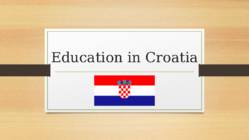
Education in Croatia Educational system in Croatia divided into: 1.Early childhood education 2.Primary education 3.Secondary education 4.Higher education Early childhood education There are three stages of early childhood education: · from when the child is 6 months old to when they're one · from the ages of one to three · from the age of three until the child stars attending primary school Even though these three stages are not compulsory, every child must attend kindergarten for a year prior to primary school. Primary education (Children begin school at the age of 6 or 7.) There are two stages: · 1st through 4th grade, being taught by one teacher per class that teaches every subject with the exception of foreign languages and Religion. The students stay in one classroom for the 4 years.
melts the snow. Winters are mild and wet on the west coast, in cities such as Vancouver and Victoria. Territories and provinces Canada consists of 3 territories and 10 provinces. Very few people live in the territories, but it has more power on deciding important questions. Newest territoy is Nunawut, it became a territory in 1999. It was created from the eastern part od North- West territories. Quebec and Ontario are the biggest provinces. In the central part of Canada there are prairies and agriculture is very common. Alberta is rich in natural resources such as oil and natural gas. In Quebec and Ontario are many manufactories and industries. In the west there is maritime climate and so they fish and ship there. Toronto is the biggest city in Canada, with a population of 5,1 million people. It is followed by Montreal with 3,9, Vancouver, Ottawa (which is the capital of Canada) 800 000 and Quebec with 700 000. Government
come to see them. Some of them are even like symbols of England. The most famous ones are: Stonehenge is one of the greatest national icons of Britain. That prehistoric monument is located in the plain of Salisbury, in the county of Wiltshire in the south-west of England. It is built of 150 enormous stones which are set in a purposive circular pattern. Stonehenge was probably built to mark the longest and shortest day of the year because it lies on the line of the midsummer sunrise and the midsummer sunset. That would have enabled people to keep a record of changing of seasons. Although it is still unclear who built it. Hadrian’s Wall is an ancient wall which was built in 2nd century by Hadrian, the emperor of Rome from AD 117 to 138, and it marked the northern border of the Roman Empire in Britain. The wall was 80 Roman miles (117 kilometres) long and it is situated in northern
Northern Ireland. The relatively limited variety of fauna and flora on the island is due to its size and the fact that wildlife has had little time to develop since the last glacial period. The high level of urbanisation on the island has contributed to a species extinction rate that is about 100 times greater than the background species extinction rate. 2 The History of the Great Britain The island was first inhabited by people who crossed over the land bridge from the European mainland. Traces of early humans have been found (at Boxgrove Quarry, Sussex) from some 500,000 years ago and modern humans from about 30,000 years ago. Until about 10,000 years ago, Great Britain was joined to Ireland, and as recently as 8,000 years ago it was joined to the continent by a strip of low marsh to what is now Denmark and the Netherlands. Britain in the reign of Elizabeth
The French education system is split into three stages: primary school (école), secondary school (collège) and high school (lycée). Primary and secondary education is free, neutral, secular and compulsory between the ages of 6 and 16. However, there are some private schools that are not subject to these obligations and particularities of the French education system. Nursery school classes accept toddlers at 2 or 3 years of age, starting in September. The children develop their basic faculties, improve their speaking skills and are introduced to the world of reading and writing, numbers and other key areas of learning. From age 6 to 11, the children attend elementary school which is mixed and freein the case of public (state) schools. The 'collège' accepts all pupils after elementary school without the need to pass an entrance exam
Comparison of Education in Britain and Estonia When looking into the educational systems of Britain and Estonia, several differences appear. In this essay I am going to point out some of the most distinguish features in the education of both countries. Firstly, there are dissimilarities in the age at which children go to school. In Estonia the age is 7 whereas in Britain children start their educational journey already as young as 5 years old. Primary school lasts 6 years just like in Estonia but the pupils in Britain are 2 years younger when they finish primary school than the pupils in Estonia. However, students in Britain and Estonia finish secondary school at the same age because secondary school lasts 5 years in Britain instead of 3 like it is in Estonia. Altogether, compulsory school in Britain lasts 11 years which is 2 years more than in Estonia. Moreover, there are slight differences as for the compulsory subjects taught in the first three
(Other: muslin, orthodox, other Christian and so on). Birth rates: Switzerland has a birthrate of 9, 51 births to 1000 people, it's in the 199 place in the world's birth rate comparison. Leisure activities: Leisure activities range from taking part in grueling sports to relaxing with family and friends. Many people also devote part of their leisure time to the public service. Life expectancy at birth: total average is 81 years but if you look at genders separately it's: male 78 years and female 84 years. Environmental problems: air pollution from vehicle emissions and open-air burning; acid rain; water pollution from increased use of agricultural fertilizers. Education: The education system in Switzerland is very diverse, because the constitution of Switzerland delegates the authority for the school system mainly to the cantons. The Swiss constitution sets the foundations, namely that primary school is obligatory for every child and is free in public schools
Education Education is so multifaceted that it is difficult for me to know where to begin discussing it, or how to prioritize the many factors. Relaying my own experience is easy: I had a standard classroom approach, supplemented by inordinate reading. In only the briefest and least memorable instances did I receive any individual tutoring. Education is commonly thought of as the job of schools. Adults cry "educate our children!" Everyone has opinions about the best way to do the job. It is of urgent importance, and all the numerous factors are much studied, debated, and new (or old) ideas continually tested or retested. Some people say "it's as simple as . . . " and then name their pet peeve or passion. My view is not of an education specialist, but of one who loves sharing what I learn, and owes much to educators
shortens the childhood and may affect negatively self-esteem, success and coping in the future. Children´s job is to play, it develops child the best, so I think anyone shouldn't forbit humans inherent needs. Children don´t have to become too fast to an adult. The high school in Great Britain starts at age eleven, but in Estonia at about age fifteen. Biggest difference is that in Great Britain they prepare young people to get a job or continue studing, but in Estonia this is only first step of educational life. After primary school in Estonia you have two ways to walk: high school or industrial school, where they get profession. Youngsters in United States of America and Great Britain have easier to make choice choosing a profession, because there they start to prepare people to get a job very early. High schools in Estonia teaches every subject almost equally, so everyone have to study everything,
Taupo also on North Island (607 sq Km) and the highest point is Mount Cook on South Island (3754 m). Over 75% of New Zealand is above 200m. Land use is broken down to about: forested 30% - meadows and pastures 50% - agricultural and under permanent cultivation 15% . Sheep and cattle graze on the rich farmland around Hamilton and New Plymouth in North Island and around Dunedin and Invercargill on South Island. It lies just west of the International Date Line and is among the first into the new millennium. People : New Zealand has a population of around 3.65 million. People from a wide range of European countries have arrived since Captain James Cook to make up 75% of the population while Maori make up about 10%. The Maori first arrived on these shores just over a 1000 years ago at the close of the last millennium. Today, the Maori have adopted western lifestyles but have actively been encouraged to keep alive their culture, language and art. Other ethnic
Challenges of children`s “participation”: A Case Study of active citizenship in Cadle Primary School Gerli Orumaa – 662974 9th of May 2014 Word Count: 8,800 `Submitted in partial fulfilment of the requirements for the degree of B.A. International Relations` Table of Contents Abstract 3 Introduction 4 Chapter 1: Citizenship, Children`s Rights and Participation: from the UN to the UK 6
advanced and high-income economy. Estonia follows market economy system which ensures the little government intervention and the determination of prices of goods and services in a free price system. Therefore, economic decisions are guided solely by the aggregate interactions of a country's citizens and businesses. In addition to mentioned afore, Estonia tends to perform favourably in measurements of civil liberties, education, and press freedom. Living in Estonia has many of its good sides, for instance it is a secure place from nature disasters and it has a beautiful nature. Although, when not to look only through rose-tinted glasses, there are still some minuses in country’s organization. So, what are the beneficial and negative sides of living in Estonia? To start with, a big advantage is a great location between Scandinavia and prosperous Russia which ensures the connections, networks and possible trading options
Washington Washington is a state in the Pacific Northwest region of the United States located north of Oregon, west of Idaho, and south of the Canadian province of British Columbia on the coast of the Pacific Ocean. It was named after George Washington, the first President of the United States, the state was made out of the western part of the Washington Territory, which had been ceded by Britain in 1846 in accordance with the Oregon Treaty in the settlement of the Oregon Boundary Dispute. It was admitted to the Union as the 42nd state in 1889. Olympia is the state capital of Washington. Washington is sometimes referred to as Washington State or the State of Washington to distinguish it from Washington, D.C., the capital of the U.S
Nowadays about 40 per cent of its inhabitants are immigrants or have a parents who were. The city has over 20 000 hectars of parkland. One of the parks, Central Park, was designed by Frederic Law Olmsted and Calvert Vaux. Its 340 hectares contain half a million tees, several lakes, a rollerskating rink, a theatre, the Metropolitan Museum of Art and much more. There are beaches in many parts of New York. One of the most popular is Coney Island Beach in Brooklyn. Visitors there can swim in the sea, enjoy the amusement park, eat hot dogs and visit the New York Aquarium, which contains about 10 000 fish. The New York authorities encourage learning for people of all ages and run thousands of schools and collages. The city also provides private education. American children must complete 12 years of education. In New York City this lasts from the ages of 6 to 17. Children begin at elementary school, move on to middle school and finish at high school, where most
Education The education system is a little bit different in the UK than ours. For example they have go to school 2 years earlier than us. Primary school is for pupils aged 5-11. Though schooling is only compulsory from age 5 in the UK, children most commonly enter Reception Class aged 4 in the academic year in which they will reach their 5th birthday. When pupils are aged 7 they sit Key Stage 1 [SATs]. Key Stage 2 SATs are taken when pupils are aged 11. Secondary school is for pupils aged 11-16. 11-13 years old pupils study a broad range of 10–15 subjects. No public examinations are taken during this time. Traditionally, at the age of 14 students start a programme that lasts for 2 years and during which time they study up to 11 subjects of their choice
1. Ancient Britain: the Celtic tribes. 2000 years ago there was an Iron Age Celtic culture throughout the Br Isles. It seems that the Celts, who had been arriving from Europe from the 8th cent BC onward, intermingled with the peoples who were already there. The Celts were extremely talented people, creative and artistic. More than 1 Celtic tribe invaded Br. The descendants of ancient Celts live in Wales, Scotland, Cornwall and Ireland. They lived in primitive society. Druids priests, more powerful than chiefs. Acted like prophets. 2. Stonehenge From prehistoric period. Was built on Salisbury plain between 2500 and 1500 bc. One of the most famous and mysterious archaeological sites in the world
Compulsory education in Britain starts at the age of 3-5. Primary (infancy) School and move to a secondary school at 11 or 12. Primary (infant) Years 1-2 Age 5-7 Primary(junior) 3-6 5-7 secondary 7-9 11-14 Secondary 10-11 14-16 Sixth form Lower sixth form 1 year 16-18 Upper sixth form 1 year A-level advanced level. Higher level academic exams that are taken mostly by people around the ae of 18 who wish to go on to higher education. GCSE general certifcate of Secondary Education. The exams taken by 15 to 16 year olds in England, Wales and Northern Ireland. Marks are iven for each subject separately. Grades are A-G. A, B and C are regarded as good Grandes.
Estonian and British Education System Estonian and British education system is not quite different. In Estonia, the education system is based on six levels which include the: kindergarten, primary school, basic school, secondary school and university or vocational school. In Britain, the education system is also based on six levels which include the: nursery school, infant school, junior school, secondary school, 6th form and university or college. What is similar for both systems is that the first level of education starts at age of three. While in Estonia this level is called Kindergarten, then in Britain it is called Nursery school.
Education Estonian Style Until the age of 7 you usually go to kindergarten, which means that you obtain preschool education. In grades 1-9 you obtain basic education. In grades 7-9 in addition to obtaining basic education, it is possible for you to get prevocational training in basic school. For persons without basic education who have passed the minimum school-leaving age (17 years) it is possible to continue their education in vocational schools on vocational training programmes (within 0,52,5 years one obtains vocational skills) or in upper-secondary schools for adults. If you have basic education, then you have choices to continue your studies: Upper-secondary school for general upper-secondary education (3 years). Vocational school for vocational secondary education (at least 3 years). If you have (general or vocational) secondary education, then you have three choices to continue your studies.
4. How many people approximately speak English? Approximately 600 million 5. Who (which tribes) gave the base of the English language?Germanic tribes- Anglo-Saxons. 6. Describe Wales.- Wales is a mountainous country on the western side of Great Britain. The national game of Wales is Rugby. Flag- Red dragon on a green and white field. They have their own language Cymraeg ( Welsh) . Anthem- Land Of My Fathers. Official animal- Dragon. There used to be a lot of coalmines. 7. What are the symbols of the 4 constituent countries? England- The three national symbols of England are St.George's cross; The red Rose and the Three Lions Crest; The oak is national tree; Northen Ireland- Shamrock; St.Patrick ;Scotland-thistle, St.Andrew 's cross . ; Wales-daffodil, leek, Prince of Wales's feathers; St.David, red dragon 8. How did the Romans influence Britain? The Romans built the first bridge(in London), the capital(London) is a
there. A lot of the Prairie Provinces' area is covered with farms producing wheat and other grains. The region is rich in oil and natural gas. In fact, Canada is the second largest oil reserve holder in the world, after Saudi Arabia. Central Canada which includes Ontario and Quebec is not the geographical centre of Canada. It is called that because it has historically been the political and economic centre of the country. Central Canada is the most heavily populated and industrialised area. In there lie the Great Lakes the largest body of fresh water in the world. Some of the first settlements in Canada were, naturally, built around those areas. In the Atlantic Provinces, the most important activities include fishing and farming of all sorts. Also in the Atlantic Provinces are the Appalachian Mountains old and rounded mountains. The North is also comprised of three territories. The area has a varied landscape including mountains and plains
The Estonian Education System The current Estonian education system consists of pre-school education, basic education, general secondary education, vocational education and higher education. Basic education is the compulsory education minimum, whics is provided by basic schools. Estonian law requires all children to be in full-time education from age of seven. In Estonia the National Curriculum is compulsory for all schools. The academic year begin on the first of September and is divided into four terms. So pupils have four holidays: a week in October, two weeks at Christmas, a week in March and three months in summer. Most Estonian children receive free education in state schools. School uniform is not compulsory. At the end of basic school pupils take three exams and at the end of twelfth form pupil take five exams. On completion of basic education, studies may be continue in a general secondary school or in a vocational institution.
If I Were a Minister of Education In the last five years we have witnessed several changes in the education system. Although some people find it useful and needed, others find it tragic. What has changed and what would I do to make school a better place? Firstly, there are several things that has been changed in the last few years, such as financing vocational schools. Students of vocational schools get paid for good grades and in some schools even for attending school. Even dorms are paid for students. That is true, we have a chance of getting a little scholarship in high schools, if we graduate with a medal, but it is times and times harder to achieve. In fact government has started to close high schools because they think that there are too many of them. It looks like our country wants only graduates with vocational education, which I find really sad.
language. English is the most common language for daily interaction among both native and non-native speakers. Spanish is the second language. The largest city is the New York City. The Government is Federal constitutional republic and the president is George W. Bush. 2. Geographical position The United States of America is located on the continent of North America. It has borders with two countries Mexico and Canada. There are also the Atlantic Ocean, the Pacific Ocean and the Gulf of Mexico surrounding the big country. There are 50 states in America. Most of the people live in towns. The biggest state is Alaska; next by size are California, Alaska and Montana. Six states - Maine, Vermont, New Hampshire, Connecticut, Rhode Island and Massachusetts are called New England. They are all small states in the USA that lie in the north- east
Partner schools in Comenius project Targo Timak Form 7a Tartu Veeriku School Sehit Millis Nuri Ilkogretim Okulu l There are 1300 students and 43 staffs. l Students are aged 6-14. l Even though their school takes place in the urban part of the city, most of the families still have their old traditional ways of life which belong to rural areas. l Their school needs this kind of projects because pupils around the school have really low economic standards and they may not be able to find another chance to attend a high standard intercultural activity in the rest of their lives.
2. The Queen’s working day. Starts after breakfast. Reads the newspapers which are prepared by the Press Secretary, and a report on the previous day’s proceedings in the Parliament and the letters she receives. Also phone calls. Once a month she attends the Privy Council in order to give Royal Assent to various items of government legislation. Discusses domestic matters with the Master of the Household. Towards the end of the day, there is always another pile of official papers and reports waiting to be read or acted upon. The business on constitutional monarchy never ends. 3. Who is the present heir to the throne? Speak about his education. Who are the 2nd and 3rd in line? Present heir is Prince Charles, The Prince of Wales. Has been an exchange student in Australia. Graduated from the university of Cambridge with BA (honors).
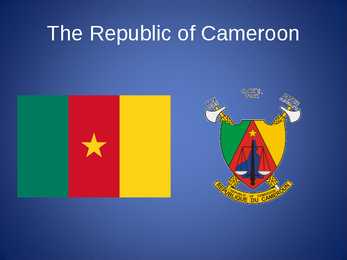
· Bordered by Nigeria to the west; Chad to the northeast; the Central African Republic to the east; and Equatorial Guinea, Gabon, and the Republic of the Congo to the south. · Cameroon's coastline lies on the Bight of Bonny, part of the Gulf of Guinea and the Atlantic Ocean. · The country is called "Africa in miniature" for its geological and cultural diversity. History · The territory of present day Cameroon was first settled during the Neolithic · Portuguese sailors reached the coast in 1472 · The German Empire claimed the territory as the colony of Kamerun in 1884 and began a steady push inland. · An economic crisis took effect in the mid-1980s to late 1990s as a result of international economic conditions, drought, falling petroleum prices, and years of corruption, mismanagement, and cronyism. Politics and Government · The President of Cameroon has broad, unilateral powers to
The United Kingdom and London United Kingdom is a political name of the United Kingdom of Great Britain and Northern Ireland. These political names include the countries of England, Scotland and Wales. Every country has its own capital and language. The capital of England is London, the people there are english and the language spoken is English. In scotland live the scots, capital is Edingburg and the languages spoken are English and Scottish. The capital of Wales is Cardiff, the people tehre are welsh and the languages spoken are welsh and English. N. Ireland is the home for the Irish, the capital is Belfast and the language is Irish. The first inhabitants were Iberians and Celts who settled on the land and were often at war with each other
 annaabi.ee